


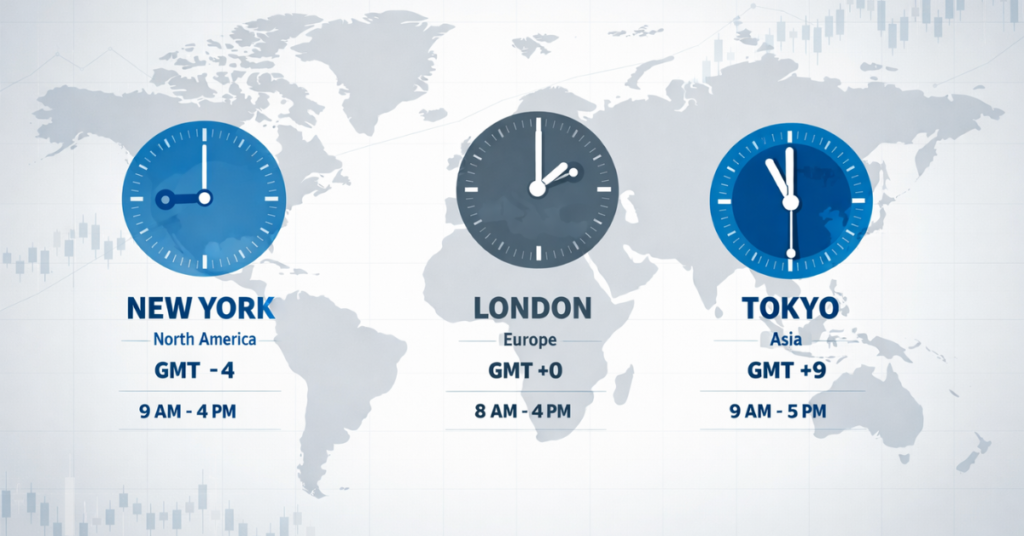
The quietest forex trading session is the Asian session, particularly during Tokyo market hours. This period typically experiences the lowest volatility and trading volume compared to any other session, as major financial centers in London and New York are closed, resulting in slower price movements and more contained currency behavior.
Key Takeaways
- The Asian session is the quietest forex trading session, with the lowest volatility and trading volume compared to London and New York.
- Lower market activity produces slower, more predictable price movements that tend to stay within tight defined ranges.
- This session is well suited for beginners and risk-conscious traders who prefer stable, controlled market conditions.
- Pairs like USD/JPY, AUD/USD, and NZD/USD are the most active during Asian hours despite overall low volatility.
- In quiet markets, trading costs matter significantly more. Low spreads and zero commissions directly protect small profits that would otherwise be eroded.
What Are Forex Trading Sessions?
The forex market operates 24 hours a day, five days a week, but its activity is not uniform throughout. It moves in cycles shaped by four major global trading sessions, each corresponding to a different regional financial center. Understanding which session is active at any given time is essential because volatility, liquidity, and trading opportunity shift dramatically between them.
The Four Main Forex Trading Sessions
| Session | Hours (GMT/UTC) | Character |
| Sydney | 10:00 PM – 7:00 AM | Quietest overall, opens the trading week |
| Tokyo (Asian) | 12:00 AM – 9:00 AM | Low volatility, range-bound, JPY pairs most active |
| London | 8:00 AM – 5:00 PM | Most active session, strong trends and breakouts |
| New York | 1:00 PM – 10:00 PM | High volatility, news-driven, USD pairs reactive |
Market activity escalates when sessions overlap. The London–New York overlap (1:00 PM to 5:00 PM GMT) is the most active window of the week. The Asian session, by contrast, operates while both London and New York are closed, which is the primary reason it is the quietest.
Which Forex Session Is the Quietest?
The Asian session, also called the Tokyo session, is widely recognized as the quietest forex trading session. It records the lowest liquidity and the smallest average pip ranges of any session during the trading week. Price movements during this window are more gradual, more contained, and more technically driven than anything seen during the London or New York sessions.
It is worth noting that the Sydney session technically opens before Tokyo and is sometimes even quieter in absolute terms. However, the Asian session as a whole (which includes Sydney, Tokyo, Hong Kong, and Singapore activity) is the established reference point when traders discuss the quietest trading window.
Why the Asian Session Is the Quietest
- The major European and US financial centers are closed, removing the largest sources of institutional order flow
- Global trading volume drops significantly with no London or New York participation
- High-impact economic news releases from the US and Europe fall outside this window
- Price action becomes technically driven rather than news or momentum driven, resulting in cleaner ranges
Why Is the Asian Session Less Volatile?
The lower volatility of the Asian session is not random. It is a structural outcome of how global market participation is distributed across time zones.
- Major markets are closed. London and New York together account for over 60% of global daily forex volume according to BIS data. When both are offline, the volume available to move prices drops dramatically, which naturally compresses price ranges.
- Institutional participation is limited. The large hedge funds, investment banks, and central bank operations that drive the biggest moves are concentrated in Western financial centers. During Asian hours, the dominant participants are regional banks, exporters, and retail traders, whose collective order flow is smaller and less directional.
- Few high-impact news releases. Most market-moving economic events, including US NFP, CPI, FOMC statements, ECB decisions, and UK GDP data, are released during the London or New York sessions. The Asian session does see Japanese economic data (CPI, trade balance, BOJ statements), but these typically produce more contained reactions.
- Regional currency focus. Activity concentrates around JPY, AUD, and NZD pairs, which have smaller average daily ranges than EUR/USD or GBP/USD under normal conditions.
Forex Session Volatility Comparison
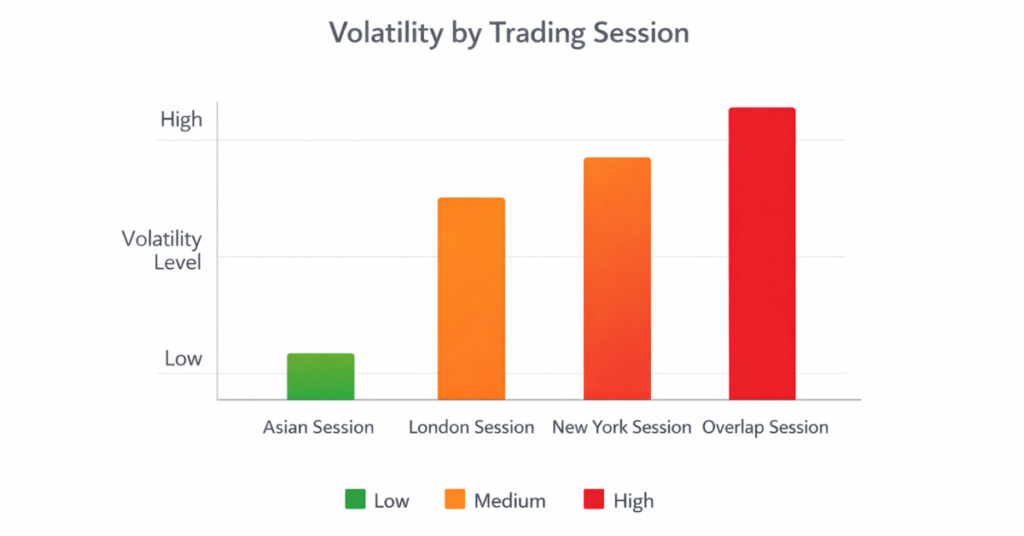
Each forex session has a distinct volatility profile. Understanding these differences helps traders choose the right session for their strategy and risk tolerance.
| Trading Session | Volatility Level | Market Activity | Typical Daily Range (EUR/USD) | Best For |
| Asian (Tokyo) | Low | Slow, range-bound | ~30–50 pips | Beginners, range trading, scalping |
| London | High | Strong trends, breakouts | ~80–120 pips | Day traders, trend traders |
| New York | Medium–High | Volatile, news-driven | ~70–100 pips | News traders, momentum traders |
| London–NY Overlap | Very High | Peak liquidity and volatility | ~100–150+ pips | Experienced active traders |
Best Trading Strategies for the Asian Session
Because the Asian session is range-bound and slow-moving, the most effective trading strategies here are ones built around structure, precision, and patience rather than momentum or breakout chasing.
1. Range Trading (Most Effective)
This is the most consistently applicable strategy in the Asian session. The approach is straightforward: identify a clear support level and a clear resistance level, buy near support, and sell near resistance. Price during Asian hours repeatedly bounces between the same zones, particularly on JPY and AUD pairs, making this a high-repetition, lower-risk setup when applied with discipline.
2. Scalping
Because price moves are small but consistent within a range, scalping can generate steady gains through multiple small entries and exits. This strategy requires a broker with very tight spreads and fast execution, because profit margins per trade are thin and spread costs eat into them directly. The Asian session is actually one of the better environments for scalping USD/JPY specifically, which maintains consistent technical behavior during Tokyo hours.
3. London Breakout Preparation
Many experienced traders use the Asian session not to trade actively, but to mark the high and low of the range it establishes. When London opens and price breaks above the Asian session high or below the Asian session low, it often signals a strong directional move for the day. This is a well-documented setup used across multiple trading patterns and requires no live trading during Asian hours, only preparation.
4. Support and Resistance Trading
Technical levels, including horizontal support and resistance, trendlines, and pivot points, tend to hold more reliably during quiet sessions because there are fewer large institutional orders to break through them. This makes the Asian session well suited to technical traders who rely on clean level-to-level entries with defined stop-losses and take-profits.
Who Should Trade the Quietest Session?
The Asian session is not right for every trader, but it is genuinely well matched for several specific trading profiles.
- Beginner traders benefit significantly from the Asian session because slower price action gives more time to analyze, decide, and execute without the pressure of fast-moving markets. Fewer sudden spikes mean fewer emotional reactions, and cleaner market structure makes it easier to learn how support and resistance actually work in real conditions.
- Risk-conscious traders who prioritize capital protection over large returns find the reduced volatility creates a more manageable environment. Smaller position sizes still generate meaningful percentage returns in well-defined range setups, without the exposure that comes with London or New York conditions.
- Scalpers and technical traders who use precision-based entries on USD/JPY, AUD/USD, and NZD/USD can find consistent setups within defined Asian session ranges. The technical behavior of these pairs during Tokyo hours is more reliable than during volatile Western sessions where momentum overrides levels.
- Traders in Asia-Pacific time zones (Pakistan, India, UAE, Southeast Asia) naturally align with this session during their local business hours, making it the most practical active trading window available without trading through the night.
Best Currency Pairs During the Asian Session
Not all currency pairs are equally active during Asian hours. Because the session is driven by Asia-Pacific regional participation, pairs involving JPY, AUD, and NZD consistently show the most reliable movement and tightest spreads during this window.
| Pair | Why It Moves | Typical Behavior |
| USD/JPY | BOJ activity, Japanese institutions, trade settlement flows | Steady moves, clean technical levels, most liquid Asian pair |
| EUR/JPY | Cross-currency flows from early European positioning | Moderate movement, suitable for range trading |
| AUD/USD | Australian market open, RBA sensitivity, commodity flows | Moderate volatility, steady price action |
| NZD/USD | New Zealand market activity, RBNZ sensitivity | Gradual moves, predictable intraday ranges |
| AUD/JPY | Risk sentiment, Asia-Pacific commodity demand | Smooth trends, frequently range-bound |
EUR/USD and GBP/USD are generally less active and may carry slightly wider spreads during Asian hours as European liquidity providers are offline. These pairs are better suited to London and New York sessions where their natural liquidity is highest.
For a focused guide on which pairs perform best specifically during Asian hours, see our dedicated article on best currency pairs for the Tokyo session.
Asian Session Trading Hours by Time Zone
The Asian session runs from 12:00 AM to 9:00 AM GMT, but what that means in local time varies significantly depending on where you are trading from. The table below makes it practical to identify when the session is active in your region.
| Time Zone | Session Open | Session Close |
| GMT / UTC | 12:00 AM (Midnight) | 9:00 AM |
| PKT (Pakistan) | 5:00 AM | 2:00 PM |
| IST (India) | 5:30 AM | 2:30 PM |
| GST (UAE / Dubai) | 4:00 AM | 1:00 PM |
| EST (New York) | 7:00 PM (Sunday) | 4:00 AM |
| JST (Japan) | 9:00 AM | 6:00 PM |
Best Trading Window Within the Session
Not all hours within the Asian session are equally active. The most stable and tradable window is approximately 2:00 AM to 6:00 AM GMT, when the Tokyo market is fully active and before early European participants begin entering. Price movements during this window are most consistent, technical ranges hold most reliably, and market noise is lowest.
The Tokyo–Sydney overlap (12:00 AM to 7:00 AM GMT) provides slightly higher liquidity on AUD and NZD pairs. The Tokyo–London transition (8:00 AM to 9:00 AM GMT) is when volatility begins to increase as European participants enter, often triggering breakouts from the Asian range. This transition window deserves specific attention as a potential entry trigger rather than a range trading environment.
How to Trade the Asian Session Effectively
Success in the Asian session comes from aligning your approach to what the market actually offers, not what you wish it would offer.
- Identify the range before trading. Wait for the first 30 to 60 minutes of the session to establish the initial range before placing entries. Jumping in immediately at session open produces worse results than waiting for the range to define itself.
- Use smaller profit targets. Average pip ranges during the Asian session are 30–50 pips on EUR/USD and similar on major pairs. Setting targets of 150 pips leads to frustration. Aligning targets to what the session realistically delivers produces consistency.
- Keep stop-losses tight. Since price movements are contained, stop-losses do not need to be wide. Tighter stops relative to smaller targets maintains a reasonable risk-reward ratio even on modest pip gains.
- Check the economic calendar before trading. Japanese data releases including CPI, trade balance, and BOJ statements occur during this session. These can cause sharp, short-duration spikes. Avoid entering new positions immediately before known Japanese data releases.
- Mark Asian session high and low for London use. Even if you choose not to trade the Asian session actively, marking its high and low before the London open is one of the most practical preparation steps you can take. A break of these levels at London open is a frequently traded setup.
Trade the Asian Session with Defcofx
Quiet sessions demand better broker conditions, not worse ones. When price moves are small and profit margins per trade are narrow, the cost structure of your broker determines whether a strategy is viable or not. Defcofx is a forex and CFD broker registered in Saint Lucia, operating through MetaTrader 5 and offering access to all major Asian session pairs including USD/JPY, AUD/USD, NZD/USD, EUR/JPY, and AUD/JPY.
For traders focused on the Asian session specifically, the trading conditions at Defcofx are built to protect the small gains that define this session’s profit model:
- Spreads from 0.3 pips with no commissions or swap fees, ensuring that range trades and scalps targeting 10–20 pip moves retain meaningful profit after costs
- Leverage up to 1:2000, giving traders full flexibility to size positions to match the session’s smaller pip ranges without over-committing capital
- 40% welcome bonus on first deposits of $1,000 or more, available to all clients globally
- Withdrawals processed within 4 business hours including weekends, keeping capital accessible at all times
- MT5 platform with real-time charting, technical indicators, and fast order execution across all Asian session pairs and time zones
- Global access with multilingual support, welcoming traders from all countries including those across Asia, the Middle East, and South Asia who trade natively during these hours
New to the Asian session? A free demo account on Defcofx lets you observe and practice trading USD/JPY, AUD/USD, and other Asian pairs in live market conditions before risking real capital. When ready to trade live, account registration takes only a few minutes.
Open a Live Trading Account5 Common Mistakes When Trading Quiet Sessions
The Asian session’s apparent simplicity leads many traders into specific and avoidable mistakes. Recognizing these patterns in advance prevents account damage and frustration.
- Overtrading out of impatience. Slow markets tempt traders to force entries that don’t meet their own criteria. Taking low-quality setups because “nothing is happening” is one of the most common Asian session mistakes. Fewer, higher-quality trades outperform frequent, marginal ones every time.
- Expecting London-sized moves. Setting 100-pip targets in a session that typically produces 30–50-pip ranges on major pairs leads to missed profits and held positions that reverse. Calibrate targets to the session’s actual output, not to what other sessions produce.
- Ignoring spread costs. In low-volatility markets, a 2-pip spread on a 10-pip target represents 20% of the trade’s profit immediately consumed by cost. Using a broker with the tightest possible spreads is not optional in this session, it is structural to the strategy working at all.
- Applying breakout strategies without confirmation. Many breakouts during the Asian session are false breakouts that reverse quickly due to thin liquidity. Breakout strategies work better at the London open using the Asian range as the reference, not during the Asian session itself.
- Skipping the economic calendar. Japanese data releases and occasional BOJ-related news can produce sudden, sharp moves during this session. Checking the economic calendar before each session and avoiding open positions around these events is a basic but frequently skipped discipline.
Final Thoughts: The Quietest Forex Trading Session
The Asian session is the quietest forex trading session by every measurable standard: lowest average pip ranges, lowest daily volume, fewest high-impact news events, and least institutional participation. This makes it the most structurally predictable session of the trading week.
That predictability is not a limitation. For the right trader, it is an advantage. Range strategies, scalping within defined zones, and technical level trading all perform more reliably in a market that moves slowly and respects structure. The discipline required to trade a quiet session well, patience, precision, and cost awareness, translates directly into stronger habits for trading more volatile sessions later.
If the Asian session matches your schedule, your strategy, or your current stage of development as a trader, Defcofx gives you the conditions and the platform to trade it well. Low spreads, full access to all major trading sessions, and a free demo account to practice before going live.
Open a Live Trading AccountFAQ
The quietest forex trading session is the Asian session (Tokyo session), running from 12:00 AM to 9:00 AM GMT. Market activity is lowest during this window because London and New York are closed, removing the majority of institutional participation and reducing daily pip ranges to their smallest levels of the week.
Yes. The Asian session is widely recommended for beginners because slower price action gives more time to analyze setups, execute trades, and manage positions without the pressure of fast-moving markets. Cleaner market structure also makes it easier to learn how support and resistance work in real trading conditions.
The London–New York overlap (1:00 PM to 5:00 PM GMT) is the most volatile period of the trading week, combining the highest global trading volume with simultaneous institutional participation from both European and US financial centers. The London session open (8:00 AM GMT) is also a consistently high-volatility window.
Yes. Profit is consistently achievable in the Asian session using strategies matched to its character: range trading, scalping within defined zones, and support and resistance trading. Profit per trade is smaller than in volatile sessions, but setups repeat more reliably and emotional pressure is lower, which benefits consistency.
USD/JPY is the most active pair during the Asian session, followed by EUR/JPY, AUD/USD, NZD/USD, and AUD/JPY. These pairs benefit from direct regional market participation from Japanese, Australian, and New Zealand financial institutions. EUR/USD and GBP/USD are less active and may carry wider spreads during Asian hours.
In low-volatility conditions, trades target smaller pip moves. If a trade targets 15 pips and the spread is 3 pips, 20% of the profit is immediately consumed by cost before the trade even closes in profit. Tight spreads and zero commissions are not just helpful in the Asian session, they are structurally necessary for range and scalping strategies to produce net-positive results.
The Asian session opens at 5:00 AM PKT and closes at 2:00 PM PKT. The most active and technically reliable trading window within the session runs from approximately 7:00 AM to 11:00 AM PKT, when the Tokyo market is fully active. The London session then begins at 1:00 PM PKT, which is when volatility starts to increase.