


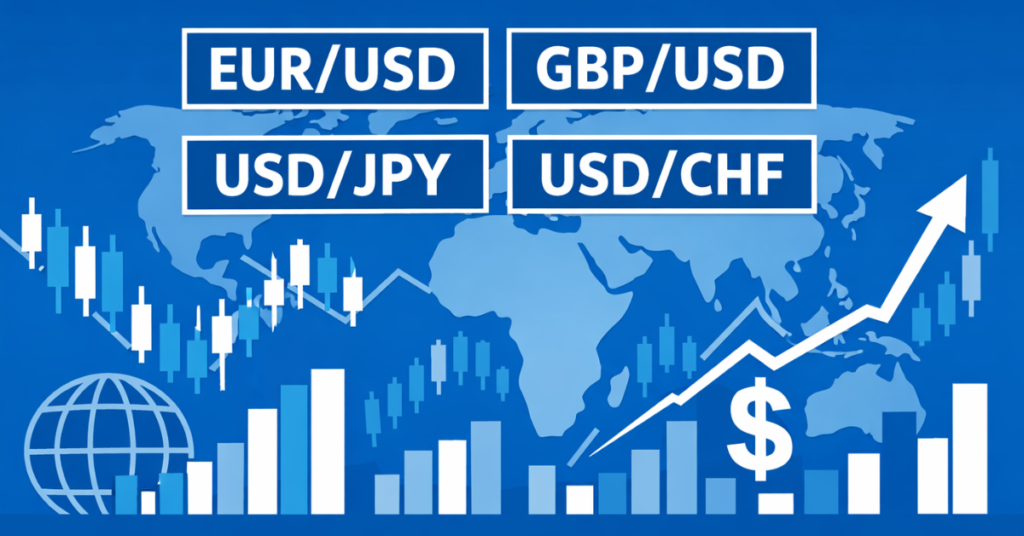
The 4 major forex pairs are EUR/USD, GBP/USD, USD/JPY, and USD/CHF. These are the most traded currency pairs in the forex market due to their high liquidity, tight spreads, and strong economic backing, making them popular choices for both beginners and experienced traders worldwide.
Key Takeaways
- The 4 major forex pairs are EUR/USD, GBP/USD, USD/JPY, and USD/CHF, all paired with the US Dollar.
- These pairs are the most traded globally, offering the highest liquidity and the tightest spreads in the market.
- Lower spreads mean lower trading costs, making major pairs cost-efficient for frequent and short-term traders.
- They are backed by the world’s strongest economies, which increases market transparency and analysis reliability.
- Each major pair has a distinct character. EUR/USD is most stable, GBP/USD is most volatile, USD/JPY and USD/CHF reflect safe-haven demand.
What Is a Forex Pair?
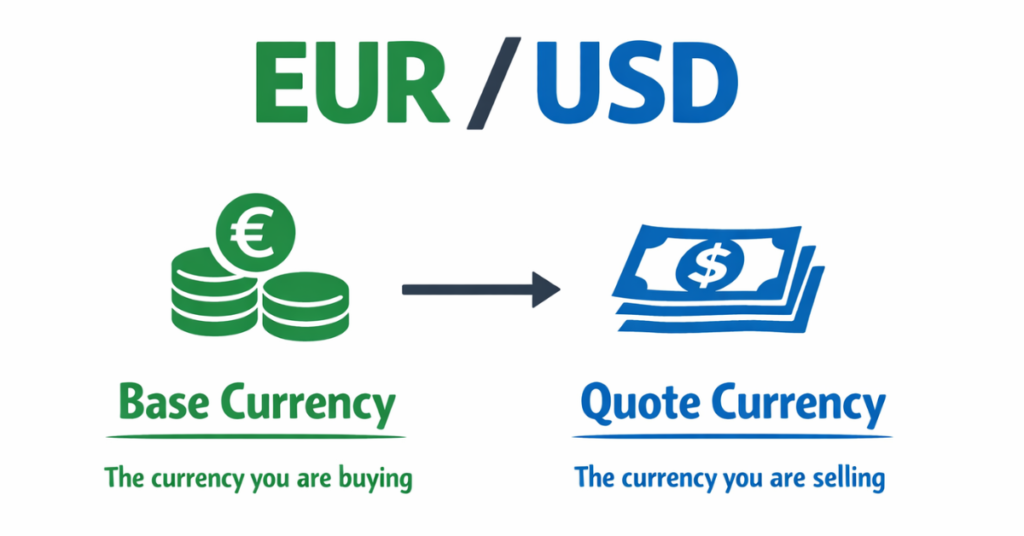
A forex pair represents the exchange rate between two currencies. Currencies are always traded in pairs because buying one means simultaneously selling the other. Every pair has a base currency (the first) and a quote currency (the second).
For example, EUR/USD = 1.10 means 1 Euro equals 1.10 US Dollars. When you trade, you are predicting whether the base currency will rise or fall against the quote currency.
What Are Major Forex Pairs?
Major forex pairs are the most actively traded currency pairs in the world. They all include the US Dollar (USD) paired with another top global currency. The USD’s role as the world’s primary reserve currency, used heavily in global trade, finance, and commodity pricing, is the reason it appears in every major pair.
In simple terms, major pairs are the most liquid, most analyzed, and most cost-efficient currency pairs available to traders. They account for the largest share of daily global forex volume and attract participation from central banks, hedge funds, institutional traders, and retail traders alike.
Major Forex Pairs by the Numbers
Understanding the scale of these pairs helps explain why they dominate trader attention. Based on data from the Bank for International Settlements (BIS) Triennial Survey and widely cited industry sources:
- The global forex market trades over $7.5 trillion per day on average, making it the largest financial market in the world.
- EUR/USD alone accounts for approximately 22–24% of all daily forex transactions, more than any other single pair.
- The four major pairs together represent the majority of total daily forex volume.
- USD is present in roughly 88% of all forex transactions globally, confirming its role as the world’s anchor currency.
- GBP/USD (Cable) is consistently among the top three most traded pairs by volume.
The 4 Major Forex Pairs Explained
Each major pair has its own personality, driven by the economic forces behind the currencies involved. Here is a breakdown of all four.
1. EUR/USD (Euro / US Dollar)
EUR/USD is the most traded forex pair in the world, representing the Eurozone economy against the United States. Its sheer volume means it consistently offers the tightest spreads and the most stable price behavior of any major pair.
- Most liquid forex pair globally, accounting for roughly 22–24% of daily volume
- Lowest trading costs due to extremely tight spreads
- Heavily influenced by ECB and Federal Reserve policy decisions
- Best starting pair for beginners due to predictable technical behavior
2. GBP/USD (British Pound / US Dollar)
Known as “Cable,” GBP/USD is the most volatile of the four major pairs. It reacts sharply to UK economic data, Bank of England decisions, and US news. This volatility creates more trading opportunities but also carries higher short-term risk.
- Higher average daily pip range compared to EUR/USD
- Very sensitive to UK inflation, employment, and GDP data
- Popular among scalpers and short-term traders seeking larger moves
- Can produce aggressive price spikes around major news events
3. USD/JPY (US Dollar / Japanese Yen)
USD/JPY is closely tied to global risk sentiment. The Japanese Yen is a traditional safe-haven currency, meaning it tends to strengthen when global uncertainty rises and weaken when risk appetite returns. This pair also responds strongly to Bank of Japan policy and US Treasury yield movements.
- Highly sensitive to global risk-on and risk-off shifts
- Reacts strongly to interest rate differentials between the US and Japan
- Often used as a macro indicator for global market sentiment
- Typically most active during the Tokyo and New York sessions
4. USD/CHF (US Dollar / Swiss Franc)
USD/CHF tends to move inversely to EUR/USD due to the close trade relationship between Switzerland and the Eurozone. The Swiss Franc is another safe-haven currency, supported by Switzerland’s political neutrality and highly stable banking system.
- Lower volatility than GBP/USD, making it more suited to conservative strategies
- Moves inversely to EUR/USD in many market conditions
- Swiss National Bank (SNB) policy is a major price driver
- Gains during global financial stress as investors seek safe-haven assets
Quick Comparison: The 4 Major Forex Pairs
| Pair | Nickname | Volatility | Best For | Safe Haven? |
| EUR/USD | Fiber | Moderate | Beginners, trend trading | No |
| GBP/USD | Cable | High | Scalpers, active traders | No |
| USD/JPY | Gopher | Moderate | Macro, risk-sentiment plays | JPY (Yes) |
| USD/CHF | Swissie | Low–Moderate | Conservative strategies | CHF (Yes) |
Why Are These the Most Traded Forex Pairs?
The four major pairs dominate global trading for several interconnected reasons.
High liquidity and deep market participation. These pairs are traded in massive volumes around the clock by central banks, institutional funds, and retail traders. That constant activity means trades execute quickly with minimal slippage, and buyers and sellers are always present.
Tight spreads and lower costs. The high demand for major pairs keeps the bid-ask spread narrow. A tighter spread means a lower cost per trade, which adds up significantly for frequent traders and scalpers.
Strong, data-rich economies behind them. Each currency in these pairs belongs to a major economy that regularly publishes economic data, interest rate decisions, and policy statements. This continuous flow of information keeps the market active and supports technical and fundamental analysis.
Predictable technical behavior. Because so many traders watch the same pairs, support and resistance levels, trend lines, and chart patterns tend to hold more reliably on major pairs than on minor or exotic pairs.
4 Risks of Trading Major Forex Pairs
Stability and liquidity do not mean risk-free. Major pairs still carry meaningful risks that every trader must understand before opening a position.
1. News-driven volatility. Even EUR/USD and USD/CHF can move 100–200 pips within minutes following a surprise interest rate decision, unexpected inflation print, or major geopolitical event. These rapid moves can trigger stop-losses or cause slippage on market orders if not anticipated.
2. Leverage amplification. High leverage increases both profit and loss potential proportionally. A trader using 1:500 leverage on GBP/USD with no stop-loss can lose their entire position in a matter of minutes during a volatile news release. Risk management is non-negotiable.
3. Correlated pair risk. EUR/USD and USD/CHF often move in opposite directions due to their shared economic relationships. Traders holding multiple positions across correlated pairs without awareness can unknowingly be doubling their exposure in the same direction.
4. Emotional trading under fast conditions. The speed of major pair markets, especially during London and New York sessions, can trigger impulsive decisions. Without a defined trading plan, traders often enter and exit based on emotion rather than analysis.
Best Major Forex Pair for Beginners
EUR/USD is the most beginner-friendly of the four major pairs. Its combination of the highest global liquidity, the tightest typical spreads, and the most stable price behavior makes it the standard starting point for new traders.
EUR/USD moves in a relatively smooth, trend-following manner compared to the sharper swings of GBP/USD. This gives beginners more time to analyze setups and make decisions without extreme short-term noise. The pair is also the most widely covered by analysts and education resources, making it easier to find relevant market context and trade ideas.
That said, beginners should still treat EUR/USD with respect. Major ECB or Federal Reserve announcements can produce sharp, fast moves that catch unprepared traders off guard. Learning to trade with discipline and proper risk controls matters far more than choosing the right pair.
Practice on a Free Demo AccountHow to Trade Major Forex Pairs (Step by Step)
Step 1: Open a Trading Account
Register with a broker like Defcofx and open a trading account to access live forex markets. If you are new, start with a demo account to practice without risking real capital. Once confident, fund a live account and begin trading.
Step 2: Choose a Major Pair to Focus On
Pick one major pair to start with rather than switching between several. Beginners typically start with EUR/USD. Learn how it moves, when it is most active, and how it responds to economic data before adding other pairs.
Step 3: Analyze the Market
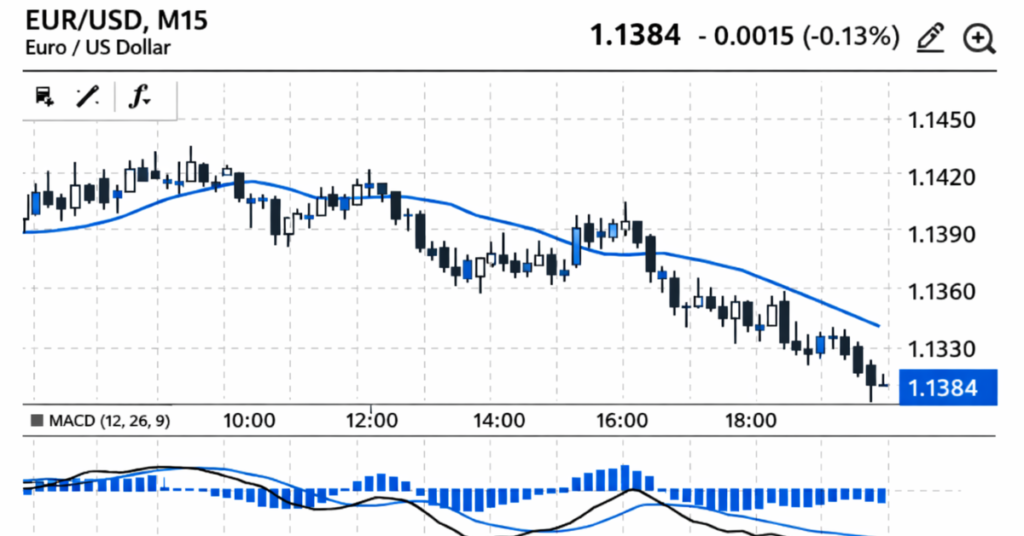
Use technical and fundamental analysis to identify potential trade setups. Check trend direction on higher timeframes, identify key support and resistance levels, and be aware of upcoming economic news that could affect the pair. Technical indicators and trend lines are useful tools for refining entries.
Step 4: Execute the Trade
Decide your direction: buy (long) if you expect the base currency to rise, or sell (short) if you expect it to fall. Set your entry, stop-loss, and take-profit levels before placing the order. Never enter a trade without knowing your exit.
Step 5: Manage Risk on Every Trade
Always use a stop-loss. Size your position to risk no more than 1–2% of your account per trade. Avoid overleveraging, especially on volatile pairs like GBP/USD. A clear risk-reward ratio, commonly 1:2 or better, helps ensure that winning trades outweigh losing ones over time.
Step 6: Review and Refine
After closing a trade, review what happened. Did it play out as expected? Where was the analysis correct or wrong? Keeping a trade journal and consistently reviewing past trades is one of the most effective habits of professional traders.
Trade Major Forex Pairs with Defcofx
Defcofx is a global forex and CFD broker registered in Saint Lucia, offering access to all four major forex pairs, plus commodities, indices, stocks, and cryptocurrencies through the MetaTrader 5 (MT5) platform. For traders focused on major pairs, the trading conditions at Defcofx are built to support both beginners learning the market and experienced traders executing active strategies.
- Spreads from 0.3 pips with no commissions or swap fees, keeping costs low across EUR/USD, GBP/USD, USD/JPY, and USD/CHF
- Leverage up to 1:2000, giving traders full flexibility to manage position sizing according to their own risk strategy
- 40% welcome bonus on first deposits of $1,000 or more, available to all clients globally
- Withdrawals processed within 4 business hours, including weekends, ensuring fast access to your funds
- MT5 platform with advanced charting, technical indicators, and fast execution for all major session conditions
- Multilingual support and global access, welcoming traders from all countries without restrictions
New to forex? Start with a free demo account on Defcofx to practice trading EUR/USD, GBP/USD, and the other major pairs with live market data and zero financial risk. When you are ready to go live, opening an account takes only a few minutes.
Open a Live Trading AccountWhat to Look for in a Broker for Major Forex Pairs
The broker you use directly affects your trading costs, execution quality, and overall experience when trading major pairs. Here are the key factors to evaluate:
- Tight spreads: Since major pairs are traded frequently, even a small spread difference compounds over dozens of trades. Look for brokers offering consistently tight spreads on EUR/USD, GBP/USD, USD/JPY, and USD/CHF.
- Fast execution: In fast-moving sessions like London open, delays cause slippage. Reliable execution prevents being filled at significantly different prices from where you entered.
- Flexible leverage: Different strategies require different leverage levels. A broker offering adjustable leverage gives you the ability to size positions appropriately for your account and risk tolerance.
- No hidden costs: Commissions, swap fees, and inactivity fees add up. Transparent pricing with no hidden charges is a major advantage, especially for active traders.
- Platform quality: MT4 and MT5 are the industry standard. Access to advanced charting, indicators, and a clean interface matters when analyzing major pairs under live conditions.
- Withdrawal reliability: Fast, dependable withdrawals are a basic requirement. Delays in accessing your funds are a red flag regardless of other conditions.
Final Thoughts on the 4 Major Forex Pairs
The 4 major forex pairs, EUR/USD, GBP/USD, USD/JPY, and USD/CHF, form the backbone of global forex trading. Their high liquidity, tight spreads, deep market participation, and strong economic foundations make them the most accessible, most analyzed, and most widely traded instruments available to forex traders.
Each pair has its own character. EUR/USD offers stability, GBP/USD offers volatility, USD/JPY reflects global risk sentiment, and USD/CHF moves with safe-haven demand. Understanding these differences helps you choose pairs that match your strategy, session preference, and risk tolerance.
But the pair itself is only one part of the equation. Long-term success in trading major pairs still comes down to proper risk management, disciplined strategy execution, and continuous learning. If you are ready to start, Defcofx gives you the conditions and tools to trade all four major pairs with competitive spreads, flexible leverage, and full platform access on MT5.
Open a Live Trading AccountFAQ
The 4 major forex pairs are EUR/USD, GBP/USD, USD/JPY, and USD/CHF. These pairs are the most traded in the forex market because they involve the US Dollar and currencies from the world’s strongest economies, making them highly liquid and cost-efficient to trade.
They are called major forex pairs because they all include the US Dollar paired with another top global currency. These pairs dominate global trading volume and are considered the most stable, most liquid, and most widely traded instruments in forex.
EUR/USD is generally the best starting pair for beginners. It has the highest global liquidity, the tightest typical spreads, and the most stable price behavior of the four major pairs. It is also the most widely covered by educational and analytical resources.
Yes, major forex pairs still carry risk. While they are more stable than minor or exotic pairs, they can experience sharp volatility during high-impact economic news such as interest rate decisions or inflation reports. Proper risk management is always required.
Major forex pairs are highly liquid because they involve the world’s largest economies and are actively traded 24 hours a day by central banks, institutional funds, and millions of retail traders. This creates constant buying and selling activity and ensures fast order execution.
Yes. Major pairs are accessible with small accounts, especially when using flexible leverage and a demo account to practice first. Defcofx allows traders to start with a free demo on MT5 to learn major pair trading before committing real capital.
Yes. Major forex pairs typically have the tightest spreads in the market due to their high liquidity and trading volume. Brokers like Defcofx offer spreads from 0.3 pips on major pairs with no commissions or swap fees, keeping trading costs competitive.