


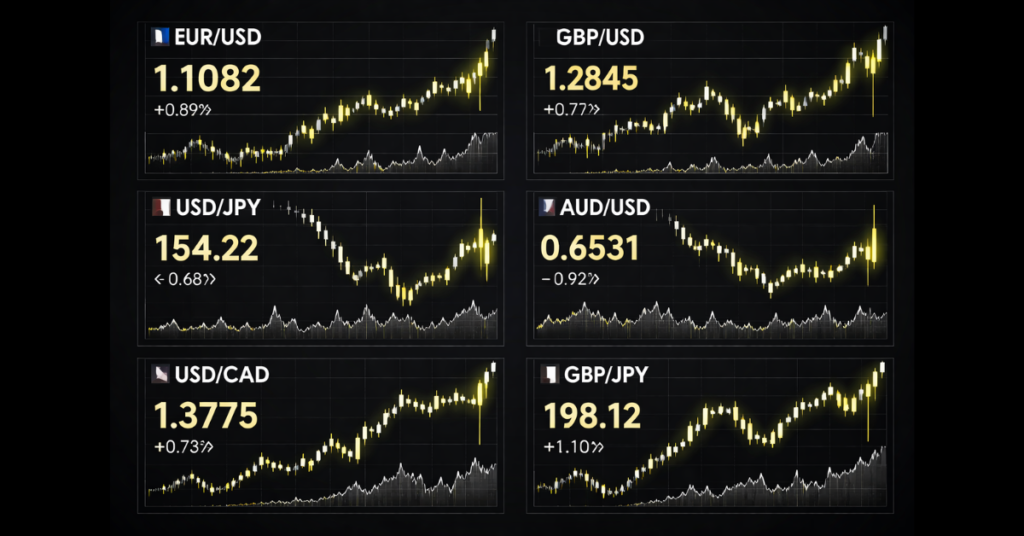
Forex volatility refers to how strongly and quickly currency prices move over time. The top 10 most volatile forex pairs are those that show large price swings due to economic data, liquidity differences, and market sentiment, offering high profit potential but also significantly increased risk for traders who are unprepared.
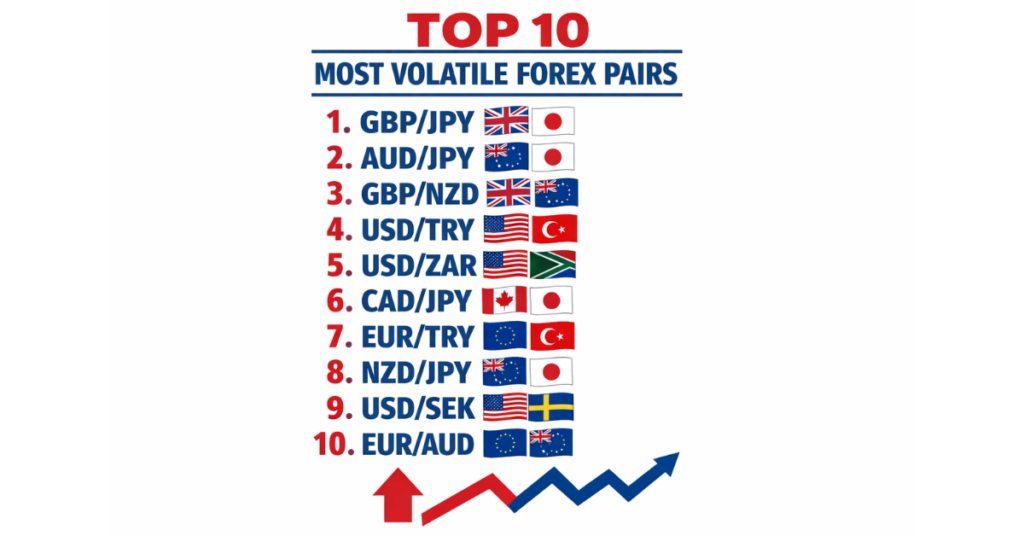
| Rank | Forex Pair | Avg Daily Range | Why It’s Volatile |
| 1 | GBP/JPY | ~150–200 pips | Risk currency vs safe-haven, high institutional volume |
| 2 | GBP/AUD | ~130–180 pips | Two volatile economies, commodity sensitivity |
| 3 | GBP/NZD | ~130–170 pips | Low liquidity cross, sharp unpredictable moves |
| 4 | EUR/AUD | ~100–150 pips | Economic contrast, strong commodity influence |
| 5 | EUR/NZD | ~100–140 pips | Lower trading volume, high news sensitivity |
| 6 | GBP/CHF | ~100–140 pips | Risk-on vs safe-haven dynamic, sudden reversals |
| 7 | AUD/JPY | ~80–120 pips | Global risk sentiment proxy, commodity flows |
| 8 | USD/TRY | ~300–600 pips | Emerging market, inflation, political instability |
| 9 | USD/ZAR | ~200–400 pips | Political risk, commodity dependency, low liquidity |
| 10 | USD/MXN | ~150–300 pips | Oil prices, US economic dependency, trade flows |
Key Takeaways
- Forex volatility measures how much and how fast currency prices move, and it is a key consideration for active traders choosing which pairs to trade.
- The top 10 most volatile forex pairs include GBP/JPY, GBP/AUD, and USD/ZAR, driven by economic contrast, lower liquidity, and strong reactions to global news.
- Volatile pairs offer higher profit potential but also significantly increase risk exposure, especially without proper position sizing and stop-loss discipline.
- Economic data releases, interest rate decisions, and global risk sentiment are the primary volatility drivers in forex.
- These pairs are commonly used by scalpers and day traders who rely on fast market movement and larger pip ranges.
- Understanding volatility helps traders choose strategies, select appropriate pairs, and apply risk management more effectively.
What Does Volatility Mean in Forex?
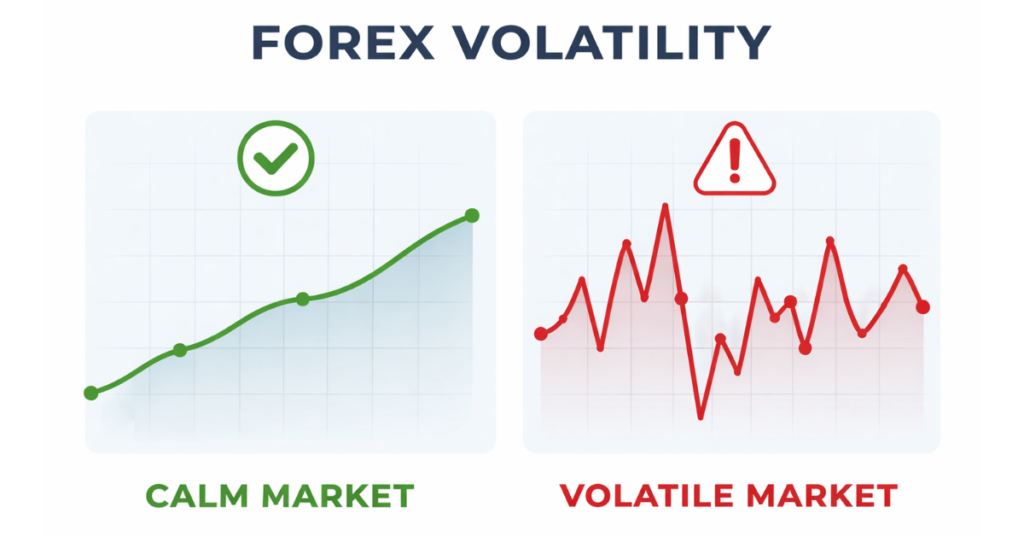
Forex volatility refers to the speed and magnitude at which currency prices change over a specific period. A highly volatile currency pair moves up and down more aggressively compared to stable pairs, creating both opportunities and elevated risk for traders.
Volatility is most commonly measured using the Average True Range (ATR) indicator, which tells traders how much a pair typically moves within a given session or time period. It can also be observed through pip ranges on charts. The greater the average movement, the higher the volatility.
The main drivers of forex volatility include economic data releases such as GDP and employment reports, interest rate decisions from central banks, geopolitical events, and shifts in overall market sentiment. For example, a surprise Federal Reserve rate decision can trigger triple-digit pip moves on major USD pairs within minutes.
What Makes a Forex Pair Highly Volatile?
A forex pair becomes highly volatile when its price experiences frequent and large movements within short time periods. Several factors combine to produce this behavior:
Economic data releases. Reports such as GDP, inflation (CPI), and non-farm payrolls cause immediate price reactions as traders reprice positions based on new information. The sharper the deviation from expectations, the more aggressive the move.
Central bank decisions. Interest rate changes or forward guidance from the Fed, Bank of England, ECB, or Bank of Japan can shift currency values by hundreds of pips in a single session. Surprise decisions amplify this further.
Liquidity gaps. Pairs involving emerging market currencies (such as USD/TRY or USD/ZAR) or lower-volume crosses (such as GBP/NZD) tend to be more volatile because fewer participants mean a single large order can move the price significantly.
Geopolitical and political events. Elections, conflict, sanctions, or trade policy shifts can destabilize a currency quickly, particularly for emerging market pairs where political risk is already priced in as a premium.
Commodity dependency. Pairs linked to commodity-exporting economies (AUD, NZD, ZAR, MXN) are exposed to volatility from commodity price swings in oil, gold, and iron ore, which can move independently of normal economic cycles.
Benefits and Risks of Trading Volatile Forex Pairs
Volatile forex pairs attract active traders for good reasons, but the same characteristics that create opportunity also create danger. Understanding both sides is essential before trading these pairs.
Benefits
- Higher profit potential per trade due to larger average daily pip ranges compared to stable major pairs
- More frequent intraday setups for scalpers and day traders who rely on short-term price movement
- Better conditions for breakout strategies, as price regularly breaks through key levels with conviction
- Faster capital growth potential when combined with disciplined risk management and a proven strategy
Risks
- Stop-losses can be triggered quickly due to sudden price spikes, especially around news events
- Higher slippage risk where orders fill at significantly different prices during fast-moving conditions
- Emotional trading pressure from fast market movements often leads to impulsive, undisciplined decisions
- Wider spreads on some pairs, particularly emerging market and low-liquidity crosses, which increases cost per trade
Top 10 Most Volatile Forex Pairs Explained
1. GBP/JPY (British Pound / Japanese Yen)
GBP/JPY is consistently ranked as the most volatile major cross pair in forex. It combines the British Pound, which reacts aggressively to UK economic data and BoE policy, with the Japanese Yen, a traditional safe-haven currency that moves sharply during global risk shifts. This dynamic creates large intraday swings, often ranging 150–200 pips per day. It is a favorite among experienced scalpers and day traders but requires strict risk discipline.
2. GBP/AUD (British Pound / Australian Dollar)
GBP/AUD combines two commodity-sensitive and economically distinct economies. The Australian Dollar reacts to iron ore, gold prices, and RBA policy, while GBP moves with UK data and BoE decisions. When both economies release conflicting data, the pair can move 130–180 pips or more in a single session.
3. GBP/NZD (British Pound / New Zealand Dollar)
GBP/NZD is a low-liquidity cross pair, meaning fewer participants trade it. This makes it prone to sharp and unpredictable price movements even on moderate news. Average daily ranges of 130–170 pips are common, and the pair is known for sudden reversals without clear technical warning.
4. EUR/AUD (Euro / Australian Dollar)
EUR/AUD reacts to both Eurozone economic policy and Australian commodity markets. When European CPI, ECB decisions, or Australian employment data release, the pair can spike 100–150 pips quickly. The economic contrast between a large currency union and a commodity-driven economy creates frequent volatility.
5. EUR/NZD (Euro / New Zealand Dollar)
Lower trading volume and a wide economic gap between the Eurozone and New Zealand make EUR/NZD highly sensitive to news from either economy. Typical daily ranges of 100–140 pips, and the pair can spike sharply during RBNZ rate decisions or Eurozone PMI releases.
6. GBP/CHF (British Pound / Swiss Franc)
GBP/CHF creates volatility through the tension between a risk-sensitive currency (GBP) and a safe-haven currency (CHF). During periods of global uncertainty, the Swiss Franc strengthens sharply while GBP weakens, causing aggressive directional moves. SNB (Swiss National Bank) interventions can also produce sudden, extreme movements.
7. AUD/JPY (Australian Dollar / Japanese Yen)
AUD/JPY is a widely watched risk sentiment indicator. When global markets are optimistic (risk-on), AUD strengthens and JPY weakens, pushing the pair higher. During fear-driven selloffs (risk-off), the opposite occurs aggressively. It also responds strongly to Chinese economic data, as Australia’s largest trading partner is China.
8. USD/TRY (US Dollar / Turkish Lira)
USD/TRY is one of the most extreme volatility pairs in forex. Turkey has experienced persistent high inflation, unorthodox central bank policy, and political instability, all of which create massive and often one-directional moves. Daily ranges of 300–600 pips are not unusual during periods of stress. This pair requires very careful position sizing and is generally not recommended for less experienced traders.
9. USD/ZAR (US Dollar / South African Rand)
USD/ZAR is driven by South Africa’s political climate, commodity prices (particularly gold and platinum), and global emerging market risk sentiment. The Rand is highly sensitive to global risk-off events, often depreciating sharply during market stress periods. Daily ranges of 200–400 pips are common during volatile market conditions.
10. USD/MXN (US Dollar / Mexican Peso)
USD/MXN is influenced by oil price movements, US trade policy (particularly USMCA and tariff decisions), and Mexican economic data. The Peso is one of the most traded emerging market currencies and tends to move sharply in response to risk sentiment shifts and US economic releases. Typical daily ranges of 150–300 pips make it an active pair for traders comfortable with emerging market dynamics.
High Volatility vs Low Volatility Forex Pairs
Understanding the difference between high and low volatility pairs helps traders match their strategy to the right market conditions rather than forcing a mismatch that leads to poor results.
| Feature | High Volatility Pairs | Low Volatility Pairs |
| Price Movement | Large and fast swings | Small and stable moves |
| Risk Level | High | Lower |
| Profit Potential | High per trade, less predictable | Moderate and more consistent |
| Trading Style | Scalping, day trading, breakouts | Swing trading, range trading |
| Reaction to News | Strong and immediate | Limited or delayed |
| Spread Costs | Can be wider, especially exotics | Generally tighter on majors |
| Examples | GBP/JPY, USD/ZAR, GBP/AUD | EUR/USD, USD/CHF, EUR/GBP |
Best Strategies to Trade Volatile Forex Pairs
Fast-moving pairs require structured approaches. Without a defined plan, volatility creates confusion rather than opportunity. Here are the most effective trading strategies for volatile market conditions.
1. Breakout Trading
Enter trades when price breaks through strong support or resistance levels with momentum confirmation. Volatile pairs like GBP/JPY and GBP/AUD regularly produce clean breakouts, especially at the London open when institutional order flow enters the market. Use ATR to set stop-loss and take-profit levels proportional to the pair’s normal daily range.
2. News Trading
Volatile pairs react sharply to economic announcements. Traders position before or after key releases including interest rate decisions, inflation data, and employment reports. This strategy requires very fast execution and tight risk management, as spreads often widen significantly immediately around news releases.
3. Scalping
Scalping involves multiple short-term entries and exits targeting small pip gains. High-volatility pairs are suited for this because frequent price movement creates more trade opportunities per session. Requires a broker with tight spreads and fast execution, as spread costs accumulate quickly across many trades. See our guide on scalping in forex for important considerations before using this approach.
4. Risk Management First
This is not a strategy in isolation but the non-negotiable foundation for all volatile pair trading. Apply a stop-loss on every trade. Size positions using appropriate lot sizes relative to account balance. Limit risk to 1–2% per trade maximum. In volatile conditions, a single unprotected trade can eliminate multiple winning trades. Read our full guide on forex risk management to understand how to apply these principles correctly.
Practice Volatile Pair Trading on a Free DemoBest Time to Trade Volatile Forex Pairs
Timing matters significantly when trading volatile pairs. The same pair can behave very differently during a quiet Asian session versus the London open or a major US news release. Choosing the right window improves both trade quality and execution.
London Session (8:00 AM to 5:00 PM UTC)
The London session is the most active period for GBP and EUR pairs. GBP/JPY, GBP/AUD, GBP/CHF, and EUR/AUD all see their highest daily activity during this window. Major economic data from the UK and Eurozone typically releases in the first two hours of this session, often triggering the day’s largest moves.
New York Session (1:00 PM to 10:00 PM UTC)
The New York session drives volatility in USD pairs including USD/TRY, USD/ZAR, and USD/MXN. Major US data releases (NFP, CPI, FOMC decisions) fall during this window and consistently produce the sharpest intraday moves of the month on these pairs.
London–New York Overlap (1:00 PM to 5:00 PM UTC)
This is the most volatile and highest-volume window of the entire trading day. Both European and US institutional traders are active simultaneously, producing the strongest price movements across all major and cross pairs. For timing your trades to maximize activity, this overlap is the peak window.
High-Impact News Events
Regardless of session, volatility spikes predictably around interest rate decisions, inflation reports (CPI), employment data (NFP), central bank press conferences, and GDP releases. Mark these events on your calendar before each week to anticipate which pairs will be most affected.
Trade Volatile Forex Pairs with Defcofx
Defcofx is a global forex and CFD broker registered in Saint Lucia, offering access to all major, minor, and exotic currency pairs including every pair on this list, through the MetaTrader 5 (MT5) platform. For traders targeting volatile pairs where execution speed, spread costs, and risk tools directly affect outcomes, the conditions at Defcofx are built to support active and high-frequency trading strategies.
- Spreads from 0.3 pips with no commissions or swap fees, keeping costs low for scalpers and frequent traders where spread impact compounds across multiple daily trades
- Leverage up to 1:2000, giving traders full flexibility in position sizing to calibrate risk on volatile pairs without over-committing capital
- 40% welcome bonus on first deposits of $1,000 or more, available to all clients globally
- Withdrawals processed within 4 business hours, including weekends, ensuring fast access to your funds
- MT5 platform with advanced charting, ATR and other volatility indicators, and fast order execution for precise entries during fast-moving conditions
- Multilingual support and global market access, welcoming traders from all countries
New to volatile pair trading? Start on a free demo account to test your strategy across GBP/JPY, GBP/AUD, and other high-volatility pairs with live market data before risking real capital. When you are ready to go live, opening an account with Defcofx takes only a few minutes.
Open a Live Trading Account5 Common Mistakes Traders Make With Volatile Pairs
Most losses on volatile pairs are not caused by the market. They are caused by traders making avoidable errors in how they approach these conditions.
1. Overleveraging Positions
Using excessive leverage on already-volatile pairs is one of the fastest ways to blow an account. A 150-pip move on GBP/JPY with a large overleveraged position can trigger a margin call before a stop-loss even activates. Scale leverage to the pair’s volatility, not against it.
2. Trading Without a Stop-Loss
Volatile pairs can move 50–100 pips in seconds during news events. A position without a stop-loss can go from manageable to catastrophic before a trader has time to react manually. Every trade on every volatile pair must have a stop-loss placed before entry.
3. Entering Trades During News Without a Plan
News creates the biggest moves but also the most chaotic conditions. Spreads widen, fills become unpredictable, and reversals happen instantly. Trading a news event without a pre-defined plan, entry rules, and exit levels is speculation, not strategy.
4. Applying the Same Strategy Across All Volatile Pairs
GBP/JPY and USD/TRY are both volatile, but they behave very differently. GBP/JPY has more technical structure and respects levels more consistently. USD/TRY is more fundamental and politically driven with less reliable technical behavior. Using the same setup on both without adjustment leads to poor results.
5. Emotional Trading
Fast markets amplify emotional reactions. Fear causes premature exits on winning trades. Greed causes holding losing positions too long. Revenge trading after a loss in fast conditions accelerates account damage. Having a written trading plan and checklist before entering any volatile pair trade is one of the most effective ways to stay disciplined under pressure.
Final Thoughts on the Top 10 Most Volatile Forex Pairs
The top 10 most volatile forex pairs offer some of the largest price movements and most active trading conditions in the market. Pairs like GBP/JPY, GBP/AUD, and GBP/NZD regularly produce 100–200 pip ranges in a single session, while emerging market pairs like USD/TRY and USD/ZAR can move several hundred pips on politically or economically driven days.
Volatility is a tool, not a guarantee. The traders who succeed with these pairs combine the right strategy for the session and market context, consistent risk management on every trade, and the discipline to avoid emotional decision-making when markets move fast.
If you are ready to trade volatile pairs with competitive conditions, Defcofx gives you access to all major, minor, and exotic pairs with tight spreads, flexible leverage, and full MT5 functionality built for active traders.
Open a Live Trading AccountFAQ
The most volatile forex pairs include GBP/JPY, GBP/AUD, GBP/NZD, EUR/AUD, and USD/ZAR. These pairs experience large and frequent price movements due to economic differences, lower liquidity, commodity sensitivity, and strong reactions to global news and market sentiment.
GBP/JPY is widely considered the most volatile major cross pair in forex. It combines the British Pound, which reacts aggressively to UK economic data and Bank of England policy, with the Japanese Yen, a safe-haven currency that moves sharply during global risk events. Average daily ranges of 150–200 pips are common.
Volatile forex pairs are generally not recommended for beginners. Fast-moving conditions require quick decisions, strict risk management, and emotional discipline that takes time to develop. New traders are better served starting with stable major pairs like EUR/USD before progressing to high-volatility crosses.
The forex market is most volatile during the London–New York session overlap, approximately 1:00 PM to 5:00 PM UTC. This window combines the highest global trading volume with active participation from both European and US institutional traders, producing the sharpest intraday price movements of the day.
Leverage amplifies both gains and losses proportionally. In volatile markets, this effect is accelerated because price moves are already larger. Using high leverage on GBP/JPY or USD/TRY without proper position sizing can result in margin calls before a stop-loss activates. Always scale leverage to match the volatility of the specific pair being traded.
GBP/JPY is not recommended for beginners due to its large daily pip ranges, fast price action, and sensitivity to multiple global risk factors. It requires strong technical analysis skills, disciplined risk management, and experience reading market sentiment before trading it effectively.