


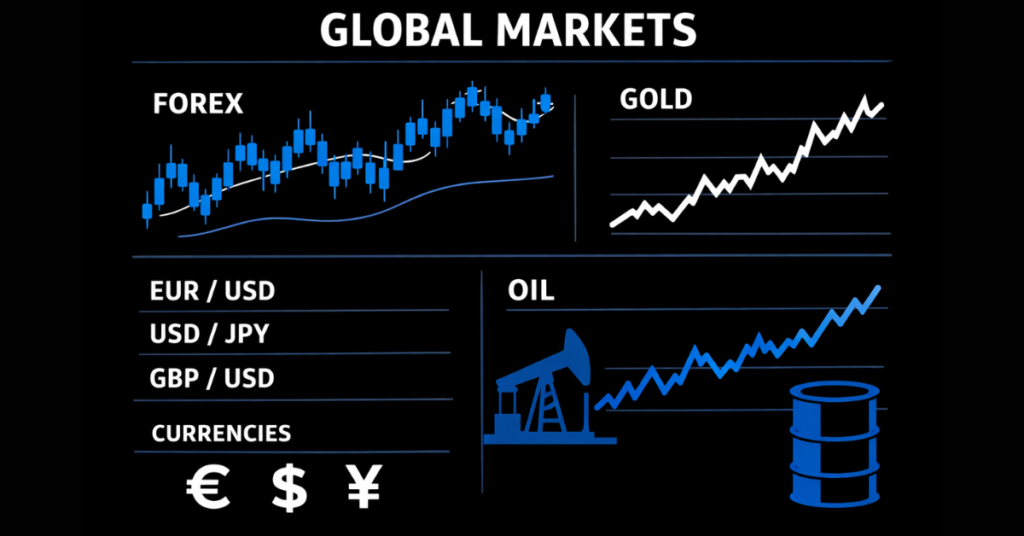
Commodities are physical goods like gold, oil, and wheat traded globally based on supply and demand. Currencies are national money units like USD, EUR, and JPY exchanged in the forex market. Both are major asset classes in global financial markets, and their prices are deeply interconnected through economic activity and global trade.
Key Takeaways
- Commodities are raw materials including gold, oil, silver, and agricultural products traded globally based on supply and demand.
- Currencies represent national monetary systems like USD, EUR, GBP, and JPY, and their values change continuously in the forex market.
- Commodity prices are primarily influenced by production levels, weather, geopolitical events, and supply disruptions.
- Currency values are mainly driven by interest rates, inflation, economic growth, and central bank policy decisions.
- Both asset classes are used for speculation, risk hedging, and portfolio diversification by traders globally.
- Commodity and currency prices are interconnected. Rising oil prices can strengthen commodity-linked currencies like CAD, and gold often moves inversely to the US dollar.
What Are Commodities?
Commodities are basic raw materials and primary goods used in production, manufacturing, and everyday consumption. Unlike stocks, commodity prices are not tied to company performance. They are driven by global supply and demand, physical production levels, and macroeconomic conditions.
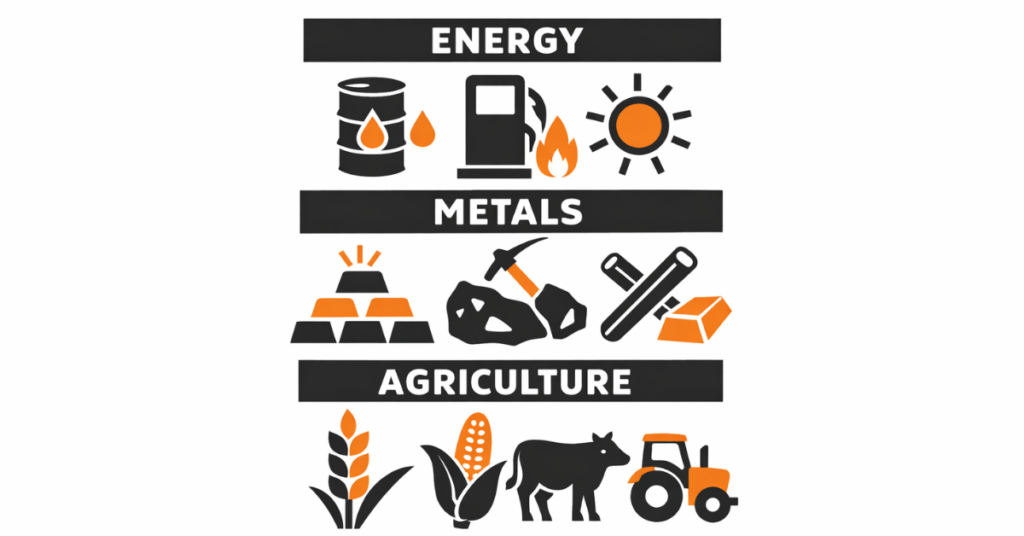
Commodities form the backbone of the global economy. Energy sources power transportation and industry. Metals supply construction and electronics manufacturing. Agricultural products feed populations worldwide. Disruptions in any of these supply chains produce immediate price movements in commodity markets.
Commodities are divided into two main categories:
Hard Commodities
Natural resources that are mined or extracted from the earth. These include gold, silver, crude oil, natural gas, and copper. Hard commodities are typically influenced by energy costs, extraction capacity, geopolitical risk, and infrastructure availability.
Soft Commodities
Agricultural products that are grown rather than extracted. These include wheat, coffee, sugar, corn, and cocoa. Soft commodities are particularly sensitive to weather patterns, harvest cycles, and seasonal demand shifts.
Complete List of Major Commodities
Energy Commodities
Energy commodities are among the most actively traded instruments in global markets because they power transportation, industry, and electricity generation worldwide. Supply disruptions in energy markets can have immediate ripple effects across multiple currencies and economies.
- Crude Oil (Brent and WTI): The most traded commodity globally. Brent crude is the international benchmark, while WTI (West Texas Intermediate) is the US benchmark. Oil prices are heavily influenced by OPEC production decisions, US inventory data, and global demand forecasts.
- Natural Gas: Increasingly important as an energy transition fuel. Prices react to seasonal demand, weather conditions, and supply infrastructure.
- Gasoline and Heating Oil: Refined petroleum products that follow crude oil pricing with additional seasonal demand factors.
Precious and Industrial Metals
Precious metals serve as safe-haven assets and inflation hedges. Industrial metals are economic indicators, reflecting manufacturing activity and construction demand globally.
- Gold (XAUUSD): The most widely traded precious metal and a traditional safe-haven asset. Gold tends to rise during periods of economic uncertainty, inflation, and USD weakness. It has an established inverse relationship with the US dollar.
- Silver (XAGUSD): Behaves similarly to gold but with higher volatility. Silver has both precious metal and industrial demand, making it reactive to both financial and manufacturing conditions.
- Platinum and Palladium: Primarily driven by automotive industry demand (catalytic converters) and South African mining supply.
- Copper: Often called “Doctor Copper” because its price is considered a leading indicator of global economic health. High copper demand signals strong manufacturing and construction activity.
Agricultural Commodities
Agricultural commodity prices are directly tied to weather patterns, harvest yields, export policies, and global food demand. These are some of the most seasonally sensitive assets in financial markets.
- Wheat and Corn: Global staple grains. Prices react sharply to droughts, floods, and major exporter policy changes (Russia and Ukraine are major wheat exporters, making geopolitical events a consistent price driver).
- Soybeans: Critical for both human consumption and animal feed. China is the world’s largest soybean importer, making US-China trade relations a significant price factor.
- Coffee: Primarily produced in Brazil, Vietnam, and Colombia. Frost, drought, and currency movements in producing countries directly influence prices.
- Sugar and Cocoa: Both affected by tropical weather patterns and demand from food processing industries globally.
What Are Currencies in Financial Markets?
Currencies are the official monetary units of countries, used for trade, investment, and economic transactions. In financial markets, they are traded in the forex market, where one currency is continuously exchanged for another based on changing exchange rates.
Unlike commodities, currencies do not have intrinsic physical value in the traded sense. They represent the relative economic strength of one country compared to another. When a country’s economy strengthens, its currency typically gains value. When economic conditions deteriorate, its currency usually weakens.
The four primary drivers of currency value are interest rates set by central banks, inflation levels within a country, economic growth measured by GDP and employment data, and political stability and global risk sentiment.
Major World Currencies List
- USD (US Dollar): The world’s primary reserve currency, present in approximately 88% of all daily forex transactions according to BIS data. The Federal Reserve’s interest rate decisions are the single most impactful driver of USD movements globally.
- EUR (Euro): The second most traded currency, used by 20 Eurozone member countries. Driven by ECB policy, Eurozone inflation, and economic performance across member economies.
- GBP (British Pound): One of the most volatile major currencies due to the UK’s trade structure and sensitivity to Bank of England policy decisions. Also known as Sterling or Cable (in the context of GBP/USD).
- JPY (Japanese Yen): Japan’s currency and a traditional safe-haven asset. Strongly influenced by Bank of Japan policy, Japanese trade balance data, and global risk sentiment. Acts as a funding currency for carry trades.
- CHF (Swiss Franc): Switzerland’s currency and another safe-haven asset. Strengthens during periods of global uncertainty due to Switzerland’s political neutrality and stable banking system.
- AUD (Australian Dollar): A commodity-linked currency closely tied to iron ore, gold, and coal export revenues. Also sensitive to Chinese economic data as China is Australia’s largest trading partner.
- CAD (Canadian Dollar): Strongly correlated with crude oil prices due to Canada’s position as a major oil exporter. Also affected by US economic data given the deep trade relationship between the two countries.
Understanding Currency Pairs
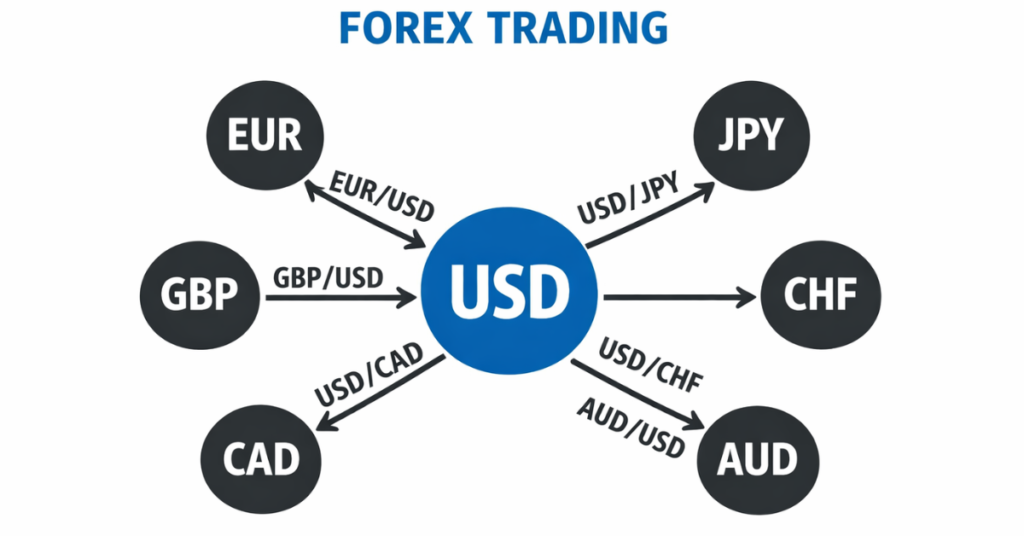
In the forex market, currencies are always traded in pairs. A currency pair shows the exchange rate between two currencies, indicating how much of the quote currency is needed to buy one unit of the base currency.
For example, if EUR/USD is trading at 1.10, one euro equals 1.10 US dollars. If you buy EUR/USD, you are buying euros and selling dollars simultaneously. If you sell EUR/USD, you are selling euros and buying dollars. Profit or loss comes from the direction the exchange rate moves after your entry.
Types of Currency Pairs
Major Pairs: All include the US dollar paired with another top global currency. These are the most liquid pairs with the tightest spreads. Examples include EUR/USD, GBP/USD, USD/JPY, and USD/CHF. For a detailed breakdown, see our guide on the 4 major forex pairs.
Minor Pairs (Cross Pairs): Do not include the US dollar. Examples include EUR/GBP, EUR/JPY, GBP/JPY, and AUD/NZD. These pairs can be more volatile than major pairs due to lower liquidity.
Exotic Pairs: Combine a major currency with a currency from an emerging market economy, such as USD/TRY or USD/ZAR. These carry the highest volatility, widest spreads, and the most exposure to political risk.
Commodities vs Currencies: Key Differences
| Aspect | Commodities | Currencies |
| Nature | Physical goods (gold, oil, wheat) | Monetary value (USD, EUR, JPY) |
| Main Price Driver | Supply and demand, weather, geopolitics | Interest rates, inflation, economic growth |
| Market Type | Commodity exchanges (COMEX, NYMEX, CBOT) | Global forex market (OTC, 24/5) |
| Volatility Trigger | Supply shocks, weather events, OPEC decisions | Central bank decisions, economic data releases |
| Holding Value | Physical assets with intrinsic use value | No intrinsic value, relative monetary value only |
| Trading Access | Futures, CFDs, ETFs | Spot forex, CFDs, futures |
| Safe-Haven Assets | Gold, silver | USD, CHF, JPY |
Relationship Between Commodities and Currencies
Commodities and currencies are closely connected through global trade and economic activity. Understanding these correlations allows traders to anticipate currency moves based on commodity price shifts, and vice versa. These are among the most practically useful relationships in financial markets.
Key Commodity-Currency Correlations
- Oil and CAD (Canadian Dollar): Canada is one of the world’s largest oil exporters. When crude oil prices rise, Canada’s export revenues increase, which typically strengthens CAD. When oil falls, CAD tends to weaken. USD/CAD often moves inversely to oil prices.
- Gold and USD: Gold and the US dollar have a historically inverse relationship. When the USD strengthens, gold typically becomes more expensive in other currencies and demand falls, pushing prices lower. Conversely, USD weakness often supports gold prices as it becomes cheaper for international buyers. Gold also rises during periods of inflation and financial uncertainty when dollar-denominated assets lose appeal.
- Iron Ore / Copper and AUD: Australia is the world’s largest iron ore exporter and a major copper producer. Rising iron ore and copper prices typically strengthen the Australian dollar, as they signal increased export revenue and Chinese industrial demand, which drives much of Australia’s commodity trade.
- Natural Gas and NOK (Norwegian Krone): Norway is a major natural gas exporter in Europe. Natural gas prices influence NOK similarly to how oil influences CAD, though NOK is not a major pair in standard retail forex trading.
How Commodities and Currencies Are Traded
Both commodities and currencies are traded through price speculation rather than physical ownership. Retail traders use instruments like CFDs (Contracts for Difference) to open long or short positions based on expected price direction, without needing to physically buy gold, oil, or foreign currency.
If a trader expects oil prices to rise following an OPEC supply cut, they can open a buy (long) position on crude oil CFD. If the price rises as expected, they profit from the difference. If a trader expects the euro to weaken against the dollar after a weak Eurozone GDP print, they can sell EUR/USD. The mechanics are identical across both asset classes.
Key instruments used for trading both asset classes include spot and forward markets for currencies, futures contracts for both commodities and currencies, CFDs for retail access to both markets with leverage, and ETFs for broader commodity or currency exposure without leverage.
Why Traders Study Commodities and Currencies Together
Traders who understand both asset classes make better-informed decisions because the two markets regularly influence each other. A gold trader who does not monitor the USD is missing context for roughly half the price movement they will see. An AUD/JPY trader who does not follow iron ore and copper is missing a structural driver of the pair’s medium-term direction.
Combined analysis serves three main purposes. First, it provides context: a currency move that initially appears to be driven by domestic economic data may actually be responding to a commodity shock, and knowing which is driving the other changes the trade decision. Second, it enables cross-market confirmation, where a setup in one market is validated by aligned movement in a correlated market. Third, it supports portfolio diversification, since commodities and currencies do not always move together, holding positions across both can balance overall exposure.
Trade Commodities and Currencies with Defcofx
Accessing both commodity and currency markets from a single, reliable platform removes friction and keeps analysis and execution aligned. Defcofx is a forex and CFD broker registered in Saint Lucia that operates through MetaTrader 5, offering a full spectrum of tradeable instruments including major, minor, and exotic currency pairs alongside gold, silver, oil, indices, and other commodities.
For traders who work across both asset classes, whether analyzing gold-USD correlations, trading commodity-linked currencies like AUD and CAD, or accessing energy markets alongside forex pairs, Defcofx provides the conditions to do so efficiently:
- Spreads from 0.3 pips with zero commissions and no swap fees, keeping trading costs consistent across both commodity CFDs and forex pairs
- Leverage up to 1:2000, giving full flexibility in position sizing across both asset classes
- 40% welcome bonus on first deposits of $1,000 or more, available to all qualifying clients globally
- Withdrawals processed within 4 business hours including weekends, ensuring capital is always accessible
- MT5 platform with advanced charting, correlation analysis tools, technical indicators, and fast order execution across all instruments
- Global access with multilingual support, welcoming traders from all countries without geographic restrictions
New to trading commodities or currencies? A free demo account on Defcofx gives you access to gold, oil, and all major forex pairs in real market conditions with zero financial risk. When ready to trade live, account registration takes only a few minutes.
Open a Live Trading Account5 Common Mistakes When Analyzing Commodities and Currencies
- Treating correlations as fixed rules. The gold-USD inverse relationship and the oil-CAD relationship are well established, but they are not permanent. During certain market conditions, these correlations break down or reverse temporarily. Using a correlation as a standalone trading signal without broader market context leads to poor decisions.
- Ignoring the dominant driver. Commodity and currency prices are each influenced by multiple factors simultaneously. A trader watching only oil prices while ignoring Bank of Canada statements is missing a critical driver of CAD. Always identify which factor is dominating the market at any given time rather than relying on one correlation.
- Applying stock market thinking to commodities. Commodities do not have earnings, dividends, or company fundamentals. A trader who expects gold to “recover” like an oversold stock because the price has dropped is applying the wrong analytical model. Commodity valuation is purely supply-demand and macro driven.
- Overtrading based on short-term price noise. Both commodity and currency markets experience frequent short-term fluctuations that do not represent genuine directional moves. Reacting to every price movement without a defined strategy leads to inconsistent results and higher transaction costs.
- Not using a trading plan. Whether trading XAUUSD, crude oil, EUR/USD, or AUD/CAD, entering the market without defined entry rules, exit rules, and maximum risk per trade removes the structure that separates trading from speculation. A pre-trade checklist applied consistently across both asset classes dramatically improves decision quality.
Final Thoughts: Commodities and Currencies in Global Markets
Commodities and currencies are two of the most actively traded and globally significant asset classes. Understanding what each one is, what drives its price, and how they interact gives traders a substantially better foundation than studying either in isolation.
The gold-dollar relationship, oil-CAD correlation, and iron ore-AUD link are not just academic concepts. They are practical, regularly observable market dynamics that active traders use to add context, find confirmation signals, and identify opportunities across both markets simultaneously.
Whether your primary focus is commodity trading, forex trading, or a combination of both, the analytical framework for understanding price drivers is the same: follow supply, demand, monetary policy, and global risk sentiment. Defcofx gives you access to all of these markets in one place.
Open a Live Trading AccountFAQ
A commodities and currencies list covers raw materials such as crude oil, gold, silver, natural gas, copper, wheat, and coffee alongside major global currencies including USD, EUR, GBP, JPY, CHF, AUD, and CAD. Both are actively traded in global financial markets through instruments including CFDs, futures, and spot markets.
The most traded commodities globally are crude oil (Brent and WTI), gold, silver, natural gas, and copper. Crude oil consistently ranks as the highest-volume commodity due to its role in energy production and transportation. Gold follows as the most traded precious metal, particularly during periods of economic uncertainty.
The major world currencies are the US Dollar (USD), Euro (EUR), British Pound (GBP), Japanese Yen (JPY), Swiss Franc (CHF), Australian Dollar (AUD), and Canadian Dollar (CAD). According to BIS data, the USD is involved in approximately 88% of all daily global forex transactions, making it the dominant reserve and trading currency worldwide.
Yes, and many traders do specifically because they are structurally interconnected. For example, analyzing oil prices and USD/CAD simultaneously provides better context for both markets than studying either in isolation. Gold and USD/JPY, iron ore and AUD/USD, and oil and USD/CAD are all commonly analyzed pairs in multi-asset trading approaches.
They represent two of the most liquid and globally significant financial markets. Together they account for trillions of dollars in daily trading volume. Commodities provide exposure to physical supply-demand dynamics and inflation hedging, while currencies provide direct access to macroeconomic and monetary policy trends. Understanding both markets gives traders a more complete view of global financial conditions.
Gold and the US dollar have a historically inverse relationship. When the USD strengthens, gold typically falls in price because it becomes more expensive for international buyers using other currencies. When the USD weakens, gold tends to rise. Gold also strengthens during periods of inflation and financial uncertainty when investors seek safe-haven assets outside dollar-denominated instruments.