


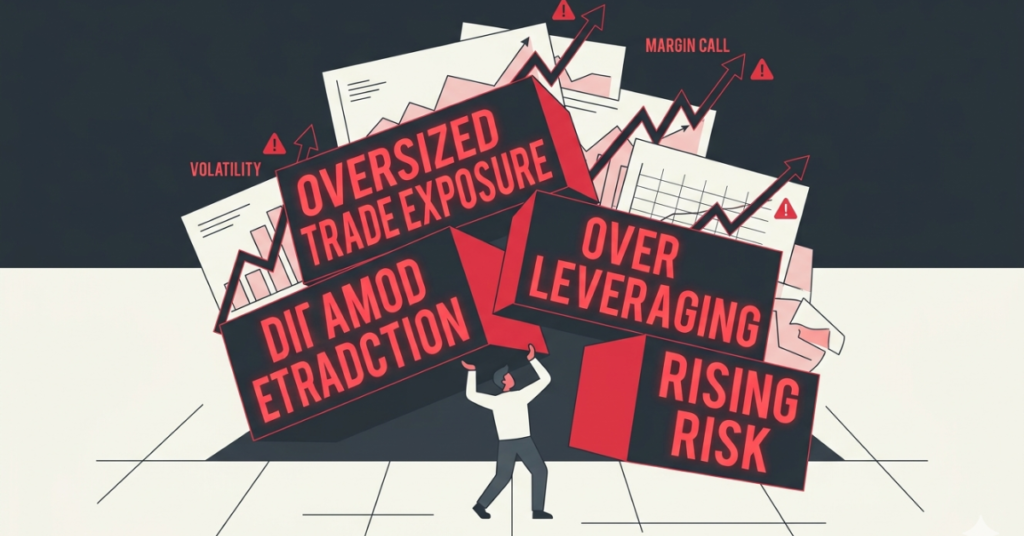
Over leveraging in trading occurs when a trader uses excessive leverage relative to their capital, opening positions far beyond what their account can safely support. While leverage amplifies profits, over leveraging magnifies losses at the same rate, often leading to margin calls, rapid capital loss, or forced account liquidation.
Key Takeaways
- Over leveraging means using more leverage than your account can safely handle, exposing you to outsized losses.
- It amplifies both profits and losses, but losses tend to accumulate faster and harder.
- Even small market movements can trigger margin calls or forced liquidation when over leveraged.
- There is no universally “safe” leverage level. It depends on strategy, capital, and market conditions.
- Proper risk management, including position sizing and stop-loss orders, is the real defence against over leveraging.
What Is Over Leveraging in Trading?
Over leveraging in trading means using borrowed capital (leverage) to open positions that are too large for your account balance to safely handle. In short, you are taking on more market exposure than your capital can absorb if the trade moves against you.
Think of leverage as a tool that lets you control bigger trades with less money. Used responsibly, it improves capital efficiency. Pushed too far, chasing bigger profits with limited funds, it becomes over leveraging.
Example: a beginner with $200 uses high leverage to open a $20,000 position. A 0.5% move against the trade wipes out half the account. That is over leveraging in action.
How Leverage Works in Forex and CFD Trading
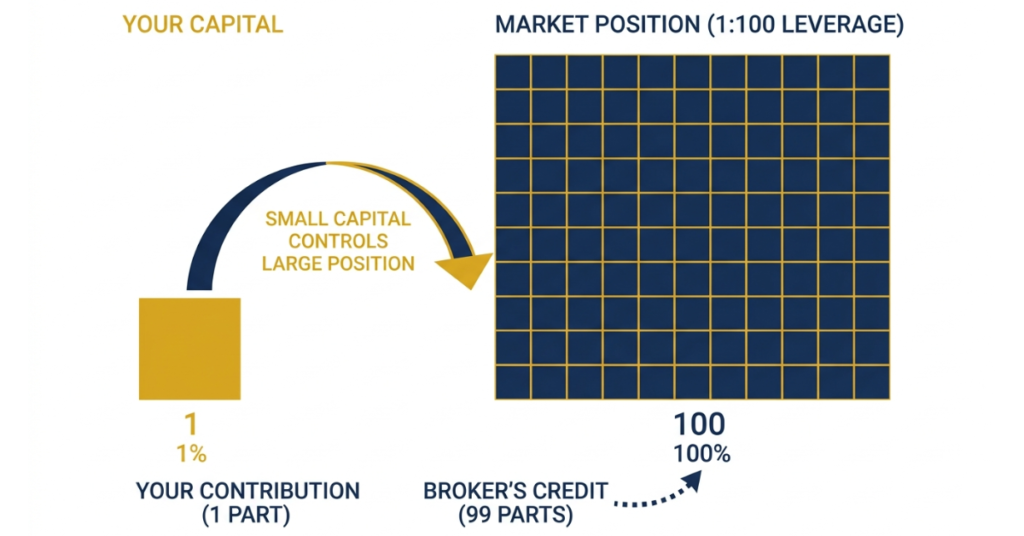
Leverage allows traders to control a larger market position using a smaller deposit, called margin. The broker provides the remaining capital, giving traders greater market exposure than their account balance alone would allow.
With 1:100 leverage, a trader controls a $10,000 position using just $100 of their own capital. With 1:500 leverage, the same $100 controls $50,000.
1:100 leverage → Control $10,000 with $100 margin
In forex and CFD trading, leverage works through margin. The broker holds a portion of your funds as margin while you control a much larger position. If the market moves against you, losses are deducted from your account balance in real time.
When Does Leverage Become Over Leveraging?
Leverage becomes over leveraging when a position is so large that even normal market fluctuations can significantly damage or wipe out your account. It is not defined by a specific leverage ratio. It is defined by the risk you take relative to your capital.
Two traders can both use 1:500 leverage, but one risks 1% per trade while the other risks 40%. The second trader is over leveraging because they cannot survive normal market moves.
Simple rule: If one trade can wipe out a large chunk of your account from a normal price movement, you are over leveraged.
This usually happens when traders:
- Size positions too aggressively relative to account balance
- Revenge trade after losses to recover quickly
- Trade without stop-loss orders
- Focus only on potential profits and ignore downside risk
Real-Life Example of Over Leveraging
A trader has a $200 account and opens a forex position worth $20,000 using high leverage. A 0.5% move against the trade equals a $100 loss, which is 50% of the account. A slightly larger move closes the account entirely.
Losses are not calculated on the $200 deposit. They are calculated on the full $20,000 position. This is the core danger of over leveraging.
What Happens If You Over Leverage?
When a trader over leverages, even routine market movements create oversized losses. This usually triggers a chain reaction:
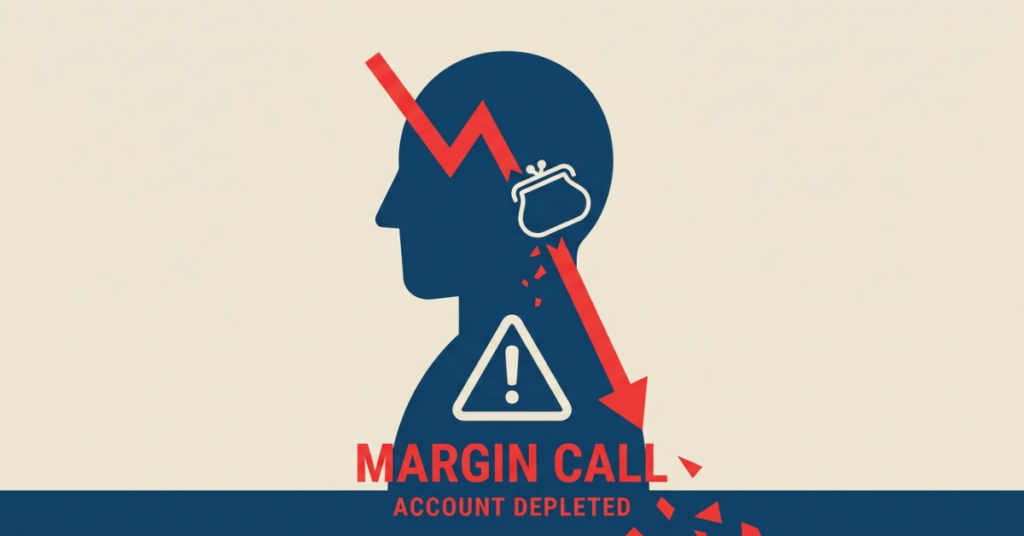
- Margin Call: The broker notifies you that your account no longer has enough equity to maintain open positions.
- Stop-Out / Forced Liquidation: If losses continue, the broker automatically closes your trades to protect against a negative balance.
- Rapid Capital Depletion: Instead of gradual gains or losses, the account balance can collapse within a single trade or a few minutes during high volatility.
Key Risks of High Leverage Trading
- Amplified Losses: Small adverse moves cause large financial damage due to oversized positions.
- Margin Calls: Equity falling below required levels forces you to add funds or close positions immediately.
- Rapid Account Depletion: High leverage can drain an account in a single volatile session.
- Emotional Trading Pressure: Fast-moving losses push traders into impulsive, undisciplined decisions.
- Forced Liquidation: Brokers close positions automatically when losses hit margin limits, locking in the loss.
- Reduced Market Tolerance: Traders have almost no room to withstand normal price fluctuations.
Leverage vs Over Leveraging
The key difference between using leverage correctly and over leveraging comes down to risk control and position sizing, not the leverage ratio itself.
| Aspect | Proper Use of Leverage | Over Leveraging |
| Definition | Using leverage within controlled risk limits | Using positions too large for account safety |
| Risk Level | Managed and calculated | Extremely high and uncontrolled |
| Account Impact | Gradual profit or loss changes | Rapid gains or full account wipeout |
| Market Tolerance | Can absorb normal price fluctuations | Cannot survive small adverse moves |
| Trading Behavior | Follows defined risk management rules | Often driven by emotion or greed |
| Outcome | Sustainable long-term trading | High chance of margin call or liquidation |
Is High Leverage Good or Bad?
High leverage is neither good nor bad on its own. It is a tool, and like any tool, its impact depends entirely on how it is used.
Used with discipline, high leverage lets traders with smaller accounts access meaningful market exposure without tying up large amounts of capital. Used without risk management, it turns every trade into an all-or-nothing bet.
How to Avoid Over Leveraging in Trading
The goal is not to eliminate leverage. It is to use it in a way that keeps your account intact even when trades go wrong.
- Use Proper Position Sizing: Risk only 1–2% of your account per trade to limit damage from any single loss.
- Always Set a Stop-Loss: Define your exit before entering a trade, not after losses start building.
- Avoid Revenge Trading: Increasing position size to recover losses faster is one of the most common causes of over leveraging.
- Know Your Risk Per Trade: Calculate exactly how much you can lose before you open any position.
- Keep Lot Sizes Proportional: Even if your broker offers high leverage, your lot size should still match your account balance.
- Stick to Your Strategy: React to your plan, not to market emotions or short-term price noise.
Best Leverage for Beginner Traders
Beginners should start with lower leverage to reduce exposure while building experience. The goal early on is to preserve capital and develop consistency, not to maximize returns.
A common starting range is 1:10 to 1:100, depending on the market and trading style. Lower leverage means more room to breathe. Normal price fluctuations will not immediately threaten the account.
If you are new to trading and want to test strategies without risking real capital, a demo account is the right first step. Defcofx offers a free demo trading account where you can practice with real market conditions and zero financial risk.
Open a Free Demo AccountWhy Risk Management Matters More Than Leverage
Leverage determines the size of your position. Risk management determines how much you can actually afford to lose. The second one matters far more.
A trader using 1:1000 leverage with strict 1% risk rules is safer than a trader using 1:10 leverage but betting 50% of their account per trade. Markets are unpredictable. Even the best setups fail. Risk management is what keeps you in the game through losing streaks.
The core principle is simple: control losses first, let profits follow. Without that foundation, no leverage ratio or trading strategy can protect you.
Trade with Defcofx: Flexible Leverage, Transparent Conditions
Defcofx is a forex and CFD broker registered in Saint Lucia, offering access to currencies, commodities, indices, stocks, and cryptocurrencies through the MetaTrader 5 (MT5) platform.
For traders focused on managing leverage responsibly, Defcofx provides the conditions that support that approach:
- Leverage up to 1:2000, with the flexibility to size positions according to your own risk tolerance
- Spreads from 0.3 pips with no commissions or swap fees, keeping trading costs low
- 40% welcome bonus on first deposits of $1,000 or more, available to all clients globally
- Fast withdrawals processed within 4 business hours, including weekends
- Multiple account types and market analysis tools to support both beginner and experienced traders
High leverage at Defcofx is a feature, not a trap. It gives experienced traders flexibility while still leaving full control of risk in the trader’s hands. Beginners can start on a demo account to understand how leverage and margin work before committing real capital.
Open a Live Trading AccountFinal Thoughts on Over Leveraging in Trading
Over leveraging is one of the most common reasons traders blow accounts, not because leverage itself is harmful, but because it is misused. Taking positions that are too large for your account, ignoring stop-losses, and revenge trading are the real culprits.
The solution is not to avoid leverage entirely. It is to use it in proportion to your capital, with clear risk limits on every trade. Discipline and position sizing will protect your account far more reliably than any market prediction.
If you are ready to trade with proper conditions and full control over your risk settings, Defcofx gives you the tools and flexibility to do exactly that.
Open a Live Trading AccountFAQ
Over leveraging in trading occurs when a trader uses excessive leverage relative to their account size, resulting in positions that are too large to manage safely. This increases the risk of significant losses even from small market movements.
Over leveraging is dangerous because it amplifies both profits and losses. While gains may look attractive, even minor price fluctuations can quickly lead to margin calls, forced liquidation, or complete account loss.
Leverage is a tool that allows traders to control larger positions with smaller capital. Over leveraging happens when that tool is used irresponsibly, taking positions that exceed safe risk limits relative to account size.
Avoid over leveraging by using proper position sizing, applying stop-loss orders on every trade, and risking no more than 1–2% of your account per position. Sticking to a defined trading plan also helps maintain discipline.
High leverage is not automatically risky. The danger lies in how it is used. When combined with strong risk management and controlled position sizing, high leverage can be used responsibly. Without discipline, it can cause severe losses.
If your account is over leveraged, you may face rapid losses, margin calls, or automatic position closures by your broker when equity falls below the required maintenance level.
Yes. Beginners can use leverage safely by starting with lower ratios, practicing on a demo account first, and focusing on risk management before scaling up. Defcofx offers a free demo account to help new traders build skills without risking real capital.