


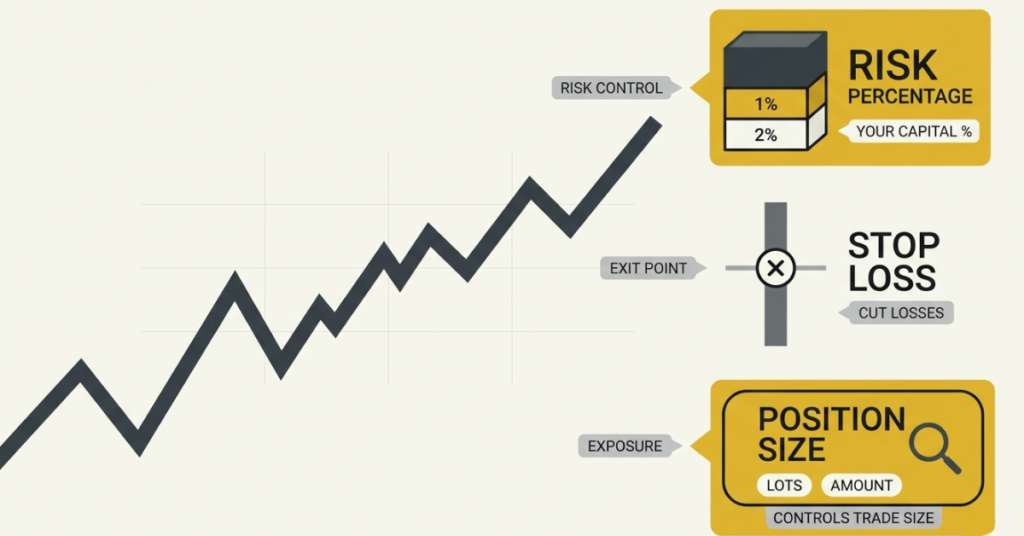
To calculate risk management in forex, determine how much of your account you are willing to risk per trade (usually 1–2%), set a stop loss in pips based on market structure, and calculate your position size accordingly. This three-step process ensures every loss is controlled, predictable, and within the limits your account can survive.
Key Takeaways
- Forex risk management is calculated using three inputs: risk percentage, stop loss in pips, and pip value. Together they determine your correct position size.
- The 1% rule is the most widely applied risk standard. At 1% risk per trade on a $1,000 account, you can lose 100 consecutive trades before your account is depleted.
- Proper lot size calculation is the most important mechanical step in risk management. A wrong lot size means a wrong risk, regardless of how well you understand the formula.
- Stop loss placement must be based on market structure, not arbitrary pip distances. A stop placed too tight guarantees it gets hit by normal market noise.
- Consistent risk control across every trade is more important than finding better entries. Risk management is what keeps you in the game long enough for your strategy to work.
Why Risk Calculation Matters More Than Strategy
The most common belief among new traders is that finding a better strategy will solve their losses. In reality, strategy selection is secondary to risk management. A mathematically profitable strategy with poor risk management will still produce account failure. A mediocre strategy with excellent risk management can produce consistent, survivable results.
The reason is straightforward. Consider two traders using the identical strategy with a 50% win rate and a 1:2 risk-reward ratio. Trader A risks 10% per trade. Trader B risks 1% per trade. After a documented losing streak of just five consecutive trades (statistically normal for any strategy), Trader A has lost 50% of their account and is in serious recovery territory. Trader B has lost 5% and remains fully operational with no meaningful impact on their trading.
Risk calculation gives traders three structural advantages: consistency because the maximum loss is always known in advance, longevity because the account survives losing streaks that are statistically certain to occur, and emotional control because predefined losses remove the need for in-trade decisions under pressure.
Core Elements Required to Calculate Forex Risk
Every forex risk calculation uses the same five inputs. Understanding what each one means and how it connects to the others is the foundation of the entire process.
| Element | What It Is | Example Value |
| Account Balance | Your total trading capital. All risk calculations are a percentage of this figure. | $1,000 |
| Risk Percentage | How much of your account you are willing to lose on one trade. Standard is 1–2%. | 1% |
| Risk Amount (in $) | The actual dollar value you can lose. Calculated from balance × risk%. | $10 |
| Stop Loss (Pips) | The distance in pips from entry to stop. Must be based on market structure, not random numbers. | 50 pips |
| Pip Value | How much money each pip represents at a given lot size. Varies by pair and lot size. | $0.10 per pip (micro lot on EUR/USD) |
| Position Size (Lots) | The output of the calculation. How many lots to trade to keep risk within your limit. | 0.02 lots |
Missing or guessing any of these values produces an incorrect position size, which means your actual risk per trade differs from your intended risk. This is the most common mechanical cause of account damage among traders who understand risk management in theory but apply it inconsistently in practice.
The Forex Risk Management Formula
Two formulas work together to complete a full risk calculation. The first gives you your risk amount in dollars. The second uses that figure to determine the correct position size.
Step 1 — Risk Amount Formula:
Risk Amount ($) = Account Balance × (Risk % ÷ 100)
Step 2 — Position Size Formula:
Position Size (Lots) = Risk Amount ($) ÷ (Stop Loss in Pips × Pip Value per Lot)
These two formulas, used in sequence, give you the exact lot size needed so that if your stop loss is hit, your account loses precisely your intended risk amount, no more.
Step-by-Step: How to Calculate Risk in Forex
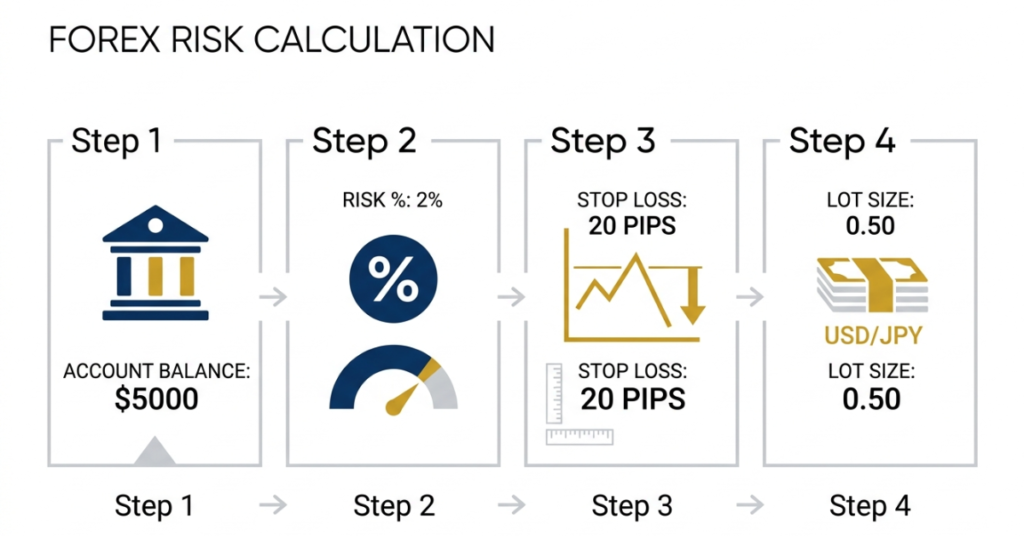
Below is the complete five-step process applied to a real trade scenario. Use these exact steps before every trade you enter.
Step 1: Choose Your Risk Percentage
Decide what percentage of your account you are willing to lose on this trade. For most traders and especially beginners, 1% is the correct starting point. Professional traders typically use 0.5–2% depending on strategy confidence and market conditions.
For this example: 1% risk on a $1,000 account.
Step 2: Calculate Your Risk Amount in Dollars
Apply the risk amount formula:
Risk Amount = $1,000 × (1 ÷ 100) = $10
This is the maximum you can lose on this trade. No matter what happens, if the stop loss is hit, you lose $10 and nothing more.
Step 3: Set Your Stop Loss Based on Market Structure
Identify where the trade setup is technically invalidated. This is your stop loss location. The distance from your entry to that level, measured in pips, is your stop loss input.
For this example: the nearest support level is 50 pips below the entry. Stop loss = 50 pips.
Step 4: Calculate Your Position Size
Now apply the position size formula. On EUR/USD, a micro lot (0.01 lots) has a pip value of approximately $0.10.
Position Size = $10 ÷ (50 pips × $0.10 per pip) = $10 ÷ $5 = 0.02 lots (2 micro lots)
This means you enter the trade at 0.02 lots. If the stop loss is hit at 50 pips, your loss is exactly: 50 pips × $0.10 × 2 micro lots = $10. Precisely what you planned.
Step 5: Execute the Trade with Full Risk Defined
Enter the trade with the stop loss placed at the calculated level and the lot size set to 0.02. At this point, risk is fully defined before a single pip moves. The maximum loss is $10. There is no in-trade decision required if the stop is hit. You exit automatically, lose exactly $10, and move to the next setup.
Full Worked Example: EUR/USD Risk Calculation
Here is the complete calculation applied to a real trade scenario with all values filled in and verified.
| Input | Value |
| Account Balance | $1,000 |
| Risk Percentage | 1% |
| Risk Amount | $1,000 × 0.01 = $10 |
| Trading Pair | EUR/USD |
| Stop Loss | 50 pips below entry |
| Pip Value (micro lot) | $0.10 per pip |
| Position Size | $10 ÷ (50 × $0.10) = 0.02 lots |
| Maximum Loss if Stop Hit | 50 × $0.10 × 2 = $10 exactly |
The result confirms that this trade is correctly sized. If EUR/USD moves 50 pips against the entry and the stop triggers, the account loses exactly $10, which is 1% of the $1,000 balance. The account continues at $990 and the process repeats on the next trade.
If the trade succeeds and targets a 1:2 risk-reward ratio (100 pips take profit), the profit is: 100 pips × $0.10 × 2 lots = $20. The trader risked $10 to make $20 on a properly calculated position.
Practice Risk Calculation on a Free Demo AccountLot Size Calculation: How Position Size Controls Risk
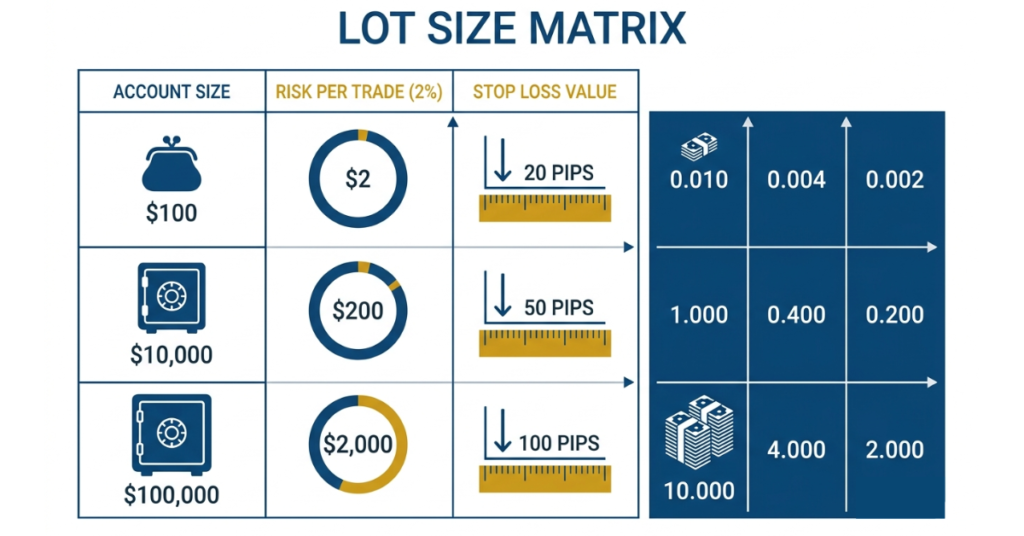
Lot size is what physically implements your risk management. You can understand every concept in this article perfectly, but if your lot size is wrong, your risk is wrong. The table below shows how lot size changes across different account sizes, risk percentages, and stop loss distances, all using a 50-pip stop on EUR/USD with $0.10 pip value per micro lot.
| Account | Risk % | Risk Amount | Stop Loss | Lot Size | Max Loss if Stop Hit |
| $1,000 | 1% | $10 | 50 pips | 0.02 lots | $10 |
| $2,000 | 1% | $20 | 50 pips | 0.04 lots | $20 |
| $1,000 | 2% | $20 | 50 pips | 0.04 lots | $20 |
| $1,000 | 1% | $10 | 25 pips | 0.04 lots | $10 |
| $1,000 | 1% | $10 | 100 pips | 0.01 lots | $10 |
The last two rows reveal the most important relationship in position sizing: when your stop loss is wider, your lot size must be smaller to maintain the same dollar risk. A 100-pip stop on a $1,000 account at 1% risk means you trade only 0.01 lots. This is correct. Trying to trade 0.02 lots with a 100-pip stop doubles your risk to $20 (2% of account) without any adjustment to risk percentage.
The 1% Rule: Why It Works Mathematically
The 1% rule states that you never risk more than 1% of your total trading account on a single trade. It is the most widely recommended risk standard in professional trading because of what it does to your account’s statistical survival over a losing streak.
At 1% risk per trade, a losing streak of 10 consecutive trades reduces a $1,000 account to approximately $904 (because each trade’s 1% is calculated on the remaining balance). That is a 9.6% drawdown. Painful but completely recoverable. At 10% risk per trade, the same 10-trade losing streak reduces the $1,000 account to $349, a 65% drawdown that requires a 186% gain just to return to breakeven.
Risk-Reward Ratio: Making Risk Worth Taking
Risk management alone is not enough. The risk-reward ratio determines whether the risk you take per trade is mathematically justified by the potential profit. Even with perfect 1% risk management, a trader who consistently targets rewards smaller than their risk will eventually lose money.
The risk-reward ratio is expressed as the relationship between your stop loss (risk) and your take profit (reward). A 1:2 ratio means you risk $10 to target $20. At this ratio, you only need to win 34% of your trades to break even. A 1:3 ratio means you break even winning just 25% of trades.
| Ratio | Risk | Reward | Break-Even Win Rate | Best For |
| 1:1 | $10 | $10 | 50% | High win-rate scalping strategies |
| 1:2 | $10 | $20 | 34% | Most day trading and swing strategies |
| 1:3 | $10 | $30 | 25% | Trend following, position trading |
Practical example with verified math: A trader takes 10 trades at 1:2 risk-reward, risking $10 to target $20. They win 4 and lose 6. Wins: 4 × $20 = $80. Losses: 6 × $10 = $60. Net profit: $80 – $60 = $20 profit with a 40% win rate. This is the mathematical power of maintaining a reward larger than risk. Profitable even when losing more trades than winning.
How Leverage Affects Risk Calculation
Leverage is one of the most misunderstood concepts in forex risk management. Leverage does not change your risk percentage. It changes how much market exposure you can access with a given amount of capital. Whether this increases or decreases your risk depends entirely on how you use it.
With 1:100 leverage, $100 of capital controls a $10,000 position. With 1:2000 leverage, the same $100 controls a $200,000 position. In both cases, your actual dollar risk per trade is still determined by your position size and stop loss, not by the leverage level itself. If you use the position size formula correctly, your risk remains exactly 1% regardless of leverage.
Where leverage creates danger is when traders use it to open positions larger than their position size formula permits. A trader who knows their formula says 0.02 lots but trades 0.20 lots because high leverage makes it technically possible has multiplied their risk by 10 without adjusting their intended risk percentage. The result is a 10% risk trade disguised as a 1% risk trade.
5 Common Risk Management Mistakes to Avoid
- Risking too much per trade. Many beginners use 5–10% risk hoping to grow the account faster. The math works against them immediately. A five-trade losing streak at 10% risk wipes out 41% of the account. The same streak at 1% risk removes 4.9%. Apply the 1–2% rule without exception.
- Trading without a stop loss. Removing a stop loss does not remove risk. It removes the upper limit on risk, making losses theoretically unlimited. Every trade must have a stop loss placed before entry. If you cannot identify where the trade is technically invalidated, the trade should not be entered.
- Guessing lot sizes. Some traders estimate lot size by feel rather than calculating it. This produces unpredictable risk per trade and makes it impossible to evaluate strategy performance accurately. Always calculate: Risk Amount ÷ (Stop Loss Pips × Pip Value).
- Overleveraging. Using leverage to trade larger positions than the position size formula permits multiplies risk without the trader’s awareness. Calculate lot size from the formula first. Never work backwards from what leverage permits.
- Ignoring trading costs. Spreads, commissions, and swap fees increase the effective cost of every trade. On a trade targeting 20 pips with a 3-pip spread, 15% of the trade’s profit target is consumed by spread cost before the trade even begins. This makes the true risk-reward ratio worse than calculated. Trading on platforms with tight spreads and no commissions keeps your calculated risk closer to your actual risk.
Apply Forex Risk Management with Defcofx
Understanding risk calculation is the first step. The second step is applying it in a trading environment where the calculations actually hold. When spreads are unpredictable, commissions eat into margins, or execution is slow, the gap between your calculated risk and your actual risk widens on every trade. Defcofx is a forex and CFD broker registered in Saint Lucia, operating on MetaTrader 5 with access to all major, minor, and exotic currency pairs alongside commodities, indices, stocks, and cryptocurrencies.
For traders applying the risk management framework in this article, Defcofx provides the conditions that keep calculated risk aligned with actual risk:
- Spreads from 0.3 pips with zero commissions and no swap fees, so the cost of each trade is known before entry and does not distort your risk-reward calculations
- Leverage up to 1:2000, giving full flexibility for position sizing across all account sizes while maintaining complete trader control over how much of that leverage is actually used
- 40% welcome bonus on first deposits of $1,000 or more, available to all qualifying clients globally
- Withdrawals processed within 4 business hours including weekends, keeping capital accessible at all times
- MT5 platform with built-in lot size calculation tools, margin calculators, and position sizing functionality that directly supports the calculation process described in this article
- Free demo account in real market conditions, allowing traders to practice the full risk calculation process on live price data before committing real capital
- Global access with multilingual support, welcoming traders from all countries
New to forex risk management? A free demo account is the ideal environment to run through the five-step calculation process on real trades with zero financial risk. Opening a live account takes only a few minutes when you are ready.
Open a Live Trading Account5 Risk Management Strategies for Beginners
The following habits, applied consistently from the first trade, prevent the most common and most expensive beginner mistakes in forex trading.
- Use a fixed risk percentage on every trade. Always 1%. Not 1% on confident trades and 3% on “high conviction” setups. A fixed percentage removes the subjective judgment that consistently leads to over-risking on trades that feel certain but are not.
- Place a stop loss before entering every trade. Not after. Not at a vague “if it goes against me” point. A specific pip level based on where the technical setup is invalidated, placed as part of the entry order. This removes the need for in-trade decisions under emotional pressure.
- Focus on consistency, not profit. In the first three to six months of trading, the correct goal is consistent application of risk management rules across 50 to 100 trades, not account growth. Discipline applied consistently is the prerequisite for profit. Profit without discipline is temporary.
- Never increase lot size to recover a loss. Martingale-style position increases (doubling lot size after a loss to recover faster) is the fastest route to account failure. After a loss, the next trade uses the same 1% risk calculation. Period.
- Practice on a demo account until the process is automatic. The five-step calculation should become a reflex, not a deliberation. Practice it on demo so that applying it live under market pressure requires no additional mental effort.
FAQ
Use two formulas in sequence. First: Risk Amount = Account Balance × (Risk% ÷ 100). Second: Position Size = Risk Amount ÷ (Stop Loss in Pips × Pip Value). Example: $1,000 account, 1% risk, 50-pip stop, $0.10 pip value. Risk Amount = $10. Position Size = $10 ÷ (50 × $0.10) = 0.02 lots. If the stop is hit, you lose exactly $10, which is 1% of the account.
1% per trade is the most widely recommended starting point. At 1% risk, a 10-trade losing streak reduces a $1,000 account to approximately $904, a 9.6% drawdown that is fully recoverable. At 10% risk, the same 10-trade losing streak reduces the account to $349, a 65% drawdown requiring a 186% gain to return to breakeven. Most professional traders use between 0.5% and 2% depending on strategy confidence and market conditions.
Apply this formula: Lot Size = Risk Amount ÷ (Stop Loss in Pips × Pip Value per Lot). Example: $20 risk, 50-pip stop, $0.10 pip value per micro lot. Lot Size = $20 ÷ (50 × $0.10) = $20 ÷ $5 = 0.04 lots. Verify the result by multiplying back: 50 pips × $0.10 × 4 micro lots = $20. If the verification matches your risk amount, the calculation is correct.
The 1% rule means you never risk more than 1% of your total account balance on a single trade. On a $1,000 account, maximum loss per trade is $10. On a $5,000 account, it is $50. The rule scales automatically with account size because it is a percentage, not a fixed dollar amount. Its mathematical value is that it keeps losing streaks within survivable range: 100 consecutive losses at 1% risk still leaves approximately 37% of the original account intact.
Leverage determines how large a position you can open with a given amount of capital. It does not determine your risk. Risk is determined by your position size and stop loss distance. When position size is calculated correctly using the formula, your risk remains at 1% regardless of whether leverage is 1:100 or 1:2000. Leverage becomes dangerous only when traders use it to open positions larger than their position size formula permits, effectively multiplying their intended risk without realizing it.
Trading costs increase your effective risk per trade. On a trade targeting 20 pips with a 3-pip spread, 15% of your target is consumed by the spread before the trade moves in your favor. This makes your actual risk-reward ratio worse than calculated. For example, a calculated 1:2 setup with a 3-pip spread on a 20-pip target effectively becomes closer to 1:1.6 after spread cost. Trading with brokers who offer tight spreads and zero commissions keeps your calculated risk aligned with your actual risk.
Final Thoughts: How to Calculate Risk Management in Forex
Calculating forex risk management is a five-step process: choose your risk percentage, calculate your risk amount in dollars, place your stop loss at a technically justified level, calculate your position size using the formula, and execute the trade with every risk parameter defined before entry. When applied consistently, this process ensures that no single trade can cause meaningful damage to your account and that your capital survives long enough for your strategy to prove its value over a statistically meaningful sample of trades.
Risk management does not guarantee profits. It guarantees that losses stay controlled, recoverable, and proportional. In a market where 70–80% of retail traders lose money primarily due to behavioral and risk management failures, consistently applying these calculations places you in the minority that trades sustainably. See our broader guide on forex risk management and our forex trading checklist for the full framework applied to a pre-trade routine.
Open a Live Trading Account