


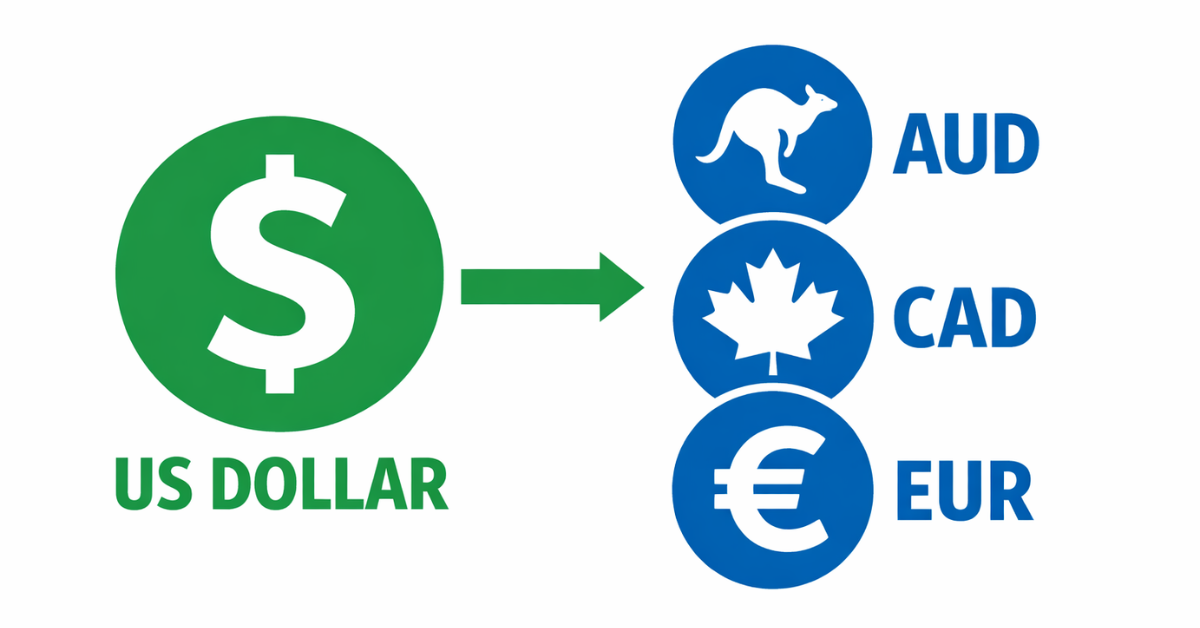
No, Canadian money is generally worth less than US money. The US dollar is stronger than the Canadian dollar in most market conditions, meaning you need more Canadian dollars to equal one US dollar. That said, exchange rates shift constantly based on economic data, oil prices, and trade conditions between the two countries.
Key Takeaways
- The US dollar is generally stronger than the Canadian dollar
- Exchange rates between USD and CAD change based on economic and trade factors
- You typically need more CAD to equal 1 USD
- Oil prices and US trade volumes heavily influence the Canadian dollar
- Currency strength is not fixed and can shift over time
- USD/CAD is a widely traded forex pair with clear, trackable drivers
What Does “Worth More” Mean in Currency?
When people ask whether one currency is worth more than another, they are referring to exchange rates. This simply tells you how much of one currency it takes to buy a unit of another.
For example, if 1 US dollar equals around 1.38 Canadian dollars, the USD is stronger. You need more Canadian money to match the value of one US dollar. This is the exchange rate, and it changes continuously based on market conditions.
Importantly, a weaker currency does not mean a weaker economy. Currency value is determined by global demand, capital flows, and policy decisions, not just the size or health of a country. For a broader understanding of how currencies work in trading, see what is forex trading and how does it work.
Why the US Dollar Is Usually Stronger
Reserve Currency Status
The US dollar is the world’s primary reserve currency. Central banks globally hold large quantities of USD, and most international trade, including oil and commodities, is priced in dollars. This creates constant, structural demand for the currency that very few others can match.
Size of the US Economy
The United States has one of the largest economies in the world. A large, diversified economy gives investors confidence, which keeps demand for USD high even during periods of uncertainty.
Interest Rate Differentials
When the US Federal Reserve raises interest rates, the USD tends to strengthen because higher rates attract capital from global investors seeking better returns. This makes the dollar more desirable relative to currencies like the Canadian dollar. You can see how this plays out in how to read currency exchange charts.
Why the Canadian Dollar Changes in Value
The Canadian dollar, often called the loonie, is one of the most commodity-sensitive major currencies in the world. Unlike the USD, which is driven primarily by global financial flows, the CAD responds strongly to a narrower set of drivers.
Oil Prices
Canada is one of the world’s largest oil exporters. When crude oil prices rise, Canada earns more from exports, which increases demand for CAD and pushes its value higher. When oil prices fall, the opposite happens. This makes the loonie closely linked to energy market conditions.
US Trade Relationship
The United States is Canada’s largest trading partner by a significant margin. Changes in US economic growth, consumer demand, or trade policy directly affect Canadian exports, which in turn affects the CAD. For a broader look at how currency pairs are structured, see forex currency pairs.
Economic Data
Canadian inflation figures, employment reports, and Bank of Canada interest rate decisions all influence the CAD. Stronger-than-expected economic data typically supports the currency, while weaker data tends to push it lower against the USD.
USD vs CAD: Side-by-Side Comparison
Here is how the two currencies compare across the most relevant factors for traders and anyone exchanging money:
| Feature | US Dollar (USD) | Canadian Dollar (CAD) |
|---|---|---|
| Global Use | Very high, reserve currency | Moderate |
| Stability | High | Moderate to high |
| Key Driver | Global demand, interest rates | Oil prices, US trade, economic data |
| Typical Strength | Stronger | Slightly weaker |
| Volatility | Moderate | Moderate, oil-sensitive |
| Trade Influence | Global | Heavily tied to US trade |
Both currencies are stable and widely traded. The key difference is that USD benefits from global reserve status, which gives it a structural advantage over CAD in most market conditions.
Can the Canadian Dollar Ever Be Stronger Than the US Dollar?
Yes, it is possible, though rare. There have been historical periods when the CAD came very close to parity with the USD or briefly exceeded it. This typically happens when oil prices are extremely high, US economic conditions are weak, or the Bank of Canada raises rates aggressively relative to the Federal Reserve.
Between 2007 and 2008, the Canadian dollar reached near parity with the US dollar, largely driven by surging oil prices and a weakening US economy at the time. While this kind of parity is uncommon, it demonstrates that currency dynamics are not fixed.
For traders, these periods of shifting currency strength are where opportunities are found. See the 28 major forex pairs list to understand where USD/CAD sits within the broader currency market.
What This Means for Forex Traders
For forex traders, the relationship between USD and CAD creates ongoing trading opportunities. The USD/CAD pair moves based on a combination of oil price changes, central bank decisions, US economic data, and Canadian trade figures, giving traders clear catalysts to analyze.
For example, if oil prices spike significantly, a trader might anticipate a stronger CAD and look for a USD/CAD sell setup. If US economic data comes in strong and Canadian data disappoints, USD/CAD may push higher, offering a buy opportunity.
The pair is liquid, well-understood, and driven by transparent fundamentals, which makes it accessible for both beginner and experienced traders.
Trade USD/CAD with Defcofx
Defcofx is a CFD broker that gives you access to the USD/CAD pair and a wide range of other major currency pairs through the MetaTrader 5 (MT5) platform. Whether you are trading based on oil market moves, central bank decisions, or technical setups, Defcofx provides the execution speed and pricing you need to act on opportunities confidently.
Here is what Defcofx traders get:
- Leverage up to 1:2000, giving you the flexibility to size positions appropriately for your account
- Spreads from 0.3 pips with no commissions or swap fees, so your trading costs stay low and predictable
- 40% Welcome Bonus on first deposits of $1,000 or more
- Withdrawals completed within 4 business hours, including weekends
- MT5 platform with real-time pricing, advanced charting, and fast order execution
- Clients accepted from all countries with multilingual support
Want to test your USD/CAD strategy before going live? Start with a Defcofx demo account and practice with real market conditions and no financial risk.
Final Answer: Is Canadian Money Worth More?
In most market conditions, no. The US dollar is typically stronger than the Canadian dollar due to its global reserve status and the size of the US economy. However, the gap between the two currencies is not extreme, and the CAD is still a stable, well-backed currency.
For everyday purposes, you will generally get more Canadian dollars per US dollar. For traders, this difference is not a fixed fact but a dynamic relationship that changes based on oil prices, central bank policy, and economic data from both sides of the border.
Practice trading USD/CAD risk-free and build your confidence before going live.
Open a Free Demo Account →Frequently Asked Questions
Is the Canadian dollar stronger than the US dollar?
No, in most conditions the Canadian dollar is weaker than the US dollar. You typically need more CAD to equal 1 USD. However, this gap can narrow or briefly reverse depending on oil prices and economic data.
Why is the US dollar stronger than the Canadian dollar?
The US dollar benefits from its status as the world’s reserve currency, the scale of the US economy, and consistently high global demand. These structural advantages keep USD stronger than most currencies, including the CAD, in the long term.
Can the Canadian dollar ever be stronger than USD?
Yes, though it is rare. In periods of surging oil prices or significant US economic weakness, CAD can approach or briefly reach parity with USD. It happened briefly around 2007 and 2008 during a period of high oil prices.
What affects the Canadian dollar the most?
Oil prices are the single biggest driver of the Canadian dollar. Beyond that, US trade volumes, Bank of Canada interest rate decisions, inflation data, and employment figures all influence CAD regularly.
Is CAD a stable currency?
Yes. The Canadian dollar is considered a stable, well-backed currency. It is supported by a strong banking system and resource-rich economy. While it fluctuates more than USD, it is among the more reliable major currencies globally.
What is the USD/CAD forex pair?
USD/CAD is a major forex pair showing how many Canadian dollars it takes to buy one US dollar. It is actively traded and commonly used by traders who follow oil markets or North American economic data.
Is USD/CAD a good pair to trade?
Yes, USD/CAD is a popular choice because its price drivers are well-known and transparent. Oil prices, Federal Reserve and Bank of Canada decisions, and US economic reports give traders clear signals to analyze and act on.
How do I know when to trade USD/CAD?
USD/CAD tends to be most active during North American trading hours, particularly when US or Canadian economic data is released. Oil market events can also trigger significant moves at any time.