


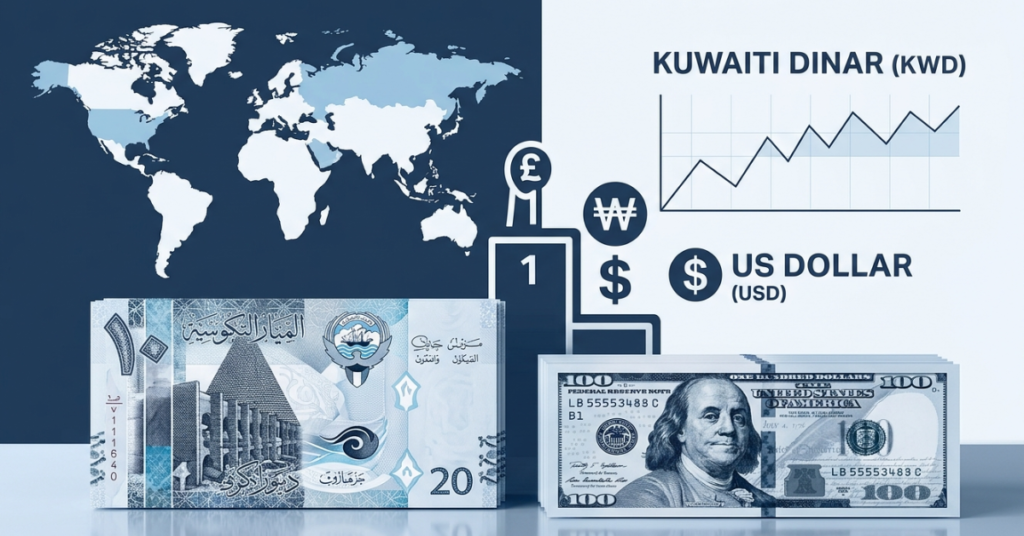
The Kuwaiti Dinar (KWD) is the most valuable currency in the world by exchange rate. One KWD equals approximately 3.25 USD. This isn’t because Kuwait has the biggest economy, but because of how its currency was structured and the immense oil revenue backing it.
Key Takeaways
- The Kuwaiti Dinar (KWD) is the highest-valued currency by exchange rate, at roughly 3.25 USD per 1 KWD.
- Currency value by exchange rate is different from economic size. The US has the largest economy but not the highest-valued currency.
- Oil wealth, monetary policy, and exchange rate pegs heavily influence which currencies top the list.
- Most of the highest-valued currencies belong to Gulf countries, which peg their currency to the US Dollar.
- High exchange rate value doesn’t mean the currency is ideal for trading, as liquidity matters more in forex.
What Does ‘Most Valuable Currency’ Mean?
When people ask about the most valuable currency, they usually mean the highest exchange rate against the US Dollar. In other words, if 1 unit of Currency X equals more than 1 USD, it’s considered ‘strong’ in nominal terms.
This is a nominal comparison, not a purchasing power comparison. A currency can have a high exchange rate for several reasons:
- It was never devalued or redenominated historically.
- The central bank deliberately kept it at a high face value.
- It’s backed by massive natural resources like oil.
- The government uses a tight monetary policy limiting money supply.
Understanding exchange rates is a core part of forex trading basics. When you trade currency pairs, you’re essentially expressing a view on the relative strength of two currencies.
Top 10 Most Valuable Currencies in the World by Exchange Rate
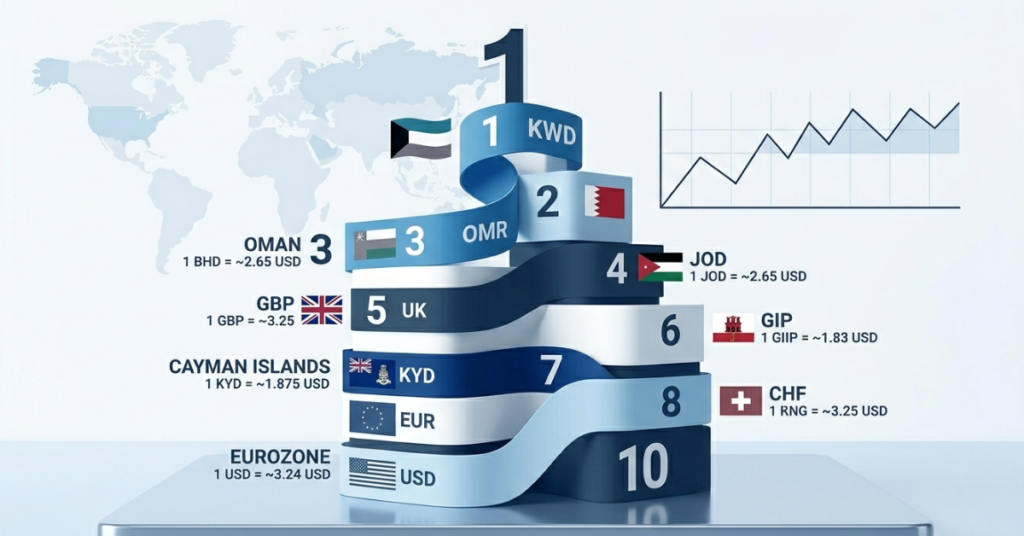
Here’s the current ranking of the highest-value currencies compared to the US Dollar (approximate rates):
| Rank | Currency | ISO Code | Country | Approx. Rate vs USD | Exchange System |
| 1 | Kuwaiti Dinar | KWD | Kuwait | ~3.25 USD | Pegged (basket) |
| 2 | Bahraini Dinar | BHD | Bahrain | ~2.65 USD | Pegged (USD) |
| 3 | Omani Rial | OMR | Oman | ~2.60 USD | Pegged (USD) |
| 4 | Jordanian Dinar | JOD | Jordan | ~1.41 USD | Pegged (USD) |
| 5 | British Pound Sterling | GBP | United Kingdom | ~1.34 USD | Free-floating |
| 6 | Gibraltar Pound | GIP | Gibraltar | ~1.34 USD | Pegged (GBP) |
| 7 | Swiss Franc | CHF | Switzerland | ~1.24 USD | Free-floating |
| 8 | Cayman Islands Dollar | KYD | Cayman Islands | ~1.20 USD | Pegged (USD) |
| 9 | Euro | EUR | Eurozone | ~1.14 USD | Free-floating |
| 10 | US Dollar | USD | United States | 1.00 USD | Free-floating (benchmark) |
Why Is the Kuwaiti Dinar So Valuable?
Kuwait is one of the world’s largest oil producers. Its oil sector accounts for roughly 90% of government revenue and around 40% of its GDP. With limited population, massive exports, and tight control over money supply, the KWD has historically maintained its high value.
Kuwait also doesn’t need to devalue its currency to boost exports, which is a common tactic used by manufacturing-heavy economies. Its wealth is resource-based, not export-competitive, so a strong currency is sustainable.
The Bahraini Dinar: Second Most Valuable Currency
Bahrain’s economy is also heavily oil-dependent. The Bahraini Dinar is pegged directly to the US Dollar at a fixed rate of 1 BHD = 2.659 USD. This peg has been maintained since 1987. Because Bahrain’s reserves and fiscal position support it, the peg holds firm.
Unlike Kuwait, Bahrain has diversified into financial services, making it a regional banking hub, which adds another layer of stability to the currency.
The Omani Rial: Third Highest Currency
Oman’s rial is also pegged to the USD at a rate of 1 OMR = 2.6008 USD. This peg was set in the 1970s during the oil boom and has remained stable. Oman’s economy is smaller than Kuwait and Saudi Arabia, but its monetary policy has kept the rial strong.
British Pound: The Highest Freely-Floating Currency
Among currencies that float freely on the open market (not pegged to anything), the British Pound Sterling (GBP) ranks highest. The GBP is one of the oldest and most traded currencies in the world. Its high value reflects the UK’s historically important role in global trade and finance, not just today’s economic size.
The GBP/USD pair, also called ‘Cable,’ is one of the most actively traded pairs in forex. Its volatility during UK economic announcements, Bank of England decisions, and political events makes it popular with active traders.
If you’re looking to trade Cable, here’s how to understand what is a forex pip to measure your profit and loss accurately.
The Swiss Franc: Safe Haven Currency with High Value
The Swiss Franc (CHF) sits just below the Euro in value and is considered one of the safest currencies in the world. In times of global uncertainty, investors flock to the CHF, pushing its value up. Switzerland’s political neutrality, strong banking sector, and low inflation policy all contribute to the franc’s strength.
Most Valuable Currency vs. Strongest Economy: Not the Same Thing
A common misconception is that the country with the largest economy should have the highest-valued currency. That’s not how it works. The United States has the world’s largest GDP, but the USD is used as a benchmark (1.00), with many currencies valued above it.
| Economy | GDP Rank | Currency | Exchange Rate vs USD |
| United States | 1 | USD | 1.00 |
| China | 2 | CNY | ~0.14 |
| Germany | 3 | EUR | ~1.14 |
| Japan | 4 | JPY | ~0.0065 |
| India | 5 | INR | ~0.012 |
| Kuwait | N/A (small economy) | KWD | ~3.25 |
As you can see, Japan and India, which are among the world’s largest economies, have currencies that are worth fractions of a dollar. Their currencies were structured differently, or were devalued and never redenominated.
Does a High Exchange Rate Mean a Good Currency for Trading?
Not necessarily. In forex, what matters most is liquidity, volatility, and the spread, not the face value of the currency. Here’s a quick comparison:
| Currency | Exchange Rate vs USD | Tradable in Forex? | Daily Volume |
| KWD (Kuwaiti Dinar) | ~3.25 | Limited | Very Low |
| BHD (Bahraini Dinar) | ~2.65 | Limited | Very Low |
| GBP (British Pound) | ~1.34 | Yes – highly liquid | Very High |
| CHF (Swiss Franc) | ~1.24 | Yes – widely traded | High |
| EUR (Euro) | ~1.14 | Yes – most traded | Very High |
| USD (US Dollar) | 1.00 | Yes – benchmark | Extremely High |
The Kuwaiti Dinar may be ‘the most valuable,’ but for active forex trading, the Euro, US Dollar, and British Pound offer far better liquidity and tighter spreads.
Want to understand spreads better before trading? Read our guide on what is a spread in forex.
Open a Live Trading AccountKey Exchange Rate Statistics
| Metric | Data |
| Most valuable currency (exchange rate) | Kuwaiti Dinar (KWD) ~3.25 USD |
| Highest freely-floating currency | British Pound (GBP) ~1.34 USD |
| Most traded currency globally | US Dollar (USD) – ~89.2% of all transactions (BIS, April 2025) |
| Daily forex market volume | Over $9.6 trillion per day (BIS Triennial Survey, April 2025) |
| Number of currencies pegged to USD | Approximately 65–70 countries |
| Currency with largest single-day move (modern history) | CHF – January 2015, +30% in minutes |
Trade Valuable Currencies with Defcofx
At Defcofx, you can trade GBP, EUR, CHF, and other major currencies against the USD and each other, all with zero commissions, spreads from 0.3 pips, and leverage up to 1:2000.
| Feature | Detail |
| Leverage | Up to 1:2000 |
| Spreads | From 0.3 pips |
| Commissions | Zero |
| Swap Fees | Zero |
| Welcome Bonus | 40% on first deposit (min. $1,000) |
| Withdrawal Speed | Within 4 business hours, including weekends |
| Platform | MetaTrader 5 (MT5) |
| Regulation | Registered in Saint Lucia |
| Account Types | Live & Demo accounts available |
Final Thoughts on Most Valuable Currency in the World by Exchange Rate
Exchange rate value alone does not determine a currency’s importance, stability, or usefulness in global markets. While the Kuwaiti Dinar remains the most valuable currency in the world by nominal exchange rate, its high value is largely the result of Kuwait’s oil wealth, controlled money supply, and currency management policies. For traders, however, liquidity, volatility, and market accessibility often matter far more than face value. Currencies like the US Dollar, Euro, British Pound, and Swiss Franc continue to dominate global forex trading because they offer deep liquidity and consistent trading opportunities.
Understanding the difference between a currency’s exchange rate value and its practical role in financial markets can help traders make more informed decisions. Whether you are trading major currency pairs or learning how exchange rates influence global economies, having access to competitive spreads, reliable execution, and advanced tools can make a significant difference. Defcofx provides traders with access to major forex markets through MT5, offering spreads from 0.3 pips, leverage up to 1:2000, zero commissions, and fast withdrawals to support a wide range of trading strategies.
FAQ
The Kuwaiti Dinar (KWD) is the most valuable currency in the world by exchange rate. One KWD is worth approximately 3.25 US Dollars.
Kuwait has vast oil reserves that generate enormous government revenue. The dinar’s supply is tightly controlled, and Kuwait pegs it to a basket of currencies rather than a single one, which provides additional stability.
No. High face value doesn’t mean a currency is better to trade. The Kuwaiti Dinar has low liquidity and limited availability in retail forex. Traders prefer the USD, EUR, GBP, and JPY because of their high volume and tight spreads.
The British Pound Sterling (GBP) is the highest-valued major currency that floats freely on the open market. The currencies ranked above it (KWD, BHD, OMR) are pegged to the USD or a basket of currencies.
In nominal exchange rate terms, yes. The Euro generally trades above 1.00 USD (e.g., 1 EUR = ~1.14 USD). However, exchange rate comparisons don’t reflect economic strength directly.
As of mid-2026, the Iranian Rial (IRR) is among the least valuable currencies in the world, with roughly 1.7 million IRR needed to buy 1 USD on the open market (the state-set official rate is considerably lower). This reflects decades of economic sanctions and high inflation.