



The best forex pairs for intraday trading are EUR/USD, GBP/USD, USD/JPY, and EUR/JPY. They offer the tightest spreads, the deepest liquidity, and reliable intraday volatility during the London and New York sessions, which lets day traders enter and exit cleanly within a single day.
Key Takeaways
- Intraday trading opens and closes positions within the same day, so tight spreads and high liquidity matter more than anything else. Learn what a spread is in forex.
- The major pairs win because their costs are low. Compare them against the full forex currency pairs list and the 7 major currency pairs.
- Volatility is session-driven. The London to New York overlap is the busiest window of the day, so timing matters as much as pair choice.
- Because you trade often, small cost differences compound. Read the average spread in forex and why every pip counts.
- Solid forex risk management and the right technical indicators for day trading keep an intraday strategy consistent.
What Makes a Forex Pair Good for Intraday Trading
Intraday trading is the opposite of holding for weeks. You take many trades inside a single day and close them all before you stop. That changes the priorities completely. Where a swing trader cares about trend persistence, a day trader cares about cost and timing, because frequent trading magnifies the impact of every spread you pay.
Three traits define a strong intraday pair:
Tight spreads: You cross the spread on every trade. Trade twenty times a day and a wide spread quietly drains the account before the market even moves.
Deep liquidity: High liquidity means fast fills and minimal slippage, which is essential when you enter and exit quickly.
Reliable intraday volatility: There has to be enough movement within the day to hit a target. Pairs that wake up during the major sessions give you that.
Want to feel how tight spreads change intraday results? You can open a free demo account.
The Best Forex Pairs for Intraday Trading
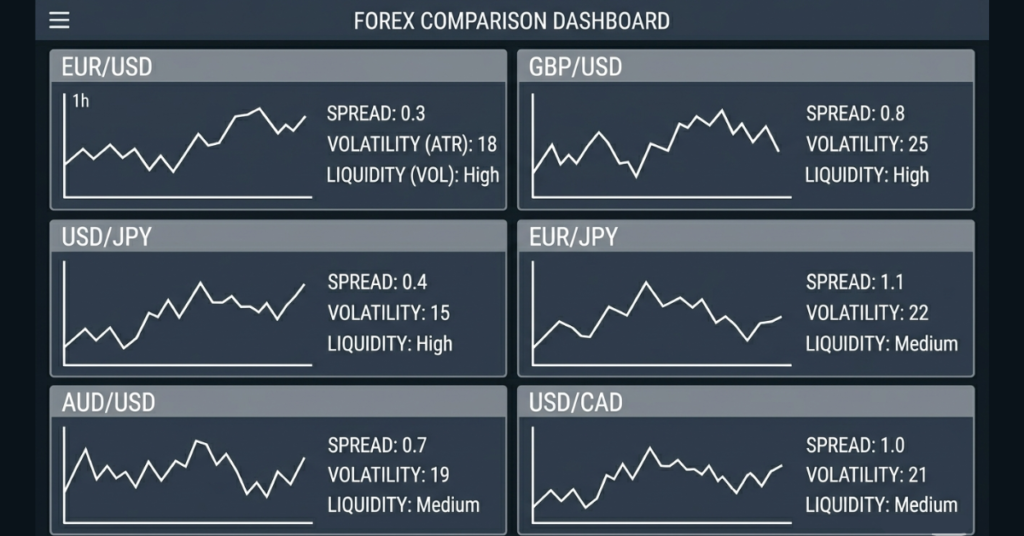
These are the pairs day traders return to most, with the trait that makes each one work intraday. Spreads shown are typical for tight-spread brokers and vary with conditions.
| Pair | Typical Spread | Why It Suits Intraday Trading |
| EUR/USD | From 0.3 pips | Lowest cost and deepest liquidity, the default intraday pair |
| GBP/USD | Low | More intraday range than EUR/USD while staying highly liquid |
| USD/JPY | Low | Smooth, liquid moves that respond well to US session flows |
| EUR/JPY | Low to moderate | Strong intraday range during the London and Tokyo overlap |
| AUD/USD | Low | Active in the Asian and early London hours, good for breakouts |
| USD/CAD | Low | Sharp intraday moves around oil and US or Canadian data |
EUR/USD: the intraday workhorse
EUR/USD is the most traded pair on earth, and for intraday trading that is exactly the point. Its spread is the tightest available, its liquidity is unmatched, and it moves enough during the London and New York sessions to offer steady setups. Lower cost per trade means a day trader keeps more of every winning move, which is why most intraday strategies are built and tested on EUR/USD first.
GBP/USD and EUR/JPY: range when you need it
When EUR/USD is too calm, these two add movement. GBP/USD carries more intraday range while staying liquid, which suits breakout and momentum traders. EUR/JPY comes alive when the Tokyo and London sessions overlap, giving Asian-hours and early-European day traders a pair with real range. Both reward a clear plan and one of the best technical indicators for day trading.
USD/JPY, AUD/USD, and USD/CAD: session specialists
These pairs shine at specific times. USD/JPY tracks the US session and US data closely. AUD/USD is most active in Asian and early London hours, making it a favorite for traders in those time zones. USD/CAD reacts sharply to oil and North American data. Knowing which pairs move 100 pips a day helps you pick the right one for the hours you actually trade.
Timing Matters as Much as the Pair
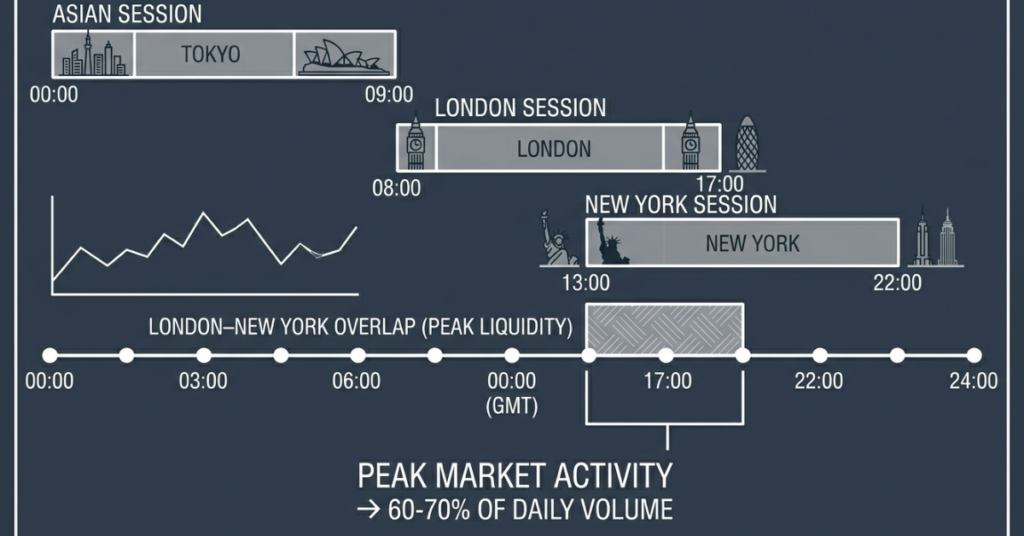
Pair choice is only half the equation. The same pair can be dead at one hour and fast at another, because forex volatility follows the trading sessions. For intraday trading, when you trade decides whether a pair is worth trading at all.
The single best window for most day traders is the London and New York overlap, when both of the largest financial centers are open at once. Liquidity peaks, spreads stay tight, and the major pairs produce their cleanest intraday moves. EUR/USD, GBP/USD, and USD/JPY are at their most tradable during this overlap.
| Session Window | Most Active Pairs | Intraday Character |
| London open | GBP/USD, EUR/USD, EUR/JPY | Strong early momentum and breakouts |
| London / New York overlap | EUR/USD, GBP/USD, USD/JPY | Peak liquidity, the best intraday window |
| New York session | USD/JPY, USD/CAD, EUR/USD | US data drives sharp directional moves |
| Asian session | AUD/USD, USD/JPY, NZD/USD | Quieter, range-bound, good for patient setups |
How to Approach Intraday Setups on These Pairs
Intraday trading rewards a tight, repeatable routine more than any clever prediction. The pieces are simple:
- Trade the active hours. Focus on the London and New York overlap, when your chosen pairs actually move.
- Keep costs low. Stay on tight-spread majors so frequent trading does not bleed your account through fees.
- Use intraday indicators. Combine price action with the best technical indicators for day trading to time entries.
- Define risk before you enter. Set a stop on every trade and apply consistent forex risk management.
- Close before you stop. Intraday means flat by end of day, so you carry no overnight risk and pay no rollover.
Why Trade Intraday With Defcofx
Intraday trading lives or dies on cost and execution. Defcofx is built on MetaTrader 5 with conditions that suit a high-frequency, same-day style:
| Feature | What Defcofx Offers |
| Spreads | From 0.3 pips, the cost that matters most for day traders |
| Commissions | None, so frequent trading carries no per-trade fee |
| Execution | Fast fills on MetaTrader 5 to reduce slippage |
| Leverage | Up to 1:2000 for flexible intraday sizing |
| Welcome bonus | 40% on first deposits of $1,000 or more |
| Withdrawals | Processed within 4 business hours, including weekends |
Forex Market Statistics Worth Knowing
Intraday trading depends on liquidity, and the forex market has more of it than any other. Figures from the 2025 BIS Triennial Central Bank Survey show why the major pairs stay tight and tradable all day:
- Global forex turnover hit about $9.6 trillion per day in April 2025, the highest on record and roughly 28% above 2022.
- The US dollar is on one side of close to 90% of all trades, which is why USD pairs offer the tightest intraday spreads.
- The euro, yen, and pound are the next most traded currencies, matching the pairs day traders use most.
- About three quarters of trading flows through London, New York, Singapore, and Hong Kong, and the London to New York overlap is where intraday liquidity peaks.
Final Thoughts on Best Forex Pairs for Intraday Trading
Intraday trading is not about finding the most volatile currency pair it is about finding the right balance between liquidity, spread cost, and intraday movement. That is why pairs such as EUR/USD, GBP/USD, USD/JPY, and EUR/JPY remain the preferred choices for active traders. They provide enough daily volatility to create trading opportunities while maintaining the tight spreads and deep liquidity needed for frequent entries and exits.
Success in intraday forex trading comes from matching the right pair with the right trading session. EUR/USD and GBP/USD tend to perform best during the London–New York overlap, while USD/JPY and AUD/USD can offer better opportunities during Asian trading hours. By focusing on a small group of highly liquid pairs, applying consistent risk management, and trading only during active market periods, traders can avoid unnecessary costs and improve the quality of their setups.
FAQ
EUR/USD is the top choice for most intraday traders. It has the tightest spreads and the deepest liquidity, so your cost per trade is the lowest available and fills are fast. It is the pair most day-trading strategies are built and tested on.
EUR/USD, GBP/USD, and USD/JPY are most active during the London and New York sessions, especially the overlap between them. AUD/USD and USD/JPY are the better choices during Asian hours. Activity follows the sessions, so the best time to trade forex depends on your pair.
Exotic pairs have wide spreads and thinner liquidity, which means higher cost and more slippage on every trade. For a style that trades often, that cost compounds fast. The average spread in forex on majors is far lower, which is why intraday traders stay with them.
Very important. The spread is paid on every trade, so for someone taking many trades a day it is often the single largest controllable cost. Choosing tight-spread majors and a low-spread broker directly improves intraday profitability.
For most day traders, yes. During the overlap both major financial centers are open, liquidity peaks, spreads stay tight, and the major pairs produce their cleanest moves. It is the window where pair choice and timing line up best.
You can, but choose pairs that suit it. AUD/USD, NZD/USD, and USD/JPY are more active in Asian hours, while EUR/USD and GBP/USD tend to be quieter. Matching the pair to the session is the key to making Asian-hours intraday trading work.
No. Swap fees apply to positions held overnight, and intraday trades are closed before the day ends, so they avoid rollover entirely. With Defcofx there are no swap fees regardless, but the intraday style sidesteps the issue by design.