


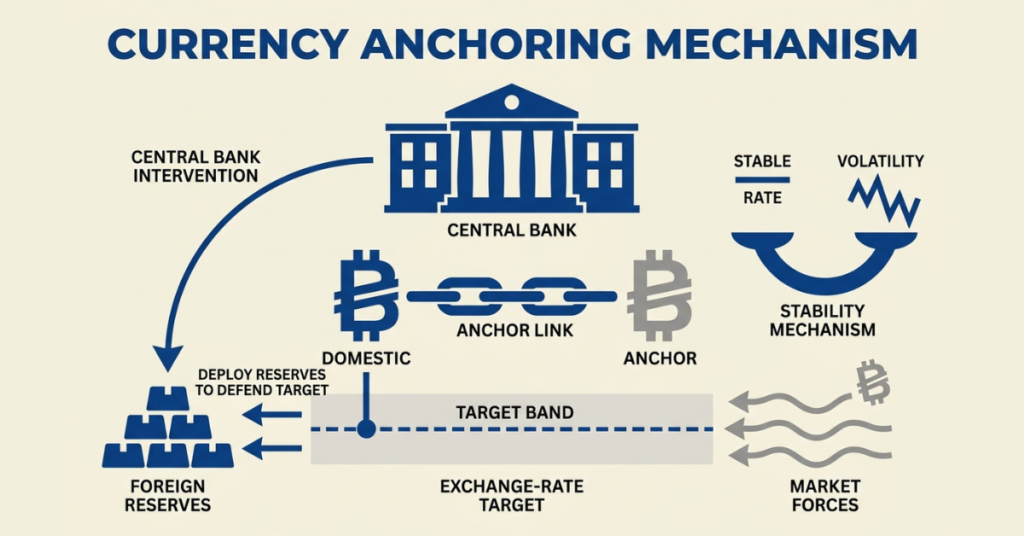
A fixed exchange rate system is an arrangement in which a country sets or maintains its currency’s value against another currency, a basket of currencies, or historically gold. The central bank uses foreign-exchange intervention and other policy tools to maintain the target rate or permitted range. The central bank buys and sells currency to hold the rate steady rather than letting the market set it freely.
Key Takeaways
- A fixed exchange rate system pegs a currency to an anchor and holds it in a tight band.
- The central bank defends the rate by buying or selling currency using its foreign reserves.
- Common anchors are a single strong currency, a basket of currencies, or historically gold.
- It differs from a floating system, where the value of a currency is determined by open-market supply and demand.
- Well-known pegs today include the Hong Kong dollar and several Gulf currencies tied to the US dollar.
Breaking Down the Definition
A fixed exchange rate system depends on three main components.
- First, a target or official exchange rate established by the monetary authorities.
- Second, an anchor, the thing the currency is pegged to.
- Third, a defense mechanism, the reserves and policy tools the central bank uses to hold the line.
All three are needed for the central bank to maintain the peg over time.
How a Fixed Exchange Rate System Works, Step by Step
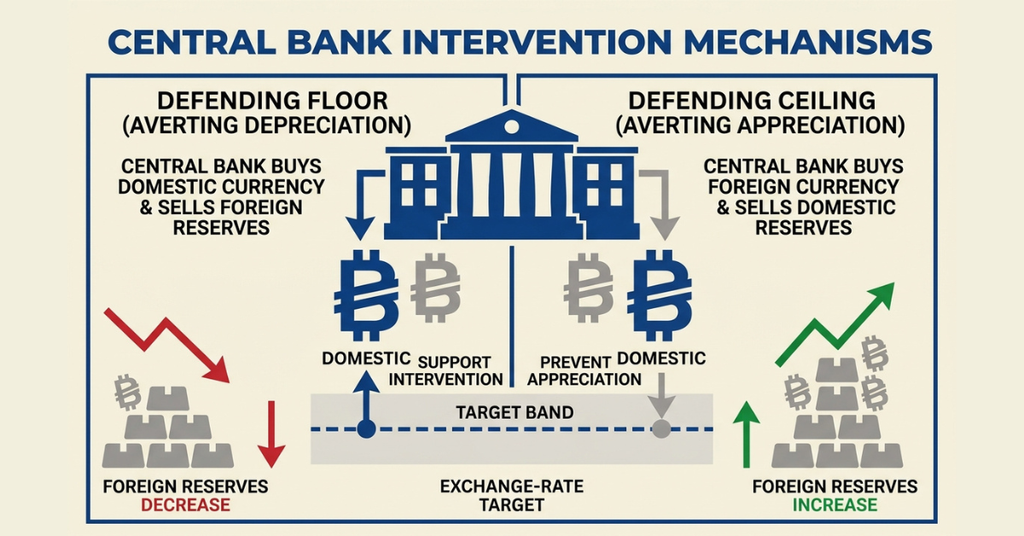
A fixed exchange rate generally works through the following steps.
- Set the official rate. The government picks a target, for example 7.8 units per US dollar.
- Choose the band. It allows a small range around the target where the rate can move freely.
- Monitor the exchange rate. The central bank monitors market conditions, currency demand, and the exchange rate relative to the target.
- Intervene when needed. If the currency weakens toward the edge of the band, the central bank can sell foreign currency and buy its own currency to support the exchange rate. If it strengthens too far, it does the reverse.
- Align interest rates. The bank keeps its policy rate close to the anchor country’s rate so capital does not rush in or out and strain the peg.
- Hold reserves ready. Adequate foreign-exchange reserves give the central bank the capacity to intervene when the currency approaches the limits of its permitted range.
The Main Types of Fixed Exchange Rate Systems
Fixed exchange rate arrangements differ in both their anchor and the degree of flexibility allowed.
| Type | How It Works | Example |
| Single-currency peg | Fixed to one strong currency, usually the US dollar | Hong Kong dollar, Gulf currencies |
| Basket peg | Fixed to a weighted group of currencies | Some Asian and Gulf states |
| Currency board | Rigid peg fully backed by reserves, little discretion | Hong Kong’s arrangement |
| Gold standard | Currency backed by and convertible to gold | Historical, pre-1971 |
| Adjustable peg | Fixed but reset from time to time | Bretton Woods era |
Real-World Examples
The Hong Kong dollar has been held near 7.8 per US dollar for decades through a currency board. Several Gulf oil exporters peg to the dollar because they price oil in dollars, so a stable rate keeps their main export revenue predictable. Historically, the Bretton Woods system after World War II fixed major currencies to the dollar, which was in turn convertible to gold, until that link ended in 1971.
Open a Demo Trading AccountDollarization is different from a currency peg because the country uses the US dollar as its currency rather than maintaining a separate currency at a fixed exchange rate. See our guide to countries that use the US dollar.
Fixed Versus Floating Systems
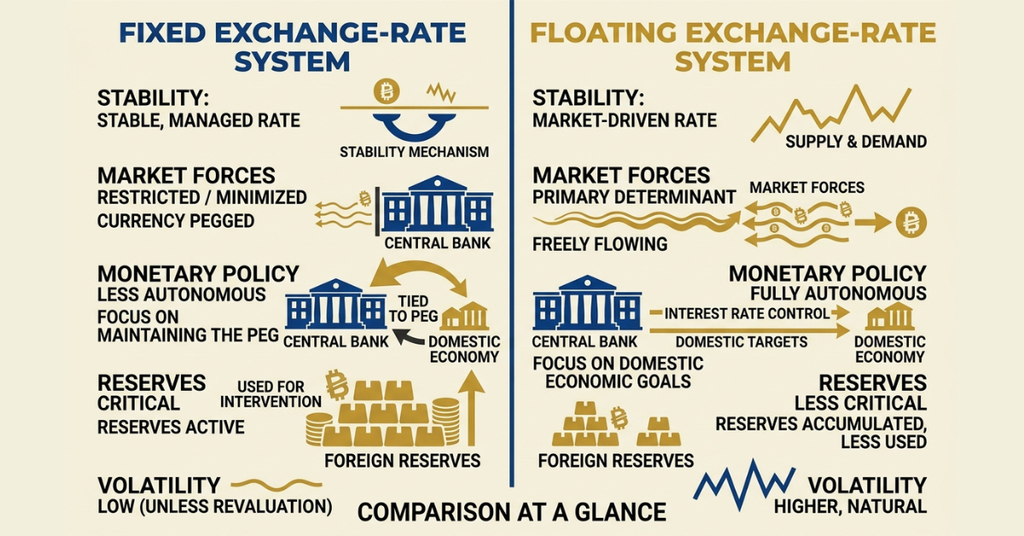
A comparison with a floating exchange rate shows the main differences between the two systems.
| Feature | Fixed System | Floating System |
| Who sets the rate | Government and central bank | Open-market supply and demand |
| Day-to-day volatility | Very low inside the band | Can be high |
| Policy freedom | Limited, tied to the anchor | Full control retained |
| Reserves needed | Large | Small by comparison |
| Main risk | Sudden break if defense fails | Ongoing price swings |
For traders, the difference is visible in exchange-rate behavior. A tightly managed currency pair may remain within a narrow range for extended periods, while floating currency pairs can experience larger day-to-day movements.
Learning to read both starts with reading currency exchange charts.
Why Trade With Defcofx
Defcofx gives traders access to forex, commodities, indices, stocks, and cryptocurrencies on the MetaTrader 5 platform, with trading conditions built for both new and experienced traders.
| Feature | What You Get |
| Spreads | From 0.5 pips, with zero commissions and zero swap fees |
| Leverage | Up to 1:2000 for greater flexibility on margin |
| Welcome bonus | 40% on first deposits of $1,000 or more |
| Withdrawals | Processed within 3 hours, including weekends |
| Platform | MetaTrader 5 with fast execution and full charting |
| Global access | Clients welcome from all countries, multiple languages |
Fixed Exchange Rate System at a Glance
| Key point | Explanation |
|---|---|
| Rate | Set or targeted by the government or central bank |
| Trading band | The permitted range around the target rate |
| Reserves | Used to intervene in the foreign-exchange market |
| Currency board | A more rigid form of a currency peg |
| Common anchor | The US dollar is widely used |
| Floating system | The exchange rate is primarily determined by market forces |
FAQ
A fixed exchange rate system links a country’s currency to an anchor, such as the US dollar. The central bank then uses foreign-exchange intervention and other policies to maintain the target rate.
It buys or sells currency in the market. If its currency weakens toward the band’s edge, it sells reserves to buy it back. If the currency becomes too strong, the central bank can instead buy foreign currency and sell its own currency.
A basic peg leaves the central bank some discretion. A currency board is stricter, backing every unit of local currency with reserves and following rigid rules with almost no discretion.
Usually a single strong currency, a basket of several currencies, or historically gold. The US dollar is the most common anchor today.
Hong Kong runs a well-known dollar peg through a currency board, and several Gulf oil exporters peg to the dollar. Many small, trade-heavy economies use some form of peg.
Yes. Fixed or tightly managed exchange rates are still used by several economies, particularly smaller economies and countries that maintain a close link to a major currency.
If the central bank runs out of reserves to defend the rate, the peg breaks and the currency can move sharply to a new level, often losing significant value quickly.