


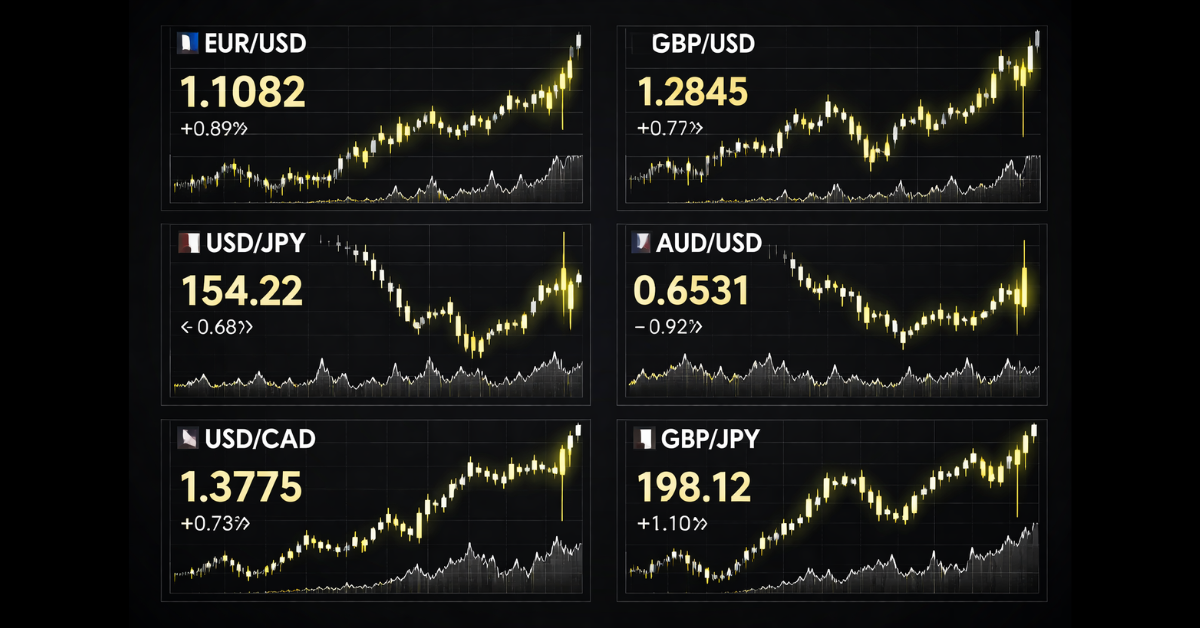
The euro, pound sterling, Japanese yen, US dollar, and Australian dollar rank among the most frequently exchanged currencies in the foreign exchange market. Each reacts uniquely to fluctuations in interest rates, inflation, employment statistics, economic expansion, and central bank regulations. Comprehending these essential factors enables traders to elucidate the reasons behind currency fluctuations and to make more astute trading choices.
Key Takeaways
- Fundamental analysis focuses on the economic factors that influence currency values.
- Interest rate decisions are one of the biggest drivers of forex markets.
- Each major currency responds differently to economic and geopolitical events.
- Combining fundamental and technical analysis often produces better trading decisions.
- Checking the economic calendar before trading can help you prepare for major market-moving events.
What Is Fundamental Analysis in Forex?
Fundamental analysis is the study of economic, financial and political factors which affect currency prices. Instead of studying chart patterns or technical indicators, traders look at the strength of an economy and the policies of its central bank to understand why a currency may rise or fall.
For example, if a country’s economy is growing steadily, inflation remains under control, and interest rates are increasing, its currency often becomes more attractive to investors. Conversely, weak economic growth or political uncertainty can reduce demand for a currency.
Professional traders often combine fundamental analysis with technical analysis to identify both the reason behind a market move and the best time to enter or exit a trade.
The U.S. Dollar (USD)
The U.S. dollar is the world’s primary reserve currency and is appears on one side of nearly 90% of global forex trades because of its global importance; economic developments in the United States often influence the entire forex market.
The U.S. dollar is mainly influenced by :
- Federal Reserve interest rate decisions
- Inflation reports (CPI and PCE)
- Non-Farm Payroll (NFP) data
- GDP growth
- Retail sales
- Consumer confidence
- Treasury yields
The United States dollar also serves as a safe haven currency. During times of global uncertainty, investors frequently shift capital into USD-denominated assets, boosting demand for the currency.
The Euro (EUR)
The euro is the official currency of the eurozone and the second most traded currency in the world. Economic conditions across multiple European countries, rather than a single nation, heavily influence the Euro.
Traders typically monitor:
- European Central Bank (ECB) interest rate decisions
- Eurozone inflation
- Manufacturing and Services PMI reports
- GDP growth
- Employment figures
- Political stability within the European Union
Because the Euro represents multiple economies, traders often monitor economic data from Germany and France, as these countries contribute significantly to the Eurozone’s overall performance.
The British Pound (GBP)
The British Pound is known for its relatively high volatility compared to many other major currencies.
The British pound reacts strongly to:
- Bank of England (BoE) interest rate decisions
- UK inflation data
- Employment reports
- GDP growth
- Retail sales
- Political developments
Since Brexit, political announcements and trade negotiations have also become important drivers of GBP price movements.
The Pound often experiences larger intraday swings than the Euro, making it attractive to active traders while also requiring careful risk management.
The Japanese Yen (JPY)
The Japanese yen is one of the world’s best-known safe-haven currencies in the world during times of market uncertainty.
The Yen, unlike most currencies, tends to rise during periods of risk aversion and decline when confidence returns to global financial markets.
The Japanese yen is sensitive to:
- Bank of Japan (BoJ) monetary policy
- Interest rate expectations
- Inflation data
- Japanese export performance
- Global stock market sentiment
- U.S. Treasury yields
Because Japan has maintained relatively low interest rates for many years, changes in BoJ policy often attract significant attention from forex traders.
The Australian Dollar (AUD)
The Australian dollar is often called a commodity currency, given the heavy reliance of the Australian economy on the exports of natural resources.
Key drivers of the Australian Dollar include:
- Reserve Bank of Australia (RBA) interest rate decisions
- Employment reports
- Inflation data
- Commodity prices
- Chinese economic growth
- Global risk sentiment
China is Australia’s largest trading partner, meaning Chinese economic data can significantly influence the Australian dollar. Strong Chinese manufacturing or industrial production figures often support AUD, while weaker data may put downward pressure on the currency.
USD vs EUR vs GBP vs JPY vs AUD: Key Differences
Although all 5 currencies respond to economic data, each has unique characteristics and tends to react differently to market events.
| Currency | Primary Drivers | Market Characteristic |
| USD | Federal Reserve, NFP, Inflation | Global reserve currency |
| EUR | ECB policy, Eurozone economy | Multi-country economy |
| GBP | Bank of England, UK economy | Higher volatility |
| JPY | Safe-haven demand, BoJ policy | Risk-off currency |
| AUD | Commodities, China, RBA | Commodity currency |
Understanding these differences helps traders anticipate which currencies may react most strongly to upcoming economic events.
Why Forex Traders Watch Interest Rate Decisions
Interest rates are one of the most powerful forces in the forex market because they influence where global investors choose to allocate capital.
When a central bank raises interest rates, investments denominated in that currency often become more attractive because they may offer higher returns. Increased demand for those assets can strengthen the currency.
On the other hand, lower interest rates may encourage investors to seek better returns elsewhere, potentially weakening the currency.
This is why traders closely monitor meetings held by the Federal Reserve, European Central Bank, Bank of England, Bank of Japan, and Reserve Bank of Australia throughout the year.
Why You Should Check the Economic Calendar Before Trading
Economic calendars list upcoming financial events that have the potential to move the forex market.
Some of the most closely watched releases include:
- Interest rate decisions
- Inflation reports
- Employment data
- GDP reports
- Manufacturing PMI
- Retail sales
- Consumer confidence
Checking the economic calendar before placing trades helps traders prepare for periods of increased volatility and avoid unexpected market movements.
Many experienced traders avoid opening new positions just before high-impact economic releases because volatility can increase significantly.
Why Successful Forex Traders Combine Both Analysis Methods
Successful forex trading rarely relies on one type of analysis alone.
For example, if the Reserve Bank of Australia unexpectedly raises interest rates while technical analysis shows AUD/USD breaking above a major resistance level, the combination of strong fundamentals and bullish technical confirmation may provide greater confidence than either signal alone.
Likewise, if weak Eurozone economic data coincides with EUR/USD breaking below long-term support, traders may have additional confidence in a bearish outlook.
Combining both approaches often helps traders understand not only where price may move but also why.
Which Currency Pairs Should Beginners Focus On?
If you’re new to forex trading, it’s generally best to start with major currency pairs such as EUR/USD, GBP/USD, USD/JPY, and AUD/USD. These pairs are among the most actively traded in the market, which means they typically offer high liquidity, tighter spreads, and smoother trade execution than many minor or exotic pairs. They are also widely covered by analysts and financial news, making it easier to follow market developments and learn how economic events affect price movements.
Among these, EUR/USD is often considered the most beginner-friendly because of its deep liquidity, relatively stable price movements, and extensive educational resources. Rather than monitoring many markets at once, new traders may benefit from focusing on one or two major pairs until they develop a consistent trading strategy and risk management plan.
Trade EUR, USD, GBP, JPY, and AUD with Defcofx
Knowing the basic drivers behind the EUR, GBP, JPY, USD, and AUD can help traders make better-informed decisions, but reliable execution is equally important.
Defcofx gives traders access to major forex pairs through MetaTrader 5, with spreads starting from 0.3 pips, commission-free trading, leverage of up to 1:2000, and withdrawals processed within four business hours. Combined with advanced charting tools and real-time market access, traders can respond more effectively to changing economic conditions.
Open a Live Trading Account
Common Mistakes Traders Make
Many beginners rely only on technical charts while ignoring the economic events that drive currency prices. As a result, they may be caught off guard when high-impact news causes sudden market volatility.
Another common mistake is assuming that positive economic news will always strengthen a currency. In reality, the forex market reacts to expectations, not just the headline data. If strong economic results have already been priced into the market, the currency may move very little or even decline after the announcement.
Some traders also focus on the economic performance of only one country. Because forex currencies are traded in pairs, it’s important to compare the economic outlook, interest rate expectations, and central bank policies of both economies before making a trading decision.
Finally, many traders overlook the economic calendar and enter trades just before major announcements such as interest rate decisions or Non-Farm Payrolls (NFP). These events can trigger sharp price swings, making it more difficult to manage risk if you’re unprepared.
Frequently Asked Questions
What are the main fundamental factors in forex trading?
The most important factors include interest rates, inflation, GDP growth, employment data, central bank decisions, political events, and overall market sentiment.
Why is the U.S. Dollar so important in forex?
The U.S. Dollar is the world’s primary reserve currency and is involved in most global forex transactions, making it one of the most influential currencies in the market.
Why is the Australian Dollar linked to commodity prices?
Australia is a major exporter of natural resources such as iron ore and coal, so changes in commodity demand and prices often affect the value of the Australian Dollar.
Why is the Japanese Yen considered a safe-haven currency?
Investors often buy the Japanese Yen during periods of economic uncertainty because it has historically been viewed as a relatively stable currency.
Which economic reports move the forex market the most?
Interest rate decisions, inflation reports, employment data, GDP releases, and central bank speeches are among the most influential market-moving events.
Should I use both technical and fundamental analysis?
Yes. Many professional traders combine both approaches to understand market direction, identify trading opportunities, and improve overall decision-making.
What is the difference between fundamental and technical analysis in forex?
Fundamental analysis explains why a currency may move by examining economic and political factors, while technical analysis focuses on price charts and indicators to identify potential trading opportunities.
Which currency pair reacts the most to economic news?
Major pairs such as EUR/USD, GBP/USD, and USD/JPY often experience the strongest price movements during major economic releases, especially interest rate decisions and U.S. Non-Farm Payroll (NFP) reports.
Why do central bank speeches move the forex market?
Markets often respond to comments about future monetary policy because traders adjust their expectations before interest rate changes occur.
Final Thoughts
Understanding what drives the EUR, GBP, JPY, USD, and AUD gives traders a stronger foundation for analyzing the forex market. By following economic indicators, monitoring central bank decisions, and combining fundamental insights with technical analysis, traders can make more informed decisions and better prepare for changing market conditions. While no strategy guarantees success, understanding the reasons behind currency movements can help improve consistency over time.