


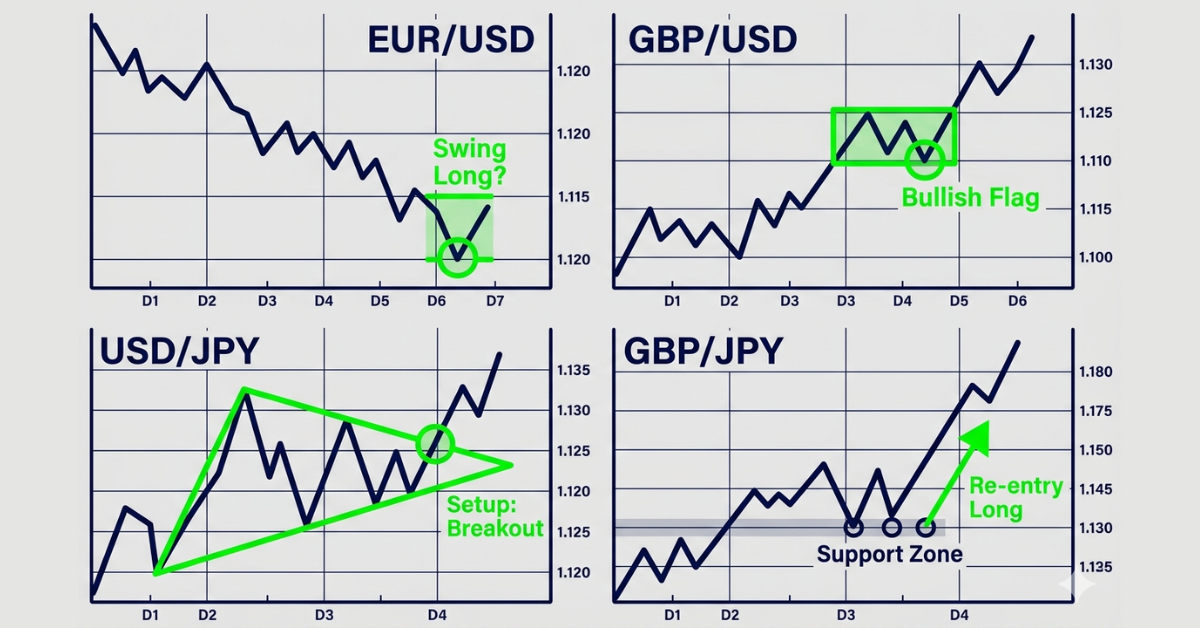
Yes, it is possible to build wealth through swing trading, but it is difficult and definitely not guaranteed. Swing trading can make money when a trader has a strategy that works over time, controls risk, and stays consistent. But it can also lose money, especially when someone trades too aggressively or expects to get rich quickly.
So, can swing trading make you rich? Possibly. But thinking of it as a fast-money shortcut is where things usually start going wrong.
Key Takeaways
- It is possible to make money from swing trading.
- Becoming wealthy from it is much harder.
- There is no guaranteed swing trading income.
- Starting capital makes a big difference.
- Compounding can help an account grow over time.
- Risk management is extremely important.
- You don’t need to win every trade to potentially be profitable.
- Trying to get rich quickly usually means taking much bigger risks.
- Consistency matters more than one huge winning trade.
What Is Swing Trading?
Swing trading is a style where you normally hold a trade for several days or sometimes a few weeks.
You’re trying to catch a larger market move rather than tiny movements throughout the day.
Imagine EUR/USD is moving upward. It drops slightly for a few days. You think the larger upward trend is still strong, so you buy during the pullback. You then hold the trade for a week while the price moves higher. That’s a basic swing trade.
Swing traders can trade forex, stocks, commodities, indices, and other financial markets.
With Defcofx, you can trade forex, metals, indices, stocks, and crypto CFDs through MT5. Review the available markets, trading conditions, and risk factors before deciding whether swing trading fits your strategy.
Open a Live Trading AccountCan Swing Trading Actually Make Money?
Yes. That’s the simple answer. But making money from some swing trades and becoming wealthy from swing trading are two very different things.
Imagine you start with $1,000. You make 5%. That’s $50. Great. But that doesn’t make you wealthy.
Now imagine someone has $100,000 and makes the same 5%. That’s $5,000. Same percentage. Very different amount of money.
This is why starting capital matters so much.
Your Starting Account Makes a Huge Difference
This part is sometimes ignored when people talk about trading profits online.
Let’s say two traders both make 10% over a certain period.
- Trader A starts with $1,000.
- Trader B starts with $100,000.
Their results would look like this:
| Starting Balance | 10% Return | New Balance |
| $1,000 | $100 | $1,100 |
| $5,000 | $500 | $5,500 |
| $10,000 | $1,000 | $11,000 |
| $50,000 | $5,000 | $55,000 |
| $100,000 | $10,000 | $110,000 |
The skill level could be exactly the same.
The dollar profit isn’t. That’s important when you see someone online saying, “I made $10,000 trading this month.”
The first question should be, “How much money were they trading with?”
Making $10,000 from a $1 million account is entirely different from making $10,000 from a $5,000 account.
Can You Turn $1,000 Into $1 Million?
Mathematically?
Sure.
Realistically?
That’s much harder.
Turning $1,000 into $1 million means multiplying the account by 1,000 times.
That usually requires either an extremely long period of successful compounding or extremely high returns.
And chasing giant returns usually means taking huge risks.
That’s where accounts can disappear rapidly.
A beginner might think:
“If I risk 50% of my account, I can double my money faster.”
True.
But you can also lose half your account from one disastrous trade.
Do that a couple of times, and your journey to $1 million becomes a journey toward $0.
How Does Compounding Work?
Compounding is one reason people are attracted to trading and investing. It basically means earning returns on previous returns.
Here’s a basic example.
- You start with $10,000.
- You make 10%.
- Now you have $11,000.
If you make another 10%, you’re not making 10% on the original $10,000 anymore.
You’re making it on $11,000.
That would be $1,100.
Now you have $12,100.
Your account can gradually become larger because your profits are being added to the amount producing future returns.
That’s compounding.
What Could Compounding Look Like?
Let’s use a completely hypothetical example.
Imagine a trader somehow manages to average 10% per year and reinvests everything.
| Year | Approximate Balance |
| Starting Amount | $10,000 |
| Year 1 | $11,000 |
| Year 2 | $12,100 |
| Year 3 | $13,310 |
| Year 5 | $16,105 |
| Year 10 | $25,937 |
The growth becomes more noticeable over time. But this table is just math.
It doesn’t mean a swing trader will actually earn 10% every year. Real trading doesn’t move in a perfectly straight line.
You might have a great year. Then a bad year. Then an average year. You could also lose money.
Explanation: Compounding can help money grow faster over time, but it only works in your favor if you’re actually producing positive returns. Losses compound too.
Why Risk Management Matters More Than Getting Rich
If you want to last in trading, protecting your money matters.
Think about it this way. You need money to trade. If you lose all your trading capital, the strategy doesn’t matter anymore. This is why experienced traders usually think about risk before profit.
Before entering a trade, ask:
- How much could I lose?
- Where is my stop-loss?
- How big should my position be?
- Does the possible reward justify the risk?
These questions aren’t exciting. But they’re incredibly important.
What Happens When You Lose 50%?
Here’s some simple math that every trader should understand.
Imagine you have $10,000.
You lose 50%.
Now you have:
$5,000.
How much do you need to make to get back to $10,000?
You might think 50%.
But no.
You need 100%.
Because:
50% of $5,000 = $2,500.
That only gets you to $7,500.
To turn $5,000 back into $10,000, you need to double it.
That’s why avoiding huge losses is so important.
| Account Loss | Return Needed to Recover |
| 10% | About 11% |
| 20% | 25% |
| 50% | 100% |
| 75% | 300% |
The bigger the loss, the harder recovery becomes.
Do You Need a High Win Rate?
Not necessarily.
Imagine a swing trader takes 10 trades.
- They win four.
- They lose six.
Sounds terrible, right?
Not if their winners are much bigger than their losers.
Imagine each losing trade costs $100.
6 losses = $600 lost.
Each winning trade makes $200.
4 wins = $800 gained.
So:
$800 − $600 = $200.
Before trading costs, they’re still ahead. That’s why traders care about risk-to-reward.
You don’t necessarily need to predict the market correctly 80% or 90% of the time. You need the combination of your wins and losses to work in your favor over many trades.
Can Swing Trading Become a Full-Time Income?
For some traders, yes. But this is where account size becomes very important again.
Imagine you need $5,000 every month to cover your life. That’s $60,000 per year.
If your trading account is only $5,000, trying to make $60,000 from it every year would mean chasing an enormous return.
You’d probably need to take extreme risks.
Now imagine your account is $500,000.
Making $60,000 would require a much smaller percentage return.
It’s still difficult and absolutely not guaranteed, but the math is very different.
This is why “Can I live from trading?” isn’t really a yes-or-no question.
You need to think about:
- Your account size.
- Your living costs.
- Your trading performance.
- Your risk.
- Your losing periods.
And how consistent your results actually are.
Swing Trading Isn’t a Salary
This aspect is extremely important.
A job might pay you AED 10,000 every month. You know roughly when that money is arriving. Trading doesn’t work like that.
One month you might make money. Another month you might make nothing. Another month you might lose money.
Even a profitable trader can have weeks or months where they lose money.
Expecting your swing trading account to produce an exact amount every month creates pressure. And pressure can lead to bad decisions.
You start forcing trades because you “need” to make $2,000 before the month ends. The market doesn’t care about your monthly target.
How Long Does It Take to Become Wealthy?
There’s no answer. Anyone telling you: “Use this strategy and you’ll be rich in six months” should immediately make you cautious.
Trading results aren’t predictable like that. The amount of time depends on your starting capital, returns, losses, additional money you add, withdrawals, trading costs, and risk.
And even then, there’s no guarantee you’ll become wealthy at all.
A better first goal is simply becoming consistent.
- Can you follow your strategy?
- Can you control losses?
- Can you avoid emotional trades?
- Can you produce positive results over a meaningful number of trades?
Those questions come before getting rich.
Don’t Judge Traders by Screenshots
Social media makes trading look incredibly easy.
Someone posts:
+$7,850 TODAY.
Nice green numbers.
Maybe a luxury car in the background.
What you don’t see is much more important.
- What’s their account size?
- How much did they risk?
- Did they lose $15,000 yesterday?
- Is the screenshot even real?
- What does their performance look like over three years?
One winning trade tells you almost nothing.
Can a Small Account Grow?
Yes, a small account can grow. But there’s a difference between growing an account and immediately living from it.
Imagine you start with $2,000.
Instead of thinking:
“How can I make $10,000 next month?”
You focus on:
- Following your strategy.
- Managing risk.
- Keeping records.
- Avoiding unnecessary trades.
- Learning from mistakes.
If your trading improves and your account grows, you can gradually build from there.
It sounds slower, because it is. But slow growth is very different from gambling on one giant trade.
Practice Swing Trading With Defcofx
Swing trading can give traders time to study larger market movements without needing to sit in front of a chart every minute.
Defcofx provides access to forex markets through MetaTrader 5, where traders can analyze multiple timeframes, use technical indicators, and manage trades with stop-loss and take-profit orders.
Open a Live Trading AccountFocus on Becoming Good Before Becoming Rich
This is probably the simplest way to look at it.
Don’t start with “How quickly can swing trading make me a millionaire?”
Start with: “Can I follow one strategy properly?”
Then: “Can I control my losses?”
Then: “Can I produce consistent results?”
Then: “Can I keep doing that over a longer period?”
Wealth, if it comes at all, would be the result of doing those things consistently while having enough capital and time.
Trying to skip straight to the millionaire part is usually where people start taking ridiculous risks.
Frequently Asked Questions
Can swing trading make you rich?
It is possible to build significant wealth through successful trading, but there is no guarantee. Results depend on capital, strategy, risk management, trading costs, and long-term consistency.
Can I make a living from swing trading?
Some traders do, but making a reliable living from trading requires sufficient capital and consistent performance. Trading income can also change significantly from month to month.
Can I start swing trading with $1,000?
You can learn and practice with a smaller account if your broker’s requirements allow it, but the dollar profits from a $1,000 account will normally be limited unless you take very high risks.
How much can swing traders make?
There is no fixed amount. Results vary widely depending on account size, strategy, market conditions, risk, experience, and trading costs.
Do swing traders make money every month?
No. Even traders who are profitable can have weeks or months where they lose money. Trading doesn’t provide a guaranteed monthly salary.
Is swing trading better than investing for getting rich?
Not necessarily. Swing trading requires more active decision-making and can involve greater trading risk. Long-term investing and swing trading are different approaches, and neither guarantees wealth.
Is swing trading gambling?
Swing trading based on a tested strategy and controlled risk is different from randomly betting on price movements. However, trading without a plan, using excessive leverage, or risking large amounts for quick profits can closely resemble gambling.
Final Thoughts
So, can you become wealthy from swing trading? Yes, it is possible, but there is absolutely no guarantee.
Swing trading can produce profits when a trader has a tested strategy, manages risk, stays consistent, and has enough capital. Compounding can also help an account grow over a long period.
But swing trading isn’t a quick way to get rich.
Small accounts produce small dollar profits unless you take very high risks, and high risks can destroy an account just as quickly as they can grow it.
Instead of focusing on getting rich quickly, focus on learning how to trade properly, protecting your capital, and becoming consistent.
That’s a much better starting point.