


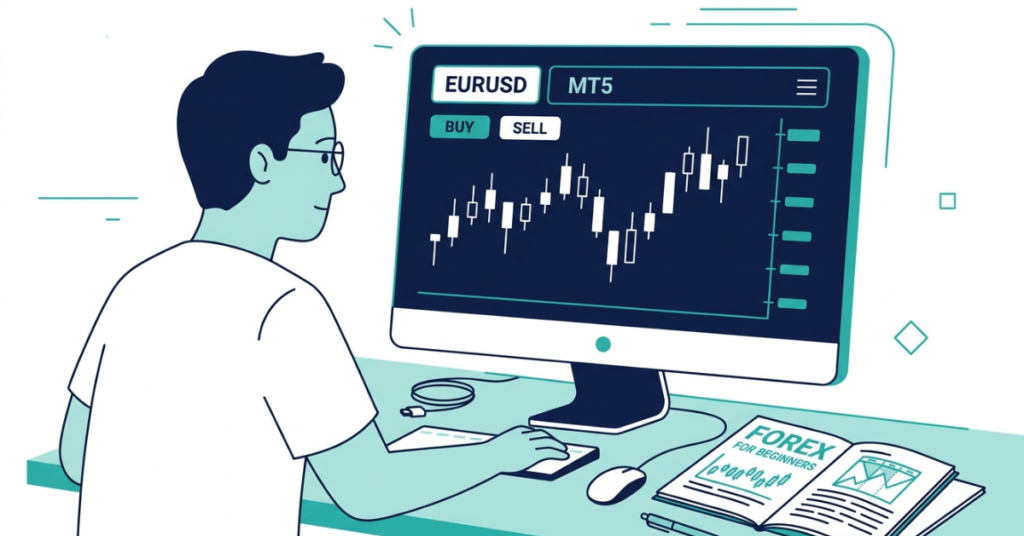
Yes, you can learn forex by yourself. Almost every skill you need, from reading charts to managing risk, is available in free guides, videos, and demo accounts. Self-study works best with a clear plan, steady practice, and patience over months, not days.
Important Insights
- Learning forex alone is realistic. The knowledge is freely available, and a demo account removes the risk while you practise.
- A structured path beats random videos. Learn the basics, then risk, then a single strategy, then live practice.
- Three pillars carry a self-taught trader: a simple strategy, strict risk management, and control over your own emotions.
- Give it months, not days. Reaching steady, consistent trading usually takes six to twelve months of regular effort.
- A large majority of retail traders lose money, so treat early goals as learning, not earning.
Is teaching yourself forex actually realistic?
It is, and plenty of profitable traders started with nothing more than free resources and a demo account. Forex is one of the few skilled fields where the tools, the market, and the education are all open to anyone with an internet connection. Nothing is gatekept behind an expensive course.
The catch isn’t access, it is discipline. On your own, no one sets your homework or stops you from making reckless trades. The traders who succeed alone are the ones who build their own structure, keep a routine, and stay honest about what is working. If you can do that, self-study is not just possible, it is how most retail traders actually learn.
What you actually need to learn
Before building a schedule, it helps to see the whole map. Forex education breaks into a handful of areas. Start with what forex trading is and how it works, then work outward. The table below is your syllabus.
| Area | What it covers | Why it matters |
| Market basics | Pairs, pips, spreads, leverage, sessions | The vocabulary everything else is built on |
| Chart reading | Candlesticks, trends, support and resistance | How you actually see opportunity |
| A strategy | One clear set of rules for entries and exits | Turns random trades into a repeatable process |
| Risk management | Position size, stop losses, risk per trade | The skill that keeps you in the game |
| Trading psychology | Handling fear, greed, and losing streaks | Where most self-taught traders truly get tested |
A self-study roadmap in 4 phases
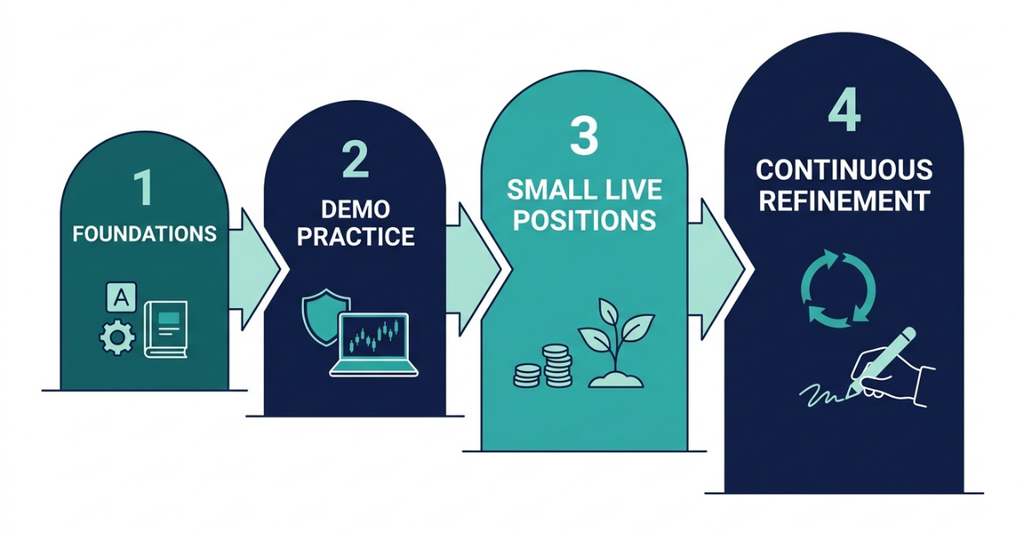
The fastest way to learn alone is to move through clear phases instead of jumping around. Each phase has one job. Don’t hurry to the next until the current one feels solid.
| Phase | Focus | Goal | Rough time |
| 1. Foundations | Learn the basics and how charts work | Understand the market and read a chart | 2 to 4 weeks |
| 2. Demo practice | Trade a demo with one simple strategy | Follow rules without real money | 1 to 3 months |
| 3. Small live | Trade tiny real positions | Handle real emotions and small risk | 2 to 4 months |
| 4. Refine | Review results and adjust | Build toward consistency | Ongoing |
Phase 1: Foundations
Spend the first few weeks on knowledge, not trading. Learn how pairs, pips, and leverage work, and get comfortable reading a candlestick chart. A solid overview of the forex market for beginners will cover most of it. Don’t open a demo until the vocabulary makes sense.
Phase 2: Demo practice
Now open a demo account and pick one simple strategy. The only aim here is following your own rules, trade after trade, with no real money on the line. This is where a demo account earns its place: mistakes cost nothing but teach everything.
Phase 3: Small live positions
Demo trading can’t teach you how it feels to have real money at risk that is why phase 3 uses very small live positions. The amounts should be small enough that a loss barely stings, because the lesson is emotional, not financial. You’re training yourself to stay calm and stick to the plan when it counts.
Phase 4: Refine and repeat
By now you have a record of real trades. Phase 4 is about reading that record honestly.
Which setups worked?
Where did you break your own rules?
Consistency comes from this loop of trading, reviewing, and adjusting, repeated over and over. There is no finish line, only steady improvement.
Free and low-cost resources to learn from
You don’t need to spend money to learn forex well. A self-taught trader can build a full education from resources that are free or nearly free:
- Broker guides and knowledge bases. Most brokers, Defcofx included, publish free beginner articles that cover the essentials clearly.
- A demo account. The single most valuable learning tool, and it costs nothing.
- Books. A few well-chosen trading books teach more than hundreds of scattered videos.
- Trading communities. Forums and groups let you learn from others, though you should weigh advice carefully since not all of it is good.
- New tools. Used wisely, AI can help beginners study charts and test ideas faster, as a helper rather than a shortcut.
How long does it take to learn forex alone?
There is no fixed answer, but honest ranges help. Understanding the basics takes a few weeks. Trading a demo with some competence takes a few months. Reaching steady, consistent results usually takes six to twelve months of regular practice, and for many people longer. Anyone promising you profit in days is selling something.
Traps that catch self-taught traders
Teaching yourself has one weakness: no one is there to catch your mistakes early. These are the ones to watch for:
- Overtrading. Taking too many trades out of boredom or the urge to act. Fewer, better trades win.
- Skipping risk management. Trading without a stop loss or with oversized positions is how accounts blow up fast.
- Strategy hopping. Abandoning a plan after two losses and grabbing a new one never lets any approach prove itself.
- Trading on emotion. Revenge trading after a loss, or getting greedy after a win, undoes careful work in minutes.
When it makes sense to get help
Self-study suits most people, but not every moment of the journey. If you keep repeating the same costly mistake, or you cannot tell why your trades fail, a good course, book, or mentor can shorten the road. Choosing the right broker for beginners also removes a lot of early friction, since a clear platform and fair conditions let you focus on learning rather than fighting your tools.
A simple plan to start this month
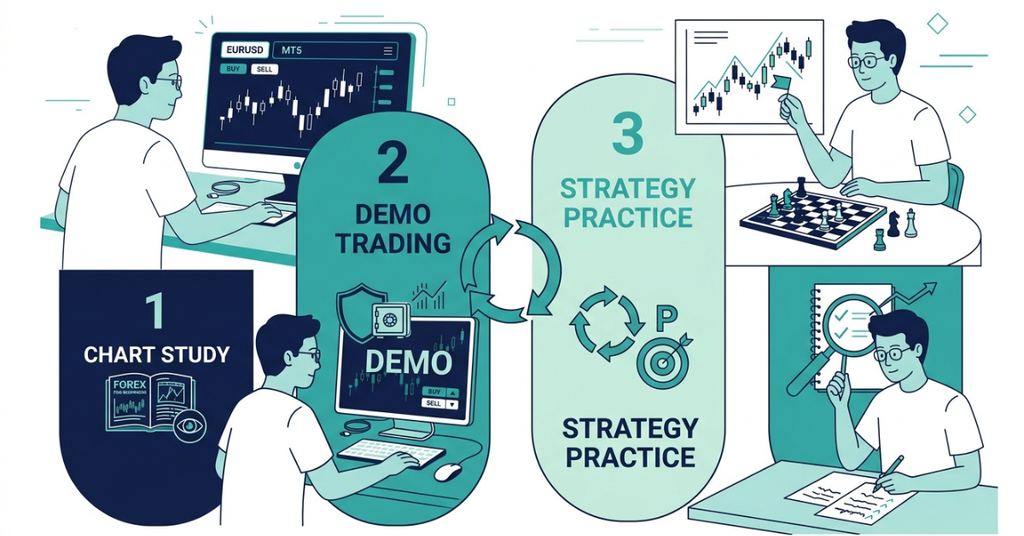
If you want a concrete beginning, here is a first-month plan any self-learner can follow:
- Week 1: Learn the basics. Pairs, pips, spreads, leverage, and how to read a candlestick.
- Week 2: Open a free demo. Get familiar with MetaTrader 5 and place a few practice trades.
- Week 3: Pick one simple strategy and trade only that on the demo, following its rules exactly.
- Week 4: Review every trade. Note what worked, what broke your rules, and adjust for next month.
Once the demo feels natural, you can move to a small live account. If your budget is tight, it is worth reading how to trade forex with a small amount so you start within your means.
Learning forex with Defcofx
Defcofx gives self-learners a free demo, a beginner-friendly platform, and low costs that let your practice count. When you are ready to test a strategy for real, these are the conditions you trade on.
| Feature | What Defcofx offers |
| Spreads | From 0.3 pips |
| Leverage | Up to 1:2000 (indices capped at 1:200) |
| Commissions | Zero |
| Swap fees | Zero |
| Welcome bonus | 40% on first deposits of $1,000 or more |
| Withdrawals | Processed within 4 business hours, including weekends |
| Platform | MetaTrader 5 |
Final Thoughts on Can You Learn Forex by Yourself
Learning forex by yourself is entirely possible, but the process works best when you treat it as a skill-building project rather than a shortcut to quick profits. Free educational material, demo accounts, trading platforms, and market analysis give beginners enough resources to build a solid foundation without immediately paying for a course or mentor.
The real challenge is creating structure. Instead of jumping between strategies and random videos, work through the basics first, practise on a demo, focus on one simple strategy, and gradually experience live trading with very small positions. This approach gives you time to understand both the technical and psychological sides of forex.
FAQ
Yes. Most retail traders are self-taught using free guides, videos, books, and a demo account. A course or mentor can speed things up, but neither is required. Structure and discipline matter far more than paid tuition.
Expect a few weeks for the basics, a few months to trade a demo competently, and six to twelve months of regular practice to reach steady results. Many people take longer, and that is normal.
Not to learn. A demo account and most educational material are free, so you can practise with zero risk for as long as you like. You only need real money when you decide to trade live, and even then you can start small.
Start with the basics: what a pair, pip, spread, and leverage are, plus how to read a candlestick chart. Once the vocabulary makes sense, move on to a simple strategy and risk management before trading live.
A demo teaches the mechanics and strategy perfectly, but it cannot recreate the emotion of risking real money. That is why a good plan uses a demo first, then very small live positions to learn the psychological side.
Usually because they skip risk management, trade on emotion, or rush to a live account too soon. The knowledge is easy to find, but the discipline to apply it is where most people struggle.
Yes. The forex market runs 24 hours a day, five days a week, so you can study and trade around your schedule. Many self-taught traders learn in the evenings and trade a timeframe that suits their hours.