


Currency controls are government-imposed restrictions that regulate how a country’s currency can be bought, sold, or moved across borders. They help manage exchange rates, protect the national economy, limit capital outflows, and stabilize financial markets, but they can also reduce freedom for businesses and traders.
Key Takeaways
- Currency controls are rules set by governments to manage how money moves in and out of a country.
- They help stabilize the economy by protecting the local currency and preventing capital flight.
- Common forms include limits on exchanging money, restrictions on foreign currency purchases, and fixed exchange rates.
- Currency controls can create stability, but they may also reduce flexibility for traders and international businesses.
- Understanding these controls is important for forex traders, as they can affect liquidity, spreads, and market access.
What Currency Controls Mean
Currency controls are economic measures used by governments or central banks to regulate how their national currency is exchanged, transferred, or accessed. These controls determine who can buy foreign currency, how much they can exchange, and under what conditions money can leave or enter the country.
They are commonly used in economies facing instability, inflation, or pressure on their exchange rates. By restricting currency movement, governments try to maintain financial order, protect the local economy, and prevent sudden capital outflows that could weaken the currency further.
Why Governments Use Currency Controls
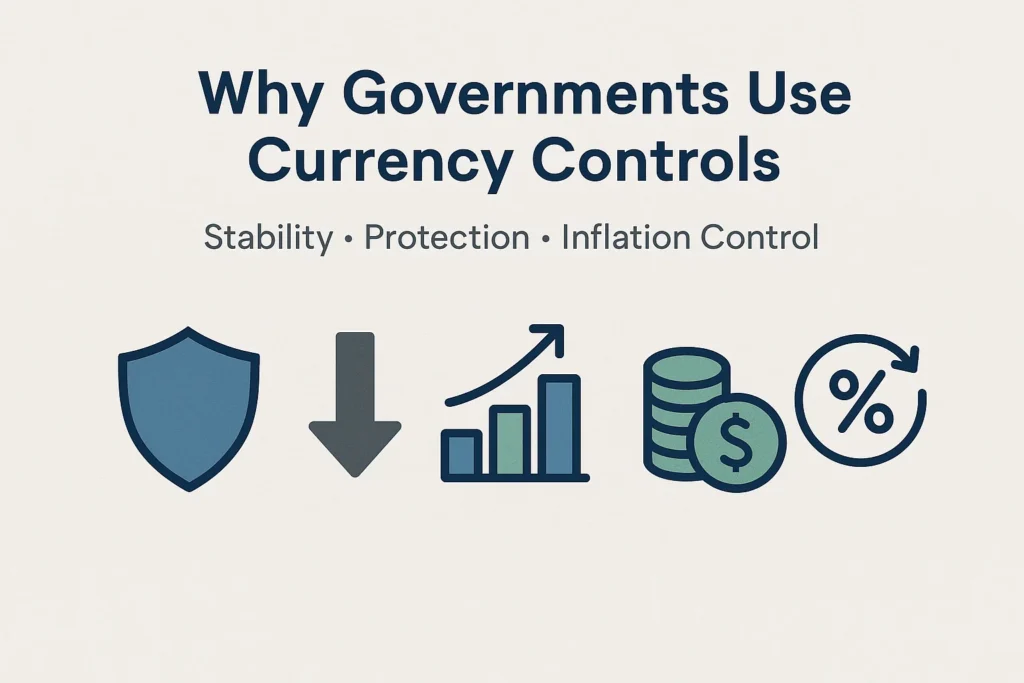
Governments implement currency controls to stabilize their economies and protect national financial interests. These measures are often introduced during periods of economic uncertainty, rising inflation, or declining foreign reserves.
Below are the main reasons currency controls are used:
Protect the National Currency
When a currency is under pressure, limiting how much foreign currency people can buy helps prevent further depreciation. This is especially important for emerging markets with fragile financial systems.
Reduce Capital Flight
During economic crises, individuals and businesses may try to move large amounts of money abroad. Currency controls slow or block these outflows, helping retain liquidity and maintain confidence in the local financial system.
Maintain Exchange Rate Stability
Countries with fixed or managed exchange rate systems often use currency controls to keep the rate stable. By regulating supply and demand, governments can avoid sudden devaluations.
Protect Foreign Reserves
Some nations rely heavily on their foreign currency reserves. Restricting access helps ensure enough reserves are available for essential imports like medicine, energy, and food.
Control Inflation
When too much local currency leaves the country, prices can rise quickly. Currency controls help stabilize prices by tightening access to foreign currency and regulating economic flows.
Types of Currency Controls
Currency controls vary depending on a country’s economic goals and the level of regulation it needs.
Below are the most common types used around the world:
Fixed Exchange Rates
Some governments fix their currency to another stable currency (like the USD). To maintain this peg, they limit how much money can be exchanged to prevent the rate from fluctuating.
Restrictions on Currency Conversion
Citizens or businesses may need approval to convert large amounts of local currency into foreign currency. This reduces sudden demand for USD, EUR, or other major currencies.
Limits on Foreign Currency Purchases
Many countries cap the amount of foreign currency people can buy per year. This prevents excessive outflows and protects foreign reserves.
Limits on Transferring Money Abroad
Governments may restrict international transfers, especially for large transactions. Businesses often require documentation to justify sending funds overseas.
Mandatory Conversion Rules
A government might require that incoming foreign currency—like export earnings—must be converted into the local currency at a set rate.
Import and Export Currency Restrictions
Travelers may not be allowed to bring large amounts of local currency in or out of the country, helping prevent black-market activities and unauthorized currency flows.
Countries That Commonly Use Currency Controls
Currency controls are most often found in economies facing inflation, political instability, or pressure on their currency. While the level of restriction varies, the following countries are known for actively using some form of currency control:
China
China manages its exchange rate through strict regulatory frameworks, capital account controls, and daily currency fixing. Large cross-border transfers often require approval from government authorities.
Argentina
Argentina frequently imposes limits on foreign currency purchases, restricts USD withdrawals, and controls international transfers to stabilize its currency during inflationary periods.
Nigeria
Nigeria uses currency controls to manage foreign reserves and stabilize the naira. Restrictions include limited access to foreign currency for imports and a managed exchange rate system.
Egypt
Egypt applies capital controls when foreign reserves decline. These restrictions help manage imports, stabilize the Egyptian pound, and regulate foreign exchange access.
Venezuela
With one of the strictest control systems, Venezuela regulates currency conversion, sets multiple exchange rates, and limits access to foreign currency to combat ongoing economic crises.
Ethiopia
Ethiopia applies strict rules on foreign currency transfers and requires approval for large international payments to protect its reserves and balance of payments.
These examples illustrate how currency controls are commonly used in regions where governments need stronger mechanisms to maintain economic stability.
How Currency Controls Affect Forex Traders
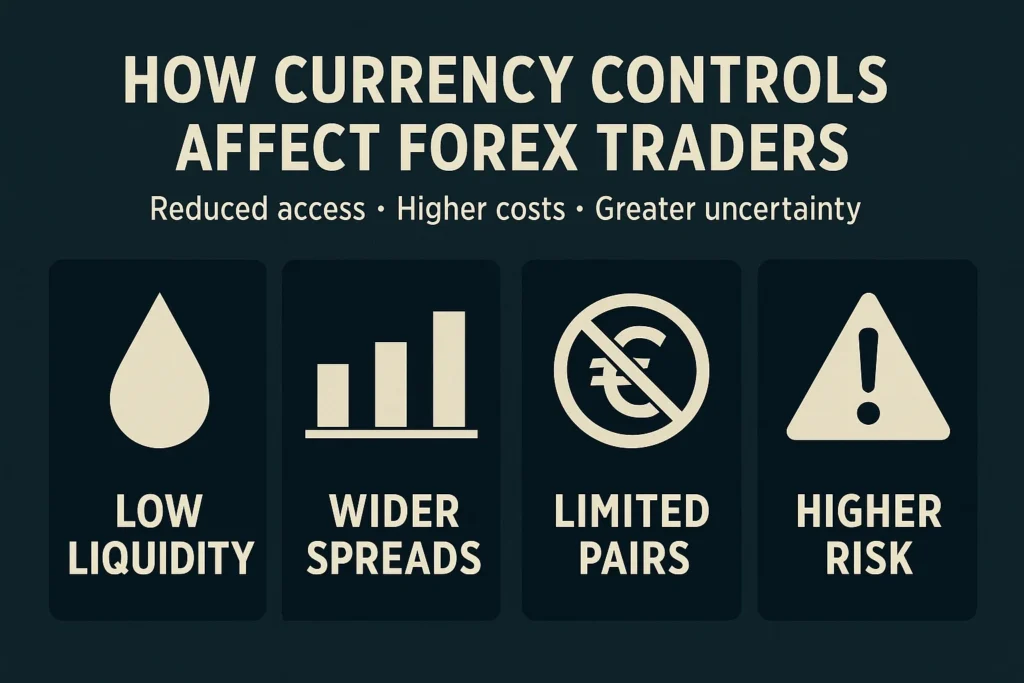
Currency controls significantly influence how traders access, analyze, and trade certain currencies. While they aim to stabilize an economy, they can also create limitations within the global forex market.
Here are the key impacts:
- Reduced Liquidity: Currencies subject to strict controls often have far fewer market participants. Lower liquidity leads to slower execution, wider spreads, and more unpredictable price movements.
- Limited Availability of Currency Pairs: Some exotic or restricted currencies may not be offered by all brokers. Traders often encounter limited options because controlled currencies cannot flow freely across borders.
- Higher Trading Costs: In regulated or controlled markets, spreads can widen due to restricted supply and lower trading volume. This can make trading certain pairs more expensive and less predictable.
- Increased Geopolitical and Economic Risk: Currency controls signal underlying instability or inflation concerns. Traders must evaluate risks such as sudden policy changes, devaluations, or capital restrictions that may impact open positions.
- Difficulty in Repatriating Profits: If a trader operates within a country that imposes controls, converting profits or withdrawing foreign currency may require permissions or be subject to delays.
- Impact on Fundamental Analysis: Economic data from countries with strict controls may be less transparent. Traders must rely on alternative indicators to assess market sentiment and risk levels.
Overall, currency controls reshape how traders interact with specific currencies, requiring greater attention to liquidity, spreads, and geopolitical influences.
Advantages vs. Disadvantages of Currency Controls (Table)
| Advantages of Currency Controls | Disadvantages of Currency Controls |
| Stabilize the national currency by reducing volatility and preventing rapid devaluation. | Reduces currency freedom, limiting how much money individuals and businesses can move abroad. |
| Protect foreign reserves, ensuring essential imports like food, medicine, and energy can be funded. | Discourages foreign investment because investors fear restrictions and sudden policy changes. |
| Control inflation by reducing capital outflows and managing money supply. | Creates black-market activity when people seek unofficial ways to access foreign currency. |
| Prevent capital flight during periods of political or economic instability. | Lowers liquidity for traders and financial markets, increasing spreads and trading costs. |
| Support exchange rate management in countries using fixed or managed currency systems. | Can slow economic growth by restricting trade, international payments, and business flexibility. |
How Defcofx Helps Traders Navigate Currency Restrictions
Currency controls can limit access to global markets, reduce liquidity, and increase trading costs. Defcofx helps traders overcome many of these challenges by offering a flexible, international trading environment designed for unrestricted access and fast execution.
Here’s how Defcofx supports traders affected by currency controls:
- Global accessibility allows clients from all countries to trade major, minor, and selected exotic pairs—even when local currency movement is restricted.
- High leverage up to 1:2000 gives traders more flexibility, enabling meaningful trading positions even with limited capital.
- Low spreads from 0.3 pips help offset the higher costs often seen in restricted markets.
- No commissions and no swap fees, ensuring transparent, cost-efficient trading.
- Fast withdrawals are processed within 4 business hours, including weekends, giving traders quick access to their funds, which is especially beneficial in jurisdictions with slower banking systems.
- 40% welcome bonus on deposits from $1000, offering additional trading capital in volatile or regulated environments.
Defcofx combines accessibility, speed, and low-cost trading conditions, making it easier for traders to participate in global forex markets, even when their local currency is subject to government controls.
Open a Trading Live AccountFinal Thoughts: What Are Currency Controls
Currency controls are powerful government tools used to regulate how money moves across borders, stabilize exchange rates, and protect a nation’s economy during periods of financial stress. While these controls can create stability at the national level, they also introduce challenges such as reduced liquidity, restricted currency access, and increased trading costs for individuals and businesses.
For traders, understanding how currency controls work, and how they impact forex markets, is essential. It helps identify risk, choose suitable currency pairs, and adjust trading strategies in response to policy changes or geopolitical developments.
Defcofx supports traders navigating these challenges by offering a global, flexible, and low-cost trading environment. With high leverage, tight spreads, fast withdrawals, and no hidden fees, Defcofx provides the conditions traders need to stay competitive even when dealing with restricted or volatile economies.
Open a Trading Live AccountFAQ: Currency Controls
Countries use currency controls to stabilize their economy, reduce inflation, protect foreign reserves, and prevent capital flight during times of economic or political uncertainty. These measures help maintain confidence in the national currency and financial system.
Currency controls can provide short-term economic stability, but they also limit financial freedom, discourage foreign investment, and reduce liquidity in currency markets. Their impact depends on how long they remain in place and how strictly they are enforced.
They can reduce liquidity, widen spreads, restrict access to certain currency pairs, and introduce additional geopolitical risk. Traders must carefully evaluate market conditions and adjust strategies when dealing with currencies under heavy regulation.
A common example is limiting how much foreign currency citizens can buy each year. Other examples include restricting international money transfers, fixing exchange rates, or requiring mandatory conversion of foreign earnings into local currency.
Nations like China, Argentina, Nigeria, Egypt, and Venezuela actively use currency controls to stabilize their financial systems. These policies often reflect attempts to manage inflation, protect foreign reserves, or reduce economic volatility.
Traders can focus on major currency pairs, use brokers with global reach, diversify trading strategies, and monitor policy updates. Platforms like Defcofx provide access to liquid markets, low spreads, and fast withdrawals, helping minimize restrictions.
Defcofx Forex Articles You Shouldn’t Miss
Discover powerful forex strategies in these top reads from Defcofx.
- What Currency is The Most Valuable
- Best Currency Pairs to Trade During London Session
- How Much is 0.5 Lot Size in Dollars
- Best Time To Trade NZD/USD
- What Is Considered the Greatest Risk Associated With Forex Settlement?
- Is NZD/USD a Major or Minor Pair?
- Trailing Stop Limit: Definition, Uses & Trading Guide
- When Does a Bearish Market Become Bullish in Forex?
- Is Pound Stronger than Dollar?