


NAS100 is the trading symbol for the NASDAQ-100 Index, which tracks 100 of the largest non-financial companies listed on the Nasdaq exchange. It is not a forex currency pair, it is a stock market index. However, most forex brokers offer NAS100 as a CFD (Contract for Difference), allowing traders to speculate on its price from the same platform they use for currencies, gold, and other instruments. It is popular for its strong trends, high liquidity, and significant daily price movement.
Trade NAS100 with Defcofx
Access NAS100 and other major indices as CFDs on MetaTrader 5. Competitive spreads, up to 1:2000 leverage, no commissions, and withdrawals within 4 hours. Start with a free demo account.
Key Takeaways
- NAS100 = NASDAQ-100 Index, it tracks 100 of the largest non-financial companies on the Nasdaq exchange
- It is not a forex pair, it is a stock index traded as a CFD on forex platforms
- Technology companies heavily dominate the index, making it sensitive to tech earnings, interest rates, and investor sentiment
- NAS100 is popular for its strong trends and large daily price swings, creating frequent opportunities for active traders
- Key drivers include corporate earnings, interest rate expectations, inflation data, and broader risk sentiment
- Defcofx offers NAS100 as a CFD alongside forex, gold, and other indices through MetaTrader 5. See indices CFDs and indices trading hours
Why Forex Traders Talk About NAS100
Modern forex brokers have expanded well beyond currencies. Today, a single trading account can access forex pairs, commodities, metals, cryptocurrencies, and stock indices, all through the same platform. NAS100 is one of the most popular instruments in this expanded universe.
The reason is straightforward: NAS100 offers strong trends and meaningful volatility. For active traders, this translates to more frequent and larger opportunities than some slower-moving currency pairs. If you have ever wondered is Nasdaq a stock or forex, the answer is that it is a stock index, but it is traded like forex through CFDs on the same platforms. For a broader comparison, see what are indices in forex.
What Does NAS100 Measure?
NAS100 tracks the performance of 100 of the largest non-financial companies listed on the Nasdaq exchange. These are weighted by market capitalization, meaning the largest companies have the most influence on the index’s price.
The index is dominated by technology and growth-oriented sectors including software, semiconductors, artificial intelligence, e-commerce, telecommunications, and consumer electronics. Some of the world’s most widely followed corporations determine the direction of the index on any given day.
When major technology stocks report strong earnings or benefit from positive sector tailwinds, NAS100 typically rises. When tech stocks come under pressure from rising interest rates, regulatory concerns, or poor earnings, the index often falls more sharply than broader market benchmarks.
NAS100 vs Forex Pairs: Key Differences
NAS100 and forex pairs are fundamentally different instruments. Understanding the distinction helps traders decide where to focus and how to apply their strategies.
| Feature | NAS100 | Forex Pairs |
| Asset Type | Stock index (CFD) | Currency pair |
| Primary Drivers | Earnings, tech sentiment, rates | Interest rate differentials, economic data |
| Trading Hours | Tied to US market hours (with extended pre/after) | 24 hours, 5 days |
| Volatility | High, large daily ranges common | Varies by pair and session |
| Risk Profile | Risk-on asset | Varies, safe-haven vs risk pairs |
| Best Used For | Trend following and momentum strategies | Macro plays, range and breakout trading |
What Moves NAS100 Prices?
| Market Driver | Effect on NAS100 |
| Corporate earnings (especially tech) | Strong results push the index higher; misses cause sharp drops |
| US interest rate decisions (Fed) | Rate hikes increase borrowing costs and pressure growth stock valuations |
| Inflation data (CPI, PCE) | High inflation raises rate-hike expectations, often weighing on NAS100 |
| Economic growth (GDP, employment) | Strong growth data supports corporate earnings expectations |
| Investor sentiment / risk appetite | Risk-on mood lifts NAS100; risk-off moves push it lower |
| Geopolitical events | Uncertainty tends to weigh on growth assets like tech stocks |
Unlike forex, where central bank interest rate policy is often the single biggest driver, NAS100 traders also pay close attention to individual company earnings reports, sector-specific news, and quarterly guidance from major tech companies. This creates a unique combination of top-down macro analysis and bottom-up company-level monitoring.
5 Common NAS100 Trading Strategies
Because NAS100 tends to trend strongly and move in clear directional patterns, the most popular strategies are built around momentum and trend capture rather than range-bound approaches.
| Strategy | How It Works | Best Conditions |
| Trend Following | Trade in the direction of the prevailing trend using moving averages or trendlines | Strong directional markets |
| Breakout Trading | Enter after price breaks through key support or resistance with momentum | Consolidation followed by expansion |
| Pullback / Retracement | Enter during temporary dips within an uptrend or rallies within a downtrend | Clear trending conditions |
| Momentum Trading | Follow strong directional movement using indicators like RSI or MACD | Fast-moving sessions, news-driven moves |
| Swing Trading | Hold positions for multiple days to capture larger trend moves | Defined multi-day trends |
Best Time to Trade NAS100
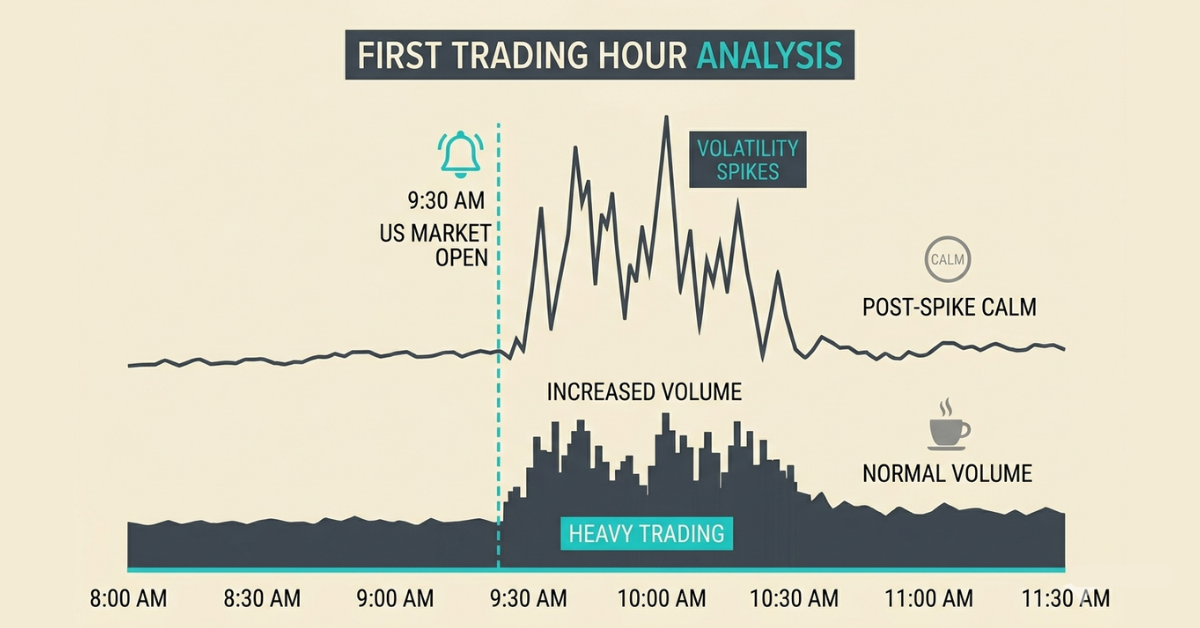
NAS100 liquidity and volatility are highest during US market hours. The index is most active from the New York session open at 9:30 AM EST through early afternoon, with another spike of activity at the close around 4:00 PM EST.
- Pre-market (4:00 AM – 9:30 AM EST): Moderate activity, often driven by earnings releases and overnight news. Spreads may be wider
- US market open (9:30 AM – 11:30 AM EST): Highest volatility of the day, especially on news days. Most active period for breakout and momentum traders
- Mid-session (11:30 AM – 2:00 PM EST): Often lower volatility; range trading or waiting for afternoon setups is common
- US afternoon / close (2:00 PM – 4:00 PM EST): Activity picks up again, often with directional moves into the close
The New York session forex pairs list is also useful context; the NY session is when USD-driven forex pairs and US indices are all most active simultaneously. See NAS100 and indices trading hours for the exact Defcofx schedule.
Is NAS100 Good for Beginners?
NAS100 is accessible for beginners, but it requires respect for its volatility. The same price swings that create opportunities can create losses quickly if position sizing is wrong or risk management is skipped.
- Advantages for beginners: Strong trends are easier to follow than choppy sideways markets. High liquidity means tight spreads and reliable fills. The index is well-covered by financial media, making it easy to follow news that affects it.
- Challenges for beginners: NAS100 can move hundreds of points in a day. Without proper position sizing, even a correct directional view can result in a loss if the stop is too tight. Beginners who focus on profits before process tend to struggle.
Starting on a demo account to understand NAS100’s behavior is highly recommended.
NAS100 and Market Sentiment
NAS100 is one of the clearest barometers of investor risk appetite in global markets. When investors feel confident about economic growth, corporate earnings, and technology innovation, money flows into growth stocks, and NAS100 rises. When concerns emerge about inflation, interest rate hikes, recessions, or geopolitical instability, NAS100 often sells off faster than more defensive indices.
This sentiment-driven nature means NAS100 traders benefit from tracking macro themes beyond just chart patterns. Understanding where the Federal Reserve is in its rate cycle, whether earnings expectations are rising or falling, and how global risk appetite is positioned all provide context that purely technical analysis cannot give alone.
Trade NAS100 with Defcofx
Defcofx is an online forex and CFD broker registered in Saint Lucia, offering access to NAS100 and other major global indices through MetaTrader 5 (MT5). Traders can access NAS100 from the same account they use for forex pairs, gold, and cryptocurrencies.
- NAS100 and major indices as CFDs, see the full list at Defcofx indices CFDs and check indices trading hours for the exact session schedule
- Spreads from 0.3 pips with no commissions and no swap fees, see Defcofx spreads
- Up to 1:2000 leverage, see leverage and margin requirements to understand position sizing for NAS100
- 40% welcome bonus on first deposits of $1,000 or more. See the promotion page
- Fast withdrawals processed within 4 business hours, including weekends
- Use how to use MetaTrader 5 to set up charts, apply indicators, and manage index positions on MT5
- Multiple account types available, including a free demo account to practice NAS100 trading on live prices at zero risk
Frequently Asked Questions
What does NAS100 mean in trading?
NAS100 is the trading symbol for the NASDAQ-100 Index, which tracks 100 of the largest non-financial companies listed on the Nasdaq exchange. It is widely traded as a CFD on forex platforms, giving traders exposure to the US technology sector without buying individual stocks.
Is NAS100 a forex pair?
No. NAS100 is a stock market index, not a currency pair. However, most forex brokers, including Defcofx, offer it as a CFD, so traders can access it alongside traditional forex instruments from the same account and platform. See is Nasdaq a stock or forex for a full explanation.
Why is NAS100 so volatile?
NAS100 is dominated by growth-oriented technology companies, which tend to react strongly to interest rate expectations, earnings reports, and investor sentiment. Any major shift in these factors can cause large, fast price swings. This volatility creates opportunity but requires proper risk management.
What affects NAS100 the most?
The biggest drivers are US Federal Reserve interest rate decisions, corporate earnings from major tech companies, inflation data (CPI/PCE), economic growth expectations, and overall investor risk appetite. Earnings seasons are particularly important because large tech constituents can move the entire index significantly.
Can beginners trade NAS100?
Yes, but with caution. NAS100 offers clear trends and high liquidity, but its volatility can produce large losses if position sizing is wrong or stops are not used. Starting with a demo account and building risk management habits first is the recommended approach. See position sizing in trading and forex risk management.
What is the best time to trade NAS100?
The US market open (9:30 AM EST) and the early afternoon window provide the highest liquidity and clearest price action for the NAS100. Pre-market hours can also show movement on earnings releases. See indices trading hours on Defcofx for the exact trading schedule.
Is NAS100 better than forex?
Neither is inherently better. NAS100 tends to offer stronger trends and larger daily price ranges, while Forex provides near 24-hour trading and a wider variety of instruments. The right choice depends on your strategy, risk tolerance, and trading style. Many traders trade both from the same account through Defcofx.
How do traders make money from NAS100?
Traders profit by correctly predicting the direction of price movement, buying before the index rises or selling before it falls through CFDs. Like all trading, outcomes depend on strategy quality, discipline, and consistent risk management. No guaranteed profit method exists.