


Approximately 30 to 40 currencies are stronger than the Chinese Yuan (CNY) based on nominal exchange rates. These include currencies like the Kuwaiti Dinar, Bahraini Dinar, and British Pound, all of which have a higher unit value than the yuan, even though China’s economy itself is one of the largest globally.
Key Takeaways
- Around 30 to 40 global currencies have a higher nominal value than the Chinese yuan
- Some of the strongest include the Kuwaiti Dinar, Bahraini Dinar, and Omani Rial
- A “stronger” currency refers to higher exchange rate value, not economic power
- The Chinese yuan is not weak, but deliberately managed for trade stability
- Currency value alone does not reflect a country’s economic strength
What Does “Stronger Currency” Actually Mean?
When people ask how many currencies are stronger than the Chinese yuan (CNY), they are usually referring to nominal exchange rate value, that is, how much one unit of a currency is worth compared to another.
In simple terms, a “stronger” currency means:
- 1 unit of that currency buys more CNY
- It has a higher face value in exchange markets
For example, 1 Kuwaiti Dinar is worth significantly more than 1 Chinese yuan, which makes it “stronger” in nominal terms.
However, this is where many people misunderstand currency strength.
How Many Currencies Are Stronger Than Chinese Yuan (CNY)?
As of recent exchange rate comparisons, around 30–40 currencies are stronger than the Chinese yuan (CNY) in nominal terms. This means that 1 unit of these currencies is worth more than 1 CNY, based purely on exchange rate value.
To give you a clearer understanding, here’s a simplified table of notable currencies that are stronger than the yuan:
| Currency | Country/Region | Approx Value (vs CNY) |
| Kuwaiti Dinar | Kuwait | ~23–24 CNY |
| Bahraini Dinar | Bahrain | ~19–20 CNY |
| Omani Rial | Oman | ~18–19 CNY |
| Jordanian Dinar | Jordan | ~10–11 CNY |
| British Pound (GBP) | United Kingdom | ~9–10 CNY |
| Euro (EUR) | Eurozone | ~7–8 CNY |
| Swiss Franc (CHF) | Switzerland | ~7–8 CNY |
| US Dollar (USD) | United States | ~7+ CNY |
| Canadian Dollar (CAD) | Canada | ~5+ CNY |
| Australian Dollar (AUD) | Australia | ~4–5 CNY |
| Singapore Dollar (SGD) | Singapore | ~5+ CNY |
| New Zealand Dollar | New Zealand | ~4+ CNY |
| Brunei Dollar | Brunei | ~5+ CNY |
| Bulgarian Lev | Bulgaria | ~3–4 CNY |
| Libyan Dinar | Libya | ~1.5–2+ CNY |
| Azerbaijani Manat | Azerbaijan | ~4+ CNY |
| Georgian Lari | Georgia | ~2–3 CNY |
| Bosnian Convertible Mark | Bosnia & Herzegovina | ~3–4 CNY |
| Fijian Dollar | Fiji | ~3+ CNY |
| Belize Dollar | Belize | ~3–4 CNY |
Beyond these, there are additional currencies (especially in smaller or pegged economies) that also exceed the yuan’s value, bringing the total count to roughly 30 to 40 currencies worldwide.
Top Strongest Currencies in the World and What It Means for Traders
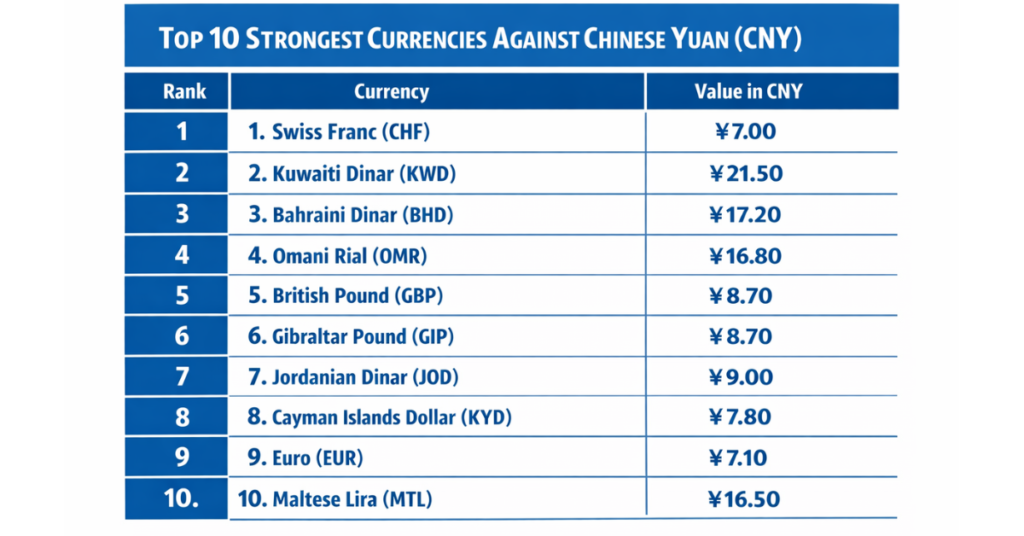
While the Chinese yuan (CNY) is widely used globally, several currencies consistently have a higher nominal value. The strongest include the Kuwaiti Dinar, Bahraini Dinar, Omani Rial, British Pound, and Euro. These currencies are considered “stronger” because 1 unit can buy significantly more yuan, although the strength does not always correlate with overall economic power.
Understanding which currencies are stronger is essential for forex traders. It helps determine which pairs are more volatile, which can impact trading strategies, and where opportunities for profit may exist.
For example, trading pairs involving high-value currencies like the Kuwaiti Dinar (KWD/CNY) or British Pound (GBP/CNY) may see larger price movements per trade, offering potential gains for active traders. However, higher movement also means higher risk, so trading requires careful planning and flexible trading tools.
Connecting Currency Strength to High-Performance Trading
Brokers like Defcofx offer features that are particularly advantageous for trading stronger currencies:
- High Leverage Options: Offers up to 1:2000 leverage, giving traders flexibility to trade larger positions even with smaller capital. This is especially useful when trading high-value currencies where price movements can be significant.
- No Commissions or Swap Fees: Low spreads starting from 0.3 pips mean that every trade is cost-efficient, maximizing the potential profits when trading strong currencies against the yuan.
- 40% Welcome Bonus: For first-time deposits of $1000 or more, traders can boost their capital and trade multiple high-value currency pairs simultaneously.
- Fast Support and Withdrawals: With withdrawals processed in 4 business hours, traders can quickly access profits from trading strong currencies without long delays.
- Global Reach: Defcofx welcomes clients from all countries and provides multi-language support, enabling traders worldwide to participate in currency markets.
Practical Example
Suppose a trader wants to take advantage of the Kuwaiti Dinar vs Chinese Yuan (KWD/CNY) pair. With Defcofx:
- They can use high leverage to open a position with a small deposit.
- Trading costs remain low due to no commissions or swap fees.
- Profits can be accessed quickly thanks to fast withdrawals.
This combination of market knowledge (knowing which currencies are stronger) and broker advantages makes it possible to trade strategically and efficiently.
Open a Live Trading AccountWhy Are These Currencies Stronger Than the Yuan?
Currencies stronger than the Chinese yuan are not randomly higher in value; their strength is driven by economic policies, market demand, and monetary systems. Understanding these factors is essential for traders to interpret forex movements accurately.
Key Factors Influencing Currency Strength
- Supply and Demand Dynamics
- A currency becomes stronger when demand exceeds supply. For example, currencies like the Kuwaiti Dinar or Bahraini Dinar are limited in circulation but highly demanded in global markets, increasing their per-unit value against the yuan.
- Monetary and Fiscal Policy
- Governments with tight monetary control or fixed exchange rates often maintain a higher currency value.
- The Chinese yuan, by contrast, is managed by the People’s Bank of China, which keeps its value relatively stable to support trade, rather than aiming for maximum per-unit strength.
- Resource-Backed Economies
- Some of the strongest currencies come from oil-rich countries (e.g., Kuwait, Oman, Bahrain). High revenue from natural resources supports higher currency value and stability in global markets.
- Economic Stability and Investor Confidence
- Currencies like the Swiss Franc (CHF) or Euro (EUR) maintain high value because of strong governance, stable economies, and low inflation, making them a safe haven for investors.
How This Affects Forex Traders
Traders can leverage knowledge of currency strength to strategically select pairs with higher volatility and profit potential. For example:
- Trading high-value currencies against CNY offers opportunities for significant movement per trade.
- Brokers like Defcofx support these strategies with:
- High Leverage Options (up to 1:2000) to maximize trade potential
- No Commissions or Swap Fees, keeping costs minimal
- Fast Support and Withdrawals, enabling quick profit access
Is the Chinese Yuan Actually Weak?
Many people assume that because several currencies have a higher nominal value than the Chinese yuan (CNY), the yuan must be weak. This is a common misconception.
While the yuan may be lower in per-unit value compared to currencies like the Kuwaiti Dinar, British Pound, or Euro, it is actively managed by China’s central bank to maintain stability for trade and economic growth. Its strength lies not in nominal value but in global influence and economic size.
- The Chinese economy is the second-largest in the world, contributing to strong international demand for the yuan.
- The currency is partially pegged and regulated, which keeps volatility lower than some freely floating currencies.
- Investors and traders respect the yuan for its stability, especially in major trade agreements and international reserves.
Chinese Yuan vs Other Major Currencies
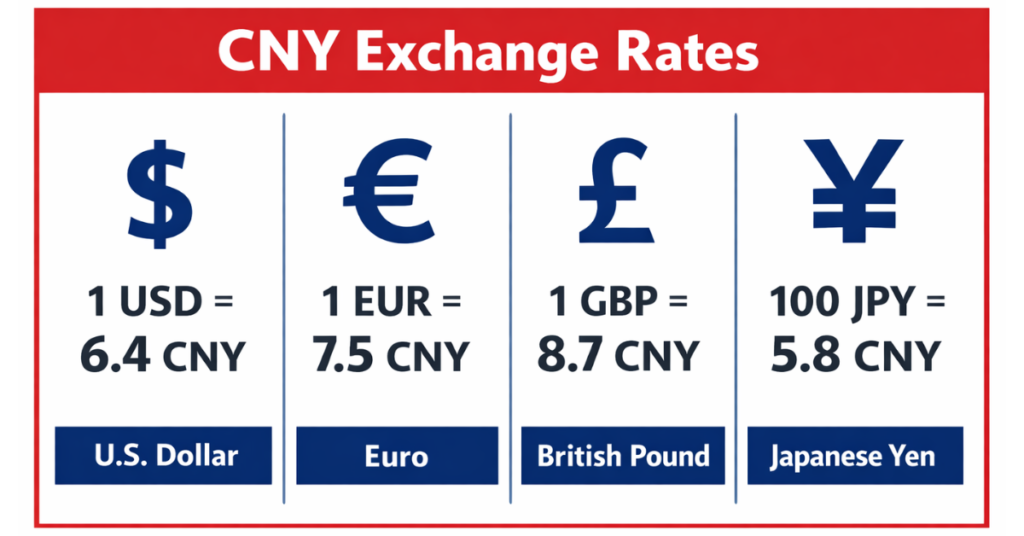
Comparing the Chinese yuan (CNY) with major global currencies helps traders understand relative strength and trading opportunities. While CNY may be lower in nominal value than currencies like the US Dollar (USD), Euro (EUR), British Pound (GBP), or Japanese Yen (JPY), it plays a critical role in international trade and forex markets.
| Currency | Country/Region | Approx Value vs CNY | Notes on Strength |
| US Dollar (USD) | United States | ~7+ CNY | Widely used as global reserve currency |
| Euro (EUR) | Eurozone | ~7–8 CNY | Strong economic union, stable currency |
| British Pound (GBP) | United Kingdom | ~9–10 CNY | High per-unit value, long-term stability |
| Japanese Yen (JPY) | Japan | ~0.05–0.06 CNY | Lower nominal, but strong economy and investor safe-haven |
| Swiss Franc (CHF) | Switzerland | ~7–8 CNY | Highly stable, safe-haven currency |
Key Insights:
- A currency with a higher per-unit value doesn’t necessarily indicate a stronger economy.
- The yuan’s controlled exchange rate ensures trade competitiveness while maintaining international confidence.
- Traders often monitor CNY pairs with USD, EUR, and GBP because these pairs have higher liquidity and predictable trends.
What This Means for Forex Traders
Knowing which currencies are stronger than the Chinese yuan (CNY) is essential for effective forex trading. Traders can leverage this knowledge to select pairs that match their risk tolerance and strategy, whether they prefer stable movements or higher volatility.
Key Considerations for Traders
- Volatility Opportunities
- Stronger currencies against CNY, such as the Kuwaiti Dinar, British Pound, or Euro, tend to have larger per-unit price movements.
- This can result in higher profit potential for skilled traders who manage risk carefully.
- Liquidity Factors
- Major currency pairs like USD/CNY, EUR/CNY, and GBP/CNY are highly liquid, making them easier to trade without wide spreads.
- Smaller high-value currencies (e.g., Kuwaiti Dinar) may have lower liquidity, so traders need to monitor market depth.
- Strategic Pair Selection
- Understanding currency strength allows traders to pair stronger currencies with weaker ones for potential profit.
- It also helps identify hedging opportunities for risk management in volatile markets.
- Timing and Market Analysis
- Traders can track economic reports, interest rates, and policy announcements from countries with strong currencies to anticipate movements against the yuan.
Trading Opportunities in Currency Differences
Understanding which currencies are stronger than the Chinese yuan (CNY) creates real trading opportunities. Traders can take advantage of fluctuations between high-value currencies like the Kuwaiti Dinar, British Pound, and Euro against CNY, maximizing potential gains from price movements.
How Traders Can Benefit
- High-Value Pairs: Currency pairs involving stronger currencies often show larger pip movements, which can be leveraged for higher returns.
- Strategic Diversification: By trading multiple strong currency pairs against the yuan, traders can spread risk while capturing various market opportunities.
- Volatility Management: Knowing which currencies are stronger allows traders to anticipate potential swings and plan trades effectively.
Using Brokers Effectively
To fully leverage these trading opportunities, choosing a broker with the right conditions is crucial. Brokers like Defcofx provide tools and features that enhance currency trading:
- High Leverage Options (up to 1:2000): Allows traders to open larger positions on high-value currencies with smaller deposits, increasing potential gains.
- No Commissions or Swap Fees: Low spreads starting from 0.3 pips ensure trading costs remain minimal, maximizing profitability even on high-volatility pairs.
- Fast Support and Withdrawals: Profits can be accessed quickly, with withdrawals completed within 4 business hours, including weekends.
- Global Reach: Traders from all countries can participate, supported by multi-language options, making it easier to engage in global currency markets.
FAQs
Approximately 30–40 currencies have a higher nominal value than the Chinese yuan. This includes currencies such as the Kuwaiti Dinar, Bahraini Dinar, British Pound, and Euro. The count fluctuates slightly with market exchange rates but generally stays within this range.
The Kuwaiti Dinar (KWD) is currently the strongest currency in nominal terms. Its high per-unit value reflects limited supply and strong demand, particularly due to Kuwait’s oil-backed economy.
No. In nominal exchange rate terms, 1 US Dollar (USD) is worth more than 1 CNY. However, the yuan’s lower per-unit value does not indicate economic weakness, as China has the second-largest economy globally.
The Kuwaiti Dinar (KWD) is valuable because of limited supply, strong demand, and a resource-backed economy. Its value is maintained through monetary policies and pegged exchange strategies.
Not necessarily. Currency value reflects exchange rates, not overall economic size or power. For example, the Chinese yuan has a lower nominal value than many currencies, but China’s economy remains one of the largest and most influential globally.
Traders can use this knowledge to:
1. Select high-potential currency pairs
2. Manage risk more effectively
3. Identify strategic trading opportunities based on volatility
4. Using a broker like Defcofx can enhance these opportunities with high leverage, low spreads, and fast withdrawals, giving traders the tools to act on market movements efficiently.
Final Thoughts on How Many Currencies are Stronger than Chinese Yuan CNY?
Understanding which currencies are stronger than the Chinese yuan (CNY) is essential for informed forex trading. While about 30–40 currencies exceed the yuan in nominal value, this does not reflect overall economic power. Factors like monetary policy, supply and demand, and economic stability determine a currency’s value more than its nominal exchange rate.
For traders, this knowledge opens up opportunities to strategically select currency pairs, manage risk, and optimize returns. Stronger currencies against the yuan, such as the Kuwaiti Dinar, British Pound, and Euro, offer higher pip movements and potential for profit but require careful planning.
When trading these pairs, using a broker that provides flexible, cost-efficient conditions is key. While the focus is on understanding the market, brokers like Defcofx can support traders with features such as high leverage, low spreads, and fast withdrawals, making it easier to capitalize on currency movements effectively.