


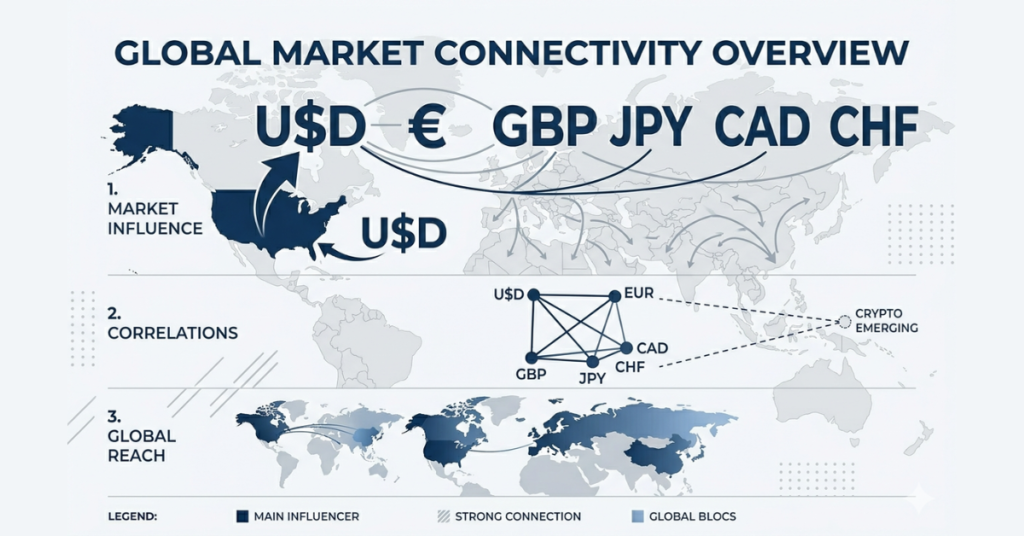
The G7 currencies are the official currencies of the seven major advanced economies: US Dollar (USD), Euro (EUR), British Pound (GBP), Japanese Yen (JPY), Canadian Dollar (CAD), Swiss Franc (CHF), and the Italian Lira’s modern replacement, still EUR. These currencies dominate global forex trading volume and are considered the most liquid in the world.
Key Takeaways
- The G7 includes the United States, United Kingdom, Eurozone, Japan, Canada, and Switzerland by currency influence.
- G7 currencies make up the majority of all daily forex trading volume globally.
- These currencies are tied to the world’s most stable and transparent economies.
- Most major forex pairs involve at least one G7 currency.
- Defcofx offers all G7 currency pairs on MT5 with tight spreads and up to 1:2000 leverage.
What Is the G7 and Why Do Its Currencies Matter in Forex?
The Group of Seven (G7) is a political and economic forum made up of the world’s seven largest advanced economies. These countries coordinate on global economic policy, trade, and finance. The original members are the United States, United Kingdom, France, Germany, Italy, Japan, and Canada. The European Union also participates.
In forex, the phrase ‘G7 currencies’ typically refers to the major currencies issued by these economies. Since France, Germany, and Italy all use the Euro, the EUR effectively represents three of the original seven nations.
Switzerland is not a G7 member, but the Swiss Franc (CHF) is widely grouped with G7 currencies in forex discussions because of its status as a global safe-haven currency and its deep integration with European financial markets. Many traders and analysts include CHF when referring to the group of major forex currencies.
These currencies matter because they are used in the majority of international trade, central bank reserves, and cross-border investment. When you look at the daily forex volume of over $7.5 trillion, the bulk of it moves through these currencies and their pairs.
The G7 Currencies List with Full Details
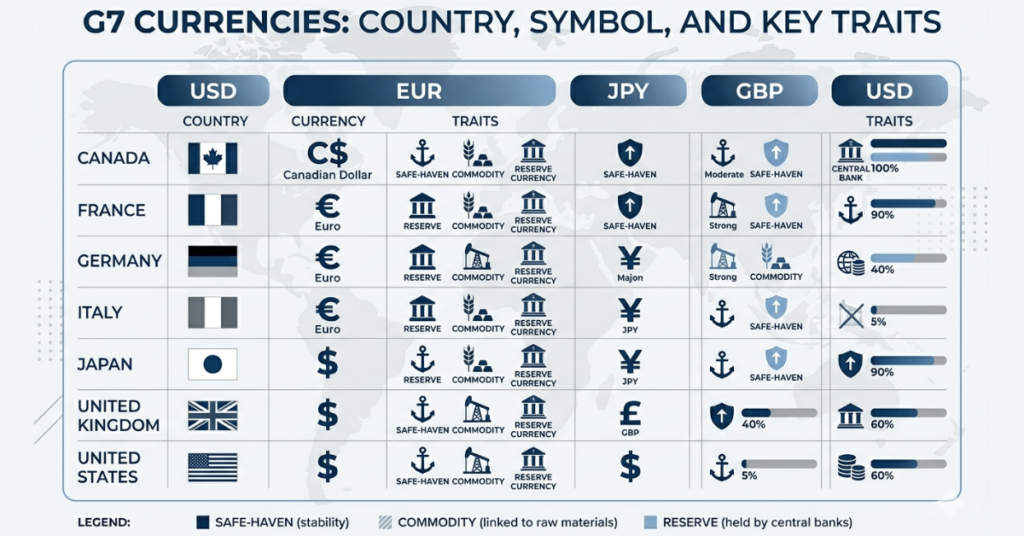
Below is a complete breakdown of each G7 currency, including what drives its value and how it behaves in the forex market:
| Currency | Symbol | Country | Central Bank | Key Characteristic |
| US Dollar | USD | USA | Federal Reserve (Fed) | World reserve currency, used in 88% of all forex transactions |
| Euro | EUR | Eurozone (19 countries) | European Central Bank (ECB) | Second most traded currency, used across 20 EU nations |
| British Pound | GBP | United Kingdom | Bank of England (BoE) | Third most traded, often volatile due to UK political events |
| Japanese Yen | JPY | Japan | Bank of Japan (BoJ) | Safe-haven currency, dominant in carry trades |
| Canadian Dollar | CAD | Canada | Bank of Canada (BoC) | Commodity currency, strongly tied to oil prices |
| Swiss Franc | CHF | Switzerland | Swiss National Bank (SNB) | Safe-haven currency, pegging history with EUR |
| Euro (representing Italy/France/Germany) | EUR | G7 EU Members | ECB | All former individual currencies replaced by EUR |
Each G7 Currency Explained
1. US Dollar (USD)
The US Dollar is the anchor of global finance. It serves as the world’s primary reserve currency, meaning central banks across the globe hold USD to back their own currencies. It is involved in roughly 88% of all forex transactions, according to the Bank for International Settlements.
The Federal Reserve’s interest rate decisions have the biggest single impact on USD strength. When rates rise, the dollar attracts capital flows from around the world. When they fall, traders often look for higher-yielding currencies.
Key pairs: EUR/USD, GBP/USD, USD/JPY, USD/CAD, USD/CHF, AUD/USD, NZD/USD
2. Euro (EUR)
The Euro is the official currency of the Eurozone, which currently includes 20 member states. It is the second most traded currency in the world and the primary counterpart in the most liquid forex pair globally, EUR/USD.
The European Central Bank (ECB) in Frankfurt sets monetary policy for the entire zone. This can create tension, as countries like Germany (with low inflation preferences) and southern European nations (with different economic conditions) often have competing interests.
Key pairs: EUR/USD, EUR/GBP, EUR/JPY, EUR/CHF, EUR/CAD
Defcofx offers EUR/USD trading with competitive spreads. See the full trading conditions on the Defcofx Forex CFDs page.
3. British Pound (GBP)
The British Pound is one of the oldest currencies in the world still in active use. It is managed by the Bank of England and tends to be among the more volatile G7 currencies due to the UK’s sensitivity to political events, including Brexit-related shifts in recent years.
GBP/USD, commonly called ‘Cable,’ is one of the most popular pairs among retail traders. The pair reacts strongly to UK inflation data, employment reports, and Bank of England rate decisions.
Key pairs: GBP/USD, EUR/GBP, GBP/JPY, GBP/CHF, GBP/CAD, GBP/AUD
Defcofx supports GBP pairs including GBP/USD, GBP/AUD, and more.
4. Japanese Yen (JPY)
The Japanese Yen is Asia’s most traded currency and one of the world’s top safe-haven assets. When global markets become uncertain, investors often buy JPY because of Japan’s large current account surplus and its role as a net creditor nation.
The Bank of Japan (BoJ) has a long history of maintaining ultra-low or even negative interest rates, making JPY a popular funding currency in carry trades, where traders borrow yen at low rates to invest in higher-yielding assets.
Key pairs: USD/JPY, EUR/JPY, GBP/JPY, AUD/JPY, CAD/JPY, CHF/JPY
Defcofx offers several JPY pairs for trading. Check out USD/JPY, CAD/JPY, and CHF/JPY.
5. Canadian Dollar (CAD)
The Canadian Dollar, nicknamed the ‘Loonie,’ is closely correlated with oil prices because Canada is one of the world’s largest crude oil exporters, particularly to the United States. When oil prices rise, CAD tends to strengthen. When oil falls, CAD often follows.
The Bank of Canada (BoC) sets monetary policy based on a mix of inflation targets, employment data, and trade conditions. Given Canada’s deep trade relationship with the US, USD/CAD is particularly sensitive to American economic indicators.
Key pairs: USD/CAD, EUR/CAD, GBP/CAD, AUD/CAD, CAD/JPY, CAD/CHF
Trade USD/CAD or AUD/CAD on Defcofx with competitive spreads and no commissions.
6. Swiss Franc (CHF)
The Swiss Franc is globally known as a safe-haven currency. In times of financial stress, investors move money into CHF because Switzerland has a long history of political neutrality, low inflation, and a highly stable banking sector.
The Swiss National Bank (SNB) is known for currency market intervention. In 2015, the SNB shocked global markets by removing its cap on the EUR/CHF exchange rate overnight, causing one of the largest single-day currency moves in history. This is a reminder that even safe-haven currencies can move sharply when policy changes unexpectedly.
Key pairs: USD/CHF, EUR/CHF, GBP/CHF, AUD/CHF, CAD/CHF, CHF/JPY
Defcofx offers AUD/CHF, CAD/CHF, and USD/CHF with full MT5 access.
Open a Demo Trading AccountG7 Currency Pairs: The Major Forex Pairs You Need to Know
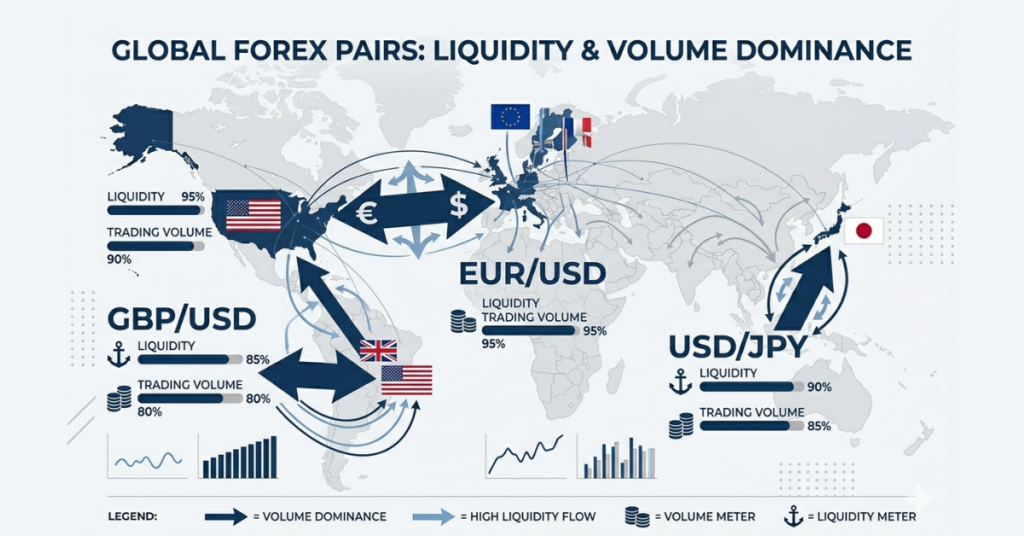
The most traded forex pairs in the world are all formed by combining G7 currencies. These are known as ‘major pairs’ and they account for the largest share of daily trading volume.
| Pair | Nickname | What It Represents |
| EUR/USD | Fiber | Euro vs US Dollar – most liquid pair in the world |
| GBP/USD | Cable | British Pound vs US Dollar – high volatility major |
| USD/JPY | Ninja / Gopher | US Dollar vs Japanese Yen – safe haven and carry trade |
| USD/CHF | Swissie | US Dollar vs Swiss Franc – safe-haven pair |
| USD/CAD | Loonie | US Dollar vs Canadian Dollar – oil-sensitive pair |
| EUR/GBP | Chunnel | Euro vs British Pound – European political sensitivity |
| EUR/JPY | Yuppy | Euro vs Japanese Yen – popular carry trade pair |
| GBP/JPY | Geppy | British Pound vs Japanese Yen – high volatility cross |
| EUR/CHF | Euro-Swissie | Euro vs Swiss Franc – correlated economies |
| GBP/CHF | – | British Pound vs Swiss Franc |
| CAD/JPY | – | Canadian Dollar vs Japanese Yen – commodity carry pair |
| CHF/JPY | – | Swiss Franc vs Japanese Yen – dual safe-haven pair |
You can use the Defcofx Forex Heat Map to monitor which G7 currencies are currently strong or weak in real time.
What Drives G7 Currency Movements?
Each G7 currency reacts to a specific set of economic drivers. Understanding these is key to building any forex trading strategy around major pairs.
Interest Rate Decisions
The single biggest driver of any G7 currency is the interest rate set by its central bank. Higher rates attract foreign capital seeking better returns, which strengthens the currency. Lower rates tend to weaken it. Rate decisions from the Federal Reserve, ECB, Bank of England, Bank of Japan, Bank of Canada, and SNB all move their respective currency pairs significantly.
Inflation Data
Central banks use inflation as the primary reason to raise or lower rates. When Consumer Price Index (CPI) data comes in above expectations, traders typically expect rate hikes and buy the related currency. Below-target inflation can push a currency lower as rate cuts become more likely.
GDP and Employment Reports
Strong GDP growth signals a healthy economy, which is generally positive for a currency. Employment data, especially the US Non-Farm Payrolls (NFP) report, is one of the most market-moving events in forex and directly impacts USD pairs.
Geopolitical Events and Risk Sentiment
When global markets are under stress from wars, financial crises, or political instability, investors typically move capital into safe-haven G7 currencies like JPY, CHF, and USD. This is called ‘risk-off’ behavior. In calmer times, higher-yielding currencies like GBP and CAD may outperform as traders take on more risk.
Trade Balances and Current Account Data
Countries that export more than they import (trade surplus) see demand for their currency rise, as foreign buyers need to purchase it to pay for goods. Japan and Germany are typical examples. Trade deficits can put downward pressure on a currency over time.
Track all major economic events using the Defcofx Economic Calendar, updated regularly with data releases from all G7 economies.
You can also read daily analysis on the Defcofx Daily Technical Analysis page to understand how these events are affecting current charts.
G7 Currencies in the Global Forex Market: Key Statistics
Here are some verified data points to help understand the scale and importance of G7 currencies in global forex trading:
- The global forex market trades over $7.5 trillion per day on average (Bank for International Settlements, 2022).
- The US Dollar is involved in approximately 88% of all forex transactions globally.
- The Euro (EUR) accounts for around 31% of daily forex volume as a counterpart currency.
- EUR/USD alone accounts for roughly 22-24% of total daily forex trading volume.
- The Japanese Yen is the third most traded currency globally, involved in about 17% of all transactions.
- G7 nations collectively account for around 40-45% of global GDP.
- G7 currencies together make up over 90% of global foreign exchange reserves held by central banks.
- GBP/USD has daily volume that regularly exceeds $400 billion, making it consistently one of the top five most traded pairs.
Trading G7 Currency Pairs with Leverage
One of the most important tools in forex trading is leverage. It allows you to control a larger position with a smaller deposit. G7 pairs, because of their high liquidity and tighter spreads, are well-suited for leveraged trading.
For example, with 1:100 leverage, a $500 deposit lets you control a $50,000 position in EUR/USD. This amplifies both potential gains and potential losses, which is why risk management tools like stop-loss orders and proper position sizing are essential.
Defcofx offers leverage of up to 1:2000 on forex pairs. Learn more on the leverage page or visit the dedicated 1:2000 leverage page for full details.
Use the Defcofx Margin Calculator and Position Size Calculator to plan your trade size and margin requirements before entering any position.
Trade G7 Currency Pairs with Defcofx
Defcofx is an online forex and CFD broker built on the MetaTrader 5 (MT5) platform. It offers access to all major G7 currency pairs along with minors, exotics, crypto CFDs, indices, stocks, and commodities.
Here is what traders get when they use Defcofx:
- Leverage up to 1:2000 on forex pairs, giving flexible trading power on all G7 pairs.
- Low spreads starting from 0.3 pips on major pairs with zero commissions or swap fees.
- A 40% welcome bonus on first deposits of $1,000 or more, applicable to all eligible clients.
- Withdrawals processed within 4 business hours, including on weekends.
- Full access to MT5 on web, desktop, and mobile.
- Market analysis tools including heat maps, economic calendar, and daily technical analysis.
- Educational resources including books and videos for traders at all levels.
Defcofx is registered in Saint Lucia and welcomes clients from around the world in multiple languages. Explore the full range of tradable instruments on the Defcofx Products page, or compare accounts on the accounts overview page.
Open a Live Trading AccountFinal Thoughts on G7 Currencies List
G7 currencies form the backbone of the global forex market. With unmatched liquidity, tight spreads, and strong institutional participation, they provide the most stable and accessible trading environment for both beginners and experienced traders. From the dominance of the US Dollar to the safe-haven appeal of the Japanese Yen and Swiss Franc, each currency brings its own behavior and opportunities to the market.
What makes G7 pairs especially valuable is their transparency and the depth of available data. Economic indicators, central bank policies, and geopolitical developments are widely covered, giving traders a clear framework to build informed strategies rather than relying on speculation alone.
FAQ
The G7 currencies are the US Dollar (USD), Euro (EUR), British Pound (GBP), Japanese Yen (JPY), Canadian Dollar (CAD), and Swiss Franc (CHF). These are the currencies of the seven most advanced economies in the world and represent the bulk of global forex trading volume.
Technically, Switzerland is not a member of the G7. However, the Swiss Franc (CHF) is widely grouped alongside G7 currencies in forex discussions because of its role as a global safe-haven currency and its deep connection to European financial markets. Most forex educators and brokers include CHF when referring to the major currencies.
EUR/USD is the most traded forex pair in the world, accounting for roughly 22-24% of total global forex volume. It combines the world’s two largest reserve currencies and offers the tightest spreads with the highest liquidity of any pair.
The G8 included Russia in addition to the G7 member nations. Russia was suspended from the group in 2014 following geopolitical events. The G7 currencies (USD, EUR, GBP, JPY, CAD, CHF) remain the core group in global finance. The Russian Ruble (RUB) is not considered a major currency in forex.
Central bank meetings are among the most market-moving events in forex. When the Federal Reserve, ECB, Bank of England, Bank of Japan, Bank of Canada, or SNB announces rate decisions or changes in policy guidance, it directly impacts the value of the related currency. These events often cause sharp spikes in volatility on the day of the announcement.
Yes. Defcofx offers a free demo account that gives you access to all major G7 currency pairs under real market conditions, but without using real money. This is an excellent way to practice your strategy before going live.
G7 currency pairs, especially majors like EUR/USD and GBP/USD, are generally recommended for beginners. They have the highest liquidity, tightest spreads, and the most publicly available analysis and educational content. Starting with these pairs gives new traders a more stable foundation before moving into minors or exotic pairs.