


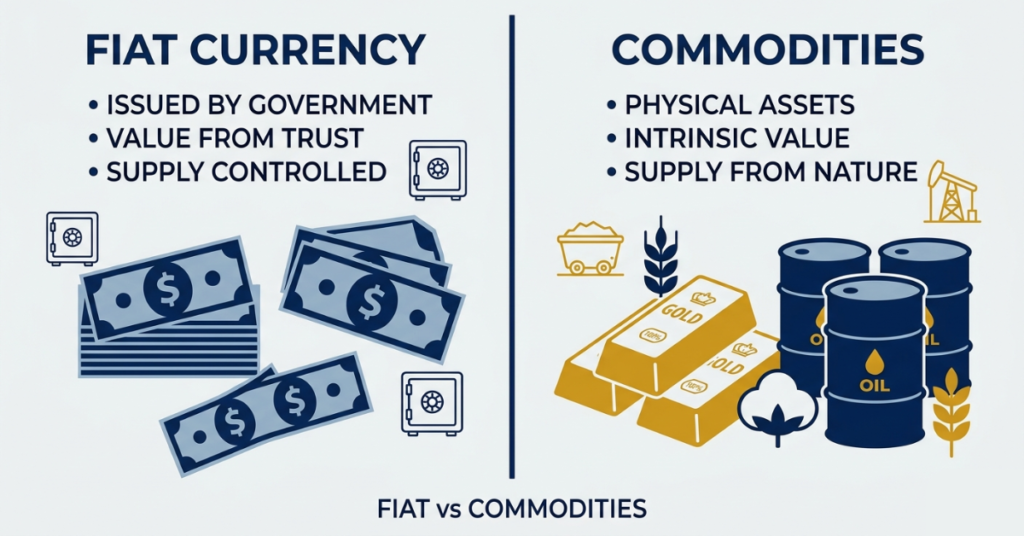
No, cash (fiat currency) is not a commodity in the traditional sense. Commodities are physical goods with intrinsic value, like gold, oil, or wheat. Cash is a medium of exchange backed by government authority, not by a physical resource. However, in forex markets, currencies are treated as tradeable assets, which creates some functional overlap worth understanding.
Key Takeaways
- Cash is a fiat currency, not a commodity. Its value is determined by government policy and market trust
- Commodities are physical goods (gold, oil, natural gas) with inherent use value
- In some academic and regulatory contexts, currencies can be treated similarly to commodities
- Forex trading involves buying and selling currency just as commodity trading involves buying and selling raw materials
- Gold was historically used as money, blurring the line between currency and commodity
What Is a Commodity?
A commodity is a raw material or primary agricultural product that can be bought, sold, and exchanged. Key examples include:
- Energy: crude oil, natural gas, heating oil
- Metals: gold, silver, copper, platinum
- Agricultural: wheat, corn, soybeans, coffee, sugar
- Livestock: cattle, hogs
The defining characteristic of a commodity is fungibility: one unit of a commodity is equivalent to any other unit of the same type. One barrel of West Texas Intermediate crude oil is the same as any other barrel of WTI crude oil. This standardisation makes commodities tradeable on exchanges.
Commodities also have intrinsic use value. Gold is used in electronics and jewellery. Oil powers vehicles and industrial machinery. Wheat becomes food. Their value is not purely based on trust, it comes from real-world utility.
Related read: How to Trade Commodities in Forex
What Is Cash (Fiat Currency)?
Fiat currency, what most people call cash, is money that a government has declared legal tender. The word ‘fiat’ means ‘by decree’ in Latin. The US dollar, the Euro, the British pound, and the Japanese yen are all fiat currencies.
Fiat money has no intrinsic value on its own. A $100 bill is physically worth almost nothing as paper. Its value comes entirely from the trust people have in the issuing government and central bank, and from its widespread acceptance as a medium of exchange.
Key characteristics of fiat currency:
- Value is maintained by government authority and central bank monetary policy
- Not backed by a physical commodity (the US abandoned the gold standard in 1971)
- Supply is controlled by central banks through interest rates and quantitative easing
- Can lose value to inflation over time
Cash vs Commodity: Key Differences
| Feature | Commodity | Cash (Fiat Currency) |
| Intrinsic value | Yes (e.g. gold is used in industry) | No (value is government-backed) |
| Traded on markets | Yes (commodity exchanges) | Yes (forex markets) |
| Supply controlled by | Nature / production limits | Central banks (monetary policy) |
| Fungibility | Yes (1 barrel of oil = 1 barrel) | Yes (1 USD = 1 USD) |
| Inflation hedge | Often yes (gold, oil) | No (loses value in inflation) |
| Used as currency | Historically yes (gold standard) | Primary function |
| Regulated as | Commodity by CFTC/ESMA | Currency by central banks |
| Tradeable via CFDs | Yes | Yes (via forex pairs) |
Where the Line Blurs: When Currency Acts Like a Commodity
The clean divide between cash and commodity gets complicated in a few important scenarios. This is where things get interesting for traders.
1. Forex trading treats currencies like tradeable assets
In forex markets, currencies are bought and sold just like commodities. When you buy EUR/USD, you are purchasing euros and selling dollars. The price fluctuates based on supply and demand, economic data, and market sentiment, much like oil or gold.
From a trader’s perspective, the mechanics are similar. You analyse charts, use leverage, manage risk, and aim to profit from price movements. The underlying instrument is different, but the trading process overlaps significantly.
Related: What Is Forex Trading and How Does It Work?
2. Gold used to be both money and a commodity
For most of modern history, gold was both a commodity and a currency. Under the gold standard, paper currency was directly backed by gold reserves. The US dollar could be exchanged for a fixed amount of gold.
When the Bretton Woods system collapsed in 1971, the dollar was unpegged from gold. Since then, gold has been a pure commodity, while the dollar became a purely fiat currency. But the historical link still explains why gold is often treated as a store of value similar to currency.
3. Commodity currencies in forex
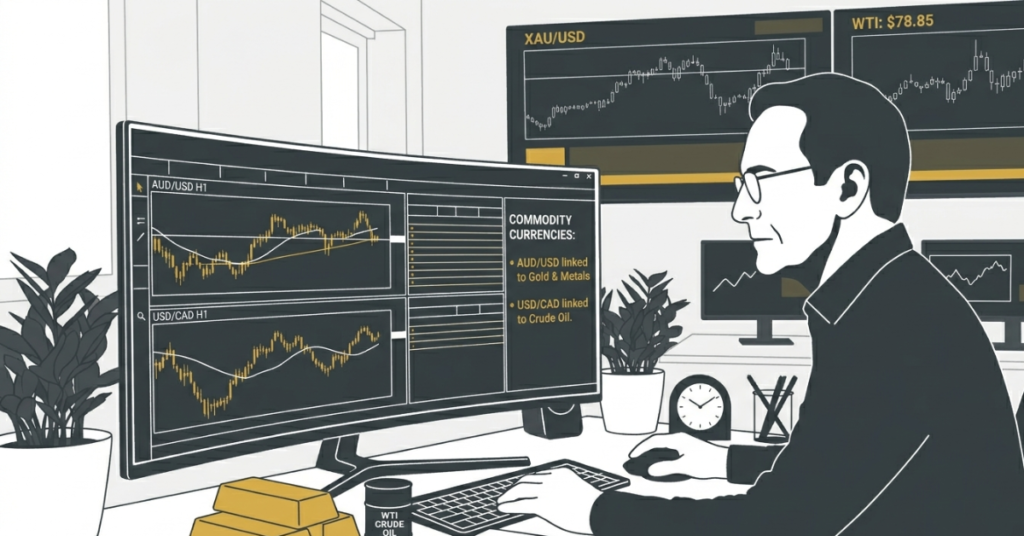
Some currencies are so closely tied to commodity exports that traders call them ‘commodity currencies’. The most well-known examples are:
- AUD/USD: Australia is a major exporter of iron ore, coal, and gold. The Australian dollar tends to rise when commodity prices rise.
- USD/CAD: Canada is a major oil exporter. CAD strengthens when oil prices go up.
- NZD/USD: New Zealand is a major agricultural exporter. Dairy and wool prices influence the NZD.
These currencies do not become commodities themselves, but their value is heavily influenced by commodity markets. Traders who understand both forex and commodities can use this relationship to their advantage.
Related: Forex Currency Pairs Overview
What Regulators Say: Is Currency a Commodity?
In the United States, the Commodity Futures Trading Commission (CFTC) has regulatory authority over certain foreign currency instruments, particularly forex futures and options. The Commodity Exchange Act (CEA) in the US broadly defines ‘commodity’ to include foreign currencies in some regulated contexts.
However, this is a regulatory classification for oversight purposes, not a statement that cash itself is a commodity. The key distinction remains: commodities have intrinsic physical value; fiat currencies do not.
What About Cryptocurrency? Is That a Commodity or Currency?
Bitcoin and other cryptocurrencies sit in a particularly interesting grey area. Some regulators (including the CFTC in the US) have classified Bitcoin as a commodity. Others treat it as a currency, a security, or something entirely new.
Key points on crypto:
- Bitcoin has a capped supply of 21 million coins, making it more like a scarce commodity than an inflationary fiat currency
- It has no government backing, unlike fiat currencies
- It has limited industrial utility compared to traditional commodities like gold or oil
- In practice, it is traded speculatively, more like a commodity futures market than a currency exchange
Related: Forex Trading vs Crypto Trading
What This Means for Your Trading
For traders, the cash vs commodity question has practical implications:
Diversification
Because currencies and commodities often move independently or inversely, trading both provides genuine diversification. For example, a falling US dollar (weak USD) typically pushes gold prices higher, since gold is priced in dollars globally.
Hedging
If you hold forex positions, understanding commodity price movements can help you hedge. A trader long AUD/USD might monitor iron ore prices as a leading indicator.
Inflation trades
When inflation rises, fiat currencies tend to lose purchasing power while commodity prices often rise. Traders use this knowledge to rotate between forex and commodity positions depending on the inflation environment.
Related: Impact of US Inflation Data on Forex Markets
Trade Both Currencies and Commodities with Defcofx
Defcofx gives you access to both forex pairs and commodity CFDs from a single MT5 platform. Whether you want to trade EUR/USD or spot gold, everything is in one place with the same competitive conditions.
- All 6 major forex pairs with spreads from 0.3 pips, no commission
- Commodity CFDs including gold (XAU/USD) and silver (XAG/USD)
- Indices, stocks, and crypto also available on MT5
- Leverage up to 1:2000 for flexible position sizing
- 40% Welcome Bonus on first deposits of $1,000 or more
- Withdrawals within 4 business hours including weekends
- Clients from all countries welcome, multilingual support available
Market Stats: Forex and Commodity Trading Today
- The global forex market trades over $7.5 trillion per day (BIS Triennial Central Bank Survey, 2022).
- The global commodity derivatives market sees trillions in notional value traded annually across exchanges.
- Gold is the most traded commodity globally, with daily OTC volumes estimated at $130 billion or more.
- Crude oil (WTI and Brent) has daily futures volume exceeding 1 billion barrels in notional terms.
- Commodity currencies (AUD, CAD, NZD) account for roughly 12% of global daily forex turnover.
Final Thoughts on Is Cash a Commodity?
Cash is not a commodity. The two belong to separate asset classes with different value drivers, different regulatory frameworks, and different roles in the global economy.
That said, the relationship between currencies and commodities is one of the most important dynamics in global markets. Understanding it, from commodity currencies like AUD/CAD to gold as an inflation hedge, makes you a better trader in both markets.
Defcofx gives you the platform to trade both, with low spreads, high leverage, and a professional MT5 environment whether you are going long on EUR/USD or buying gold as a hedge.
FAQ
No, cash (fiat currency) is not a commodity. It has no intrinsic use value. Its value comes from government decree and public trust. Commodities like gold, oil, and wheat have real-world physical utility that underpins their value.
Gold is classified as a commodity today. It was historically used as currency and as the basis for the gold standard, but since the end of the Bretton Woods system in 1971, it has been a pure commodity. Many traders still treat it as a store of value similar to a currency, which is why it is priced against the US dollar (XAU/USD).
In a functional sense, yes. Forex trading involves buying and selling currencies, and in some regulatory frameworks (like the US CFTC), foreign currency instruments are overseen under commodity trading laws. But economically, currencies and commodities are different asset classes.
Commodity currencies are currencies whose exchange rates are heavily influenced by commodity exports. The main examples are the Australian dollar (AUD), the Canadian dollar (CAD), and the New Zealand dollar (NZD). Traders watch commodity price trends as signals for these currency pairs.
This is still being debated by regulators globally. In the US, the CFTC has treated Bitcoin as a commodity. However, it is also used as a medium of exchange in some contexts. Most traders and analysts treat Bitcoin as a speculative asset with characteristics of both.
Yes, but in opposite directions. Inflation tends to erode the value of fiat currencies (they lose purchasing power). At the same time, inflation often drives up commodity prices, particularly gold and oil. This is why traders often buy commodities as an inflation hedge.
Yes. Defcofx’s MT5 platform gives you access to forex pairs, gold (XAU/USD), silver (XAG/USD), indices, and crypto all in one place. You can manage all positions from a single account.