


Forex trading, specifically spot currency pairs like EUR/USD or USD/JPY, is the quickest trade to learn. The concepts are straightforward, the market runs 24 hours a day five days a week, spreads are low, and you can start practising on a free demo account within minutes. You can grasp the basics in one to two weeks.
Key Takeaways
- Forex spot trading on major pairs is the fastest to pick up for most new traders
- Spot gold and silver CFDs are a close second due to their simple price movement logic
- Futures and options require significantly more time to understand and use effectively
- A demo account is the fastest, safest way to learn any trade before risking real money
- Defcofx offers free demo accounts and educational resources to help you get started fast
What Makes a Trade Quick to Learn?
Before answering what the quickest trade is, it helps to define what ‘quick to learn’ actually means. A trade being easy to pick up does not mean it is easy to profit from. It means the core concept is simple, the entry and exit mechanics are clear, and the market is accessible without complex instruments or significant capital requirements.
A trade is quick to learn when it has:
- Clear, understandable price drivers (economic data, supply and demand, etc.)
- Simple buy/sell mechanics without complex derivatives or margin calculations
- Low barrier to entry, both in capital and knowledge required
- Lots of free learning resources, tools, and practice environments
- Real-time feedback, so you learn quickly from what works and what does not
How Different Trades Compare by Learning Speed
| Trading Method | What You Trade | Time to Learn Basics | Complexity | Best For |
| Forex (Major Pairs) | Currency pairs | 1–2 weeks basics | Medium | All traders |
| Spot Gold / Silver | Commodities (CFDs) | 1–2 weeks | Low-Medium | Beginners |
| Stock CFDs | Company shares | 2–4 weeks | Medium-High | Experienced |
| Indices (e.g. US30) | Index baskets | 2–3 weeks | Medium | Intermediate |
| Crypto (BTC/ETH) | Cryptocurrencies | 1 week concepts | High volatility | Risk-tolerant |
| Futures | Contracts | 4–8 weeks | High | Advanced |
| Options | Derivatives | 8–12 weeks | Very High | Professional |
Why Forex Is the Quickest Trade to Learn
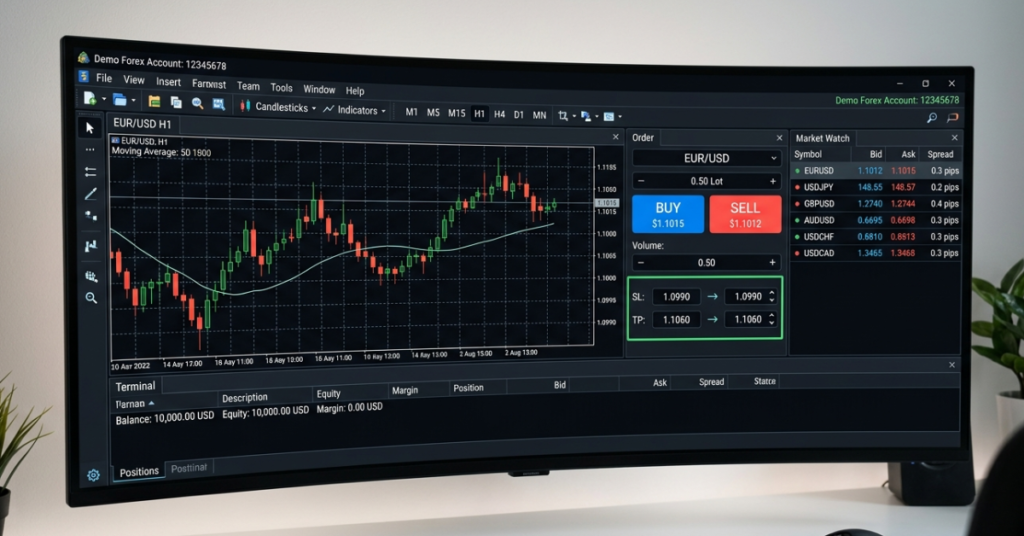
Forex, or foreign exchange trading, involves buying and selling currency pairs. When you trade EUR/USD, you are simply saying one currency will gain value relative to the other.
Here is why it tops the list for quick learning:
1. Simple concept
Buy if you think a currency will go up. Sell if you think it will go down. That is the entire premise. There is no dividend to track, no company earnings report to decode, and no option premium to calculate.
2. Free demo accounts
Every major broker, including Defcofx, offers free demo accounts with real market prices. You can practise forex without risking a cent, which dramatically shortens the learning curve.
Related: What Is a Demo Account in Forex?
3. 24/5 market access
Forex is open from Sunday evening to Friday night. You can practise and trade around your schedule, which is a significant advantage for people learning outside of standard business hours.
4. Enormous learning resources
Because forex is the largest financial market in the world, with over $7.5 trillion traded daily, there is more free educational content available for forex than virtually any other market.
5. Small starting capital
You can start trading forex with very small amounts. At Defcofx, you can open an account and get access to major pairs with competitive conditions.
Related: How to Trade Forex with $100
Second Quickest: Spot Gold and Silver (CFDs)

If forex does not appeal to you, spot gold (XAU/USD) and silver (XAG/USD) are a very close second in terms of ease of learning. These are traded as CFDs (Contracts for Difference) on most platforms, including MT5.
- Why gold and silver are easy to learn:
- Gold’s price is driven by a small number of clear factors: the US dollar strength, inflation expectations, and risk sentiment
- It moves in recognisable patterns that are easy to spot on charts
- There is no need to understand company fundamentals or complex derivatives
- Gold tends to be less noisy than some forex pairs, making chart analysis cleaner for beginners
Related: How to Trade Commodities in Forex
A Solid Third: Index CFDs (US30, S&P 500)
Trading index CFDs, like the Dow Jones (US30) or the S&P 500, gives you exposure to a basket of stocks without picking individual companies. You are essentially betting on the direction of the entire stock market or a specific sector.
It takes a little longer to learn because you need to understand macro factors like Fed policy, earnings seasons, and employment data. But once you get the logic, it is very accessible.
Related: What Is US30 in Forex?
What Takes Much Longer to Learn
Stock CFDs and equities
Individual stock trading requires understanding company fundamentals, earnings reports, sector dynamics, and management changes. These add layers of complexity that extend the learning time significantly.
Futures contracts
Futures involve contracts to buy or sell an asset at a future date and price. The mechanics of margin, rollover, contract expiry, and contango/backwardation make it a steeper learning curve. Most traders spend weeks just understanding the structure before placing a trade.
Options trading
Options are arguably the most complex retail instrument. You need to understand calls, puts, strike prices, expiry dates, premium decay (theta), and implied volatility. It can take months to trade options with any real confidence.
The Fastest Way to Learn Forex Trading Step by Step
- Open a free demo account at Defcofx and explore the MT5 platform for a few days without placing any trades.
- Learn the basics: what is a currency pair, what is a pip, what is a lot size, and how to place a buy/sell order.
- Start with one pair: EUR/USD is the best starting pair for most beginners.
- Learn one simple trading strategy first, such as support and resistance or moving average crossovers.
- Use a trading checklist before every demo trade so you build good habits from the start.
- Review your trades. What worked? What did not? Keep a simple journal.
- Once you are consistently profitable on demo for 2 to 4 weeks, consider moving to a live account with a small deposit.
Related: How to Trade Forex — Complete Beginner’s Guide
Also read: Forex Trading Checklist
Learn to Trade with Defcofx
Defcofx is designed for traders at all stages, from complete beginners to experienced professionals. Whether you want to practise with a demo or go live with real capital, Defcofx has the tools and conditions to support your learning.
- Free demo account with real market conditions on MT5
- Access to all major forex pairs, commodities, indices, and crypto
- Spreads starting from 0.3 pips, no commissions, no swap fees on most accounts
- Up to 1:2000 leverage, giving you flexibility as you grow your account
- 40% Welcome Bonus on first deposits of $1,000 or more
- Withdrawals processed within 4 business hours, including weekends
- Support team available to help new traders with platform and account questions
Related: Best Forex Website for Traders
Also read: Top 5 Tips for Becoming a Full-Time Forex Trader
Open a Live Trading AccountFinal Thoughts on What’s the Quickest Trade to Learn
If you are looking for the quickest trade to learn, forex is your best starting point. It is accessible, well-documented, and practicable for free through demo accounts. Spot gold is a strong second option if you prefer commodity markets.
The key is not just learning fast, it is learning properly. Use a demo account, follow a simple strategy consistently, and do not rush to go live until you have built real confidence. Defcofx gives you all the tools to do exactly that.
FAQ
Forex spot trading, especially on major pairs like EUR/USD, is the easiest trade to learn for most beginners. The concept is simple, demo accounts are free, and there is an enormous amount of free educational content available.
You can understand the basic concepts, how to place a trade, what pips are, and how to use simple indicators, in one week. However, becoming a consistent, profitable trader takes more time and practice. Use a demo account to accelerate your learning without risking real money.
Gold (XAU/USD) has fewer price drivers than many forex pairs, which can make it simpler to analyse for beginners. However, gold can be very volatile during US economic releases and geopolitical events, so risk management is still essential.
Most traders can learn the basics in one to two weeks. Becoming consistently profitable typically takes months of practice and discipline. The timeline shortens significantly when you use a structured approach and a demo account.
A demo account uses virtual money in real market conditions. It is ideal for learning without financial risk. A live account uses real money and involves real emotional pressures that demo trading does not replicate fully. Most traders should start with demo and transition to live only after consistent practice.
Yes. Defcofx allows you to open a live account with competitive conditions. You can also practise for free on a demo account with no deposit required.