


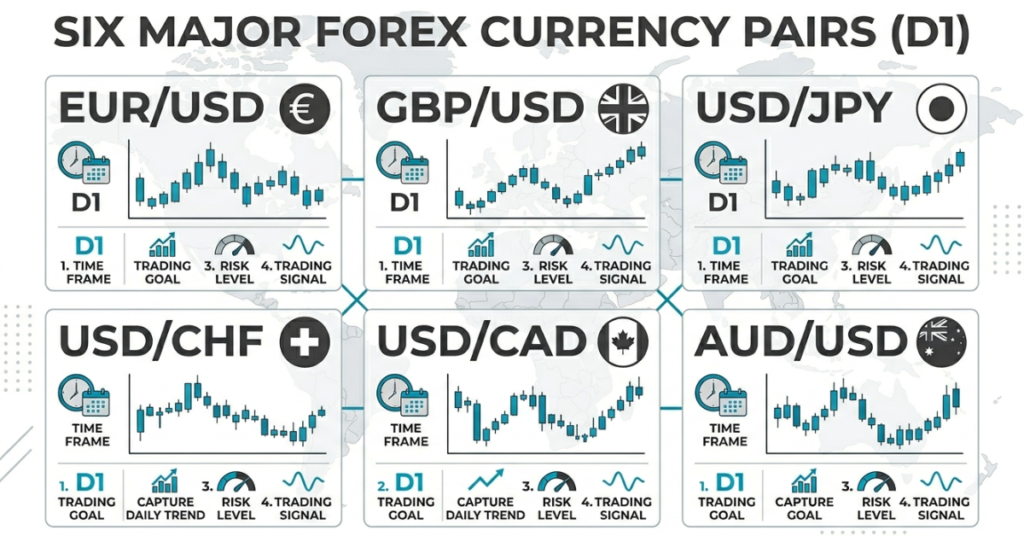
The 6 major currency pairs in forex are EUR/USD, USD/JPY, GBP/USD, USD/CHF, AUD/USD, and USD/CAD. All six include the US dollar and account for the bulk of daily forex trading volume worldwide. They offer high liquidity, tighter spreads, and more predictable price action compared to exotic or minor pairs.
Key Takeaways
- All 6 major pairs involve the US dollar (USD)
- EUR/USD is the most traded pair in the world
- Major pairs have the lowest spreads and highest liquidity
- Each pair behaves differently based on economic data and central bank decisions
- Defcofx offers all major pairs with spreads starting from 0.3 pips
Why Currency Pairs Are the Foundation of Forex Trading
Forex trading is all about exchanging one currency for another. Every trade you make involves a pair, a base currency and a quote currency. The major pairs are the ones that move the most volume globally, making them the most traded, most liquid, and typically the most beginner-friendly.
Understanding the 6 major forex pairs is not just a starting point. It is the core of how the forex market operates day to day. Whether you are scalping EUR/USD during the London session or holding a USD/CAD position overnight, knowing these pairs inside out makes a real difference.
The 6 Major Currency Pairs at a Glance
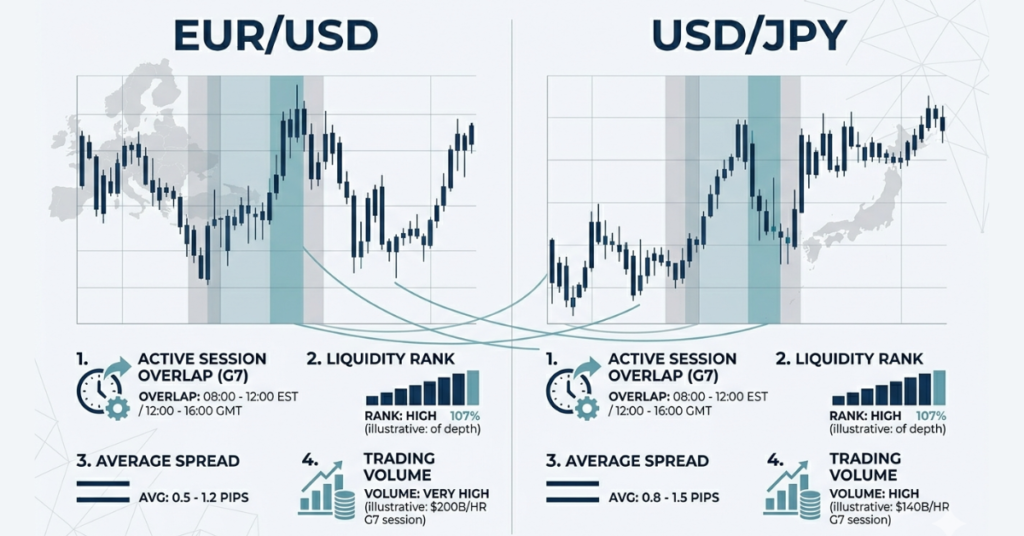
| Pair | Nickname | Countries | Avg Daily Volume | Spread (approx) |
| EUR/USD | The Fiber | Eurozone / USA | ~$1.1 trillion | 0.1–1 pip |
| USD/JPY | The Gopher | USA / Japan | ~$750 billion | 0.5–1 pip |
| GBP/USD | The Cable | UK / USA | ~$630 billion | 0.5–2 pips |
| USD/CHF | The Swissie | USA / Switzerland | ~$380 billion | 0.5–2 pips |
| AUD/USD | The Aussie | Australia / USA | ~$350 billion | 0.5–2 pips |
| USD/CAD | The Loonie | USA / Canada | ~$260 billion | 0.5–2 pips |
Now let’s break each one down in detail.
1. EUR/USD: The Fiber
EUR/USD is the most traded currency pair in the world. It represents the exchange rate between the Euro (used by 20 Eurozone countries) and the US Dollar. On any given day, EUR/USD trading volume can exceed $1 trillion.
- This pair is extremely popular because:
- It has the tightest spreads of any pair
- It reflects two of the world’s largest economies
- News from the US Federal Reserve and the European Central Bank (ECB) directly move it
- It is available to trade nearly 24 hours, 5 days a week
Related read:Forex Currency Pairs Overvie
2. USD/JPY: The Gopher
USD/JPY is the second most traded pair and reflects the exchange rate between the US Dollar and the Japanese Yen. Japan has the third-largest economy in the world, and the Yen is known as a safe-haven currency.
What makes USD/JPY stand out:
- Very tight spreads, similar to EUR/USD
- Heavily influenced by the Bank of Japan (BoJ) interest rate decisions
- The Japanese Yen is seen as a safe haven during global risk-off events
- US Treasury yields have a strong correlation with this pair
Related read: Japanese Yen Carry Trade Explained
3. GBP/USD: The Cable
GBP/USD is nicknamed ‘The Cable’ because in the 1800s, the exchange rate between the British Pound and US Dollar was transmitted via an underwater transatlantic cable. It remains one of the most volatile major pairs today.
Key things to know about GBP/USD:
- Higher volatility than EUR/USD, which means bigger moves but also bigger risk
- Strongly impacted by UK economic data, Bank of England (BoE) policy, and political events
- Popular among experienced traders who understand how to manage wider spreads
- Post-Brexit trade developments continue to affect this pair’s longer-term trends
4. USD/CHF: The Swissie
USD/CHF measures the US Dollar against the Swiss Franc. Switzerland’s economy and its central bank, the Swiss National Bank (SNB), are key drivers of this pair. The Swiss Franc is another safe-haven currency, similar to the Yen.
Characteristics of USD/CHF:
- Tends to move inversely to EUR/USD due to the Franc-Euro relationship
- Reacts strongly to global uncertainty and financial crises
- The SNB is known for direct currency interventions when the Franc gets too strong
- Less volatile on average compared to GBP/USD, but can spike on geopolitical news
5. AUD/USD: The Aussie
AUD/USD reflects the Australian Dollar against the US Dollar. Australia is a major commodity exporter, meaning gold, iron ore, and coal prices often influence the Aussie. It is closely tied to China’s economic activity because China is Australia’s biggest trading partner.
Why traders watch AUD/USD:
- Strong correlation with commodity prices, especially gold and iron ore
- China’s GDP data and trade reports often move the Aussie
- Reserve Bank of Australia (RBA) rate decisions are key events for this pair
- It is often used as a proxy for risk appetite in global markets
Related read: How to Trade Commodities in Forex
6. USD/CAD: The Loonie
USD/CAD measures the US Dollar against the Canadian Dollar. The Canadian economy is heavily dependent on oil exports, so crude oil prices have a direct impact on the Loonie. The pair is also influenced by US-Canada trade relations.
What drives USD/CAD:
- Crude oil prices: when oil rises, CAD tends to strengthen (USD/CAD falls)
- Bank of Canada (BoC) interest rate decisions
- US-Canada trade data, given the close economic ties between the two countries
- Employment reports from both countries move this pair significantly
Forex Market Stats Worth Knowing
- The global forex market trades over $7.5 trillion per day (BIS Triennial Survey, 2022).
- The 6 major pairs collectively account for roughly 70–75% of total forex trading volume.
- EUR/USD alone represents approximately 22% of all daily forex transactions.
- USD is involved in around 88% of all forex trades globally.
- Retail forex traders account for approximately 5% of the total daily forex volume.
How to Choose Which Major Pair to Trade
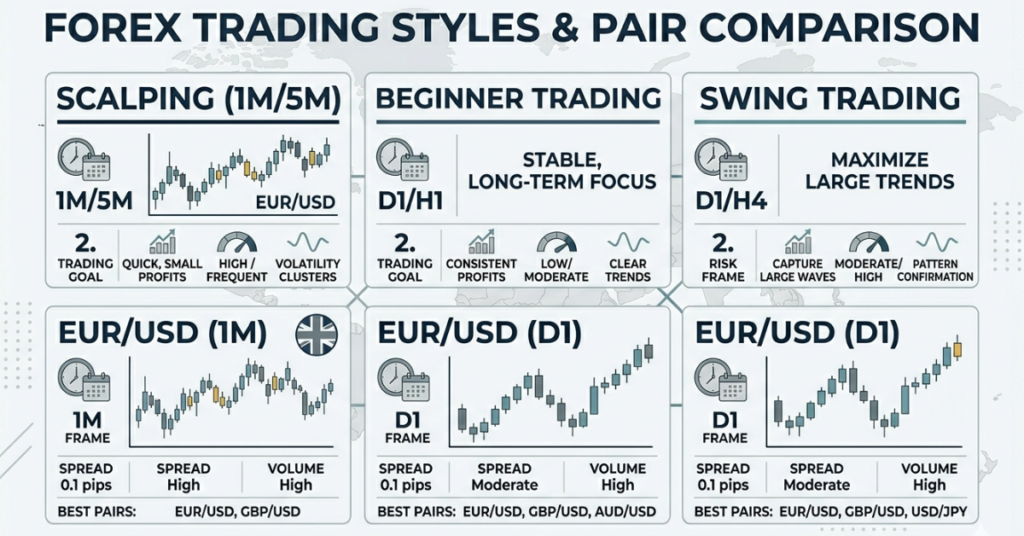
| Trading Style | Best Major Pair(s) | Why |
| Beginner | EUR/USD, USD/JPY | Tightest spreads, most educational resources available |
| Scalper | EUR/USD, GBP/USD | High volume and sharp intraday moves |
| Swing Trader | GBP/USD, AUD/USD | Clear trend structures and medium-term volatility |
| News Trader | USD/CAD, USD/JPY | Strong reactions to economic releases |
| Safe Haven Seeker | USD/CHF, USD/JPY | Both CHF and JPY strengthen in risk-off markets |
Spreads and Liquidity: Why They Matter for Major Pairs
Spread is the difference between the buy price (ask) and the sell price (bid) of a currency pair. It is essentially the cost of entering a trade.
Major pairs have the lowest spreads because they have the highest trading volume. Here is why that matters:
- Lower spreads mean lower cost per trade
- More liquidity means easier order execution, especially for larger positions
- Tighter spreads allow tighter stop losses, which is essential for risk management
Related read: What Is a Spread in Forex?
Why Trade Major Pairs with Defcofx
Defcofx is a global forex and CFD broker built on MetaTrader 5 (MT5), giving traders access to all 6 major currency pairs and more, with conditions that support serious trading.
Here is what Defcofx brings to the table for major pair traders:
- Spreads from 0.3 pips on major pairs, with no hidden commissions
- Leverage up to 1:2000, giving you flexibility on position sizing
- 40% Welcome Bonus on your first deposit of $1,000 or more
- Fast withdrawals completed within 4 business hours, including weekends
- MT5 platform with advanced charting, indicators, and one-click trading
- Clients from all countries welcome, with multilingual support
Related read: Best Forex Broker for Beginners
Also see: How to Open a Forex Trading Account
Open a Demo Trading AccountPractical Tips for Trading Major Currency Pairs
- Focus on one or two pairs when starting out. Mastering EUR/USD before jumping to five pairs is a smarter approach.
- Know the session timings. EUR/USD is best during London-New York overlap. AUD/USD is most active during Sydney and Tokyo sessions.
- Watch central bank calendars. Fed, ECB, BoE, BoJ, RBA, BoC decisions are market-moving events for each respective pair.
- Use a demo account to test your strategy before going live. Defcofx offers a free demo with real market conditions.
- Check the spread before entering a trade. Spreads can widen during major news events even on major pairs.
Related read: Top 15 Forex Trading Tips for Beginners
Also read: Forex Risk Management Guide
Final Thoughts on 6 Major Currency pairs
The 6 major currency pairs are the backbone of forex trading. They offer liquidity, predictability, and lower costs that make them suitable for all types of traders. Whether you are a beginner trying to understand how forex works or an experienced trader fine-tuning your strategy, these pairs are where most of the action happens.
Understanding each pair, what drives it, when it is most active, and how it behaves during news events, is the foundation of consistent trading.
FAQ
The 6 major forex pairs are EUR/USD, USD/JPY, GBP/USD, USD/CHF, AUD/USD, and USD/CAD. All six involve the US dollar and represent the most traded and most liquid pairs in the global forex market.
They are called major pairs because they are the most heavily traded, have the highest daily volume, and involve the US dollar paired with another major world currency. They offer the tightest spreads and the most market information compared to minor or exotic pairs.
EUR/USD is generally the best starting point for beginners. It has the tightest spreads, the most available analysis, and tends to follow relatively clear technical patterns. USD/JPY is another beginner-friendly option.
Yes. Because major pairs have the highest trading volume, brokers can offer tighter spreads. At Defcofx, major pair spreads start from 0.3 pips with no commission.
EUR/USD is the most traded currency pair globally, accounting for roughly 22% of daily forex transactions according to the Bank for International Settlements (BIS).
Yes. Defcofx uses MetaTrader 5 (MT5), which gives you full access to all major currency pairs, advanced charting tools, and automated trading features.
Major pairs all include USD and have high liquidity. Minor pairs (also called cross pairs) do not include USD, such as EUR/GBP or AUD/JPY. Exotic pairs involve one major currency and one from a developing economy, such as USD/TRY or EUR/ZAR. Exotics have wider spreads and lower liquidity.