


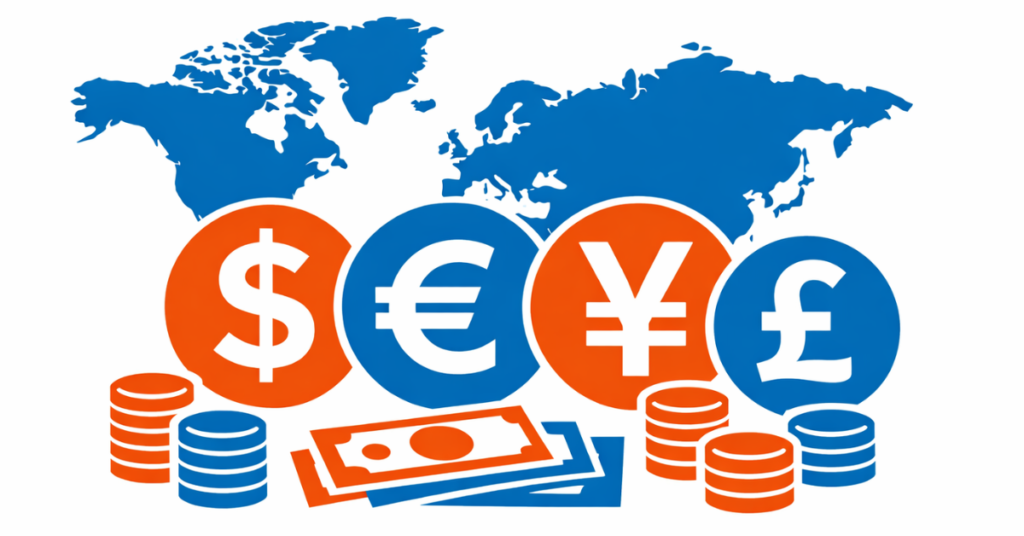
There are approximately 170 to 180 currencies worldwide, depending on how they are classified. According to ISO 4217 standards, around 180 currency codes exist, although fewer are actively used in circulation. Despite this large number, only a small group of currencies dominate global trade, finance, and forex markets.
Want to trade the world’s most active currencies? Explore how Defcofx provides access to major forex markets with competitive trading conditions.
Open a Live Trading AccountKey Takeaways
- There are approximately 170 to 180 currencies in the world, depending on how they are counted.
- The total number varies due to differences in official recognition, shared currencies, and unofficial usage.
- Not all currencies are considered international, only a few are widely used in global trade and finance.
- Some regions share a single currency, while others adopt foreign currencies instead of issuing their own.
- Only a limited number of currencies are actively traded in the forex market, making them more important for global investors and traders.
- Most currencies are used only domestically and are not actively traded in forex markets.
What Are International Currencies?
International currencies are those that are widely accepted and used beyond their home country for global trade, investments, and financial transactions. Unlike local or domestic currencies, these currencies have strong demand worldwide and are commonly used in cross-border payments, reserves, and international contracts.
In simple terms, every country may have its own currency, but not all of them are considered “international.” A currency becomes international when it is trusted, stable, and frequently used by governments, businesses, and financial institutions across different countries.
For example, the US Dollar (USD) is the most widely used international currency, followed by the Euro (EUR) and the British Pound (GBP). These currencies are often used for international trade, foreign exchange reserves, and global investments.
This distinction is important because it highlights that while there are many currencies in the world, only a small group truly operates at an international level, influencing global markets and economies.
How Many Currencies Exist in the World?
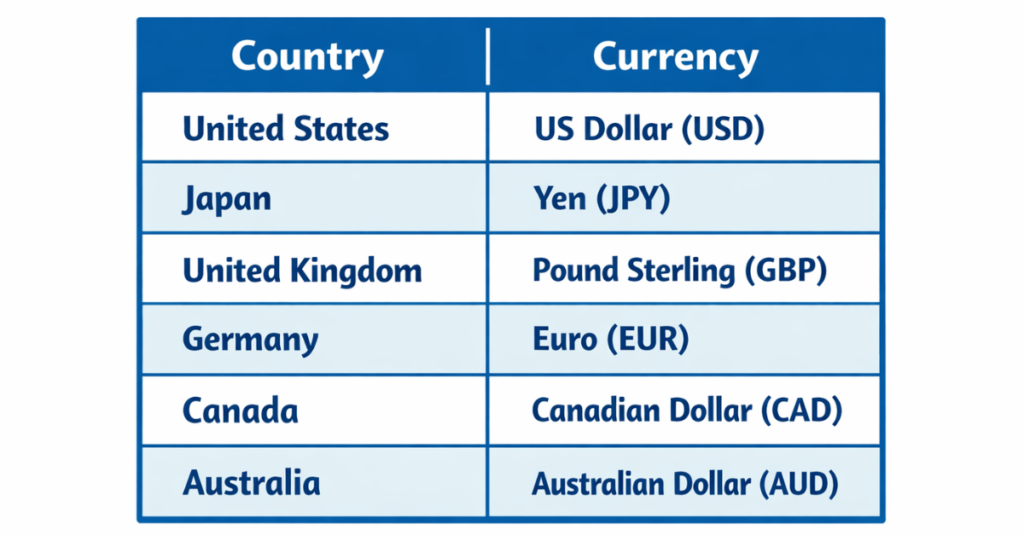
There are currently around 170 to 180 recognized currencies globally, but this number can fluctuate based on different classifications. The count includes currencies issued by sovereign nations, as well as those used in territories, partially recognized states, or regions that have their own monetary systems.
Some countries share a single currency, such as the Euro (EUR) used by multiple European Union nations, which reduces the total number of distinct currencies in active use. Others adopt foreign currencies instead of issuing their own, such as Ecuador using the US Dollar (USD).
Table: Example of Countries and Their Currencies
| Country / Territory | Currency | ISO Code |
| United States | US Dollar | USD |
| European Union (selected) | Euro | EUR |
| United Kingdom | British Pound | GBP |
| Japan | Japanese Yen | JPY |
| Switzerland | Swiss Franc | CHF |
| Ecuador | US Dollar | USD |
| Zimbabwe | Zimbabwe Dollar | ZWL |
This table highlights that while the number of currencies is large, actual global usage is concentrated in key currencies that dominate international trade and finance.
Why the Number of Currencies Varies
The total number of currencies in the world isn’t fixed because of several key factors:
- ISO Currency Codes vs. Real-World Use: The ISO 4217 standard assigns a code to officially recognized currencies, but not all codes correspond to actively used currencies. Some exist only for accounting or historical purposes.
- Shared Currencies: Certain regions, like the Eurozone, share a single currency (Euro – EUR) across multiple countries, reducing the number of distinct currencies in practical use.
- Unrecognized or Semi-Recognized States: Territories or partially recognized countries may issue their own currency, but these aren’t universally counted as international currencies. Examples include Kosovo (Euro usage) or Somaliland (Somaliland Shilling).
- Pegged and Unofficial Currencies: Some currencies are pegged to stronger currencies like the USD or EUR, or used alongside them. These variations make counting total currencies more complex.
- Some currencies exist mainly for accounting or financial reporting purposes and are not actively traded.
This explains why different sources report slightly different numbers of world currencies, even though the total range remains around 170–180.
How Many Currencies Are Truly “International”?
Although there are around 170–180 currencies globally, only a small number are widely used in international trade and finance. These currencies are trusted, stable, and frequently held as foreign reserves by governments and financial institutions.
Major International Currencies:
- US Dollar (USD): The dominant reserve and trade currency worldwide.
- Euro (EUR): Used by multiple European countries and widely held globally.
- British Pound (GBP): Trusted and stable, often used in international contracts.
- Japanese Yen (JPY): Important in Asia and global finance.
- Swiss Franc (CHF): Considered a safe-haven currency.
List of Major Global Currencies
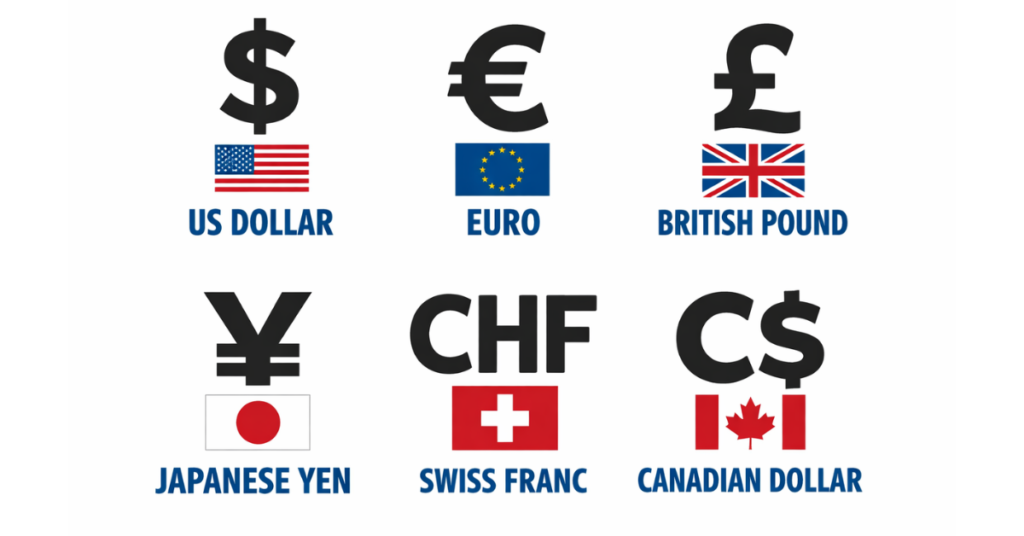
Not all currencies hold equal importance in the global economy. While there are over 170 currencies worldwide, only a handful dominate international trade and financial markets. These are widely recognized, stable, and actively traded in the forex market.
Table: Major Global Currencies
| Currency | Country / Region | ISO Code | Usage / Importance |
| US Dollar | United States | USD | Global reserve, trade, forex dominance |
| Euro | Eurozone | EUR | Used by multiple EU countries, major reserve currency |
| British Pound | United Kingdom | GBP | Trusted for international contracts |
| Japanese Yen | Japan | JPY | Key Asian and global trade currency |
| Swiss Franc | Switzerland | CHF | Safe-haven currency, widely held |
| Canadian Dollar | Canada | CAD | Commonly traded in forex |
| Australian Dollar | Australia | AUD | Major commodity currency |
| Chinese Yuan | China | CNY | Growing international trade influence |
Focusing on these currencies is essential for anyone involved in global finance, investment, or trading. They also form the core of most trading platforms, including brokers like Defcofx, where major pairs are offered for traders.
Which Currency Is Used the Most Worldwide?
The US Dollar (USD) is the most widely used currency internationally, and its influence is unmatched in global finance. It is not only the primary reserve currency held by central banks worldwide but also the standard currency for pricing key commodities such as oil, gold, and other raw materials. Because of its stability, liquidity, and global acceptance, most international contracts and trade agreements default to USD, even in countries that do not use it domestically.
Other major international currencies include the Euro (EUR), used across many European Union nations; the British Pound (GBP), known for its long-standing stability; and the Japanese Yen (JPY), which is important in Asia and global financial markets. These currencies are also widely held as foreign reserves, used in cross-border trade, and actively traded on forex markets, giving them both economic and financial significance.
This understanding is crucial for anyone involved in international finance or forex trading. Focusing on these major international currencies allows traders to benefit from high liquidity, predictable market behavior, and more trading opportunities, while platforms like Defcofx ensure they can trade efficiently with optimal conditions.
How Many Currencies Are Traded in Forex?
While there are over 170 currencies worldwide, only about 50–70 currencies are actively traded in the global foreign exchange (forex) market. These include the major currencies USD, EUR, GBP, JPY, CHF as well as minor and exotic currencies from emerging economies.
Trading volume in forex is heavily concentrated in these major currencies, making them the most liquid and widely traded pairs. For example, the EUR/USD, GBP/USD, and USD/JPY pairs dominate daily forex trading, while exotic pairs like USD/TRY or EUR/ZAR see lower liquidity and higher volatility.
Why International Currencies Matter in Trading
International currencies are important for several reasons, and understanding their role is essential for traders and investors.
Key Points:
- Liquidity: Major international currencies are highly liquid, meaning trades can be executed quickly without significantly affecting prices.
- Stability: Well-recognized currencies, like USD and EUR, tend to have lower volatility compared to exotic or local currencies.
- Global Trade: Most international trade contracts and commodity prices are denominated in a few major currencies.
- Diversification: Traders can diversify portfolios by holding currencies from different economies.
Table: Importance of Major Currencies in Trading
| Currency | Importance | Typical Use |
| US Dollar (USD) | Most liquid, global reserve | International trade, forex pairs |
| Euro (EUR) | Shared by multiple countries | Cross-border transactions, reserves |
| British Pound (GBP) | Stable, historically strong | Investment and hedge purposes |
| Japanese Yen (JPY) | Key Asian currency | Forex trading, safe-haven during crises |
| Swiss Franc (CHF) | Safe-haven currency | Risk management in volatile markets |
Risks of Currency Trading
Trading international currencies can be highly rewarding, but it also carries several risks that traders must understand before participating in the forex market.
Key Risks:
- Volatility Risk: Currency values fluctuate constantly due to economic, political, or geopolitical events. High volatility can lead to significant gains or losses.
- Leverage Risk: Using leverage amplifies both profits and losses. Traders must carefully manage their positions to avoid large drawdowns.
- Liquidity Risk: Not all currency pairs have the same trading volume. Exotic or less-traded currencies can experience wide spreads or delayed order execution.
- Economic and Political Risk: Changes in government policies, central bank decisions, or economic crises can drastically affect currency values.
Table: Risk Examples in Currency Trading
| Risk Type | Example | Impact on Trader |
| Volatility Risk | GBP/USD sudden swing due to Brexit news | Large gains or losses in minutes |
| Leverage Risk | 1:1000 leveraged position on USD/JPY | Amplified loss if market moves against you |
| Liquidity Risk | USD/ZAR low-volume trading | Wider spreads, slower execution |
| Political/Economic Risk | Unexpected central bank rate change | Sharp currency movement, unpredictability |
Who Should Trade Currencies?
Not every trader is suited for currency trading. Understanding who benefits most helps avoid unnecessary losses and improves the chances of success.
Ideal Participants:
- Experienced Traders: Those familiar with market analysis, technical indicators, and macroeconomic factors.
- Risk-Tolerant Individuals: Traders willing to handle market volatility and potential losses.
- Global Market Enthusiasts: People interested in monitoring international economies and using that knowledge in trades.
Less Suitable For:
- Complete Beginners: Without proper education or demo practice, beginners may face steep learning curves.
- Conservative Investors: Those prioritizing capital preservation may find high volatility and leveraged trading too risky.
- Traders Without Risk Management: Individuals who do not use stop-losses, position sizing, or hedging strategies.
FAQs
There are approximately 170–180 currencies globally, though the number varies depending on whether you count shared currencies, unrecognized territories, or pegged currencies.
The Kuwaiti Dinar (KWD) is often considered the strongest currency in terms of exchange rate value, though major international currencies like USD, EUR, GBP, and JPY dominate global trade and reserves.
The US Dollar (USD) is the most widely used currency worldwide for trade, investment, and as a reserve currency held by central banks.
No. While there are around 170–180 currencies globally, only 50–70 currencies are actively traded in the forex market. Major currencies dominate trading volume, while minor and exotic currencies are less liquid and carry higher risk.
Forex trading typically involves major, minor, and exotic pairs. There are over 150 possible currency pairs, but most trading activity is concentrated in the major pairs like EUR/USD, GBP/USD, and USD/JPY.
Because major currencies offer high liquidity, tighter spreads, and more stable price behavior, making them more suitable for trading.
Final Thoughts on How many international currencies are there?
In summary, the world has around 170 to 180 currencies, but only a small number are considered truly international and dominate global trade and finance. Major currencies like the US Dollar (USD), Euro (EUR), British Pound (GBP), and Japanese Yen (JPY) are widely traded and held as reserves, forming the backbone of the global financial system.
Understanding the scope of international currencies is essential not only for global finance but also for forex trading. By knowing which currencies are widely used, individuals can make informed trading decisions, manage risk more effectively, and identify opportunities in the global market.
Start trading the world’s most active currencies, create your Defcofx account and access global forex markets with flexible trading conditions.
Open a Live Trading Account