



G4 currencies refer to the four most influential and widely traded currencies in the global financial system: the US Dollar (USD), Euro (EUR), Japanese Yen (JPY), and British Pound (GBP). These currencies dominate forex markets due to their strong economies, high liquidity, and central role in international trade and finance.
Key Takeaways
- G4 currencies include the US Dollar (USD), Euro (EUR), Japanese Yen (JPY), and British Pound (GBP), which are the most traded currencies globally.
- They dominate the forex market due to their high liquidity, economic stability, and global demand.
- These currencies form the foundation of major forex pairs like EUR/USD and USD/JPY.
- Traders prefer G4 currencies because they offer tight spreads, fast execution, and consistent price movements.
What Are the G4 Currencies? (In-Depth Explanation)
G4 currencies are the four most dominant and influential currencies in the global financial system:
- US Dollar (USD)
- Euro (EUR)
- Japanese Yen (JPY)
- British Pound (GBP).
In forex trading, the term “G4” is used to describe currencies that consistently show the highest trading volume and global acceptance. These currencies are grouped together because they represent some of the largest and most stable economies in the world. Their strength comes from factors such as strong central banking systems, high international demand, and widespread use in global trade and reserves.
For example, the US Dollar alone is used in a significant portion of international transactions, making it the backbone of the forex market.
From a trading perspective, G4 currencies are known for their deep liquidity, meaning there are always buyers and sellers available. This results in smoother price movements, lower transaction costs, and better execution key advantages for both beginner and professional traders.
Another important reason these currencies are categorized together is their predictability compared to exotic currencies. While no market is risk-free, G4 currencies tend to react more systematically to economic data such as interest rates, inflation, and employment reports. This makes them easier to analyze using both fundamental and technical strategies.
List of G4 Currencies Explained Individually
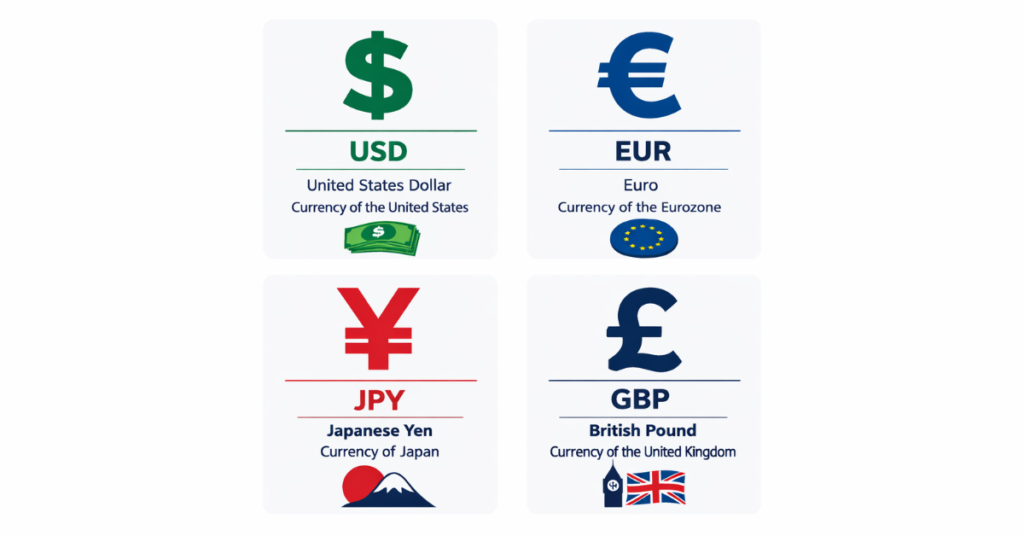
To truly understand G4 currencies, it’s important to look at each one individually and see why it holds such a strong position in the global financial system.
US Dollar (USD)
The US Dollar is the most dominant currency in the world and acts as the primary global reserve currency. It is widely used in international trade, especially for commodities like oil and gold. Because of the economic strength of the United States and the influence of its central bank (the Federal Reserve), USD is involved in the majority of forex transactions.
Euro (EUR)
The Euro is the official currency of the Eurozone, which consists of multiple European countries. It is the second most traded currency globally and represents a large, unified economic region. The Euro plays a major role in global finance due to the economic stability and trade power of countries like Germany and France.
Japanese Yen (JPY)
The Japanese Yen is known as a safe-haven currency, meaning investors often move their money into it during times of economic uncertainty. Japan’s strong export economy and low interest rate environment make the Yen a unique and highly traded currency, especially during volatile market conditions.
British Pound (GBP)
The British Pound is one of the oldest and most historically significant currencies in the world. It remains a major player in forex markets due to the financial influence of the United Kingdom, particularly London, which is one of the largest financial hubs globally. GBP is often more volatile compared to other G4 currencies, creating both opportunities and risks for traders.
Why Are G4 Currencies the Most Traded in the World?
G4 currencies dominate forex trading because they combine stability, liquidity, and global relevance. Traders, corporations, and governments prefer these currencies for international transactions, investments, and reserves, which consistently drives high trading volumes.
- Liquidity and Stability: One of the main reasons G4 currencies are highly traded is their liquidity. There are always buyers and sellers available in the market. High liquidity ensures smoother price movements and lower spreads, which is ideal for both short-term traders and long-term investors. Their stability also reduces unpredictable swings, making them a safer option compared to emerging or exotic currencies.
- Global Reserve Currency Status: The US Dollar, Euro, Japanese Yen, and British Pound are held in significant amounts by central banks worldwide as reserve currencies. This widespread acceptance reinforces their demand and ensures continuous trading activity across different time zones.
- Impact on Global Trade: These currencies are commonly used in international trade settlements, including commodities like oil, gold, and industrial products. Companies and governments rely on G4 currencies to conduct cross-border transactions efficiently, which further increases their trading volume.
- Predictable Market Behavior: Compared to less traded currencies, G4 currencies respond more predictably to economic data and policy changes, such as interest rate announcements or GDP reports. This predictability makes them more attractive for traders using both fundamental and technical strategies.
What Are G4 Currency Pairs? (Major Forex Pairs Explained)
G4 currency pairs are combinations of the four major currencies (USD, EUR, JPY, GBP) that are most frequently traded in the forex market. These pairs are often referred to as “major pairs” because they involve at least one G4 currency and are highly liquid, making them ideal for trading.
Examples of Major G4 Pairs:
- EUR/USD – Euro vs US Dollar, the most traded currency pair worldwide
- GBP/USD – British Pound vs US Dollar
- USD/JPY – US Dollar vs Japanese Yen
- EUR/GBP – Euro vs British Pound
Why Traders Prefer These Pairs:
- High Liquidity: There’s always a buyer and seller, which ensures smoother price movements.
- Tight Spreads: Trading costs are lower, often starting from 0.3 pips, making them cost-efficient for scalping and day trading.
- Predictable Behavior: G4 pairs tend to respond consistently to economic data, such as interest rates, employment figures, and central bank announcements.
- Global Accessibility: These pairs are available on nearly all trading platforms, allowing traders worldwide to participate.
How G4 Currencies Work in Forex Trading
Trading G4 currencies involves buying one currency and selling another simultaneously. This is done through currency pairs, where the value of one currency is quoted against another. For example, in the EUR/USD pair, buying means you expect the Euro to strengthen against the US Dollar, while selling means you anticipate it will weaken.
Price Movements and Pips
The price of G4 currency pairs moves in pips, which are the smallest unit of change in forex pricing. Because G4 currencies are highly liquid, pip movements are generally more predictable, which is advantageous for planning trades and managing risk.
Influencing Factors
Several factors impact G4 currency values:
- Economic Data: Reports like GDP, employment, and inflation influence market perception of economic strength.
- Central Bank Policies: Interest rate decisions by the Federal Reserve, European Central Bank, Bank of Japan, or Bank of England can shift currency values.
- Global Events: Political events, trade agreements, and international crises affect currency demand and volatility.
Real-World Example:
If the US releases strong employment data, the USD may strengthen against the EUR. A trader holding EUR/USD could sell the pair to profit from the USD appreciation.
Best G4 Currency Pairs to Trade
When trading G4 currencies, some pairs are more favorable due to liquidity, volatility, and trading session overlaps. Choosing the right pairs can improve trading efficiency and reduce risk.
Top G4 Currency Pairs:
- EUR/USD: The most traded pair globally, offering tight spreads and predictable movements. Ideal for beginners and professionals.
- USD/JPY: Popular during the Asian trading session; favored for safe-haven strategies and short-term trades.
- GBP/USD: More volatile than EUR/USD, providing higher potential returns for experienced traders.
- EUR/GBP: Useful for European market strategies, less influenced by the USD, and moderately stable.
Why These Pairs Are Preferred:
- High Liquidity: Constant market activity ensures smoother execution.
- Cost Efficiency: Trading with spreads as low as 0.3 pips reduces costs.
- Predictable Behavior: Respond consistently to economic data and central bank policies.
Are G4 Currencies Safe to Trade?
G4 currencies are generally considered more stable and safer to trade compared to exotic or less-traded currencies. However, “safe” does not mean risk-free, and understanding both their advantages and potential pitfalls is essential for any trader.
Stability and Liquidity
Because USD, EUR, JPY, and GBP dominate global markets, they experience high liquidity, meaning trades can be executed quickly without causing large price swings. High liquidity reduces slippage and allows traders to enter and exit positions with confidence.
Predictable Market Behavior
G4 currencies react systematically to major economic indicators and central bank announcements. For instance:
- If the Federal Reserve increases interest rates, the USD typically strengthens.
- Eurozone economic growth can boost the EUR.
This predictability helps traders make informed decisions based on both fundamental and technical analysis.
Volatility and Risks
While G4 currencies are stable, they are not immune to market fluctuations. Volatility can increase during:
- Major geopolitical events
- Sudden changes in interest rates
- Unexpected economic data
Risk Management Tips
- Use moderate leverage appropriate to your experience level.
- Track economic calendars for important data releases.
- Diversify trades across multiple G4 pairs to reduce exposure.
G4 vs G10 Currencies
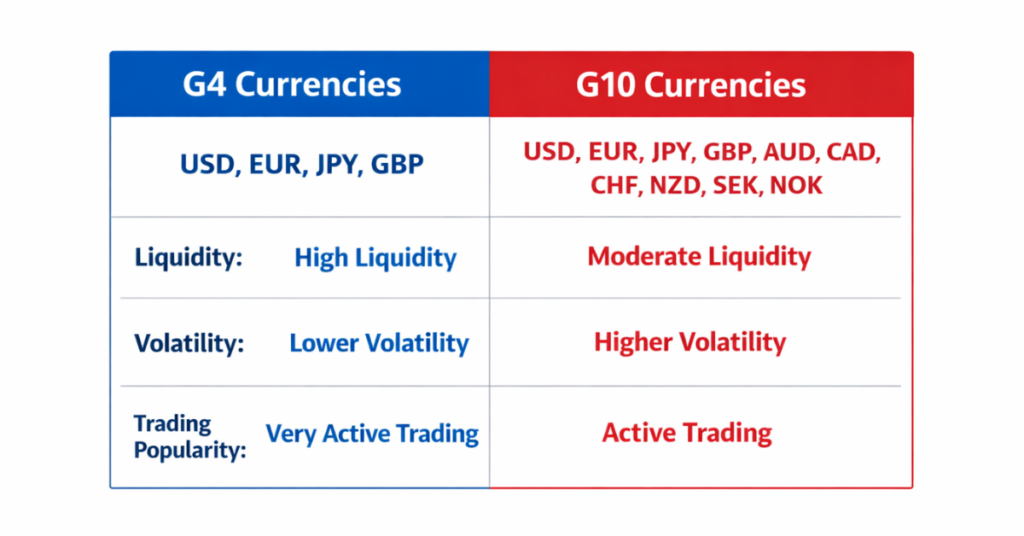
Understanding the difference between G4 and G10 currencies helps traders identify liquidity, volatility, and trading opportunities. The table below summarizes their key differences:
| Feature | G4 Currencies (USD, EUR, JPY, GBP) | G10 Currencies (G4 + AUD, CAD, CHF, NZD, SEK, NOK) |
| Liquidity | Extremely high, tight spreads | High, slightly wider spreads |
| Market Influence | Major impact on global finance | Moderate, often regional influence |
| Volatility | Generally stable, predictable | Can be more volatile (commodity-linked currencies) |
| Trading Popularity | Most traded pairs globally | Popular for diversification, less traded than G4 |
| Trading Strategy Fit | Ideal for beginners & professionals | Suited for diversification & advanced strategies |
5 Common Mistakes Traders Make with G4 Currencies
Even though G4 currencies are widely regarded as stable and predictable, traders, especially beginners, often make mistakes that can reduce profits or increase losses. Understanding these pitfalls helps improve trading strategies and decision-making.
1. Overleveraging: High liquidity and tight spreads can tempt traders to use excessive leverage. While leverage can amplify profits, it also magnifies losses. Using moderation and proper risk management is essential.
2. Ignoring Economic News: G4 currencies respond strongly to economic indicators such as interest rates, inflation reports, and employment data. Neglecting news events can lead to unexpected losses due to sudden market reactions.
3. Trading Without a Strategy: Entering trades without a plan, relying solely on intuition, or copying others’ trades often results in poor performance. A clear entry, exit, and risk management strategy is critical.
4. Focusing Only on Volatility
Some traders chase high volatility in GBP/USD or USD/JPY without understanding market context. Volatility alone does not guarantee profit; it must be analyzed alongside economic trends and timing.
5. Ignoring Risk Management Tools: Many traders fail to use stop-loss, take-profit, or position sizing properly. Risk management is vital, even when trading the most stable currencies like the G4.
5 Practical Tips for Trading G4 Currencies
Trading G4 currencies effectively requires a combination of strategy, timing, and risk management. By following practical tips, traders can increase their chances of consistent profits while minimizing potential losses.
1. Understand Market Sessions: G4 currencies are most active during specific trading sessions:
- EUR/USD & GBP/USD: European and US sessions
- USD/JPY: Asian and US sessions
Trading during active sessions ensures higher liquidity and tighter spreads.
2. Follow Economic Indicators: Monitor key reports like:
- Interest rates
- Inflation data
- Employment statistics
These indicators directly influence G4 currency movements and help anticipate price trends.
3. Diversify Across Pairs: Avoid relying on a single pair. Combining EUR/USD, USD/JPY, and GBP/USD can balance risk and take advantage of different market movements.
4. Manage Leverage Wisely: While brokers like Defcofx offer high leverage up to 1:2000, it’s crucial to use leverage responsibly. Overleveraging can magnify losses, even in stable G4 currencies.
5. Use Technical and Fundamental Analysis
- Technical analysis: Identifies trends, support, and resistance levels
- Fundamental analysis: Tracks economic news and global events
Combining both approaches improves decision-making and trade timing.
Final Thoughts on What are the G4 currencies?
G4 currencies USD, EUR, JPY, and GBP form the backbone of the global forex market. Their high liquidity, stability, and predictable behavior make them ideal for both beginners and experienced traders. Understanding their characteristics, major pairs, and market influences is essential for making informed trading decisions.
Trading G4 currencies requires strategy, risk management, and awareness of economic events. While they are generally safer and more predictable than exotic currencies, risks still exist, particularly when overleveraging or ignoring market signals.
Focusing on major pairs like EUR/USD, USD/JPY, and GBP/USD can provide consistent trading opportunities, especially when trades are executed with the right knowledge and discipline.
FAQs
The four major currencies, known as G4 currencies, are the US Dollar (USD), Euro (EUR), Japanese Yen (JPY), and British Pound (GBP). They dominate global forex trading due to their liquidity, stability, and widespread use in international finance.
The strength of a G4 currency depends on economic conditions, interest rates, and market demand. Historically, the US Dollar (USD) is considered the strongest due to its global reserve status, but the British Pound (GBP) often shows higher volatility, creating opportunities for traders.
The USD is the most traded currency because it serves as the primary reserve currency, is widely used in international trade, and benefits from the economic power and stability of the United States. It is part of nearly 90% of all forex transactions.
Yes, G4 currencies are generally beginner-friendly due to high liquidity, predictable behavior, and widespread availability. Trading major pairs like EUR/USD and USD/JPY allows new traders to start with tighter spreads and lower transaction costs.
The most traded G4 pairs include:
EUR/USD – Most liquid and widely traded
USD/JPY – Popular for Asian and US sessions
GBP/USD – Offers higher volatility for potential returns
EUR/GBP – Less USD-dependent, moderately stable