


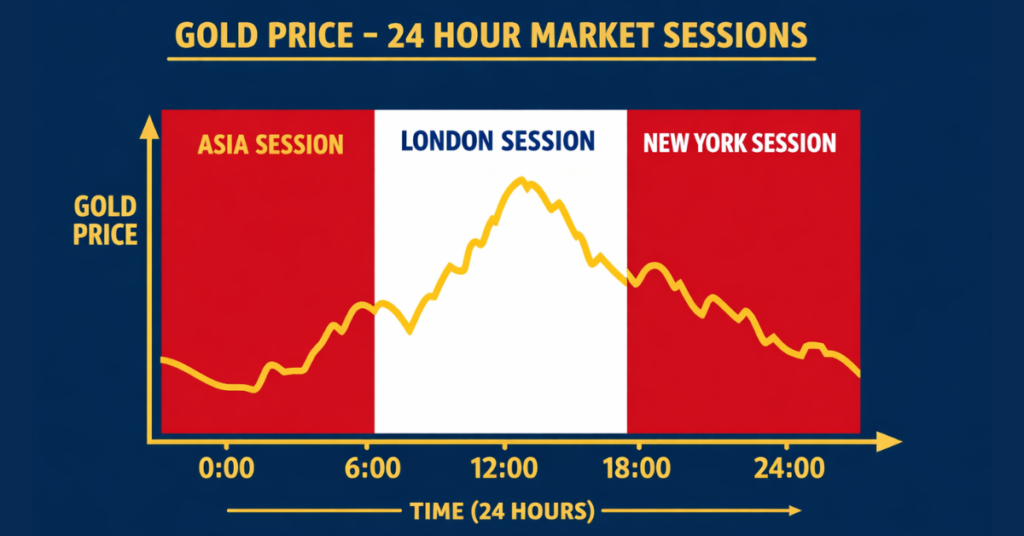
The gold market doesn’t open at a single fixed time like stocks. It trades almost 24 hours a day from Sunday evening to Friday evening (GMT) through the global forex session structure. Trading begins when Asian markets reopen and continues rolling through London and New York until the weekly close.
Key Takeaways
- The gold market has no single fixed daily opening time.
- It operates on a continuous 24-hour global trading cycle, five days a week.
- Trading begins on Sunday evening (GMT) when global forex markets reopen.
- Liquidity and price movement depend on which trading session is active.
- The London session and the London–New York overlap are the most important windows for gold price action.
- Gold trading stops only during the weekend break from Friday evening to Sunday evening (GMT).
What Is the Gold Market?
The gold market is a global trading system where gold is bought and sold in different forms including spot gold, futures contracts, and CFDs. It does not operate from one physical location. Instead, its price moves across international financial centers based on supply, demand, currency strength, and economic conditions.
For retail traders, gold is most commonly accessed as XAUUSD, which represents the price of one troy ounce of gold measured in US dollars. XAU is the international currency code for gold derived from the Latin word “aurum.”
Types of Gold Trading
- Spot Gold: Immediate buying and selling at the current market price. Reflects real-time global demand and is used primarily by institutional traders and central banks.
- Gold Futures: Contracts to buy or sell gold at a predetermined price on a specific future date. Traded on regulated exchanges such as COMEX (part of the CME Group in the United States). More commonly used for hedging by producers, miners, and speculators.
- Gold CFDs (XAUUSD): The most popular method for retail traders. No physical ownership of gold is involved. Traders speculate on price movement only, going long if they expect the price to rise and short if they expect it to fall. Available on platforms like MetaTrader 5 (MT5).
What Time Does the Gold Market Open?
The gold market begins trading on Sunday evening when global forex markets reopen. The exact time varies slightly by broker and liquidity provider, but the standard reference point is approximately 5:00 PM New York time (EST) / 10:00 PM GMT on Sunday.
From that point, gold trades continuously as liquidity rolls through Asia, then Europe, then the United States, until the market closes on Friday evening at approximately 5:00 PM EST / 10:00 PM GMT.
Gold Market Open and Close Times by Time Zone
| Time Zone | Weekly Open (Sunday) | Weekly Close (Friday) |
| GMT / UTC | ~10:00 PM | ~10:00 PM |
| EST (New York) | ~5:00 PM | ~5:00 PM |
| PKT (Pakistan) | ~3:00 AM (Monday) | ~3:00 AM (Saturday) |
| IST (India) | ~3:30 AM (Monday) | ~3:30 AM (Saturday) |
| GST (UAE / Dubai) | ~2:00 AM (Monday) | ~2:00 AM (Saturday) |
Why There Is No Fixed Daily Opening Time
Gold isn’t traded through a single centralized exchange for retail participants. Pricing is provided through global forex liquidity networks where banks, institutions, and market makers operate across every time zone. This creates a rolling market structure, not a daily open-and-close system like equity markets. The market opens once per week on Sunday evening, runs continuously through the week, and closes once on Friday evening.
Why Gold Trades 24 Hours
Gold trades nearly 24 hours a day because it is embedded in the global forex infrastructure, which spans every major financial center worldwide. As one region’s business day ends, another begins, allowing continuous price discovery and trading activity without interruption during weekdays.
Gold’s 24-hour nature is also supported by its role as a global store of value. Central banks, sovereign wealth funds, mining companies, and institutional investors across every continent trade gold, creating demand for continuous market access at all hours.
The global cycle flows as follows: Asia opens and provides the first wave of liquidity. Europe (led by London) takes over mid-morning GMT and dramatically increases activity. The United States joins in the afternoon GMT, adding the highest volume of the day. When the US session ends, the market transitions back toward Asian hours until Friday’s close.
Gold Trading Sessions Explained
Gold trading activity is shaped by three major global sessions. Each session has different liquidity levels, volatility characteristics, and trading behavior that directly impact how XAUUSD moves during that window.
| Session | Hours (GMT/UTC) | Activity Level | Gold Market Behavior |
| Asia (Tokyo/Sydney) | 12:00 AM – 9:00 AM | Low to Moderate | Range-bound, slow movement, fewer breakouts |
| London (Europe) | 8:00 AM – 5:00 PM | High | Strong trends form, liquidity increases sharply |
| New York (US) | 1:00 PM – 10:00 PM | Very High | Highest volatility, news-driven moves, USD impact |
| London–NY Overlap | 1:00 PM – 5:00 PM | Peak | Maximum activity, sharpest gold price swings |
Asia Session
The Asia session is the quietest period for gold. Price tends to move slowly within a narrow range, with few breakout opportunities. This session is useful for identifying range boundaries and preparing setups for the London open, but it rarely produces the type of sustained directional moves that active gold traders look for.
London Session
The London session marks the beginning of meaningful gold price action each day. As European institutional participants enter the market, liquidity rises sharply and the price often breaks out of the range established during the Asian session. Economic data from the UK and Eurozone, along with broader risk sentiment, drives the early direction. Many of the day’s major moves in XAUUSD begin here.
New York Session
The New York session is when gold is most volatile. US economic releases including CPI, NFP, and Fed statements land during this window and consistently produce the sharpest intraday moves in XAUUSD. Gold’s inverse relationship with the US dollar means that any significant USD movement during this session directly and immediately impacts gold price.
London–New York Overlap (Peak Window)
The overlap between 1:00 PM and 5:00 PM GMT is consistently the most active trading period for gold each day. Both European and US institutional traders are simultaneously in the market, combining the highest global liquidity with the strongest price movement. For traders seeking the clearest setups and most reliable price action in XAUUSD, this four-hour window is the primary focus.
Best Time to Trade Gold
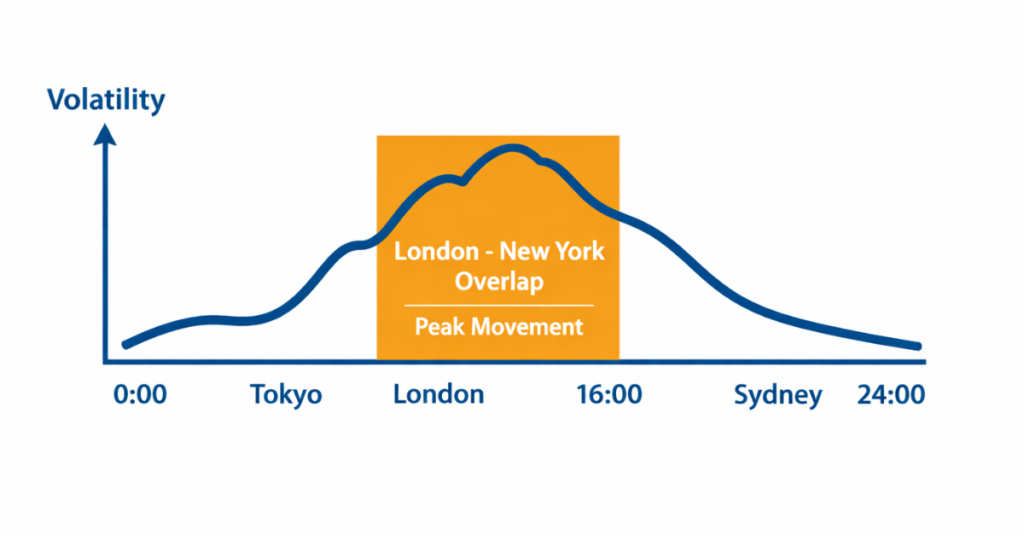
The best time to trade gold is during peak liquidity windows when price movement is most directional and setups are most reliable. Based on the session structure above, two periods stand out consistently.
- London session open (8:00 AM GMT): Strong trend formation begins as European institutional order flow enters. Gold frequently breaks out of the overnight Asian range here, setting the directional bias for the day.
- London–New York overlap (1:00 PM to 5:00 PM GMT): The highest-volume window of the day. US data releases, Fed commentary, and combined institutional participation produce the sharpest and most sustained gold price moves. This is the primary window for active gold traders.
Periods to Avoid
- Mid-Asian session (2:00 AM to 6:00 AM GMT): Low liquidity, range-bound, and prone to false signals. Trading here without a specific range strategy leads to poor results.
- Late New York / Pre-Asia transition: After the US session closes, volume drops sharply. Price becomes less predictable and often moves on thin liquidity, which can produce misleading price action.
- Just before and after major news: Spreads widen significantly around high-impact US economic releases. Entering positions immediately before news can expose trades to slippage and unpredictable spike reversals.
Gold Market Hours by Region
While the global market structure is the same for all traders, the local experience of gold trading differs depending on your time zone. Below is a practical breakdown of what the gold trading week looks like from different regional perspectives.
- Pakistan (PKT): The weekly market open falls around 3:00 AM Monday morning. Peak trading activity during the London session runs from 1:00 PM to 10:00 PM PKT, with the best trading window during the London–New York overlap (6:00 PM to 10:00 PM PKT).
- India (IST): Peak activity runs from approximately 1:30 PM to 10:30 PM IST, with the highest-quality gold setups typically forming between 6:30 PM and 10:30 PM IST during the overlap.
- UAE / Dubai (GST): The primary active window falls roughly 12:00 PM to 9:00 PM GST, with peak volatility from 5:00 PM to 9:00 PM GST during the overlap.
- US Eastern Time (EST): The most active gold trading period runs from 8:00 AM to 5:00 PM EST, covering both the London session tail and the full New York session.
Is the Gold Market Open 24 Hours?
Yes. The gold market is effectively open 24 hours a day, five days a week, but with important distinctions in activity levels across those hours. It opens once per week on Sunday evening (GMT) and runs continuously until Friday evening (GMT). It does not close and reopen each day like a stock exchange.
However, being technically “open” is not the same as being actively traded. During certain hours, particularly the mid-Asian session, the market may technically be open but price moves very little. During the London–New York overlap, the same market can move 30–50 USD per ounce in a matter of hours. The difference is purely about session-driven liquidity.
Weekend Closure
The only period when gold is genuinely unavailable for trading is the weekend gap, from approximately Friday 10:00 PM GMT to Sunday 10:00 PM GMT. During this window, no live pricing or trade execution occurs. When the market reopens Sunday evening, a price gap can sometimes appear if significant news broke over the weekend, which is an important risk management consideration for traders holding positions into the close.
What Drives Gold Price Movement?
Understanding what moves gold helps traders align their timing with the sessions where those drivers are most active. Gold is not purely a technical instrument. Its price is fundamentally driven by several global forces:
- US Dollar strength: Gold and the USD have a historically inverse relationship. When the dollar weakens, gold typically rises. When the dollar strengthens, gold often falls. Because USD strength is most actively repriced during the New York session, that is when the clearest XAUUSD reactions occur.
- Federal Reserve policy: Interest rate decisions, FOMC statements, and Fed member speeches directly impact gold. Higher rates increase the opportunity cost of holding gold (which pays no interest), pushing price down. Rate cuts or dovish signals support gold prices.
- US economic data: CPI inflation, non-farm payrolls, GDP reports, and jobless claims all influence both the USD and gold simultaneously. Strong data tends to pressure gold; weaker-than-expected data tends to support it.
- Geopolitical risk: Gold is a traditional safe-haven asset. During periods of conflict, political instability, or financial system stress, investors move capital into gold, driving prices higher.
- Central bank buying: Central banks globally have been significant net buyers of gold in recent years. Large institutional purchases from emerging market central banks (China, India, Turkey, Russia) directly support long-term demand.
How Gold Trading Works for Retail Traders (XAUUSD)
Most retail traders access gold through CFDs (Contracts for Difference) under the ticker XAUUSD. This method requires no physical ownership of gold. You are speculating purely on whether the price of gold will rise or fall against the US dollar.
XAUUSD tells you how many US dollars are needed to buy one troy ounce of gold. If XAUUSD is trading at 2,350, one ounce of gold costs 2,350 US dollars. If the price rises to 2,400, a trader who bought at 2,350 profits 50 USD per ounce (before spread and any applicable costs).
- Buy (long): Open when you expect gold prices to rise
- Sell (short): Open when you expect gold prices to fall
- Profit or loss: Determined by the difference between your entry and exit price, multiplied by your position size
On platforms like MetaTrader 5, XAUUSD pricing updates continuously during active market hours. Traders can place market orders, pending orders, set stop-losses, and take-profit levels just as they would on any forex pair. The key variables that affect outcome are entry timing, position size, spread cost, and how well risk is managed relative to the pair’s natural volatility.
5 Key Risk Considerations for Gold Traders
Gold is one of the most reactive instruments in retail trading. Its combination of high average daily pip ranges and sensitivity to global macro events makes risk management non-negotiable.
- High intraday volatility: XAUUSD can move 20–50 USD or more in a single session during high-impact news. Without a stop-loss, a single trade can cause disproportionate account damage.
- Leverage amplification: High leverage magnifies both gains and losses on the same volatile instrument. Proper position sizing and risk management principles apply directly to gold trading.
- Weekend gap risk: Holding gold positions into Friday’s close exposes traders to potential weekend gaps when the market reopens Sunday evening.
- News spike risk: Spreads on XAUUSD widen significantly around major US releases. Entering immediately before news without accounting for spread and slippage is a common and costly mistake.
4 Common Misunderstandings About Gold Trading Hours
Misconception 1: “Gold opens at a specific time every day.” Gold does not have a daily opening bell. It opens once per week on Sunday evening and trades continuously until Friday evening. There is no daily restart.
Misconception 2: “Gold is controlled by one central exchange.” Gold is priced globally through interbank forex networks. Retail traders access it through CFD brokers, not a single centralized exchange. Different brokers may show slightly different prices depending on their liquidity providers.
Misconception 3: “All brokers have identical gold trading hours.” While the underlying global market structure is the same, individual brokers may vary slightly in when they make XAUUSD available based on their liquidity provider arrangements. Check your specific broker’s platform for exact times.
Misconception 4: “Gold moves the same amount throughout the day.” This is false and leads to poor trade planning. During the Asian session, XAUUSD may move 5–10 USD. During the London–New York overlap on a news day, it can move 30–50 USD or more. Session timing determines everything about how much the market moves.
Trade XAUUSD with Defcofx
Defcofx is a globally accessible forex and CFD broker registered in Saint Lucia. The platform runs on MetaTrader 5 and gives traders direct access to XAUUSD alongside major currency pairs, commodities, indices, stocks, and cryptocurrencies. For traders focused on gold, where execution quality and cost structure matter across every session of the trading week, Defcofx provides the infrastructure to compete effectively.
- Spreads starting from 0.3 pips with zero commissions and no swap fees, reducing the cost burden on strategies that require frequent entries across multiple daily sessions
- Leverage up to 1:2000 with full trader control over position sizing, allowing flexibility to calibrate exposure to gold’s natural intraday volatility
- 40% welcome bonus on qualifying first deposits of $1,000 or more, giving new clients additional margin capital to work with from day one
- Withdrawals completed within 4 business hours, including weekends, keeping funds readily accessible rather than tied up in processing delays
- MT5 platform featuring real-time XAUUSD pricing, advanced charting tools, and fast order execution across all major session windows
- Worldwide access with multilingual support, serving traders from all countries without geographic restrictions
Not sure how gold trades across different sessions? A free demo account on Defcofx lets you observe XAUUSD behavior in real market conditions during both active and quiet periods before placing any real capital at risk. When you are ready to trade live, registering an account takes only a few minutes.
Open a Live Trading AccountFinal Thoughts on Gold Market Trading Hours
The gold market does not have a single daily opening time. It follows the global forex session cycle, beginning Sunday evening and running continuously until Friday evening (GMT). What matters for traders is not when the market technically opens, but when it moves with genuine force and reliability.
The London session and the London–New York overlap are where XAUUSD consistently produces the cleanest trends, the highest volume, and the most reactive price action relative to economic events. Timing your gold trades to these windows, rather than trading randomly across the 24-hour cycle, is one of the most straightforward improvements any trader can make.
Combine session awareness with strong trade planning, controlled risk on every position, and a clear understanding of what drives gold prices, and you have the foundation for a disciplined approach to XAUUSD trading. Defcofx gives you the platform, the conditions, and the access to apply that approach across every session of the trading week.
Open a Live Trading AccountFAQ
The gold market opens on Sunday evening at approximately 10:00 PM GMT when the global forex market reopens for the week. It then trades continuously across Asian, London, and New York sessions until Friday evening at approximately 10:00 PM GMT.
Yes. Gold is effectively traded 24 hours a day, five days a week. It opens once per week on Sunday evening (GMT) and closes Friday evening (GMT), running continuously through the week. Activity levels vary significantly by session, with the London–New York overlap offering the highest volatility and liquidity.
Gold is most volatile during the London session (8:00 AM to 5:00 PM GMT) and especially during the London–New York overlap (1:00 PM to 5:00 PM GMT). US economic releases including CPI, NFP, and Federal Reserve statements during this window consistently produce the sharpest intraday moves in XAUUSD.
No. The gold market does not close daily. It only closes for the weekly weekend break, from approximately Friday 10:00 PM GMT to Sunday 10:00 PM GMT. There is no daily opening or closing bell as there is with stock markets.
Gold prices are most strongly influenced by US Dollar strength or weakness (gold and USD move inversely), Federal Reserve interest rate decisions and FOMC statements, US economic data including CPI inflation and non-farm payrolls, global geopolitical risk and financial uncertainty, and central bank gold purchasing activity globally.
XAUUSD is the ticker symbol for gold priced in US dollars in the forex and CFD market. XAU is the international currency code for gold (from the Latin ‘aurum’), and USD is the US Dollar. XAUUSD tells you how many US dollars are required to buy one troy ounce of gold. It is the most common way retail traders access the gold market through platforms like MetaTrader 5.