


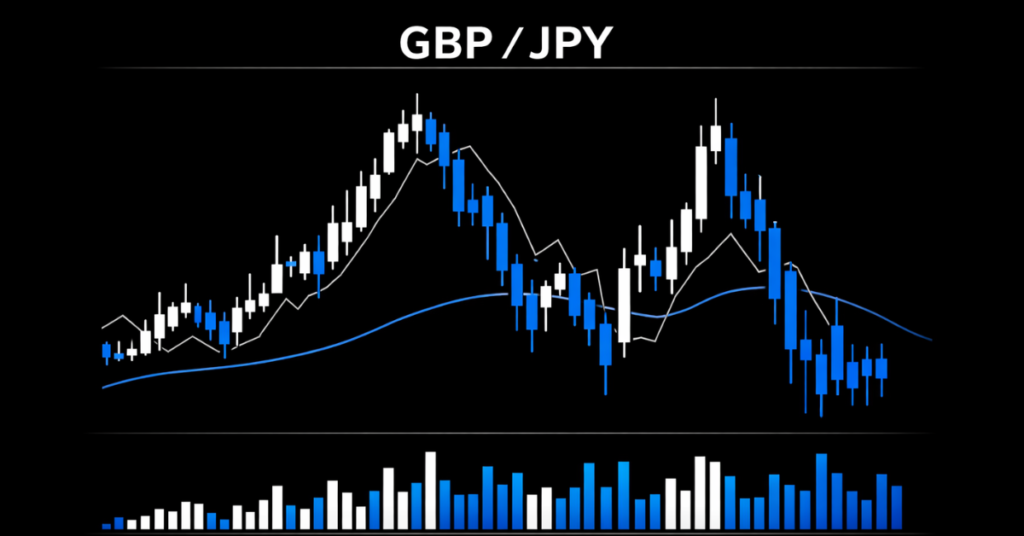
The forex pair with the highest volatility is generally GBP/JPY (British Pound vs Japanese Yen). It consistently experiences large and fast intraday price swings, typically 150–200 pips per day, due to the economic contrast between the UK and Japan, its sensitivity to global risk sentiment, and lower relative liquidity compared to major pairs like EUR/USD.
Key Takeaways
- The most volatile forex pair is typically GBP/JPY, averaging 150–200 pips of movement per day under normal market conditions.
- Other highly volatile pairs include EUR/JPY, GBP/AUD, GBP/NZD, and USD/TRY, each driven by different structural factors.
- Volatility measures how fast and how much a currency pair’s price moves. Higher volatility means larger profit potential but also larger loss risk.
- Cross pairs involving JPY (a safe-haven currency) tend to be the most volatile among non-exotic instruments because they combine risk-sensitive and risk-averse currencies.
- High volatility pairs suit experienced traders using scalping, breakout, and news-based strategies. They are not ideal for beginners without proper risk management in place.
What Does Forex Volatility Mean?
Forex volatility refers to how much and how quickly the price of a currency pair changes over a specific time period. A highly volatile pair moves up and down aggressively within short time frames, while a low-volatility pair moves more slowly and within tighter ranges.
Volatility is most commonly measured using the Average True Range (ATR) indicator, which shows how many pips a pair typically moves within a given session or day. A higher ATR value means more volatility. It can also be assessed visually by comparing the size of candlestick bodies and wicks across a chart.
Volatility reflects how reactive a currency pair is to market forces including interest rate changes, inflation reports, geopolitical events, and shifts in global risk appetite. For example, when GBP/JPY moves sharply within minutes due to a Bank of England announcement, that is high volatility in direct action.
Why Volatility Matters in Trading
- More price movement within short time frames means more tradeable opportunities per session
- Greater profit potential per trade for active and short-term traders
- Faster and stronger reactions to economic news create breakout opportunities
- But higher volatility also means larger potential losses if risk is not controlled, stop-losses trigger more frequently, and emotional trading pressure increases significantly
What Causes High Volatility in Currency Pairs?
Forex volatility is not random. It is produced by specific, identifiable structural and economic factors. Understanding these helps traders anticipate when and why aggressive price movements occur.
- Economic divergence between two countries. When one economy is growing strongly while the other faces uncertainty or contraction, the currency relationship becomes unstable and produces sharper movements. GBP/JPY is a textbook example of this dynamic.
- Central bank policy decisions. Interest rate changes or forward guidance from the Bank of England, Bank of Japan, Federal Reserve, or ECB can produce immediate and aggressive currency moves. Surprise decisions amplify these effects significantly.
- Geopolitical events. Elections, armed conflicts, trade disputes, or unexpected global crises create uncertainty that drives rapid position adjustment by institutions and retail traders alike.
- Session timing and overlap. During the London–New York overlap (1:00 PM to 5:00 PM GMT), trading volume peaks and volatility is at its highest for most pairs. GBP pairs in particular see their largest daily moves during London session hours.
- Liquidity differences between pairs. Major pairs like EUR/USD benefit from enormous liquidity depth that absorbs large orders without sharp price impact. Cross pairs like GBP/JPY and GBP/AUD have lower relative liquidity, meaning the same order size produces a proportionally larger price move.
Most Volatile Forex Pairs
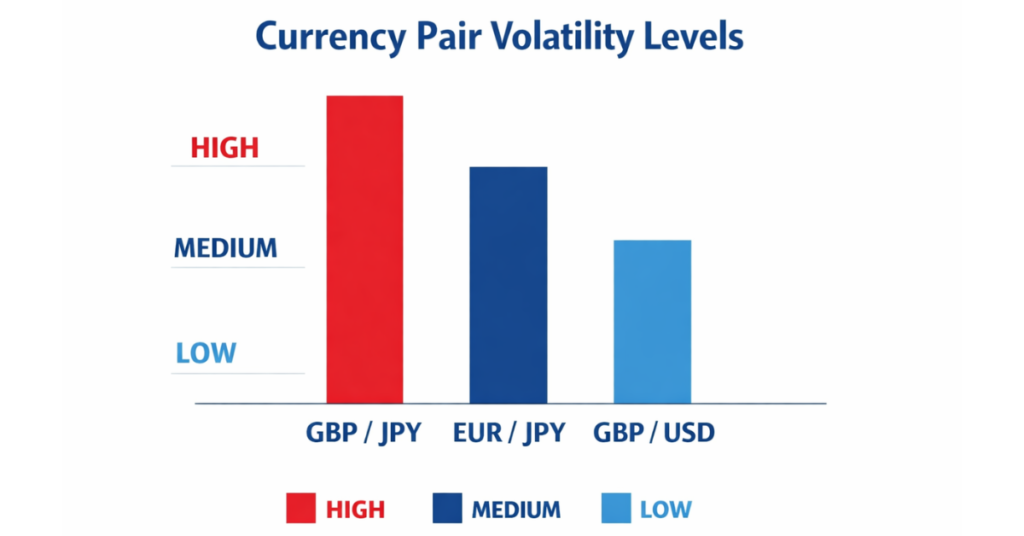
The highest volatility in forex is found in cross pairs and select emerging market pairs, where economic imbalance, lower liquidity, or strong geopolitical sensitivity produces larger intraday ranges. Below are the consistently most volatile pairs in global forex markets, with approximate average daily ranges.
GBP/JPY (British Pound / Japanese Yen)
GBP/JPY is widely regarded as the most volatile cross pair in forex. Average daily ranges of 150–200 pips are common under normal market conditions, with ranges extending significantly further during UK economic data releases or global risk events.
This volatility comes from the fundamental contrast between a risk-sensitive currency (GBP) and a safe-haven currency (JPY). When global risk sentiment shifts, institutions simultaneously buy one and sell the other, amplifying the move. The pair is most active and volatile during London session hours and the London–New York overlap.
GBP/AUD (British Pound / Australian Dollar)
GBP/AUD is one of the most volatile cross pairs after GBP/JPY. It combines two commodity-sensitive and economically distinct economies. The Australian dollar reacts strongly to iron ore and commodity prices as well as RBA policy, while GBP moves with UK data and Bank of England decisions. When both economies release conflicting data, the pair can move 130–180 pips or more in a single session.
EUR/JPY (Euro / Japanese Yen)
EUR/JPY is highly volatile due to the combination of European economic data and Japan’s safe-haven currency dynamics. It tends to move sharply during ECB rate announcements, Eurozone inflation releases, and global risk sentiment shifts. Average daily ranges of 80–120 pips are typical, with extended ranges during European sessions.
GBP/USD (British Pound / US Dollar)
Known as “Cable,” GBP/USD is a major pair but consistently more volatile than EUR/USD due to the UK economy’s sensitivity to inflation, employment data, and Bank of England policy. Typical daily ranges of 80–120 pips, with larger moves around UK CPI, GDP, and Federal Reserve decisions.
AUD/JPY (Australian Dollar / Japanese Yen)
AUD/JPY is strongly driven by global risk sentiment. AUD strengthens when global growth is optimistic (risk-on) and weakens during market stress (risk-off), while JPY moves in the opposite direction as a safe-haven asset. Chinese economic data is also a major driver, as Australia’s largest export relationship is with China. Average daily ranges of 60–100 pips.
USD/TRY (US Dollar / Turkish Lira)
USD/TRY is an exotic pair and one of the most volatile instruments in retail forex. Turkey has faced persistent inflation exceeding 40–70% in recent years, unconventional central bank policy, and significant political uncertainty. Daily ranges of 300–600 pips are not unusual during periods of market stress. This pair carries substantially wider spreads than cross pairs and requires very careful position sizing. It is not recommended for beginners.
Why GBP/JPY Is the Most Volatile Pair
GBP/JPY consistently ranks as the most volatile accessible forex pair because it combines two fundamentally opposite currency personalities. The British Pound is a risk-sensitive currency that reacts aggressively to UK economic data, Bank of England policy changes, and political developments. The Japanese Yen is a safe-haven currency that strengthens when global markets are uncertain and weakens when investor confidence rises.
When risk sentiment shifts globally, both forces activate simultaneously. During risk-off periods, institutions sell GBP (weakening as growth concerns rise) and buy JPY (strengthening as a safe haven). During risk-on periods, the opposite occurs. This synchronized double movement is why GBP/JPY moves more aggressively than pairs where both currencies respond to the same economic forces.
The pair is also particularly responsive to UK-specific data. UK CPI releases, non-farm employment data, Bank of England Monetary Policy Committee decisions, and GDP reports all produce sharp, sometimes 100-pip moves on GBP/JPY within minutes of release. Combined with its already elevated baseline volatility, these events can produce extreme intraday ranges.
Trading Behavior of GBP/JPY
- Average daily range of 150–200 pips, significantly wider than EUR/USD (50–100 pips)
- Sharp, high-momentum breakouts during UK economic data releases
- Strong trends that develop quickly but can reverse just as fast
- Most active and volatile during the London session (8:00 AM to 5:00 PM GMT) and London–New York overlap (1:00 PM to 5:00 PM GMT)
- Technical levels respect well during calm periods but are overridden quickly by news-driven momentum
Volatility Comparison: Majors vs Crosses vs Exotics
| Category | Examples | Avg Daily Range | Volatility Level | Liquidity | Behavior |
| Major Pairs | EUR/USD, USD/JPY, GBP/USD | 50–120 pips | Low to Moderate | Very High | Stable, reacts smoothly to news, tighter spreads |
| Cross Pairs | GBP/JPY, EUR/JPY, GBP/AUD | 100–200 pips | High | Medium | Strong price swings, sentiment-driven, fast breakouts |
| Exotic Pairs | USD/TRY, USD/ZAR, USD/MXN | 200–600 pips | Very High | Low | Sudden spikes, wide spreads, politically driven |
Best Trading Approaches for Volatile Pairs

Volatile pairs require a structured approach. Without a defined strategy and strict risk controls, fast-moving markets produce losses faster than they produce profits. Below are the most consistently effective approaches for trading high-volatility currency pairs.
1. Scalping
Scalping targets small, repeatable pip gains across multiple short-term entries within a session. GBP/JPY and EUR/JPY are well suited for scalping because their large daily ranges produce frequent intraday momentum moves. This approach requires a broker with tight spreads and fast execution, as profit margins per trade are small and spread costs directly affect profitability. See our guide on scalping in forex for the key considerations.
2. Breakout Trading
Breakout trading focuses on entering the market when price breaks through a defined support or resistance level with momentum. Volatile pairs like GBP/JPY regularly produce strong breakouts at key technical levels, especially during the London session open or immediately following economic data releases. The London breakout of the Asian session range is one of the most commonly used setups on this pair. More detail on applicable patterns is available in our day trading patterns guide.
3. News-Based Trading
Economic announcements including Bank of England rate decisions, UK CPI, NFP, and ECB statements create sharp volatility spikes on GBP and JPY pairs. Traders using this strategy either position ahead of a scheduled release based on directional bias, or enter immediately after the release once the initial spike direction is confirmed. Spreads widen significantly around major news events, which must be factored into entry and exit planning.
4. Risk Management (Most Important of All)
No strategy works on volatile pairs without strict risk control. A stop-loss on every trade is non-negotiable. Position sizes must account for the pair’s wider-than-average daily range. Risking 1–2% of account capital per trade maximum is the standard framework. Read our full guide on forex risk management for a complete breakdown of how to apply these principles to volatile trading conditions.
Risks of Trading High Volatility Pairs
Rapid, unexpected price swings. GBP/JPY can move 100+ pips in minutes following a major news event. A trader without a stop-loss can lose a significant portion of their account before they react manually. Fast markets remove the option of thoughtful response.
Stop-loss whipsawing. In highly volatile conditions, price regularly spikes through support or resistance levels briefly before reversing. These false breakouts trigger stop-losses set too close to entry, exiting trades at a loss right before they would have moved in the anticipated direction. Stop placement on volatile pairs must account for the pair’s average true range to avoid premature exits.
Slippage during news events. During high-impact economic releases, spreads widen and market orders can fill at significantly different prices than the price visible at entry. This is particularly common on GBP/JPY, GBP/AUD, and USD/TRY. Using limit orders where possible and avoiding entry immediately before known news events reduces this risk.
Emotional trading pressure. Fast markets amplify emotional reactions. Fear causes premature exits on winning trades. Greed causes holding losing trades too long. Revenge trading after a loss in fast conditions accelerates account damage. A written pre-trade checklist applied before every entry is one of the most effective tools for maintaining discipline under volatile conditions.
Who Should Trade High Volatility Pairs?
Experienced traders who already understand price action, market structure, risk-reward management, and how economic events affect specific pairs. Experience allows these traders to capitalize on fast moves without reacting emotionally to temporary reversals.
Short-term traders including scalpers and day traders who need frequent intraday setups within a defined session window. The large daily ranges of GBP/JPY and EUR/JPY provide multiple tradeable opportunities per session that simply do not exist on lower-volatility pairs.
Strategy-driven traders using breakout or news-based approaches. These strategies specifically require strong momentum and directional moves to produce their expected returns. Stable pairs do not provide the pip range for these strategies to be cost-efficient after spread.
Traders with disciplined risk management already in practice. Volatility is manageable for any trader who consistently applies stop-losses, sizes positions proportionally to account capital, and limits risk to 1–2% per trade maximum.
Not suitable for beginners. Beginners should build skills and risk management habits on stable major pairs like EUR/USD or USD/JPY before approaching GBP/JPY or exotic pairs. The emotional intensity of volatile pairs during live trading creates poor learning conditions for traders who have not yet developed consistent analytical frameworks.
Trade Volatile Pairs with Defcofx
For traders targeting high-volatility pairs, the quality of your broker’s execution and cost structure directly determines whether a strategy is viable. When targeting 20–30 pip scalps on GBP/JPY, a 3-pip spread consumes 10–15% of the trade’s target. When breakout trading, delayed execution means missing the entry entirely. Defcofx is a globally accessible forex and CFD broker registered in Saint Lucia, operating on MetaTrader 5 with full access to GBP/JPY, EUR/JPY, GBP/AUD, GBP/USD, AUD/JPY, USD/TRY, and all other highly volatile pairs alongside the complete forex and commodities market.
- Spreads from 0.3 pips with zero commissions and no swap fees, directly protecting the narrow margins that define scalping and frequent trading on volatile pairs
- Leverage up to 1:2000, giving traders complete flexibility to calibrate position sizes proportionally to the wide pip ranges that volatile pairs produce daily
- 40% welcome bonus on first deposits of $1,000 or more, available to all qualifying clients globally
- Withdrawals processed within 4 business hours including weekends, keeping capital accessible at all times during active trading weeks
- MT5 platform with real-time charting, ATR and volatility measurement tools, and fast order execution built for precision entries and exits in fast-moving conditions
- Global access with multilingual support, welcoming traders from all countries without geographic restrictions
New to volatile pair trading? A free demo account at Defcofx lets you trade GBP/JPY, EUR/JPY, and other high-volatility pairs in real market conditions with zero financial risk before committing real capital. Opening a live account takes only a few minutes when you are ready.
Open a Live Trading AccountFinal Thoughts: Which Pair Has the Highest Volatility?
GBP/JPY is the most volatile accessible forex pair, producing average daily ranges of 150–200 pips driven by the fundamental contrast between a risk-sensitive currency and a safe-haven currency. EUR/JPY, GBP/AUD, and GBP/USD are close behind among cross and major pairs, while exotic pairs like USD/TRY carry even larger raw pip ranges but with significantly wider spreads, lower liquidity, and less reliable technical structure.
Volatility is not an obstacle. It is a structural characteristic of certain pairs that suits specific traders and strategies. Used with proper risk management, the large daily ranges of volatile pairs offer more opportunity per session than stable pairs can. Used without discipline, they accelerate losses at the same rate.
The right approach is to match the pair’s volatility profile to your strategy, session, and risk framework before entering. If you are building experience with volatile pairs, starting on a demo account and reading our guide on forex trading strategies before going live gives you the best foundation. Defcofx provides the platform and conditions to apply that foundation across the full range of volatile pairs.
Open a Live Trading AccountFAQ
GBP/JPY is consistently the most volatile accessible forex pair, averaging 150–200 pips of daily movement under normal market conditions. This is driven by the fundamental contrast between the British Pound (risk-sensitive) and the Japanese Yen (safe-haven), which causes synchronized amplified moves whenever global risk sentiment shifts.
GBP/JPY combines two fundamentally opposite currency personalities. The British Pound reacts aggressively to UK economic data and Bank of England policy. The Japanese Yen is a traditional safe-haven that strengthens during global uncertainty and weakens when confidence rises. When risk sentiment shifts, both currencies move simultaneously in opposite directions, amplifying the total price movement of the pair beyond what either currency produces individually.
GBP/USD and EUR/JPY offer high volatility with better liquidity and more reliable technical structure than extreme pairs. GBP/USD averages 80–120 pips daily and is well suited for breakout and news strategies. EUR/JPY averages 80–120 pips and responds cleanly to ECB policy and global risk sentiment. Both are significantly more manageable than exotic pairs like USD/TRY, which carry much wider spreads and less predictable behavior.
Forex markets are most volatile during the London–New York overlap (1:00 PM to 5:00 PM GMT), which combines the two highest-volume sessions simultaneously. The London session open (8:00 AM GMT) is also consistently high-volatility for GBP and EUR pairs. Major economic releases including US NFP, Federal Reserve decisions, Bank of England announcements, and UK CPI consistently produce the largest intraday spikes of the month on affected pairs.
High volatility creates more profit opportunity per trade due to larger price movements, and suits strategies like scalping, breakout trading, and news trading. However, it equally increases loss potential and requires stronger risk management than stable markets. Whether high volatility is good for any individual trader depends on their experience, strategy, and how rigorously they apply stop-losses and position sizing rules.
No. GBP/JPY is not recommended for beginners. Its large daily pip ranges, fast-moving price action, and sensitivity to multiple global risk factors create an emotionally intense environment that makes it very difficult to build consistent analytical and risk management skills. Beginners should start with EUR/USD or USD/JPY, build core trading skills on demo first, and progress to volatile pairs only after developing a reliable risk management framework on live capital.