



The best currency pairs to trade in the Tokyo session are USD/JPY, EUR/JPY, AUD/JPY, and NZD/JPY because the Japanese yen dominates market activity during Asian hours. These pairs offer steady, low-to-moderate volatility with clean technical behavior, making them well suited for range trading, scalping, and controlled-risk strategies.
Key Takeaways
- The best pairs to trade in the Tokyo session are USD/JPY, EUR/JPY, AUD/JPY, and NZD/JPY, all driven by strong Japanese yen activity during Asian market hours.
- The Tokyo session runs from 12:00 AM to 9:00 AM GMT, with peak liquidity in the first two to three hours after the Tokyo open.
- The session features low to moderate volatility, making it suited for range trading, scalping, and precision-based strategies rather than breakout trading.
- AUD/USD and NZD/USD can also be traded but show slower movement due to the absence of JPY involvement.
- GBP pairs should generally be avoided during Tokyo hours due to low liquidity and choppy, unpredictable price action.
- In a low-volatility session, trading costs including spreads and commissions directly affect profitability and must be kept minimal.
What Is the Tokyo Forex Session?

The Tokyo session, also called the Asian trading session, is one of the three major forex trading sessions in the global market. It opens at 12:00 AM GMT and closes at 9:00 AM GMT. Peak activity occurs in the first two to three hours after the Tokyo open, when Japanese financial institutions are most actively placing orders.
Tokyo Session Timing by Time Zone
| Time Zone | Session Open | Session Close |
| GMT / UTC | 12:00 AM (Midnight) | 9:00 AM |
| JST (Japan) | 9:00 AM | 6:00 PM |
| PKT (Pakistan) | 5:00 AM | 2:00 PM |
| IST (India) | 5:30 AM | 2:30 PM |
| GST (UAE / Dubai) | 4:00 AM | 1:00 PM |
| EST (New York) | 7:00 PM (Previous Day) | 4:00 AM |
Key Characteristics of the Tokyo Session
- Lower volatility: Price movements are generally smaller and more contained than London or New York, making the session more predictable but less explosive.
- Strong JPY influence: Japan is the dominant financial hub active during this window. JPY pairs receive the highest institutional order flow, making them the most reliable pairs to trade.
- Range-bound behavior: Most currency pairs tend to consolidate or move within defined support and resistance zones rather than trending strongly.
- Technical price structure: Lower institutional participation from Western markets means price respects technical levels more cleanly and consistently than during news-driven sessions.
Best Currency Pairs to Trade in the Tokyo Session
Choosing the right currency pairs determines whether you find consistent setups or struggle against the session’s nature. The pairs below are grouped by performance level based on how much regional liquidity and price movement they receive during Tokyo hours.
Tier 1: Primary Pairs (Highest Activity)
| Pair | Volatility | Why It Works in Tokyo | Best Strategy |
| USD/JPY | Moderate | Most liquid JPY pair, strongest institutional activity from Japanese banks and exporters | Range trading, scalping |
| EUR/JPY | Moderate | Combines European and Japanese flows, responds to broader risk sentiment | Range trading, breakout prep |
| AUD/JPY | Moderate | Driven by Asia-Pacific commodity demand and Australian market overlap | Range trading, scalping |
| NZD/JPY | Low–Moderate | Steady movement tied to regional risk appetite and RBNZ sentiment | Range trading |
Tier 2: Secondary Pairs (Moderate Activity)
These pairs can be traded during Tokyo hours but show slower and less consistent movement compared to JPY crosses. They are worth monitoring if you prefer to diversify, but setups are fewer and less reliable.
- AUD/USD: Benefits from the Australian market overlap. Moderate activity with steady, range-bound price action. Suitable for range strategies on clean setups.
- NZD/USD: Similar to AUD/USD in character. Regional activity supports moderate movement, but daily ranges are smaller than JPY crosses.
- EUR/USD: Generally quiet and consolidating during Tokyo hours. Acceptable to monitor for range boundaries but better reserved for the London session when European liquidity arrives.
Pairs to Avoid in the Tokyo Session
- GBP/USD, GBP/JPY, and all GBP pairs: The London market is closed during Tokyo hours, removing the primary liquidity source for sterling pairs. Without European participation, GBP pairs produce choppy, unpredictable price action with wider spreads and poor technical structure. Wait for the London session open before trading these.
- Exotic pairs (USD/TRY, USD/ZAR, etc.): Low liquidity during Asian hours makes exotic pairs even more unpredictable. Wide spreads compound the problem. Avoid during this session.
Why JPY Pairs Move the Most in the Tokyo Session
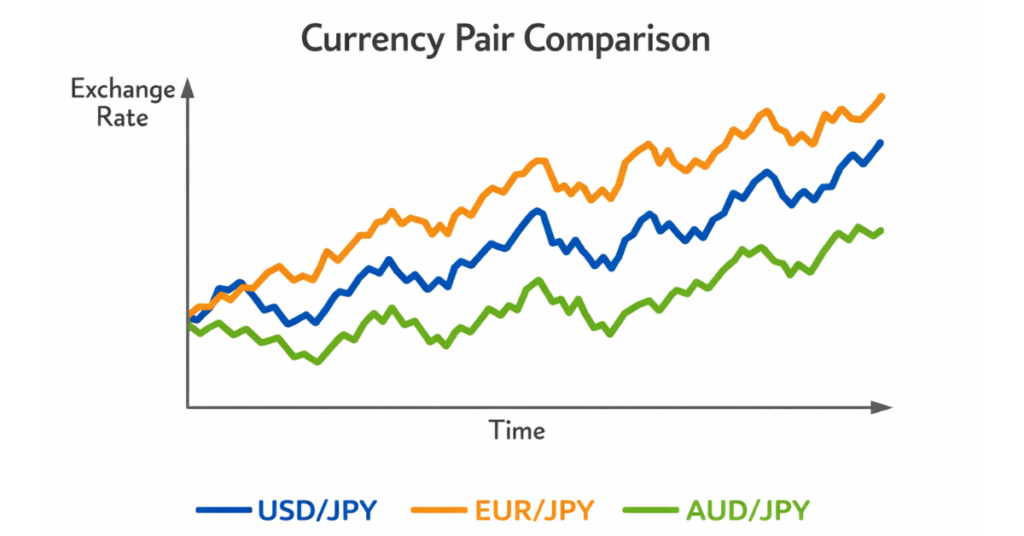
JPY pairs dominate the Tokyo session because this is the window when Japanese financial markets are fully operational. Japan holds the third largest economy in the world by nominal GDP, and its financial institutions, including the Bank of Japan, major commercial banks, and large exporters and importers, are all placing significant orders during Tokyo hours.
Japan’s export-driven economy creates a structural demand for currency conversion, particularly in USD/JPY, where large corporations regularly convert US dollar revenues back into yen. This commercial flow creates consistent, non-speculative price movement that is more predictable than the momentum-driven moves seen during Western sessions.
Regional participation from Australia and New Zealand further supports JPY cross pairs like AUD/JPY and NZD/JPY, as the Sydney market overlaps with the early Tokyo window, adding liquidity to Asia-Pacific currency pairs specifically.
4 Key JPY Pairs and Their Drivers
- USD/JPY: Highest liquidity of any Tokyo session pair. Driven by BOJ policy, Japanese institutional flow, and US Treasury yield movements. Most technically reliable pair during Asian hours.
- EUR/JPY: Reflects a combination of early European positioning and Japanese sentiment. Responds to global risk-on/risk-off shifts more than USD/JPY.
- AUD/JPY: Influenced by commodity demand, Chinese economic data (Australia’s largest trading partner), and Asia-Pacific risk appetite. Smooth trending behavior during Tokyo.
- NZD/JPY: Smaller average range but consistent and predictable. Tied to RBNZ policy and regional commodity flows.
Volatility Breakdown: Tokyo Session Pairs
Understanding the relative volatility of each pair during Tokyo hours helps traders set realistic profit targets and stop-loss levels. The table below shows how each major Tokyo session pair typically behaves.
| Pair | Volatility Level | Avg Daily Range (Tokyo) | Trading Behavior | Suitability |
| USD/JPY | Moderate | ~40–70 pips | Clean, technical, structured | High |
| EUR/JPY | Moderate | ~50–80 pips | Responsive to sentiment shifts | High |
| AUD/JPY | Moderate | ~40–70 pips | Smooth trending or range moves | High |
| NZD/JPY | Low–Moderate | ~30–50 pips | Slow but predictable | Medium |
| AUD/USD | Low | ~25–45 pips | Limited, mostly range-bound | Medium |
| EUR/USD | Low | ~20–35 pips | Consolidating, few setups | Low |
Best Trading Strategies for the Tokyo Session
The Tokyo session requires a different mindset from London or New York. The market is quieter, more structured, and technically driven. The most consistently effective trading strategies here are built around precision and repetition rather than momentum chasing.
1. Range Trading (Most Effective)
Range trading is the most reliable strategy during the Tokyo session. Price repeatedly moves between defined support and resistance zones on JPY pairs, particularly USD/JPY and AUD/JPY. The approach is to buy near established support, sell near established resistance, and exit before the pair tests the boundary too hard. Because the market rarely breaks out during this session, this pattern repeats with high frequency on clean charts.
2. Scalping
Scalping works well during the early Tokyo window when institutional order flow from Japanese banks creates consistent, small directional moves on USD/JPY and AUD/JPY. Multiple short-term entries targeting 10–20 pips per trade can generate steady returns across a session. Because profit per trade is small, spread costs must be minimal. This strategy fails when spread costs consume too large a percentage of each trade’s target, which is why broker conditions are directly tied to scalping profitability during this session.
3. London Breakout Preparation
One of the most practical uses of the Tokyo session for active traders is identifying and marking the Asian session range high and low. When London opens at 8:00 AM GMT and price breaks above the Tokyo high or below the Tokyo low, it often signals a strong directional move for the London session. This setup requires no trading during Tokyo hours, only range identification and preparation. It connects the two sessions strategically and is a documented, widely used approach across day trading patterns.
4. Support and Resistance Trading
Technical levels including horizontal support and resistance, trendlines, and pivot points hold more reliably during low-participation sessions. Without large institutional orders overwhelming technical levels, price tends to respect them and reverse predictably. This makes the Tokyo session genuinely well suited to technical traders who prefer level-to-level entries with clean risk-reward setups.
Practice Tokyo Session Trading on a Free DemoBest Time to Trade Tokyo Session Pairs
Timing within the Tokyo session matters significantly. Not all hours are equally productive, and trading at the wrong time during this session produces poor results even with the right pairs and strategy.
The most active and reliable trading window is approximately 12:00 AM to 3:00 AM GMT, when the Tokyo market is at full operational capacity. Japanese banks, exporters, and institutions are placing their largest orders during this period, creating the most consistent movement on JPY pairs. Range setups are clearest here, and scalping opportunities are most frequent.
From approximately 3:00 AM to 6:00 AM GMT, activity gradually slows. The market remains technically readable but produces fewer high-quality setups. More selective trade entry is required during this phase.
The Tokyo–London transition (7:00 AM to 9:00 AM GMT) is a unique window where volatility begins increasing as early European participants enter. This is when the London breakout preparation strategy activates, and price often breaks out of the range established during the earlier Tokyo hours.
Tokyo vs London vs New York Session Comparison
Understanding how the Tokyo session differs from London and New York helps traders set appropriate expectations and avoid applying the wrong strategy to the wrong market environment.
| Feature | Tokyo Session | London Session | New York Session |
| Hours (GMT) | 12:00 AM – 9:00 AM | 8:00 AM – 5:00 PM | 1:00 PM – 10:00 PM |
| Volatility | Low–Moderate | High | High–Very High |
| Best Pairs | USD/JPY, EUR/JPY, AUD/JPY | EUR/USD, GBP/USD, EUR/GBP | USD pairs, commodities, XAUUSD |
| Market Behavior | Range-bound, technically driven | Strong trend formation, breakouts | News-driven breakouts and reversals |
| Trading Style | Scalping, range trading | Swing trading, breakout strategies | Momentum trading, news trading |
| Best For | Beginners, range traders, Asia-Pacific traders | Day traders, experienced active traders | Momentum traders, news traders |
For a detailed comparison between the Tokyo and London sessions specifically, see our dedicated guide on trading Tokyo vs London sessions.
Trade Tokyo Session Pairs with Defcofx
Precision trading during the Tokyo session demands a broker environment where costs are minimal and execution is reliable. When targeting 15–30 pip moves on range setups or executing multiple scalp entries per session, every fraction of a pip in spread directly impacts whether the strategy generates net profit or net loss. Defcofx is a globally accessible forex and CFD broker registered in Saint Lucia, built on the MetaTrader 5 platform with full access to all primary Tokyo session pairs including USD/JPY, EUR/JPY, AUD/JPY, NZD/JPY, AUD/USD, and NZD/USD.
- Spreads from 0.3 pips with zero commissions and no swap fees, protecting the narrow margins that define scalping and range strategies during low-volatility Asian hours
- Leverage up to 1:2000, giving traders full flexibility to size positions appropriately relative to the smaller pip ranges the Tokyo session typically delivers
- 40% welcome bonus on qualifying first deposits of $1,000 or more, available to all clients globally
- Withdrawals processed within 4 business hours including weekends, ensuring capital remains readily accessible
- MT5 platform with advanced charting, all major technical indicators, and fast order execution across every Tokyo session pair and time frame
- Global access with multilingual support, particularly suited to traders in Pakistan, India, UAE, and Southeast Asia who trade natively during Tokyo session hours in their local time zones
Not yet trading live? A free demo account at Defcofx lets you practice USD/JPY, AUD/JPY, and other Tokyo session pairs in real market conditions with zero financial risk. When you are ready for live trading, account setup takes only a few minutes.
Open a Live Trading Account5 Common Mistakes Traders Make in the Tokyo Session
Even experienced traders underperform during the Tokyo session when they bring the wrong expectations or apply mismatched strategies. These are the most common and most avoidable mistakes.
- Expecting London-sized volatility. The Tokyo session is structurally different from London. Waiting for 80–100 pip moves on EUR/USD or GBP/USD during Asian hours leads to overtrading and frustration. The session’s typical pip ranges on JPY pairs are 40–70 pips. Strategies and targets should reflect that reality.
- Trading GBP pairs during Tokyo hours. GBP pairs without London liquidity produce erratic, low-volume price action that does not respect technical levels. Many traders learn this lesson expensively. The simple rule is to wait until London opens at 8:00 AM GMT before trading any GBP pair.
- Overtrading to compensate for slow markets. Patience is the most important skill in the Tokyo session. Taking marginal setups just to feel active increases transaction costs and produces inconsistent results. Fewer, higher-quality trades consistently outperform high-frequency low-conviction entries in this session.
- Ignoring Japanese economic data releases. The Tokyo session does include scheduled Japanese data, including CPI, trade balance, and BOJ policy decisions. These can cause sudden sharp moves, particularly on USD/JPY. Always check the economic calendar before the session and avoid open positions immediately before or during known Japanese data releases.
- Applying wide stop-losses based on London habits. Because Tokyo session ranges are smaller, stop-losses calibrated for London conditions are disproportionately wide relative to the trade’s realistic target. This produces poor risk-reward ratios. Stops should be tighter and proportional to the pair’s actual Tokyo session range.
Final Thoughts on Tokyo Session Currency Pairs
The Tokyo session is a structured, low-to-moderate volatility trading environment where the best opportunities are found on JPY pairs, specifically USD/JPY, EUR/JPY, AUD/JPY, and NZD/JPY. These pairs reflect genuine regional market activity from Japan’s financial institutions and the broader Asia-Pacific market ecosystem.
Success during Tokyo hours does not come from chasing big moves. It comes from recognizing the session’s range-bound character, applying strategies that match it, and maintaining the patience to wait for setups that meet your defined criteria rather than forcing entries in thin conditions.
The Tokyo session also serves a strategic preparation function for the London session. The range it builds becomes the reference point for one of the most traded setups of the week: the London breakout of the Asian session high or low. Understanding both sessions together gives traders a complete framework rather than treating each in isolation.
If you are ready to trade Tokyo session pairs with optimal conditions, Defcofx gives you the platform, the spreads, and the access to all major JPY, AUD, and NZD pairs across the full global trading session schedule.
Open a Live Trading AccountFAQ
The best pairs to trade in the Tokyo session are USD/JPY, EUR/JPY, AUD/JPY, and NZD/JPY. These pairs benefit from the highest Japanese yen activity during Asian market hours, producing stable, technically reliable price movements suited for range trading and scalping. AUD/USD and NZD/USD can also be traded but typically show slower movement.
USD/JPY typically shows the most consistent and reliable movement during the Tokyo session because it receives the highest institutional order flow from Japanese banks, exporters, and importers. EUR/JPY and AUD/JPY also show meaningful movement due to cross-currency flows and Asia-Pacific commodity activity.
Yes. The Tokyo session is one of the most suitable environments for beginners because slower price action allows more time to analyze setups and manage trades without fast-moving market pressure. Cleaner technical structure makes it easier to practice support and resistance trading. Beginners should focus on JPY pairs, avoid overtrading, and start on a demo account to build confidence before going live.
The Tokyo session runs from 12:00 AM GMT (midnight) to 9:00 AM GMT. The most active and reliable trading window is approximately 12:00 AM to 3:00 AM GMT when Japanese institutional order flow is at its highest. Activity slows progressively toward the session close, and volatility increases again during the Tokyo–London transition from 7:00 AM to 9:00 AM GMT.
Range trading and scalping strategies work most consistently during the Tokyo session because price movements are smaller and technical levels hold more reliably. Traders identify defined support and resistance zones on JPY pairs and enter at boundaries with tight stops. Many traders also use Tokyo hours to mark the Asian session range high and low, which serves as a reference for London breakout strategies at session open.
Yes. GBP pairs are generally unsuitable during Tokyo hours because the London market is closed, removing the primary liquidity source for sterling. Without European participation, GBP pairs produce choppy, unpredictable price action with wider spreads and poor technical structure. GBP/USD and GBP/JPY are best traded after the London session opens at 8:00 AM GMT.