


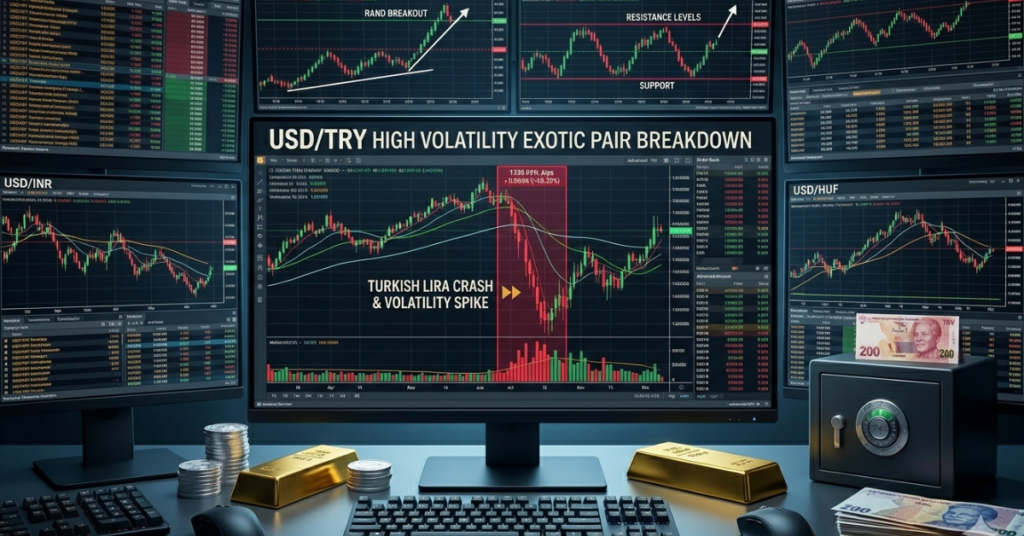
An exotic currency pair consists of one major currency (like USD or EUR) paired with the currency of a smaller or emerging economy, such as USD/TRY (Turkish Lira), USD/ZAR (South African Rand), or USD/MXN (Mexican Peso). These pairs are less liquid than majors, carry higher spreads, but often offer bigger price moves for traders who understand the risks.
Key Takeaways
- Exotic pairs combine a major currency with a developing or smaller-market currency.
- They have wider spreads and lower liquidity than major or minor pairs.
- Price volatility is typically higher, creating both risk and opportunity.
- Economic and political events in the exotic currency’s home country drive big swings.
- You can trade exotic pairs on MT5 via Defcofx with competitive conditions.
What Are Exotic Currency Pairs?
In forex trading, currency pairs are grouped into three categories: majors, minors (also called crosses), and exotics. Majors are pairs like EUR/USD or GBP/USD that dominate global trading volume. Minors are pairs that exclude the US dollar but still involve major economies. Exotics are everything else.
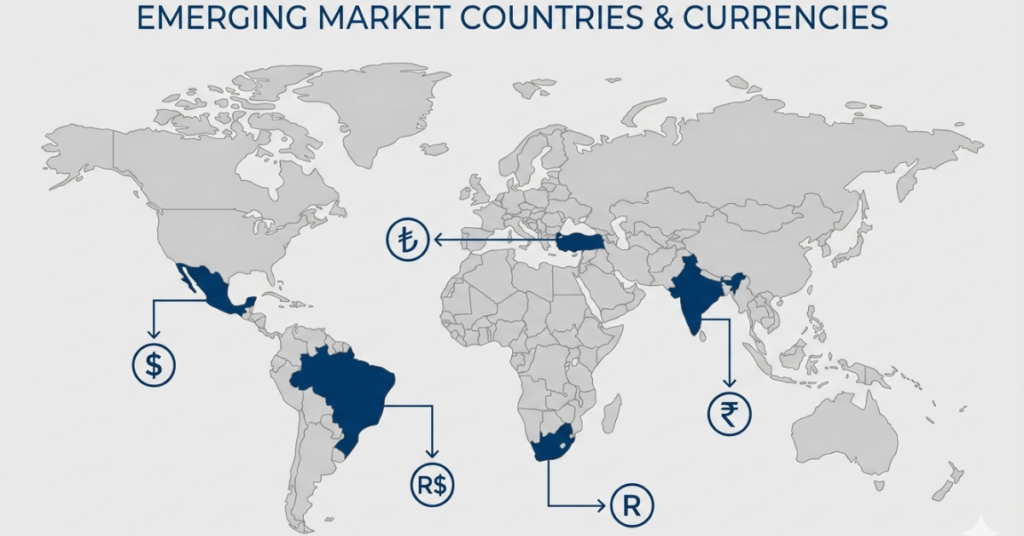
An exotic pair always includes one currency from a developed economy (usually USD, EUR, or GBP) and one from an emerging or smaller market. Countries like Turkey, South Africa, Mexico, Brazil, Thailand, and Hungary fall into this category.
These pairs are not as actively traded, which means the bid-ask spread tends to be wider. But what they lack in liquidity, they sometimes make up for in volatility, and for experienced traders, that means more opportunity if managed correctly.
The Full Exotic Currency Pairs List
Below is a comprehensive list of commonly traded exotic currency pairs, grouped by region:
USD-Based Exotic Pairs
| Pair | Countries | Notable Feature |
| USD/TRY | USA / Turkey | High volatility, political sensitivity |
| USD/ZAR | USA / South Africa | Commodity-driven, gold correlation |
| USD/MXN | USA / Mexico | Closely tied to US economic data |
| USD/BRL | USA / Brazil | Emerging market, political risk |
| USD/HKD | USA / Hong Kong | Semi-pegged, low volatility |
| USD/SGD | USA / Singapore | Stable, trade-heavy economy |
| USD/THB | USA / Thailand | Tourism and export-driven |
| USD/IDR | USA / Indonesia | Commodity-linked, high spread |
| USD/INR | USA / India | Growing market, RBI influence |
| USD/MYR | USA / Malaysia | Oil-sensitive, BNM controlled |
| USD/CNH | USA / China (offshore) | Reflects global trade flows |
| USD/PHP | USA / Philippines | Remittance-driven economy |
EUR-Based Exotic Pairs
| Pair | Countries | Notable Feature |
| EUR/TRY | Eurozone / Turkey | Very high spread and volatility |
| EUR/ZAR | Eurozone / South Africa | Reacts to global risk sentiment |
| EUR/HUF | Eurozone / Hungary | EU-tied but EM risk profile |
| EUR/PLN | Eurozone / Poland | Central European policy sensitive |
| EUR/CZK | Eurozone / Czech Republic | Managed by CNB intervention |
| EUR/HKD | Eurozone / Hong Kong | Low volatility, USD peg effect |
GBP-Based Exotic Pairs
| Pair | Countries | Notable Feature |
| GBP/ZAR | UK / South Africa | Post-colonial trade ties |
| GBP/TRY | UK / Turkey | Political risk driven |
| GBP/SGD | UK / Singapore | Financial hub pairing |
| GBP/HKD | UK / Hong Kong | Historical colonial link |
Other Exotic Pairs Worth Knowing
| Pair | Countries | Notable Feature |
| AUD/MXN | Australia / Mexico | Commodity cross with EM risk |
| CHF/HUF | Switzerland / Hungary | European safe haven vs EM |
| NOK/SEK | Norway / Sweden | Scandinavian cross, oil-linked |
| CAD/SGD | Canada / Singapore | Resource vs financial hub |
You can check live spreads and trading conditions on these pairs through the Defcofx Spreads page.
Why Exotic Pairs Have Higher Spreads
The spread in forex is the difference between the buy price and sell price. With exotic pairs, this spread is significantly wider compared to major pairs like EUR/USD, which can have spreads starting from just 0.3 pips at Defcofx.
There are three main reasons why exotic spreads are higher:
- Lower trading volume means brokers take on more risk and charge accordingly.
- Fewer market makers are quoting prices for these currencies at any given time.
- Political instability, currency controls, or central bank interventions in exotic economies increase unpredictability.
This is why it’s important to use a broker with transparent pricing. Defcofx offers competitive spreads with no hidden commissions. See full details on the trading conditions page.
Exotic vs Major vs Minor Currency Pairs
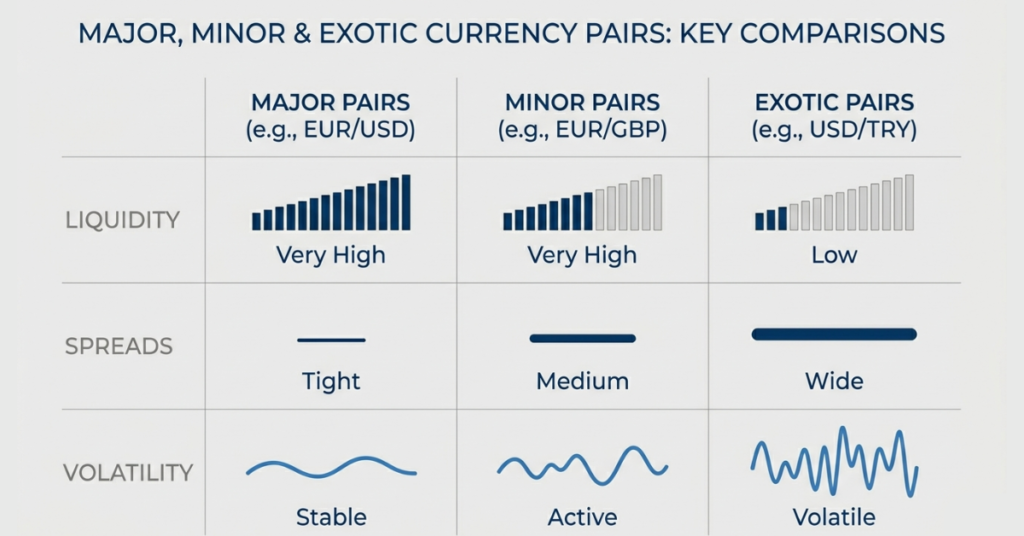
| Feature | Major Pairs | Minor Pairs | Exotic Pairs |
| Liquidity | Very High | Medium | Low |
| Spread | Tight | Moderate | Wide |
| Volatility | Moderate | Moderate-High | High |
| Best For | All levels | Intermediate | Experienced |
| Examples | EUR/USD, GBP/USD | EUR/GBP, AUD/CAD | USD/TRY, USD/ZAR |
What Moves Exotic Currency Pairs?
Understanding what drives price action in exotic pairs is essential before you trade them. Unlike major pairs where the US Federal Reserve or ECB decisions dominate the news, exotic pairs are influenced by a much wider set of factors:
1. Political Risk
Elections, government instability, sanctions, or geopolitical tensions in the exotic country can cause massive swings. The Turkish Lira (TRY) is a good example. It has dropped significantly during periods of political uncertainty and has seen sharp central bank rate cuts that went against conventional monetary policy.
2. Commodity Prices
Many exotic currencies are directly tied to commodity exports. The South African Rand (ZAR) tracks gold prices quite closely because South Africa is one of the world’s largest gold producers. Similarly, the Brazilian Real (BRL) moves with iron ore and soybean export prices.
3. Central Bank Policy
Emerging market central banks often intervene in currency markets to manage exchange rates. Malaysia’s central bank (BNM) and China’s PBOC are known for this. These interventions can suddenly reduce volatility or create sharp moves that catch traders off guard.
4. US Dollar Strength
Since most exotic pairs involve USD as the base, any shift in US monetary policy, inflation data, or Federal Reserve decisions creates ripples through all exotic pairs. A strong dollar typically weakens exotic currencies as capital flows out of emerging markets.
5. Global Risk Sentiment
In periods of global uncertainty, traders move capital into safe-haven currencies (USD, JPY, CHF). This capital outflow from emerging markets often puts downward pressure on exotic currencies. Tracking the broader risk environment is part of trading exotics well.
Use the Defcofx Economic Calendar to stay on top of key events that can impact exotic pairs.
Tips for Trading Exotic Currency Pairs
Trading exotics is not the same as trading EUR/USD. Here are some practical things to keep in mind:
- Use smaller position sizes to account for higher volatility and wider spreads.
- Always check the spread before entering a trade on any exotic pair.
- Monitor the political and economic news in the exotic currency’s home country.
- Avoid trading during off-market hours when liquidity drops even further.
- Use stop-loss orders on every trade, as exotic pairs can gap unexpectedly.
- Leverage can amplify losses fast with exotic pairs, so size positions carefully.
You can check Defcofx forex market hours to understand when liquidity is best for specific pairs.
Use the pip calculator and position size calculator to manage risk correctly when trading exotic pairs.
Key Statistics on Exotic Currency Pairs Trading
To put exotic pair trading in context, here are some relevant data points from the global forex market:
- The forex market trades over $7.5 trillion daily on average (BIS Triennial Survey, 2022).
- Major pairs (EUR/USD, USD/JPY, GBP/USD) account for roughly 70% of total daily trading volume.
- Exotic pairs make up a small fraction of overall volume, but their share has grown as emerging market economies have expanded.
- USD/MXN is one of the most liquid exotic pairs, with average daily volumes exceeding $110 billion.
- The Turkish Lira lost over 80% of its value against the dollar between 2018 and 2023, driven by inflation and unconventional monetary policy.
- The South African Rand showed a correlation of over 0.7 with gold prices in multiple multi-year studies.
Trade Exotic Currency Pairs with Defcofx
Defcofx is an online forex and CFD broker offering access to a wide range of forex pairs, including exotic pairs, on the MetaTrader 5 (MT5) platform. Defcofx is registered in Saint Lucia and designed for traders who want professional-grade conditions without unnecessary complexity.
Here is what makes Defcofx a solid choice for trading exotic currency pairs:
- Leverage up to 1:2000 on forex pairs, giving you the flexibility to trade more with less capital.
- Low spreads starting from 0.3 pips with no commission or swap fees.
- A 40% welcome bonus on your first deposit of $1,000 or more, available to all clients.
- Withdrawals processed within 4 business hours, including weekends.
- MT5 platform with advanced charting, fast execution, and multi-device access.
- Market heat maps, economic calendar, and daily technical analysis tools available on-site.
Defcofx accepts clients globally with multilingual support. Learn more about the platform on the why Defcofx page, or explore account types to find the best fit for your trading goals.
Open a Live Trading AccountFinal Thoughts on Exotic Currency Pairs List
Exotic currency pairs offer a very different trading experience compared to major and minor pairs. While they come with higher spreads and lower liquidity, they also present unique opportunities driven by strong volatility, emerging market growth, and macroeconomic shifts that are often overlooked in mainstream trading.
However, these opportunities come with equally significant risks. Political instability, sudden central bank interventions, and thin liquidity can lead to sharp, unpredictable price movements. This is why exotic pairs are best approached with a solid understanding of global economics, disciplined risk management, and a well-tested trading strategy.
FAQ
An exotic currency pair is a forex pair that combines one major currency (like USD, EUR, or GBP) with the currency of an emerging or smaller economy, such as the Turkish Lira (TRY), South African Rand (ZAR), or Mexican Peso (MXN). These pairs are less liquid and have wider spreads compared to major pairs.
Exotic pairs are generally better suited for experienced traders. The wider spreads, higher volatility, and sensitivity to local political and economic events make them harder to manage. Beginners are better off starting with major pairs like EUR/USD and using a demo account to practice first.
USD/MXN (US Dollar / Mexican Peso) is consistently among the most traded exotic pairs due to the strong economic ties between the United States and Mexico. USD/ZAR and USD/TRY also see significant volume in the global forex market.
Minor pairs (also called cross pairs) are pairs that do not include the US dollar but include other major currencies like EUR, GBP, or JPY. Examples include EUR/GBP and AUD/JPY. Exotic pairs involve at least one currency from an emerging or smaller economy, which makes them significantly more volatile and less liquid than minors.
Yes. Defcofx provides access to exotic currency pairs through the MetaTrader 5 platform. You can check available pairs and their current spreads on the Defcofx platform after creating an account.
Exotic pairs have fewer active buyers and sellers in the market at any given time. This lower liquidity means brokers face more risk when offering these pairs, and they compensate by charging a wider bid-ask spread. Political instability or capital controls in the exotic country can widen spreads even further.
The main risks include high spreads that eat into profits, sudden government interventions, political instability, and sharp overnight gaps. These pairs also react strongly to global risk-off events, which can cause large, fast moves that are difficult to manage without proper position sizing and stop-loss orders.