


Leverage in the stock market means borrowing capital to increase your exposure to a trade beyond what your own funds would allow. For example, with 10:1 leverage, $1,000 in your account controls $10,000 worth of positions. It multiplies both profits and losses, making risk management critical.
Key Takeaways
- Leverage allows traders to control larger positions with less capital by borrowing from their broker.
- In stock markets, leverage is typically lower (2:1 to 4:1) compared to forex, where ratios can reach 1:2000.
- While leverage can boost returns significantly, it also magnifies losses and can result in losing more than your initial deposit.
- Margin is the collateral you deposit to access leveraged positions, and a margin call is triggered when losses eat into that collateral.
- Defcofx offers leverage up to 1:2000 across forex, commodities, indices, and crypto CFDs on MetaTrader 5.
How Leverage Works in the Stock Market
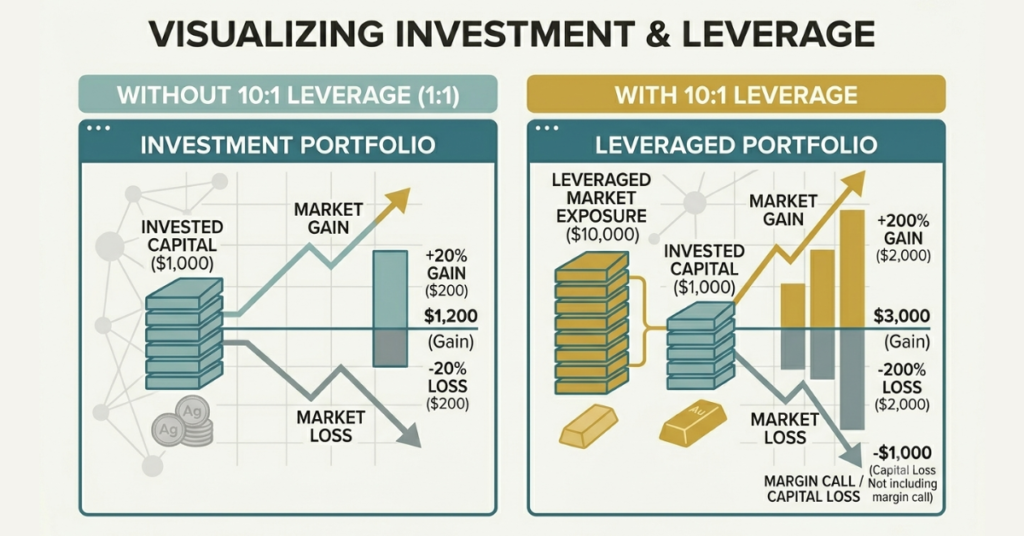
When you trade with leverage, your broker lends you additional capital so you can open a position larger than your account balance. You only need to deposit a fraction of the total trade value, known as the margin requirement.
Here is a simple example:
| Scenario | Without Leverage | With 10:1 Leverage |
| Your Capital | $1,000 | $1,000 |
| Position Size | $1,000 | $10,000 |
| Stock Price Rise of 5% | +$50 (5% return) | +$500 (50% return) |
| Stock Price Drop of 5% | -$50 (5% loss) | -$500 (50% loss) |
As the table shows, leverage multiplies the outcome in both directions. The same $1,000 of capital earns ten times more if the trade goes your way, but loses ten times more if it goes against you.
Leverage Ratios: What Do They Mean?
A leverage ratio expresses how much of a position you can control relative to your own capital. Common formats include:
- 10:1 leverage means $1 of yours controls $10 in the market.
- 1:100 leverage means $1 controls $100 in the market.
- 1:2000 leverage means $1 controls $2,000 in the market (common in forex brokers like Defcofx).
Different markets have different leverage limits, often regulated by financial authorities. Here is a general comparison:
| Market / Asset Class | Typical Leverage Range |
| Stocks (US regulated) | 2:1 to 4:1 |
| Stock CFDs (via broker) | Up to 20:1 |
| Forex Majors | Up to 30:1 (EU) or 1:500+ (offshore) |
| Commodities (Gold, Oil) | Up to 10:1 to 20:1 |
| Crypto CFDs | Up to 2:1 to 10:1 |
| Defcofx (all instruments) | Up to 1:2000 |
Defcofx stands out among brokers by offering leverage up to 1:2000, one of the highest available globally. This applies across forex, indices, commodities, and crypto.
Open a Live Trading AccountWhat Is Margin? The Other Side of Leverage
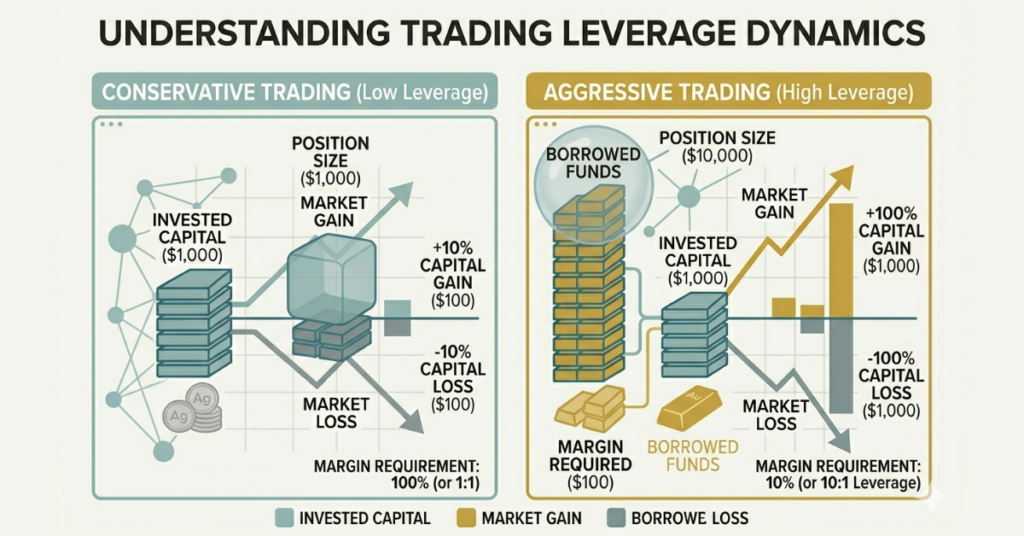
Margin is the deposit you put up to open a leveraged position. It is not a fee, it is collateral that your broker holds while your trade is open.
The margin requirement is usually expressed as a percentage of the total position size. For example, a 1% margin requirement on a $10,000 position means you need $100 in your account to open that trade.
You can use Defcofx’s margin calculator to calculate the exact margin needed before placing any trade.
What Is a Margin Call?
A margin call happens when your account equity (balance minus open losses) falls below the required margin level. When this happens, your broker may ask you to deposit more funds or automatically close some of your positions to protect against further losses.
Understanding what a margin call is and how to avoid it is one of the most important skills for any leveraged trader.
- Keep your account funded above the margin maintenance level at all times.
- Use stop-loss orders to exit trades before losses reach margin call territory.
- Avoid overleveraging by sizing positions appropriately relative to your account balance.
Leverage in Stocks vs. Leverage in Forex and CFDs
Leverage in the traditional stock market is more restricted compared to forex and CFD trading. Here is why:
In most regulated stock markets, such as those governed by the US Securities and Exchange Commission (SEC) or FINRA, retail investors can only use up to 4:1 intraday leverage through margin accounts. This limit is meant to protect retail investors from excessive risk.
In the forex and CFD space, however, leverage limits are set by the broker and local regulation. Offshore brokers registered in jurisdictions like Saint Lucia, the Seychelles, or Vanuatu can offer significantly higher leverage, sometimes exceeding 1:1000.
This is why many active traders prefer forex trading vs stock trading when they want maximum capital efficiency from smaller account sizes.
The Risks of Leverage in the Stock Market
Leverage does not change the underlying market, it changes your exposure to it. The risks include:
Amplified Losses
If you are 10:1 leveraged and the stock drops 10%, you have lost your entire position. A 15% drop means you owe more than you invested. This is the most direct danger of high leverage.
Margin Calls and Forced Liquidation
If your equity drops below the required margin, your broker will close your positions at market price, often at the worst possible moment, locking in losses without your input.
Emotional Trading
Leverage increases the emotional weight of each trade. Seeing a $5,000 floating loss on a $1,000 account triggers panic in most traders, leading to poor decision-making. A disciplined approach and solid risk plan are non-negotiable.
Interest on Borrowed Funds
When you hold leveraged positions overnight, brokers typically charge a swap fee or financing cost. However, Defcofx charges no swap fees, which removes one of the common hidden costs of leveraged trading.
Open a Demo Trading AccountHow to Use Leverage Responsibly
High leverage does not mean high risk is unavoidable. The risk level is determined by your position sizing and risk management rules, not just the leverage ratio itself.
Rule 1: Risk Only 1–2% Per Trade
This is the foundation of forex risk management. Never risk more than 1-2% of your total account on any single trade, regardless of how confident you are. If your account is $5,000, your maximum loss per trade should be $50–$100.
Rule 2: Always Use a Stop-Loss
A stop-loss order automatically closes your trade if the price moves against you by a set amount. It removes the emotional element and caps your downside before a margin call is triggered.
Rule 3: Do Not Maximize Leverage Automatically
Having access to 1:2000 leverage does not mean you should use 1:2000 on every trade. Experienced traders typically use a fraction of available leverage to keep their risk per trade within acceptable bounds.
Rule 4: Understand the Instrument
High leverage on a volatile asset like crypto is fundamentally different from high leverage on a forex major. Before trading, read the instrument specifications and check the spreads page to understand cost structure.
Leverage in the Stock Market: Key Statistics
- The Federal Reserve’s Regulation T limits US retail investors to 50% initial margin for stocks, equating to 2:1 leverage on initial purchase.
- Studies show that 70–80% of retail CFD traders with high leverage lose money. This figure is regularly disclosed by regulated brokers across the EU.
- The global CFD and leveraged trading market is estimated to generate billions in daily volume, with forex dominating at over $7.5 trillion per day globally.
- In 2020, ESMA (European Securities and Markets Authority) permanently capped retail leverage at 30:1 for major forex pairs and 2:1 for crypto in European markets.
- Institutional investors routinely use leverage ratios of 10:1 to 30:1 on equity portfolios and futures positions.
Why Traders Choose Defcofx for Leveraged Trading
Defcofx is built for traders who want competitive leverage without the excessive fees and commissions that other brokers layer onto leveraged accounts.
| Feature | Defcofx Offering |
| Maximum Leverage | Up to 1:2000 |
| Spreads | From 0.3 pips |
| Commissions | Zero |
| Swap Fees | Zero |
| Platform | MetaTrader 5 |
| Welcome Bonus | 40% on first deposit of $1,000+ |
| Withdrawal Time | Within 4 business hours, including weekends |
You can learn more about the platform’s leverage structure on the forex leverage page or review the knowledge base on leverage and margin requirements before getting started.
Final Thoughts on What Is Leverage in the Stock Market?
Leverage is one of the most powerful tools available to traders because it allows you to control larger positions with a relatively small amount of capital. Used correctly, it can improve capital efficiency, increase potential returns, and provide access to opportunities that would otherwise require significantly larger account balances. However, leverage does not create an edge on its own; it simply magnifies the outcome of your trading decisions.
The most important lesson for traders is that leverage should never replace proper risk management. A trader using moderate leverage with disciplined position sizing, stop-loss orders, and a clear strategy is far more likely to succeed than someone using maximum leverage without a plan. The real risk comes not from leverage itself, but from overexposure and poor trade management.
FAQ
Leverage means borrowing money from your broker to buy more stock than you could with just your own cash. If you have $1,000 and use 5:1 leverage, you can buy $5,000 worth of stock. Any profit or loss is based on the full $5,000 position, not just your $1,000.
Leverage is a tool it is not inherently good or bad. Used responsibly with proper risk management, it can significantly boost returns on smaller accounts. Used recklessly, it is one of the fastest ways to wipe out capital. The key is understanding and controlling your exposure.
In the US, retail margin accounts are typically limited to 4:1 intraday leverage and 2:1 overnight leverage for stocks under FINRA rules. In forex and CFD markets, leverage limits vary by broker and jurisdiction. Defcofx offers up to 1:2000 leverage on its trading instruments.
If a leveraged position moves against you, your losses are magnified in proportion to the leverage used. If losses reach a critical level relative to your margin, your broker may issue a margin call or automatically close your positions to prevent the account from going negative.
Beginners should start with a demo account to understand how leverage behaves in real market conditions before using it with real money. Defcofx offers a free demo account that replicates live trading conditions. You can also read the beginners guide to forex trading to build foundational knowledge first.
Leverage is the ratio by which your position size exceeds your own capital. Margin is the collateral amount you deposit to open and maintain a leveraged position. They are interconnected: higher leverage means a smaller margin requirement for the same position size.