


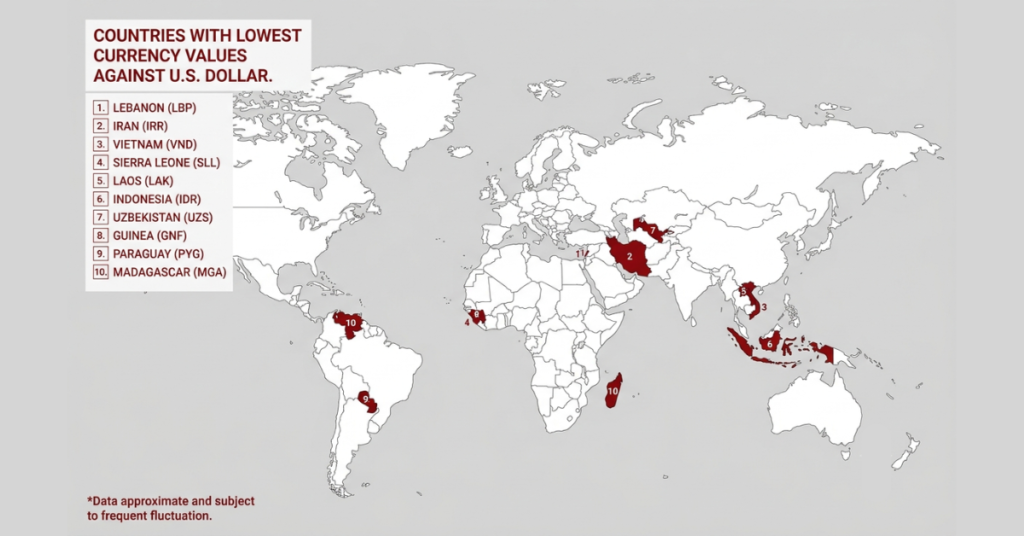
The Iranian rial holds the lowest currency value against one US dollar, trading at well over 1.8 million rials per dollar on the open market by mid-2026. On official exchange rate boards, the Lebanese pound ranks lowest, at roughly 89,500 pounds per dollar. Both reflect years of inflation, sanctions, or banking crises rather than simple economic size.
Key Takeaways
- The Iranian rial is the world’s lowest-valued currency by open-market exchange rate in 2026.
- The Lebanese pound is lowest when official, government-quoted rates are used instead.
- Vietnam, Laos, Indonesia, and Sierra Leone also rank among the lowest-value currencies without being in an economic crisis.
- Currency value is a face-value measurement, not a direct signal of a country’s overall economic health.
How Currency Value Against the Dollar Is Measured
A currency’s value against the dollar is simply how many units of that currency it takes to buy one US dollar. This is a nominal figure, not a measure of purchasing power or the size of a country’s economy. Japan’s yen trades at over 160 per dollar and Japan still has one of the largest economies in the world. The ranking below focuses purely on units per dollar, which is what most people mean when they ask which currency is worth the least.
Two things drive a currency toward the bottom of this list. The first is history: some currencies were never redenominated after a period of high inflation, so their unit value stayed small even after prices stabilized. The second is an ongoing loss of confidence, usually tied to sanctions, war, high debt, or a central bank printing money faster than the economy grows.
The Lowest-Valued Currencies Against the US Dollar
| Currency | Country | Approx. Rate to $1 | Main Driver |
| Iranian rial (open market) | Iran | 1,800,000+ IRR | Sanctions, high inflation |
| Lebanese pound (official) | Lebanon | ~89,500 LBP | Banking and debt crisis |
| Vietnamese dong | Vietnam | ~26,300 VND | Managed exchange rate policy |
| Lao kip | Laos | ~22,000 LAK | High public debt, inflation |
| Indonesian rupiah | Indonesia | ~18,000 IDR | Historic devaluation, never redenominated |
| Sierra Leonean leone | Sierra Leone | ~24,000 SLE | Post-conflict recovery, inflation |
| Uzbek sum | Uzbekistan | ~12,100 UZS | Post-Soviet currency reform |
| Guinean franc | Guinea | ~8,800 GNF | Weak export diversification |
Rates move constantly, and Iran in particular runs two markets: an official rate set by the central bank and a much weaker open-market rate that reflects what people actually pay. When traders and publications say Iran has the weakest currency in the world, they are almost always citing the open-market figure.
Why Some Weak Currencies Signal Crisis and Others Do Not
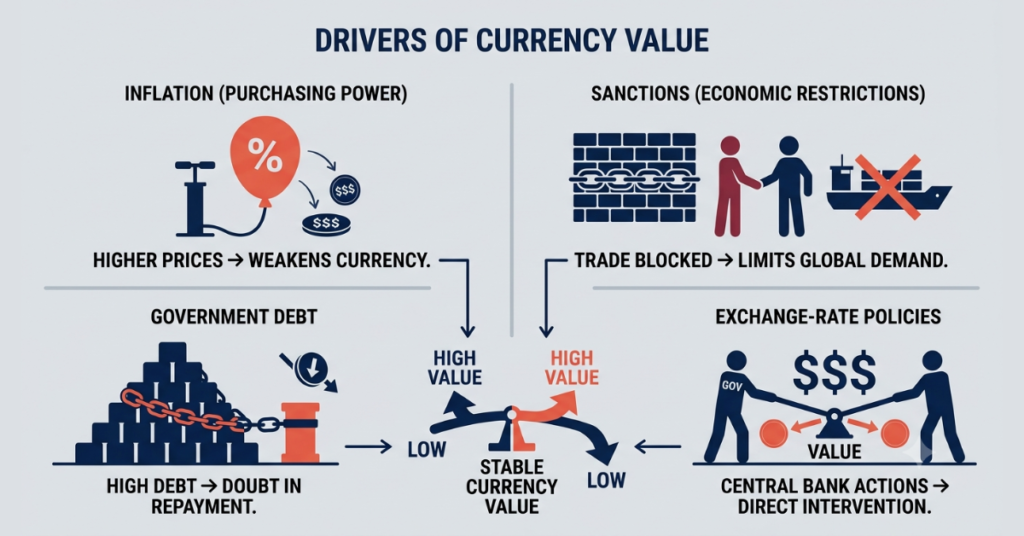
The Iranian rial and Lebanese pound reflect genuine economic distress. Iran’s inflation has run above 40% for multiple years under sustained sanctions, while Lebanon’s banking system has been effectively frozen since 2019, trapping depositors and collapsing confidence in the pound.
What This Means for Currency Traders
Extremely weak currencies rarely appear as standalone trading pairs on retail platforms because liquidity is thin and spreads widen sharply during political shocks. Most traders instead watch how dollar strength or weakness plays out across liquid majors and minors, where price discovery is faster and execution is more reliable.
You can see current spreads across major, minor, and exotic pairs on the forex currency pairs page, and compare it against how currency value is determined more broadly.
Defcofx Features for Trading Currency Pairs
| Feature | Defcofx Offering |
| Spreads | From 0.3 pips on major pairs |
| Leverage | Up to 1:2000 |
| Commissions | Zero commissions, zero swap fees |
| Platform | MetaTrader 5 |
| Welcome Bonus | 40% on first deposits of $1,000 or more |
| Withdrawals | Processed within 3 hours, including weekends |
Trading a weak or exotic currency directly is difficult for retail accounts, but exposure to dollar strength and weakness is easy to build through major pairs. Defcofx runs on MetaTrader 5 with tight spreads and deep leverage, so you can size positions around dollar-driven moves without unnecessary friction.
Open a Live Trading AccountStatistics Snapshot
Iran’s open-market rial traded near 1,470,000 per dollar in January 2026 and had climbed above 1,800,000 by mid-2026, with inflation exceeding 40% in recent years.
Lebanon’s official pound rate sits near 89,500 to the dollar, following the collapse of the previous 1,500 peg.
Vietnam’s dong has stayed broadly stable near 24,000 to 26,300 per dollar over the past two years despite the low nominal value.
Defcofx: Built for Trading Dollar-Driven Markets
Currency stories like these move fast, and catching the dollar side of the trade means having a platform that keeps pace. Defcofx runs entirely on MetaTrader 5, giving traders one-click execution, real depth on major and minor pairs, and leverage up to 1:2000 for those who want to size positions aggressively. Spreads start from 0.3 pips with no added commission, and there are no swap charges for holding positions overnight. New clients funding an account with $1,000 or more can claim a 40% welcome bonus, and every withdrawal request is processed within 3 hours, weekends included.
Open a Demo Trading AccountFinal Thoughts on Which Country Has the Lowest Value of $1
A low currency value against the U.S. dollar does not automatically mean a country’s economy is weak. While currencies such as the Iranian rial and Lebanese pound have lost significant value because of inflation, sanctions, and financial crises, others like the Vietnamese dong or Indonesian rupiah maintain low nominal exchange rates largely because of historical monetary policies and managed exchange-rate systems.
For forex traders, the important lesson is not the face value of a currency but the economic forces driving its movement. Most of the world’s weakest currencies are not actively traded on retail platforms due to limited liquidity and political restrictions. Instead, traders typically gain exposure to U.S. dollar strength and weakness through highly liquid major and minor currency pairs, where pricing is transparent and execution is more reliable.
FAQ
The Iranian rial is the lowest-valued currency by open-market exchange rate, trading above 1,000,000 rials per US dollar in 2026.
It depends on which rate you use. On official exchange boards the Lebanese pound is lowest, but Iran’s unofficial open-market rate for the rial is far weaker than either figure.
Not necessarily. Vietnam’s dong is one of the lowest-valued currencies in the world by unit count, yet Vietnam has posted consistent economic growth for years.
Usually because of a past period of hyperinflation that was never followed by a redenomination, so the currency’s face value stayed low even after prices stabilized.
Most retail brokers, including Defcofx, do not list these as tradable pairs because of thin liquidity and heavy political risk. Traders typically gain dollar exposure through major pairs instead.
Value refers to the nominal exchange rate, how many units equal one dollar. Strength refers to whether that value is rising or falling over time, regardless of the starting unit count.
You can open a demo account to practice first, then move to a live account with spreads from 0.3 pips, leverage up to 1:2000, and MetaTrader 5 execution.