


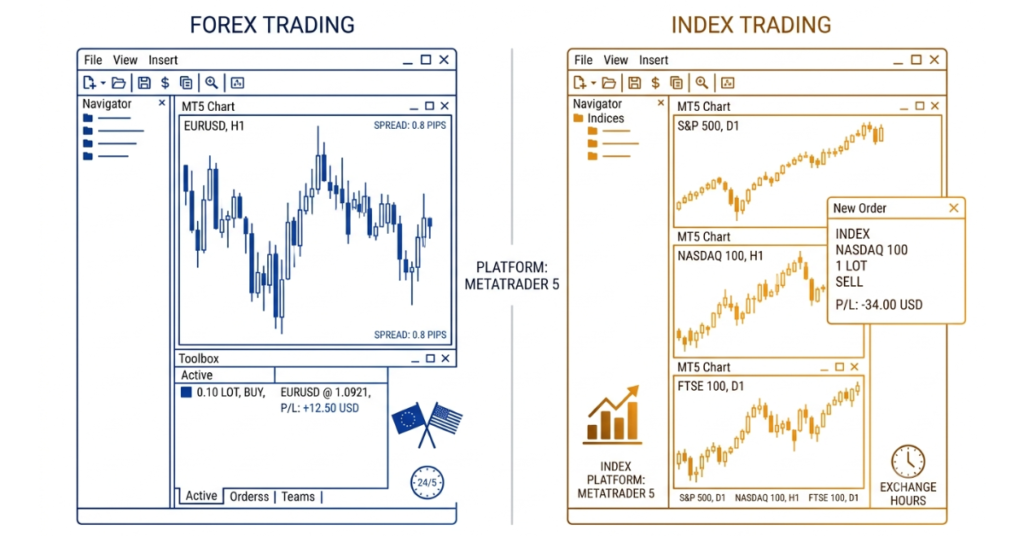
Forex and indices can both be traded through CFDs, but the way they move is different. With forex, you are comparing the strength of one currency against another. With indices, you are trading the overall performance of a group of companies. The difference becomes clear when you look at what actually moves the chart and how traders approach each market.
| Factor | Forex Trading | Index Trading |
|---|---|---|
| What moves the market | Currency strength, interest-rate decisions, inflation data, central bank comments, and economic reports | Company earnings, sector performance, economic growth, interest rates, and overall market sentiment |
| Trading hours | Runs almost 24 hours during weekdays because global currency sessions overlap from Asia to Europe and the US | Mainly follows stock exchange sessions, although many brokers offer extended index CFD trading hours |
| How price moves feel | Major pairs like EUR/USD often move in a more structured way, with key reactions around economic events | Indices can make stronger directional moves when markets react to earnings, news, or changes in risk appetite |
| Liquidity | Very high in major currency pairs due to global forex activity | High in major indices, especially during the opening and closing hours of the underlying exchange |
| What you are exposed to | The economy and currency strength of two countries | A basket of companies, sectors, and the broader market |
| Number of markets available | Major, minor, and exotic currency pairs | Global indices such as US500, NAS100, GER40, UK100, and others |
| Common trader focus | Economic calendars, central banks, currency strength, and technical setups | Earnings seasons, market sentiment, economic trends, and sector movements |
| Risk consideration | News releases can create sudden currency spikes and spread changes | Market gaps and strong moves can happen when major companies or economic events affect sentiment |
A View from a Trader
Traders frequently come to Defcofx assuming that the same strategy will work instantly when they move from forex to indices. The market’s character is distinct, even though the chart appears familiar.
Someone trading the Euro/Dollar pair, for instance, could pay closer attention to interest rate forecasts and policy announcements from central banks. When trading the NAS100, one should keep an eye on tech stocks, earnings reports, and the general sentiment of investors regarding risk.
When trading in relation to economic developments, patience and precision are frequently rewarded. While indices tend to provide more momentum when the market as a whole is moving in a certain direction, they may also react swiftly to shifts in mood.
The best market to invest in is the one you know enough about to control your risk appropriately, not the one with the largest fluctuations.
Main Important Points to Consider
- Forex trading focuses on buying and selling currency pairs, while index trading tracks the performance of a group of stocks representing a market or sector.
- The forex market operates nearly 24 hours a day from Monday to Friday, whereas index trading mainly follows the trading hours of the underlying stock exchange, although CFDs often offer extended sessions.
- Forex prices are driven primarily by interest rates, inflation, central bank decisions, and economic data, while indices respond more to corporate earnings, sector performance, and overall economic sentiment.
- Both forex pairs and index CFDs can be traded on MetaTrader 5, allowing traders to go long or short without owning the underlying assets.
- Selection between forex and index trading depends on your preferred trading schedule, market knowledge, and strategy rather than one market being universally better than the other.
Start Your Trading Journey with Defcofx
With Defcofx, you can explore both forex and index trading opportunities through one powerful platform. Whether you are an experienced trader or taking your first steps into the markets, we provide the tools and access you need to begin your trading journey with confidence.
We welcome traders from all backgrounds and are committed to supporting everyone who wants to pursue opportunities in forex and index markets.
Open a Live Trading AccountHow Forex Trading Works
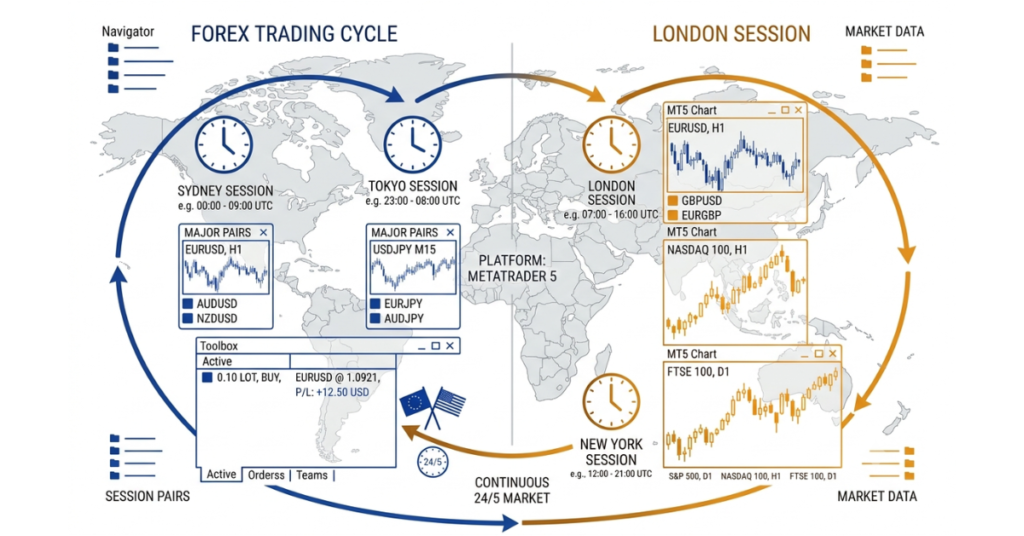
You are always trading one currency against another in forex trading.
If you buy EUR/USD, you are buying euros and simultaneously selling US dollars, betting that the euro will strengthen relative to the dollar. The forex market is decentralized, meaning trading happens over-the-counter through a global network of banks and brokers rather than on a single exchange. This structure is why forex markets can run almost continuously, opening in Sydney, moving through Tokyo and London, and closing in New York before the cycle begins again.
Forex trades from around 9:00 PM GMT Sunday through 9:00 PM GMT Friday without a full close, since a major financial center is always open somewhere in the world. Currency pairs typically move in response to central bank interest rate decisions, employment reports, inflation figures, and shifts in risk sentiment between countries. A forex trader watches central bank meetings closely, reacting to news at almost any hour of the day.
How Index Trading Works
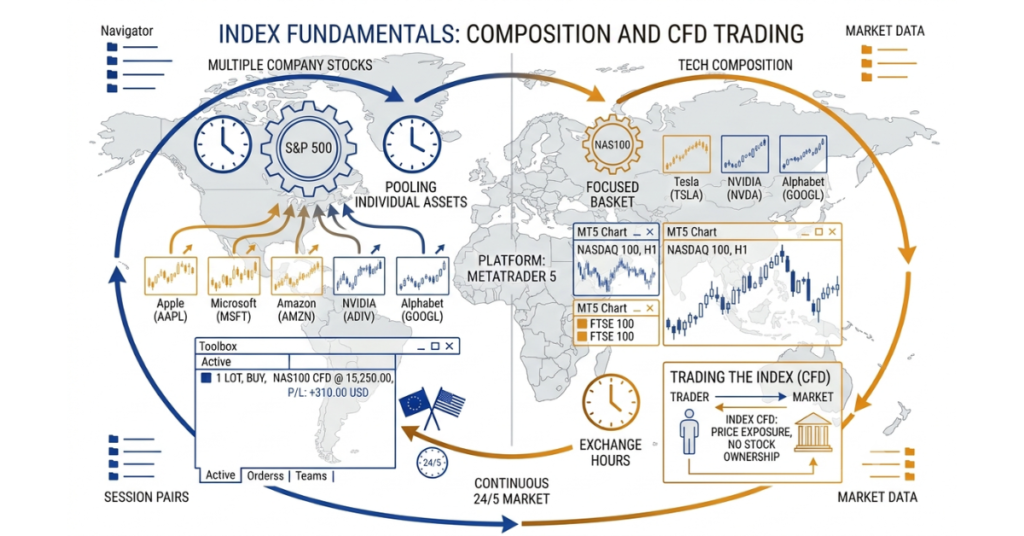
An index groups together a selection of stocks, usually chosen to represent a sector, country, or market segment, and calculates a single value based on their combined performance. The S&P 500 tracks 500 large US companies, the FTSE 100 tracks the largest firms listed in London, and the NAS100 tracks technology-heavy Nasdaq-listed companies. When you trade an index CFD, you are speculating on whether that combined value will rise or fall, without needing to buy each underlying stock individually.
A common misunderstanding: trading an index is not the same as owning shares in every company inside it. With an index CFD, you never take ownership of the underlying stocks. You are simply speculating on the price movement of the index value itself, which also means you cannot receive shareholder dividends directly, though some providers adjust pricing to reflect dividend events.
Indices are tied more closely to the trading hours of their home exchange, though CFD providers commonly extend these windows beyond the standard cash session. Indices respond more to corporate earnings seasons, sector-wide news, and the overall health of the economy the index represents. An index trader pays close attention to quarterly earnings reports from the largest constituent companies. Both markets can experience sharp volatility around major news events, but the specific calendar that matters differs between them.
Both markets are available as CFDs on MetaTrader 5, meaning the mechanics of placing a trade, setting stop-loss and take-profit levels, and managing leverage are largely the same. Major indices such as the US500 or NAS100 offer strong liquidity concentrated around exchange hours and compare index options on our indices CFDs page. New traders often start with one major forex pair or one well-known index rather than spreading attention across both markets at once.
Market Scale and Participation
The foreign exchange market is widely recognized as the largest financial market in the world by trading volume, with daily turnover measured in the trillions of dollars according to the Bank for International Settlements’ triennial survey.
Major stock indices, while smaller in daily notional turnover than the forex market as a whole, still represent some of the most heavily traded instruments among CFD and futures traders because of how closely they track broad economic sentiment. Retail participation has grown in both markets over the past decade, driven partly by the availability of CFD trading through MetaTrader 5 style platforms that give access to instruments that were once mostly limited to institutional traders.
How Do You Decide?
You should base your decision on your risk tolerance, trading time horizon, and preferred news sources; there is no objectively “better” market.
- Forex can be more suited to your trading strategy if you want to time your trades around scheduled events and have near-constant access to the market, such as central bank pronouncements.
- Index trading can be better suited to your needs if you like keeping up with business and industry news and are okay with sessions having a more defined beginning and finish.
Since the two markets can move in different directions at different times, many traders find that using both helps them diversify their trading strategies.
Need Guidance on Your Trading Journey?
Not sure where to begin? Our team at Defcofx is here to provide guidance and support for new traders and beginners looking to start their trading journey.
Whether you are exploring forex or index trading for the first time, feel free to reach out to us. Simply fill out our contact form, and we’ll be happy to assist you.
Contact DefcofxFAQs
Both carry significant risk, and the level depends more on the leverage and position size used than on the asset class itself. Forex pairs and indices can each experience sharp, fast moves around major news.
Yes. Platforms like MetaTrader 5 let you access forex pairs, indices, metals, and other instruments from a single trading account.
Neither is inherently easier. Some beginners find indices more intuitive since they track familiar companies, while others prefer the structured economic calendar that drives forex.
You don’t receive dividends directly from an index CFD, though providers often apply an adjustment to reflect dividend payouts from constituent companies.
Minimums vary by broker and account type. Demo accounts let you practice both markets without risking real funds before committing capital.
Currency trading happens over-the-counter across global financial centers, so as one region closes, another opens, keeping the market active almost continuously on weekdays.
Yes, Defcofx offers a wide range of forex pairs alongside major global indices on MetaTrader 5, with spreads from 0.3 pips and no commission.
Explore More Helpful Forex Articles with Defcofx
- Who Benefits from a Weak U.S. Dollar?
- Which Country Has the Lowest Value of $1?
- How Much Commission Does MetaTrader 5 Take?
- How Can You Protect Your Savings from a Weak Dollar?
- Another Names for US30 in Forex
- Does the S&P 500 trade after-hours?
- Best Time to Trade NAS100
- How Many Stocks Are on the Nasdaq?
- What Is the Difference Between Dow Jones and Nasdaq?
- How Much Do I Need to Trade NAS100?