


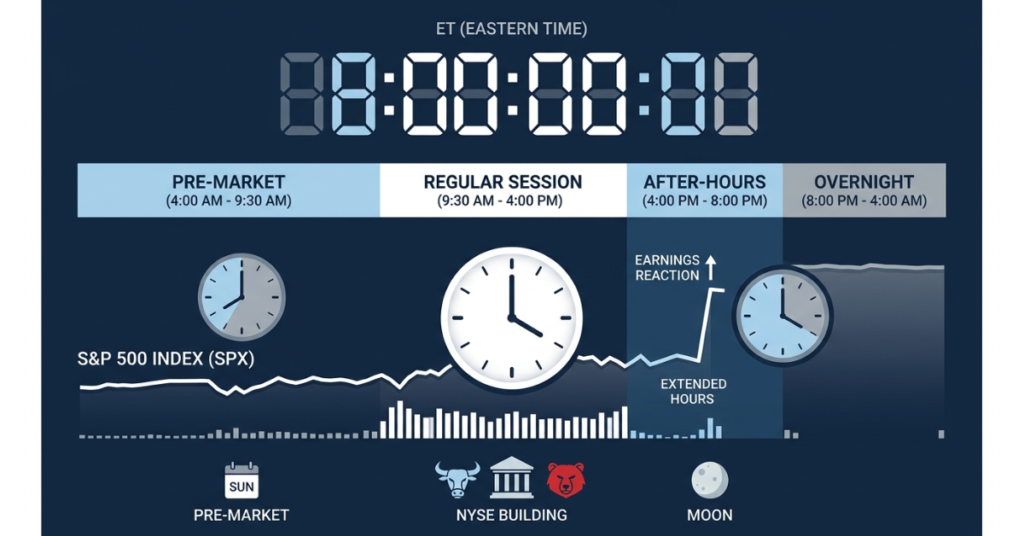
The S&P 500 index itself doesn’t trade after-hours because it is a calculated benchmark not a listed security. However, instruments tracking it including S&P 500 futures, ETFs like SPY, and index CFDs, do trade beyond the 9:30 AM to 4:00 PM ET session, with futures and CFDs offering close to 24-hour access on weekdays.
Main Points to Consider
- The S&P 500 index is a calculated number, not a security, so it can’t be bought or sold directly at any hour.
- S&P 500 futures trade almost 23 hours a day, from 6:00 PM Sunday through 5:00 PM Friday ET, with a short daily break.
- ETFs such as SPY trade in extended sessions, roughly 4:00 AM to 8:00 PM ET, but with thinner liquidity than the regular session.
- Index CFDs on platforms such as MetaTrader 5 give you exposure to the S&P 500 across extended windows without owning any underlying shares.
- Extended-hours trading carries wider spreads and lower volume, so price gaps are more common than during the regular session.
Why the S&P 500 Index Itself Never Trades
The S&P 500 is an index, meaning it is a running calculation of the combined value of 500 large US companies, weighted by market capitalization. Nobody can buy or sell the index number directly. What traders actually buy and sell are instruments built to track that number, and those instruments each have their own trading hours.
This distinction matters because it explains why the answer to the question isn’t a simple yes or no. The index calculation itself stops updating once the underlying stocks on the NYSE and Nasdaq close for the day at 4:00 PM ET. But derivatives and proxies for the S&P 500 keep moving well beyond that point.
S&P 500 Futures: The Closest Thing to 24-Hour Trading
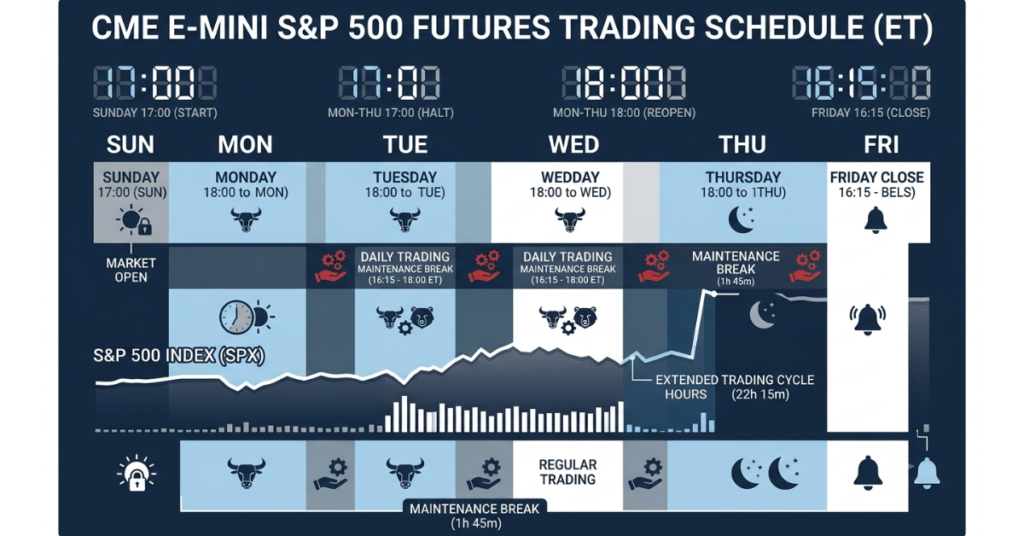
E-mini S&P 500 futures, traded on the CME Globex electronic platform, run almost continuously from 6:00 PM Sunday to 5:00 PM Friday Eastern Time, pausing for a short maintenance break each day. This is why financial news often quotes ‘futures pointing up’ or ‘futures pointing down’ before the regular stock market opens. These futures prices are the market’s best real-time estimate of where the S&P 500 will open.
Extended-Hours Trading for S&P 500 ETFs
Exchange-traded funds that track the S&P 500, such as SPY, VOO, and IVV, are listed securities, so they follow the extended-hours windows set by US exchanges and individual brokers. Pre-market typically runs 4:00 AM to 9:30 AM ET, and after-hours runs 4:00 PM to 8:00 PM ET. Volume during these windows is a fraction of the regular session, which tends to widen bid-ask spreads and increase the risk of slippage.
Trading the S&P 500 as a CFD
For traders who want exposure to the S&P 500 without owning shares or futures contracts, index CFDs are a practical alternative. A CFD, or contract for difference, lets you speculate on the price movement of the US500 index without taking delivery of anything. Because CFDs are offered directly by a broker rather than routed through a stock exchange, providers can extend their own trading windows, often well beyond the hours available to retail stock traders.
Defcofx offers the US500 index as a CFD on MetaTrader 5, with trading hours that align closely with the futures market. You can check exact daily session times on our indices trading hours page before planning any after-hours position.
Comparing Your Options for After-Hours S&P 500 Exposure
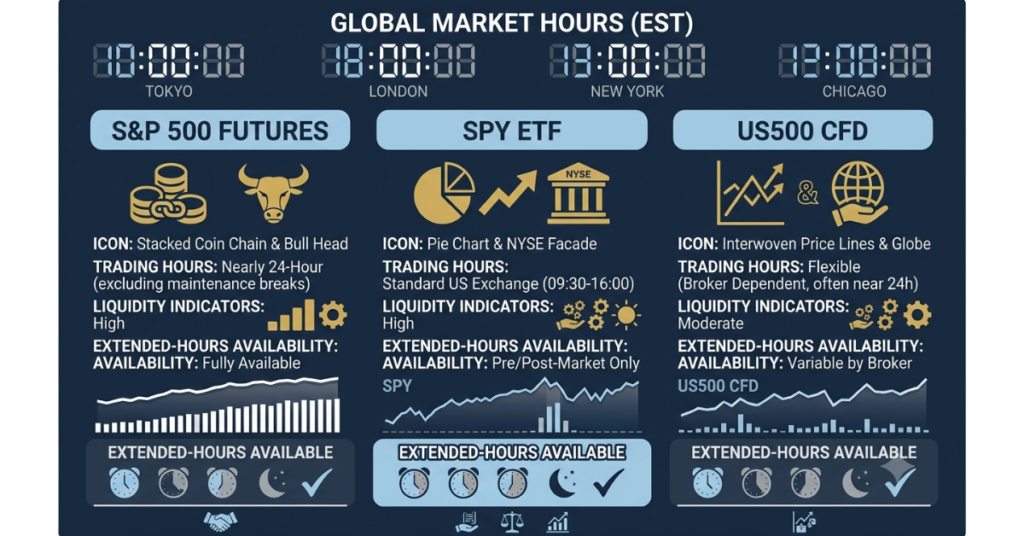
| Instrument | Typical Hours (ET) | Liquidity Outside Regular Session |
| S&P 500 Index | Not tradable directly | N/A |
| S&P 500 Futures (ES/MES) | Nearly 23 hrs, Sun 6PM–Fri 5PM | High relative to other options |
| SPY / VOO ETFs | 4:00 AM–8:00 PM (extended) | Low, wide spreads possible |
| US500 Index CFD | Broker-dependent, extended sessions | Depends on broker’s liquidity provider |
Defcofx and Index Trading
Access global index markets with Defcofx and trade popular instruments such as US500 through the powerful MetaTrader 5 platform. Enjoy competitive trading conditions with spreads starting from 0.3 pips and zero commission charges.
With leverage of up to 1:2000 available on eligible account types, traders can manage position sizes based on their individual strategies and risk preferences, without being limited by traditional exchange requirements.
New clients who fund a live account with $1,000 or more may qualify for a 40% welcome bonus, while withdrawal requests are typically processed within 4 business hours, including weekends.
S&P 500 Trading Sessions Explained
Understanding the difference between cash markets, extended hours, and futures trading can help traders follow global market movements.
Regular US Session
The primary trading period for US stocks and many ETFs. This session generally provides the highest liquidity and strongest participation.
Extended Hours
Pre-market and after-hours trading allows investors to react to some news events outside regular exchange hours, but liquidity is generally lower.
Index Futures Market
CME E-mini and Micro E-mini S&P 500 futures provide global market access and allow traders to respond to overnight developments.
Why Traders Monitor Futures
Futures markets can provide an early indication of market sentiment before the US opening bell. Economic reports, earnings news, and geopolitical events can influence futures prices before cash markets reopen.
Trading Consideration
Overnight markets may experience lower liquidity and wider spreads. Trading conditions depend on the instrument, broker, and market environment.
FAQ
No. The S&P 500 is a calculated benchmark, not a security. You gain exposure through index funds, ETFs, futures, or CFDs that track its performance.
CME Globex E-mini S&P 500 futures open at 6:00 PM Eastern Time on Sunday and trade nearly continuously until 5:00 PM Friday, with a short daily maintenance break.
Generally yes. Lower volume during extended hours tends to widen spreads and increase the chance of significant price gaps between trades.
Index CFDs are designed to mirror the price movement of the underlying index closely, though small differences can occur due to spreads, overnight financing, and the broker’s own pricing feed.
Futures require margin and carry significant leverage, so they suit traders who already understand risk management. A demo account is a practical way to learn the mechanics first.
Futures react to overnight news, earnings releases, and international market activity, giving traders an early signal of likely direction before the cash market opens.
Yes, Defcofx offers the US500 index CFD on MetaTrader 5 with spreads from 0.3 pips, zero commission, and leverage of up to 1:2000 on eligible accounts.
Final Thoughts on Does the S&P 500 Trade After-Hours
The S&P 500 itself never trades after-hours because it is only a market index that measures the performance of 500 large U.S. companies. What traders actually access outside regular market hours are instruments that track the index, such as futures, ETFs, and index CFDs. Each offers different trading windows, liquidity levels, and risk profiles.
For most retail traders, understanding which product you’re trading is more important than simply knowing the market is “open.” Futures provide the broadest access, ETFs offer limited pre-market and after-hours trading, while CFDs allow extended trading sessions through brokers like Defcofx. Regardless of the instrument you choose, after-hours trading typically comes with lower liquidity, wider spreads, and greater price volatility, making disciplined risk management essential.
Explore More Helpful Forex Articles with Defcofx
- Who Benefits from a Weak U.S. Dollar?
- Which Country Has the Lowest Value of $1?
- What If I Invested $10,000 in Gold 20 Years Ago?
- How Can You Protect Your Savings from a Weak Dollar?
- Another Names for US30 in Forex
- How to Trade US30
- Best Time to Trade NAS100
- How Many Stocks Are on the Nasdaq?
- What Is the Difference Between Dow Jones and Nasdaq?
- How Much Do I Need to Trade NAS100?