


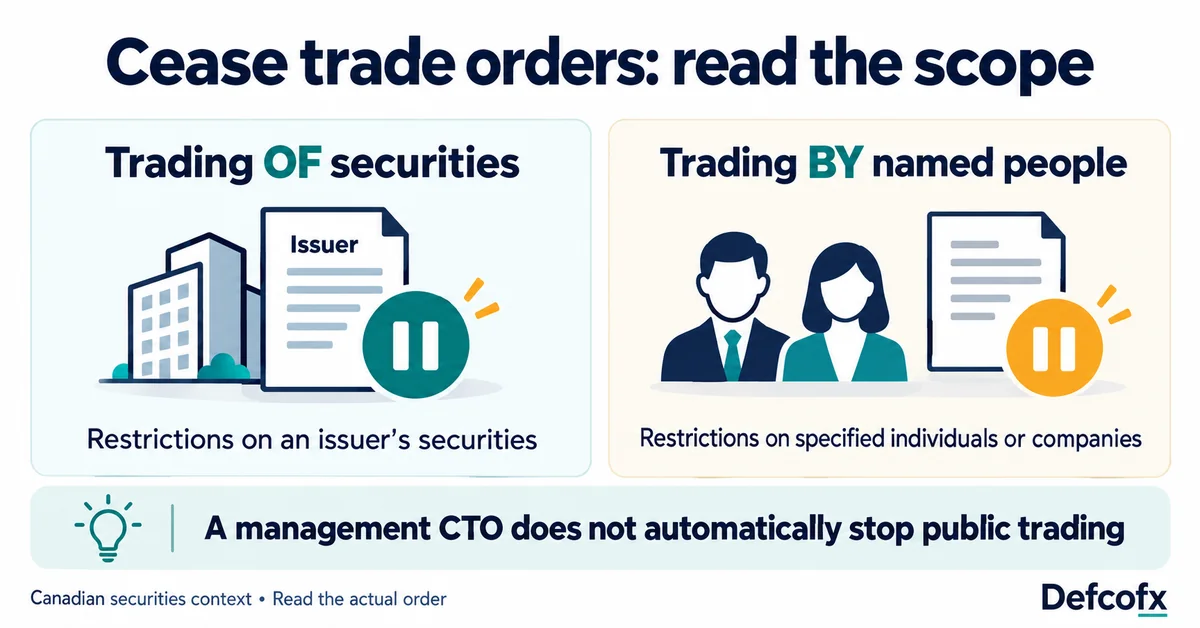
A cease trade order (CTO) is a decision under Canadian securities law that restricts trading in specified securities or trading by particular people or companies. It may follow a disclosure failure or an enforcement proceeding. Who is restricted, which transactions are prohibited, and when the order ends depend on its actual terms.
Key takeaways
- A CTO is a legal restriction, not a stop-loss instruction placed by a trader.
- Read whether the order bans trading of an issuer’s securities or trading by named people.
- A management cease trade order can restrict specified managers while other investors continue trading.
- There is no standard number of days after which every CTO ends.
- Check SEDAR+, the regulator’s decisions, and your broker before acting on a restricted holding.
What does a cease trade order mean?
In Canada, securities authorities can restrict trading when disclosure obligations are not met or securities-law concerns require intervention. An issuer is the company or other organization whose securities are involved. The Government of Newfoundland and Labrador explains that orders can concern a company or an individual and can arise from disclosure failures or an investigation of possible wrongdoing.
A CTO should therefore be read as a specific decision, rather than as a generic “market closed” notice. A restriction affecting one issuer does not itself close an entire exchange, and a restriction on one person does not necessarily prevent everyone else from trading.
The Canadian Securities Administrators (CSA) separates CTOs into bans on trading of an issuer’s securities and bans on trading by particular individuals or companies. A decision can fall into both categories.
Who issues a CTO, and why?
Canadian provincial and territorial securities authorities issue CTOs under the applicable legislation; enforcement restrictions may also be imposed through the relevant tribunal process. An exchange’s trading suspension is a separate mechanism. Calling every exchange halt a CTO confuses two different sources of trading restrictions.
Common circumstances include overdue financial statements or other required disclosure, and enforcement proceedings concerning possible or established securities-law breaches. The Alberta Securities Commission explains both disclosure-related and enforcement-related CTOs. A filing failure and an allegation of fraud are not interchangeable: read the reasons in the decision before drawing conclusions.
Issuer CTO versus management cease trade order
| Question | Issuer-wide trading restriction | Management cease trade order |
|---|---|---|
| What is restricted? | Trading in the securities identified in the order | Trading by the managers or other people identified |
| Can other investors trade? | They may be prohibited from trading the affected securities | Generally yes, if no separate restriction applies to them or the security |
| What must you check? | Securities, transactions, jurisdictions, exceptions, and current status | Named persons, covered securities, and the terms of the order |
A management cease trade order (MCTO) can be used in a disclosure-default process to restrict specified management or insiders rather than the investing public. The BC Securities Commission’s reporting FAQs explains this distinction and refers issuers to National Policy 12-203. An MCTO is not automatic permission for anyone named in it to trade through a different account.
Two illustrative examples
Example A: a fictional company misses required financial filings. An order prohibits trading in its specified shares. A shareholder’s existing sell order does not override that prohibition.
Example B: a fictional company receives an MCTO naming its chief executive and finance officer. Those people are restricted as described in the order, while an unrelated shareholder may still trade if no other restriction applies. Neither example describes an actual company or predicts a regulatory outcome.
How is a CTO different from a halt or stop-loss order?
| Term | What it means | Key distinction |
|---|---|---|
| Cease trade order | A securities-law decision restricting specified trading | Scope and duration come from the decision and applicable law |
| Trading halt | A temporary marketplace pause, often around material news | Trading resumes through the applicable market process |
| Exchange suspension or delisting | A restriction on exchange trading or removal from listing | Not the same as a CTO; more than one restriction can apply |
| Stop-loss or stop-limit order | A trader’s instruction to a broker, subject to execution rules | It cannot authorize a transaction prohibited by law |
CIRO’s trading-halt guidance describes a halt as a pause that allows information to reach and be absorbed by the market. It also distinguishes halts from CTOs and suspensions. A halt ending does not establish that every other legal restriction has ended.
For the broker-instruction side of the comparison, see our stop-limit order explainer. Similar terminology does not make the two mechanisms equivalent.
How long does a cease trade order last?
There is no universal CTO expiry period. An order can have an expiry date, be extended, or remain in effect until revoked. The ASC distinguishes interim orders, which expire unless extended, from final orders that remain effective unless revoked. “Final” should not be read as “guaranteed to last forever.”
For failure-to-file orders, submitting the missing documents does not itself establish that trading is allowed again. National Policy 11-207 describes the revocation review process; for orders in effect for 90 days or less, filing the required disclosure initiates that process, while longer-standing orders generally require an application. The 90-day threshold is a procedural distinction, not an automatic expiry date. Check the current policy and the regulator’s decision for the particular case.
A partial revocation can permit a specific transaction while the broader CTO remains in place. It is not a general reopening of trading. Read the conditions and any continuing restrictions rather than relying on the word “revocation” alone.
Source: National Policy 11-207, sections 20, 24, and 32.
How to check a CTO on SEDAR+
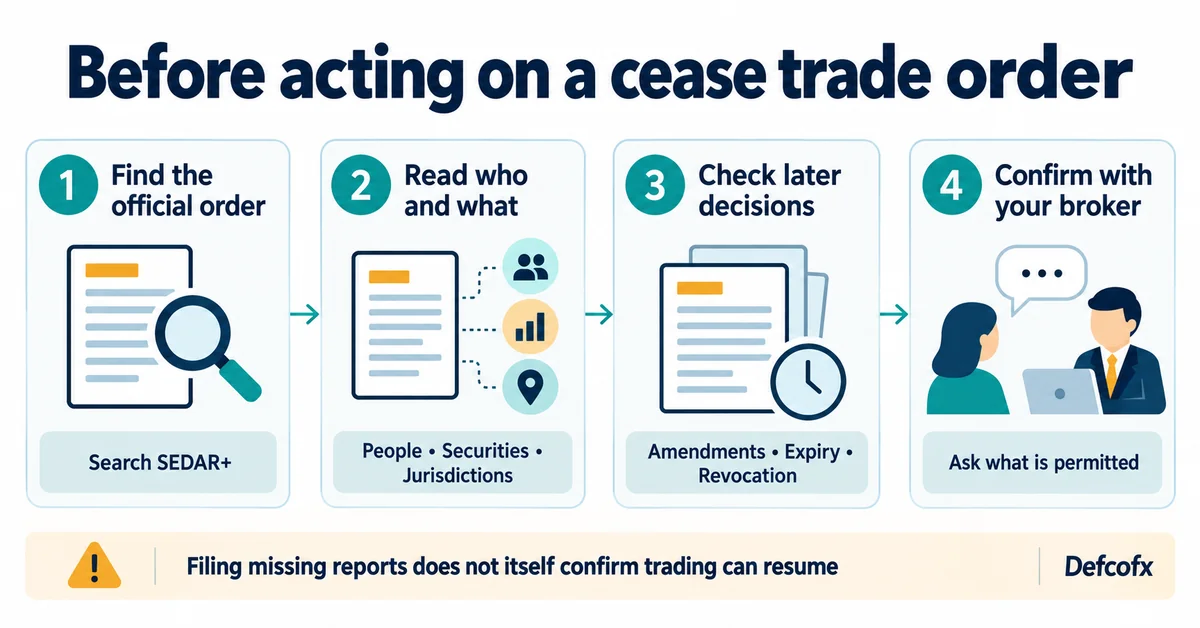
Use the official record rather than relying on a social-media post or a broker’s abbreviated status message. The SEDAR+ search guide explains the public search and its filters:
- Open SEDAR+ and select the cease trade orders search.
- Search for the issuer or organization using its name or profile number where available.
- Review the ban type and issuing jurisdiction, then open the actual supporting decision.
- Check later amendments, extensions, expiry information, and revocation decisions. The default search is for active bans; include inactive results when researching the history.
- Confirm the identity of the security and the proposed transaction with your broker before submitting an instruction.
Management-order search tip: the SEDAR+ CTO FAQs advises searching for a named individual in document content when checking an MCTO. A name/profile search alone can miss the relevant person. Open the document to confirm the name, and remember that a non-searchable upload may not appear in a text-content search.
What should you check if you already own the shares?
Start with five fields in the decision: who is named, which securities are covered, what activities are restricted, where it applies, and what changes or ends the restriction. Keep the decision and subsequent notices with your investment records.
Do not assume that moving the holding to another broker, arranging a private sale, or using a foreign exchange removes the restriction. The BCSC’s CTO guidance notes that an issuer-wide order can cover exchange trading, private transactions, and securities issuance. Limited relief may exist, including specific arrangements for some long-held securities, but its conditions must be satisfied.
Geographic effect also requires care. The CSA’s jurisdiction guide explains automatic reciprocal provisions and MI 11-103. A separate local order need not appear for a restriction to apply. Ask the issuing authority or a qualified adviser if the scope is unclear.
Does a CTO affect forex or CFDs?
A CTO concerning a company’s shares is not, merely by that fact, a shutdown of unrelated currency pairs. Equally, a person-specific order may have broader wording than a ban on one stock. Read the instruments and activities covered rather than assuming that “forex” or “CFD” means an exemption.
A CFD referencing an affected share is a separate contract. Whether quoting, new orders, closing, or adjustments are available depends on the applicable legal restriction and the provider’s contract terms. This article does not assert that Defcofx offers a particular affected security or a specific treatment of CTOs.
Leverage cannot lift a regulatory prohibition or ensure an exit from a restricted instrument. Before trading a derivative, review Defcofx’s trading conditions and risk disclosure. For a platform restriction, give support the symbol and relevant notice and ask what actions are permitted.
Review Defcofx trading conditions
Frequently asked questions
Is a cease trade order a sign of bankruptcy?
Not necessarily. Disclosure defaults and enforcement matters can lead to CTOs. The order alone does not establish insolvency or the value of the investment; review the issuer’s filings and the stated reasons.
Can I sell shares during a CTO?
Only if the sale is permitted under the applicable order and law. A broad ban may prevent it, while an MCTO naming other people may not restrict you. Have your broker confirm any relevant exception before acting.
Does a stop-loss still protect my position?
A stop-loss cannot require execution of a prohibited trade. Trading interruptions and gaps can also prevent an exit at the intended price. Check how your broker handles outstanding instructions.
Does an MCTO stop everyone from trading?
No. It restricts the people specified in it. Other investors can generally trade unless a separate order, halt, or other restriction applies.
Does filing the missing financial report lift a CTO?
Do not assume so. Filing may start a regulatory review. Verify the operative revocation, expiry, or other permission and any remaining marketplace restrictions before trading.
What does “Amended” mean in a CTO record?
It means the original decision has changed. It does not by itself mean the trading ban has been lifted. Read the amendment alongside the original and later decisions.
Does revocation guarantee trading resumes immediately?
No. Check whether other orders, exchange suspensions, or broker restrictions remain. A regulatory decision and an exchange’s trading status answer different questions.
Can a CTO apply outside the issuing province?
Yes. Reciprocal provisions or other applicable rules can extend its effect. Do not infer permission from the absence of a separately listed order in your province.
Can I claim the holding as a tax loss?
A CTO alone does not settle the tax treatment. Consult a qualified tax adviser about the holding and any permitted disposal or relief; do not assume that an inability to sell creates an automatic deduction.
Canadian securities context; sources checked 25 October 2026. This is general education. The actual order, applicable law, and subsequent decisions determine the restriction.