


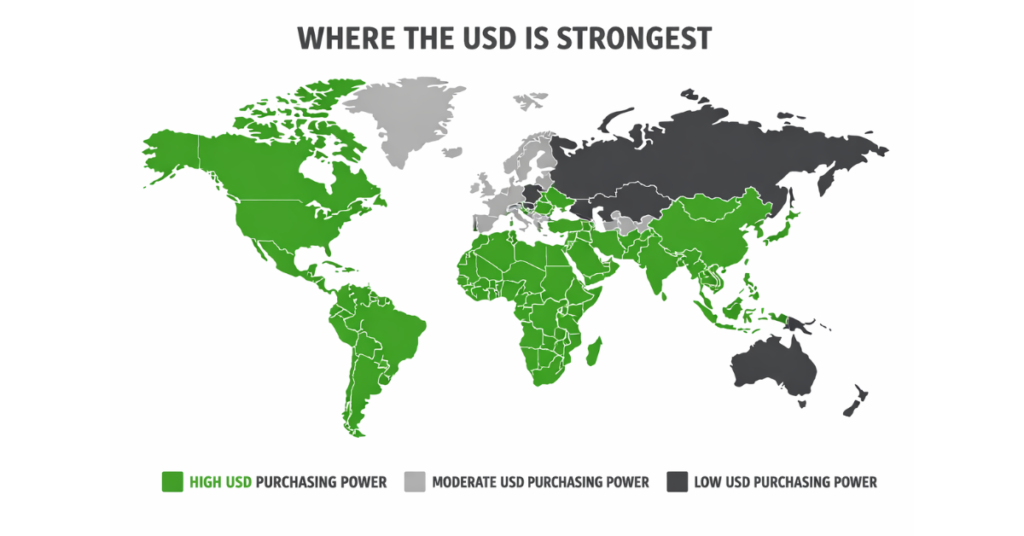
The country with the strongest currency against the US dollar is Kuwait, as the Kuwaiti Dinar (KWD) has the highest nominal value compared to USD. However, if “best exchange rate” means where your dollar has the most purchasing power, countries like Vietnam, Indonesia, Mexico, or Turkey often provide better real-world value.
Key Takeaways
- Kuwait has the strongest currency against the US dollar, making it the highest-value exchange rate in nominal terms.
- The USD has greater purchasing power in lower-cost countries like Vietnam and Indonesia.
- A strong currency does not always mean better value for travelers.
- Exchange rates are influenced by inflation, interest rates, and economic stability.
- USD exchange rate fluctuations also create opportunities in global currency markets.
What Does “Best Exchange Rate for USD” Actually Mean?
When people ask “what country has the best exchange rate for USD”, they usually mean one of two things:
- Which country has the strongest currency value compared to the US dollar?
- Where does the USD have the most purchasing power?
These are completely different concepts.
1. Strongest Currency (Nominal Exchange Rate)
This refers to how much one unit of a foreign currency is worth in USD terms. For example, the Kuwaiti Dinar is worth more than one US dollar, making Kuwait the country with the highest currency value in the world.
If 1 KWD equals more than 3 USD, it means Kuwait’s currency is stronger in nominal terms. However, this does not automatically mean your money goes further there.
2. Purchasing Power (Cost of Living Value)
Purchasing power measures how much goods and services your USD can buy in a country.
For example, in countries like Vietnam or Indonesia, everyday expenses such as food, transportation, and accommodation are significantly lower than in the United States.
So even if their currencies are weaker, your USD may stretch much further.
Countries With the Strongest Currency Against USD
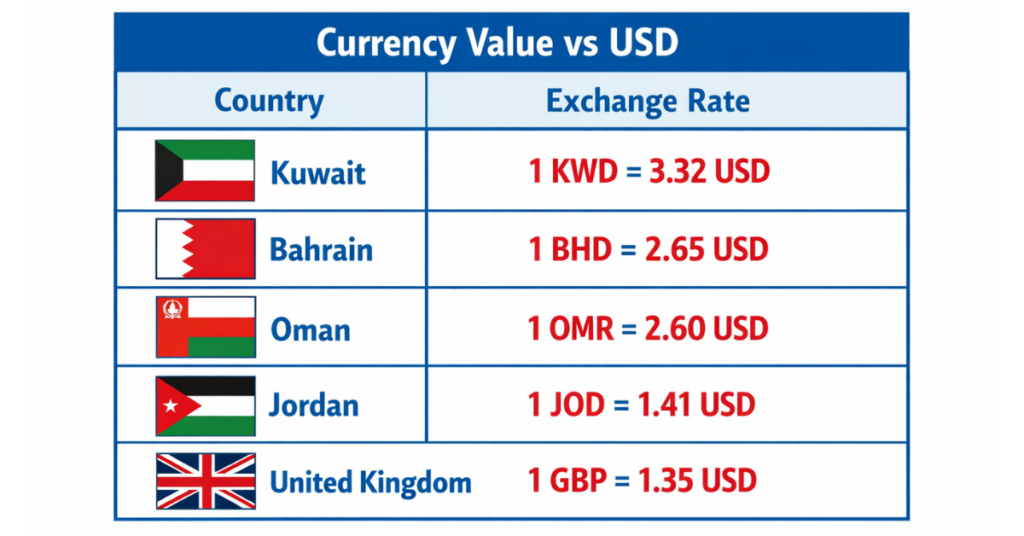
If “best exchange rate for USD” means the highest currency value compared to the US dollar, then the following countries rank at the top globally.
1. Kuwait
Currency: Kuwaiti Dinar (KWD)
Kuwait consistently holds the world’s strongest currency. Its high oil revenues, stable economy, and controlled monetary policy keep the dinar highly valued against USD.
2. Bahrain
Currency: Bahraini Dinar (BHD)
Bahrain’s currency is pegged to the US dollar and remains one of the highest-valued currencies globally due to its strong financial and oil sectors.
3. Oman
Currency: Omani Rial (OMR)
The Omani Rial is another Gulf currency supported by oil exports and economic stability.
4. Jordan
Currency: Jordanian Dinar (JOD)
Jordan maintains a fixed exchange rate system, helping preserve currency strength relative to USD.
5. United Kingdom
Currency: British Pound (GBP)
The pound sterling remains historically stronger than USD due to the UK’s financial influence and developed economy.
Comparison Table (Nominal Exchange Strength)
| Country | Currency | Approx. Value vs USD | Why It’s Strong |
| Kuwait | KWD | Highest globally | Oil reserves, monetary control |
| Bahrain | BHD | Very high | USD peg, strong finance sector |
| Oman | OMR | Very high | Energy exports |
| Jordan | JOD | High | Fixed exchange system |
| United Kingdom | GBP | Higher than USD | Developed economy |
Countries Where USD Has the Highest Purchasing Power
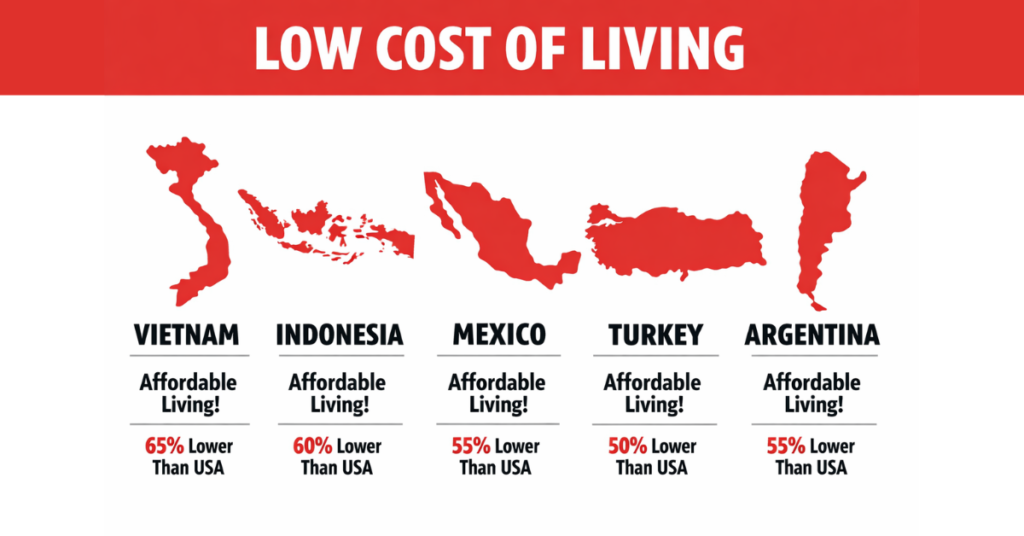
If “best exchange rate” means where your USD goes the furthest, the picture changes. Here, lower-cost countries allow you to buy more goods and services per dollar, even though their currencies are weaker.
Top Examples
Vietnam: USD stretches far in Vietnam due to low living costs. Travelers can enjoy accommodation, meals, and transportation at a fraction of U.S. prices.
Indonesia: The Indonesian Rupiah’s lower value means USD can cover more local expenses, from hotels to street food.
Mexico: The peso’s relative weakness provides higher purchasing power for visitors from the U.S., especially in smaller towns.
Turkey: Currency depreciation makes travel and daily expenses very affordable for USD holders.
Argentina: Strong inflation in Argentina means USD can buy significantly more than local wages suggest, ideal for travelers.
How This Links to Trading Opportunities
While physical travel benefits from purchasing power, traders can also leverage currency differences to maximize returns. Platforms like Defcofx provide:
- High Leverage up to 1:2000 maximize USD trading potential.
- No Commissions or Swap Fees spreads starting from 0.3 pips allow cost-efficient trades.
- Global Reach trade from anywhere, supporting multiple languages.
- Fast Support and Withdrawals within 4 business hours, including weekends.
Live USD Exchange Rates & How They Fluctuate
Exchange rates change constantly. The value of the US dollar rises or falls based on economic data, central bank decisions, and global events. Whether you are traveling or trading, understanding what moves exchange rates helps you make better financial decisions.
Main Factors That Move USD Exchange Rates
1. Interest Rates
When a country raises interest rates, it often attracts foreign investors seeking higher returns. This increases demand for that country’s currency and can strengthen it against USD.
If interest rates fall, demand may decrease, weakening the currency.
Example: If the U.S. Federal Reserve raises interest rates while the European Central Bank keeps rates unchanged, investors may move money into USD assets. As a result, the USD may strengthen against the Euro.
2. Inflation
Low inflation helps preserve a currency’s purchasing power. High inflation reduces confidence and weakens a currency over time.
Example: If Country A has 2% inflation and Country B has 15% inflation, Country B’s currency is more likely to lose value relative to USD.
3. Economic Growth (GDP)
Strong economic growth signals stability and investment potential, supporting currency strength. Weak growth can reduce investor confidence.
Example: If U.S. GDP growth exceeds expectations, USD often strengthens because investors anticipate stronger economic performance.
4. Trade Balance
Countries that export more than they import create higher demand for their currency, which can strengthen it.
Example: If Japan increases exports significantly, global buyers must purchase Japanese Yen, increasing its demand and potentially strengthening it against USD.
5. Political Stability
Political uncertainty or conflict increases risk. Investors often move money into safer assets such as USD during unstable periods.
Example: During global geopolitical tensions, USD frequently strengthens as investors seek stability.
Why Exchange Rate Movements Matter
For travelers, currency fluctuations affect how far USD will stretch abroad. A small change in exchange rate can increase or reduce travel expenses.
For traders, exchange rate volatility creates opportunities in currency pairs such as USD/EUR or USD/JPY. However, volatility also increases risk.
If you are trading USD currency pairs, factors such as spreads, execution speed, and leverage influence overall results. Platforms like Defcofx provide access to forex markets with spreads starting from 0.3 pips and leverage up to 1:2000.
Open a Live Trading AccountCan You Profit From USD Exchange Rate Changes?
Fluctuations in the US dollar exchange rate create opportunities for both travelers and traders.
- For travelers, understanding when and where to exchange money can help you get more value for your spending, particularly in countries where the USD has higher purchasing power, such as Vietnam or Indonesia. Timing conversions strategically can make a noticeable difference in everyday expenses like accommodation, meals, and transportation.
- For traders, USD currency pairs like USD/EUR, USD/JPY, or USD/IDR can offer significant profit potential due to daily market volatility. Factors such as interest rate changes, inflation, trade balances, and political events directly influence these rates. By understanding these dynamics, traders can make informed decisions about when to enter or exit positions.
While trading, platforms like Defcofx provide an environment to take advantage of these movements. Features such as low spreads starting from 0.3 pips and fast withdrawals can improve efficiency, but it is important to remember that currency trading carries inherent risks. High leverage can amplify profits but also increases exposure to potential losses, so careful risk management is essential.
Is the Strongest Currency Always the Best Choice?
Not necessarily.
If your goal is:
- Prestige or currency strength → Kuwait ranks highest.
- Travel value and daily affordability → Lower-cost countries provide better value.
- Investment or trading → Volatility and economic trends matter more than nominal strength.
Many travelers assume strong currency equals better value, but in reality, cost of living determines how far your money goes.
Final Thoughts on What Country Truly Has the Best Exchange Rate for USD?
In conclusion, the “best” country for USD depends entirely on your purpose. If you are looking for the strongest currency in nominal terms, Kuwait stands out as the top choice, with the Kuwaiti Dinar (KWD) holding the highest value against the US dollar. This makes it ideal for those who want a currency with high global strength.
However, if your goal is to maximize spending power, countries like Vietnam, Indonesia, or Mexico offer the most value. Here, everyday costs are lower, allowing your USD to go much further.
For those interested in trading USD rather than traveling, currency fluctuations create potential opportunities. Choosing a reliable trading platform with cost-efficient execution, such as Defcofx, can help leverage these market movements efficiently. Features like low spreads starting from 0.3 pips, fast withdrawals, and global access make trading USD currency pairs smoother and more accessible.
Ultimately, the “best exchange rate” is determined by whether you prioritize currency strength, spending power, or trading opportunities. Travelers and investors alike should evaluate the economic environment, cost of living, and market volatility to make informed decisions.
Open a Live Trading AccountFAQs
The country with the highest currency value against USD is Kuwait, where 1 Kuwaiti Dinar is worth more than 3 USD. Other high-value currencies include the Bahraini Dinar, Omani Rial, and British Pound.
USD stretches further in countries with lower living costs. Examples include Vietnam, Indonesia, and Mexico, where your dollars buy more goods and services.
Currently, USD and EUR fluctuate constantly. In terms of nominal exchange rate, the Euro is typically stronger than USD, meaning 1 EUR is worth more than 1 USD. However, USD often has higher purchasing power in lower-cost countries.
Major factors include interest rates, inflation, GDP growth, trade balances, and political stability. These economic and political conditions determine whether the USD strengthens or weakens against other currencies.
Yes, traders can profit from USD fluctuations using online platforms. Brokers like Defcofx allow trading with features like low spreads, fast withdrawals, and global access, helping you leverage currency volatility effectively.