


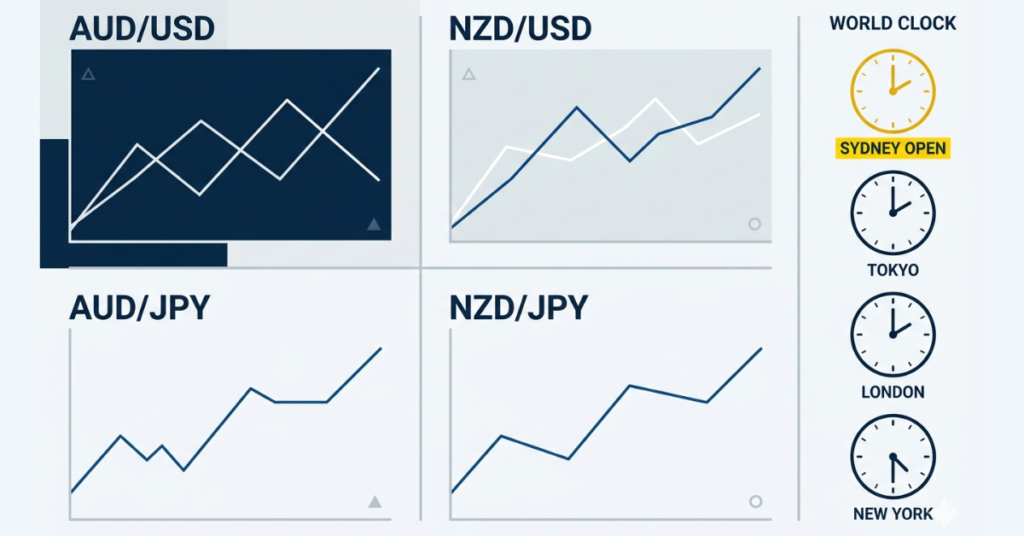
The best forex pairs to trade during the Sydney session are AUD/USD, NZD/USD, AUD/JPY, and NZD/JPY. The session opens the trading week and is centered on Australia and New Zealand, so their currencies see the most activity, tighter spreads, and the cleanest moves during these hours.
Key Takeaways
- The Sydney session opens the global trading week and is the quietest of the four major sessions, so liquidity is lower and moves are calmer. See how it fits in the forex trading sessions in EST.
- Because it is the home market for the Australian and New Zealand dollars, AUD and NZD pairs are the most active and most reliable to trade.
- The Sydney to Tokyo overlap brings the most liquidity of the session, lifting yen crosses like AUD/JPY. Compare it to the best currency pairs for the Tokyo session.
- Quieter hours favor range-based approaches over breakout chasing. The low volatility currency pairs behave well here.
- Knowing which currencies are most active during specific sessions is the key to choosing the right pair for the Sydney hours.
Understanding the Sydney Session
Forex runs around the clock through four major sessions: Sydney, Tokyo, London, and New York. The Sydney session opens the week and the daily cycle. It is the first to come online after the weekend, which makes it important even though it is the calmest of the four.
Because Sydney is the lead market for the Australian and New Zealand economies, the Australian dollar and the New Zealand dollar are at their most active during these hours. Liquidity outside the Asia-Pacific currencies is thinner than it is later in the day, so spreads on pairs like EUR/USD or GBP/USD can be wider and their moves less decisive. The smart approach is to trade what the session actually moves.
The Best Forex Pairs for the Sydney Session
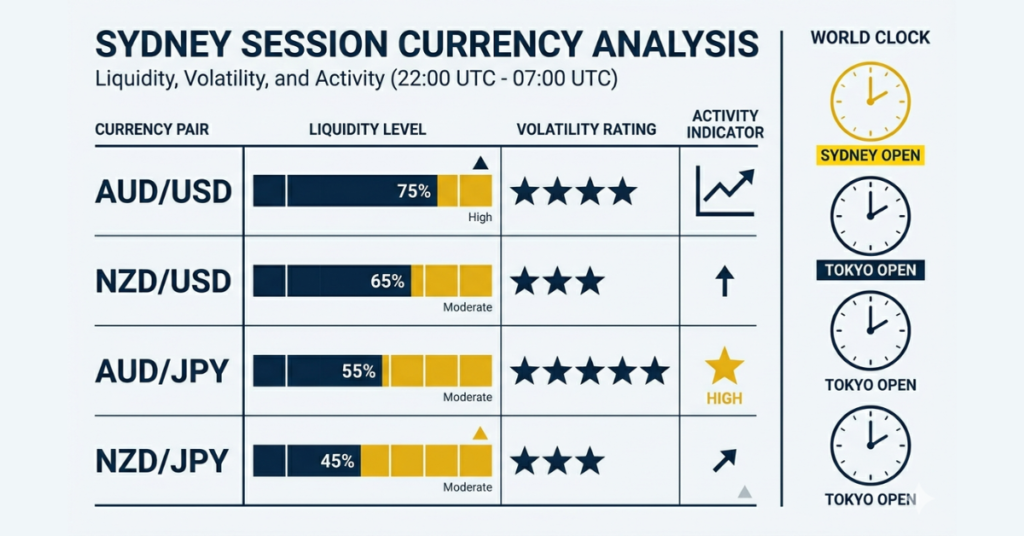
These are the pairs that move best during the Sydney hours, led by the local currencies. The notes show why each one fits the session.
| Pair | Activity Level | Why It Suits the Sydney Session |
| AUD/USD | High | The flagship Sydney pair, most active and most liquid in these hours |
| NZD/USD | High | New Zealand dollar is in its home market, clean and tradable |
| AUD/JPY | High in overlap | Yen cross that comes alive during the Sydney to Tokyo overlap |
| NZD/JPY | Moderate to high | Another overlap favorite with good range when Tokyo opens |
| AUD/NZD | Moderate | A pure Asia-Pacific cross, often range-bound and predictable |
| USD/JPY | Moderate | Picks up once Tokyo joins, bridging into the Asian session |
AUD/USD and NZD/USD: the session leaders
These two are the natural choices. During the Sydney session the Australian and New Zealand dollars trade in their own time zone, where local data, central bank commentary, and regional flows actually land. That gives AUD/USD and NZD/USD tighter spreads and more purposeful moves than pairs whose home markets are asleep. If you trade only one pair in these hours, AUD/USD is the one. Timing guides for the best time to trade AUD/USD and the best time to trade NZD/USD line up closely with this session.
AUD/JPY and NZD/JPY: trade the overlap
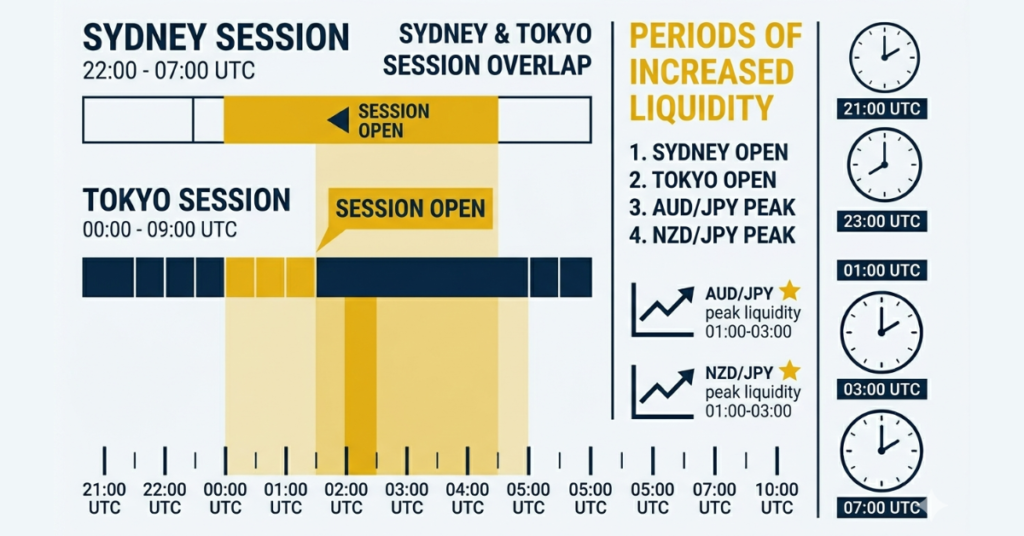
The most active part of the Sydney session arrives when Tokyo opens and the two sessions overlap. Liquidity rises, and the yen crosses are the main beneficiaries. AUD/JPY and NZD/JPY pick up range during this window, making them the better choice once Tokyo is online. This overlap is the closest the Asian hours get to the energy of the London session, so it is worth planning your trades around it.
AUD/NZD: the range specialist
AUD/NZD pits two closely linked economies against each other, which tends to keep it range-bound rather than strongly trending. During quiet Sydney hours that predictability is useful. It often respects support and resistance cleanly, which suits the range-trading mindset the session rewards. It sits among the low volatility currency pairs for good reason.
How to Trade the Quieter Sydney Hours
The Sydney session calls for a different mindset than the fast London and New York hours. Lower volatility means fewer big breakouts and more controlled ranges. Fighting that with a breakout-everything approach usually leads to false signals. Working with it pays off.
- Favor range trading. In calm conditions, buying near support and selling near resistance often works better than chasing breakouts.
- Respect wider spreads on non-local pairs. Stick to AUD and NZD pairs where the session keeps costs reasonable.
- Plan around the Tokyo overlap. Save your higher-energy setups for when Tokyo opens and liquidity rises.
- Watch Asia-Pacific data. Australian and New Zealand releases and RBA or RBNZ commentary are the main catalysts in these hours.
- Keep risk tight. Thin liquidity can produce the odd sharp move, so apply consistent forex risk management on every trade.
How the Sydney Session Compares
Putting the four sessions side by side makes the Sydney session’s character clear. It is the calm opener, not the volatility peak, and that shapes which pairs and tactics work.
| Session | Liquidity | Best Pairs | Character |
| Sydney | Lowest | AUD/USD, NZD/USD, AUD/JPY | Quiet opener, range-friendly |
| Tokyo | Moderate | USD/JPY, AUD/JPY, EUR/JPY | Yen-led, steady moves |
| London | Highest | EUR/USD, GBP/USD, EUR/JPY | High volatility and breakouts |
| New York | High | EUR/USD, USD/JPY, USD/CAD | US data-driven directional moves |
For a fuller breakdown, see how the Asian, London, and New York sessions compare, and where the line sits between the London session and the Asian session.
Why Trade the Sydney Session With Defcofx
Lower-liquidity hours make trading conditions matter even more, because wider spreads bite hardest when the market is quiet. Defcofx runs on MetaTrader 5 with conditions that help during the Sydney session:
| Feature | What Defcofx Offers |
| Spreads | From 0.3 pips, which matters most during quieter hours |
| Commissions | None on trades |
| Swap fees | Zero, useful if a Sydney-session trade runs overnight |
| Leverage | Up to 1:2000 for flexible position sizing |
| Platform | MetaTrader 5 with fast execution across all sessions |
| Welcome bonus | 40% on first deposits of $1,000 or more |
| Withdrawals | Processed within 4 business hours, including weekends |
Forex Market Statistics Worth Knowing
Session activity is really a story about where the money is. Figures from the 2025 BIS Triennial Central Bank Survey show why the Sydney hours are calmer and why AUD and NZD pairs lead them:
- Global forex turnover reached about $9.6 trillion per day in April 2025, a record, but that volume is heavily concentrated in the London and New York hours.
- Roughly three quarters of all trading flows through London, New York, Singapore, and Hong Kong, with London alone near 38%, so when those centers are closed the market is quieter.
- The US dollar is on one side of nearly 9 in 10 trades, which is why AUD/USD and NZD/USD, both dollar pairs, lead the Sydney session.
- The Australian dollar and New Zealand dollar see their peak share of activity in their home Asia-Pacific hours, exactly when the Sydney session runs.
Final Thoughts on Best Forex Pairs to Trade During the Sydney Session
The Sydney session may be the quietest major forex session, but that does not make it unimportant. In fact, its lower volatility and more predictable market conditions can provide valuable opportunities for traders who prefer a measured approach over fast-moving breakouts. By focusing on currencies that are actually active during these hours, primarily AUD and NZD pairs, traders can align themselves with the session’s strongest sources of liquidity and market movement.
AUD/USD, NZD/USD, AUD/JPY, and NZD/JPY consistently stand out as the most suitable Sydney session pairs because they benefit from local economic data, central bank developments, and regional trading flows. Traders who understand the session’s slower pace and take advantage of the Sydney-Tokyo overlap can often find cleaner setups than those chasing volatility in inactive markets.
FAQ
AUD/USD is the best single pair for the Sydney session. The Australian dollar is in its home market during these hours, so AUD/USD has the most activity, tighter spreads, and the cleanest moves. NZD/USD is the strong second choice.
Because Sydney is the lead market for the Australian and New Zealand economies. Local data, central bank commentary, and regional flows hit during these hours, which gives the AUD and NZD pairs more liquidity and more purposeful moves than currencies whose home markets are closed. See which currencies are most active during specific sessions.
Yes, with the right expectations. It is the quietest major session, so it favors patient, range-based trading over breakout chasing. If you focus on AUD and NZD pairs and trade the Tokyo overlap for more movement, the Sydney session offers steady, manageable opportunities.
The overlap happens when Tokyo opens while Sydney is still running, and it is the most active part of the Sydney session. Liquidity rises and yen crosses like AUD/JPY pick up range. Many traders save their main setups for this window. Compare it with the best currency pairs for the Tokyo session.
You can, but it is usually not ideal. EUR/USD is most active during the London and New York hours, when its home markets are open. During the Sydney session it tends to be quieter with wider spreads, so AUD and NZD pairs are the better fit for these hours.
Less volatile. With London and New York closed, overall liquidity is lower and ranges are tighter, which is why the session suits calmer, range-based strategies. The most volatile forex pairs tend to do their heavy moving later in the day, not during Sydney hours.
The Sydney session runs through the Asia-Pacific morning and opens the global trading week, though the exact clock time depends on your time zone and daylight saving. The forex trading sessions in EST guide lays out the hours so you can align them to your local time.