


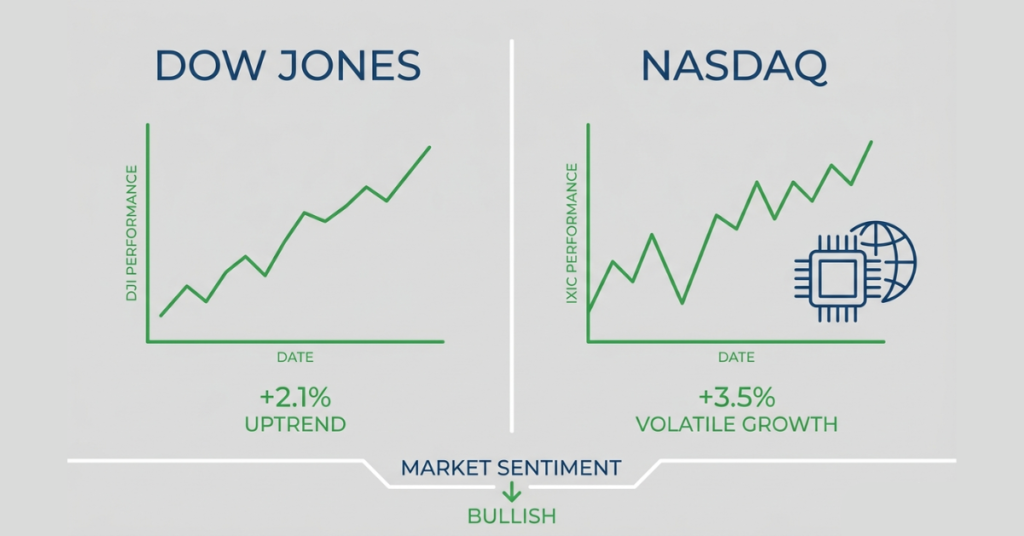
The main difference is what each one measures and how. The Dow Jones Industrial Average tracks 30 large, established U.S. companies and is price-weighted. Nasdaq can mean an exchange or its indexes, which track thousands of mostly tech-driven stocks and are weighted by market value.
Key Takeaways
- The Dow (DJIA) follows just 30 blue-chip companies, while the Nasdaq Composite follows thousands of listed stocks.
- The Dow is price-weighted, so higher-priced shares move it more. Nasdaq indexes are market-cap-weighted, so the biggest companies carry the most influence.
- “Nasdaq” can refer to the stock exchange itself or to an index built from it, such as the Composite or the Nasdaq-100.
- The Dow leans toward industrials, finance, and consumer names. Nasdaq leans heavily toward technology and growth companies.
- Both can be traded as index CFDs on a platform like MT5 without owning the underlying shares.
Index vs Exchange: The First Point of Confusion
People often compare the Dow and the Nasdaq as if they are the same type of thing. They are not. The Dow Jones Industrial Average is purely a stock index, a single number that summarizes how a basket of companies is performing. The Nasdaq, on the other hand, started as a stock exchange, a marketplace where shares actually change hands.
So when you hear “the Nasdaq was up today,” it usually refers to the Nasdaq Composite index, not the exchange. The largest stock exchange in the United States by listed company count is the Nasdaq exchange, and the indexes built on top of it share the same name. That overlap is why the comparison gets messy.
What the Dow Jones Industrial Average Tracks
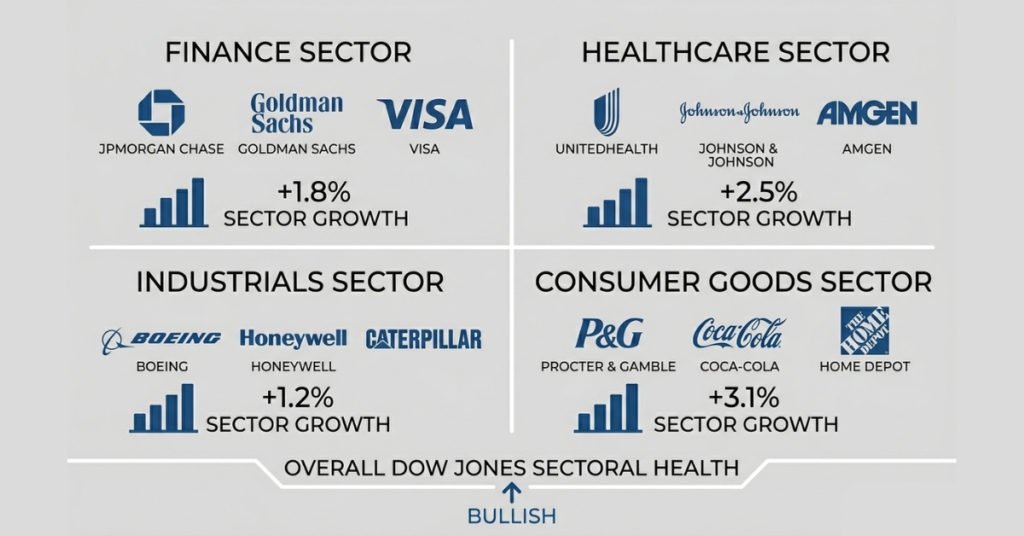
The DJIA is a small, curated list of 30 large and well-known U.S. companies. These are mature businesses spread across sectors like industrials, healthcare, finance, and consumer goods. Because the list is short and hand-selected by a committee, the Dow works as a snapshot of how big, stable American corporations are doing.
The Dow is also one of the oldest market measures still in use, which is part of why news outlets quote it so often. It is familiar, simple to follow, and easy to summarize in a single headline number.
What the Nasdaq Tracks
The Nasdaq Composite includes almost every common stock listed on the Nasdaq exchange, which runs into the thousands. It is heavily tilted toward technology, software, biotech, and other growth-focused companies. If you want a quick read on how the tech sector is feeling, the Nasdaq is the index most people watch. You can read more about whether Nasdaq is a stock or forex instrument if the labels still feel unclear.
There is also the Nasdaq-100, a narrower index of around 100 of the largest non-financial companies on the exchange. This is the one most CFD traders follow, often quoted as NAS100 or US100. It removes the smaller names and concentrates on the giants that drive most of the movement.
Price-Weighted vs Market-Cap-Weighted: The Real Mechanical Difference
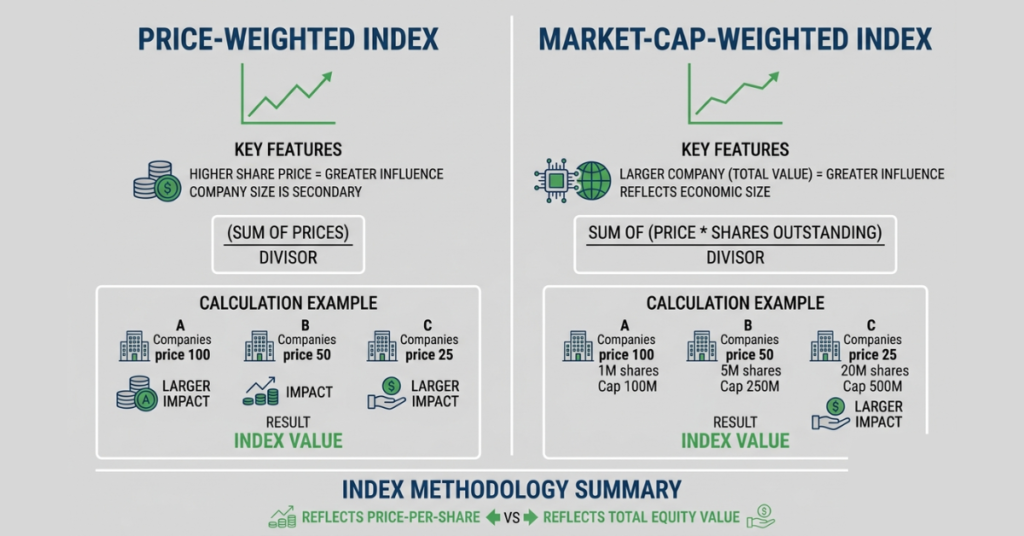
This is the part that changes how each index behaves. The Dow is price-weighted, which means a company with a higher share price moves the index more, regardless of how large the company actually is. A stock trading at $400 pushes the Dow around more than one trading at $80, even if the cheaper stock belongs to a far bigger business.
Nasdaq indexes are market-cap-weighted. Here, a company’s total market value decides its influence. The largest companies, the ones worth trillions, carry the heaviest weight. This is why a few mega-cap tech names can swing the Nasdaq significantly on their own.
Dow Jones vs Nasdaq at a Glance
| Feature | Dow Jones (DJIA) | Nasdaq Composite |
| Type | Stock index | Stock index (built on the Nasdaq exchange) |
| Number of stocks | 30 companies | Roughly 3,300 to 3,700 companies |
| Weighting method | Price-weighted | Market-cap-weighted |
| Sector focus | Industrials, finance, consumer | Technology and growth-heavy |
| Selection | Chosen by a committee | Nearly all Nasdaq-listed common stocks |
| Common CFD label | US30 | US100 / NAS100 (Nasdaq-100 subset) |
If you want to see how these indexes move in real conditions without risking funds, you can practice on a free demo account.
Why the Two Indexes Often Move Differently
Because the Dow holds steady blue-chip names and the Nasdaq leans into tech, the two can tell different stories on the same day. When technology stocks rally, the Nasdaq usually jumps while the Dow barely reacts. When investors shift toward safer, dividend-paying companies, the Dow can hold up better than the Nasdaq.
This is one reason traders watch both. Comparing them gives a sense of where money is flowing, toward growth or toward stability. If you are weighing index exposure against individual shares, this guide on forex trading vs stock trading adds useful context on how markets differ in pace and risk.
How Traders Access the Dow and Nasdaq
You do not need to buy all 30 Dow stocks or thousands of Nasdaq names to gain exposure. Most traders use index CFDs, which track the index price and let you trade both rising and falling markets. The Dow is usually offered as US30, and the Nasdaq-100 as US100 or NAS100.
At Defcofx, both are available on MetaTrader 5 with spreads from 0.3 pips, no commissions, and no swap fees. If indexes are new to you, the explainer on what indices are in forex is a good starting point, and the indices trading hours page shows when each one is active.
Why Trade Indices With Defcofx
Defcofx gives traders a straightforward way to access major indexes like the Dow and Nasdaq-100 through CFDs, with conditions built for active trading.
| Feature | What Defcofx Offers |
| Trading platform | MetaTrader 5 (MT5) |
| Spreads | From 0.3 pips |
| Commissions | Zero commissions |
| Swap fees | Zero swap fees |
| Leverage | Up to 1:2000 |
| Welcome bonus | 40% on first deposits of $1,000 or more |
| Withdrawals | Processed within 4 business hours, including weekends |
| Market access | Indices, forex, metals, energies, stocks, crypto CFDs |
Dow vs Nasdaq: A Few Numbers Worth Knowing
- These figures shift over time as companies are added, removed, or change value, but they capture the scale difference between the two.
- The DJIA holds exactly 30 companies, a number that has stayed fixed for decades.
- The Nasdaq Composite tracks roughly 3,300 to 3,700 companies, depending on the source and date.
- The Nasdaq-100 narrows that down to about 100 of the largest non-financial firms on the exchange.
- In the Nasdaq Composite, the top 10 stocks can account for more than half of the index’s movement, a sign of how concentrated mega-cap influence has become.
Final Thoughts on What Is the Difference Between Dow Jones and Nasdaq
The Dow Jones and Nasdaq are often mentioned together, but they represent different parts of the U.S. stock market. The Dow Jones Industrial Average focuses on just 30 large, established companies and provides a snapshot of traditional blue-chip corporate performance. The Nasdaq, particularly the Nasdaq-100 and Nasdaq Composite, offers broader exposure to technology, innovation, and growth-oriented businesses, making it more sensitive to shifts in investor sentiment and market trends.
Neither index is inherently better than the other. The Dow generally appeals to traders and investors seeking exposure to mature, diversified companies with relatively stable price behavior, while the Nasdaq attracts those looking for stronger growth potential and larger price movements. Many market participants follow both because comparing their performance can reveal whether capital is flowing toward defensive blue-chip stocks or higher-growth technology sectors.
FAQ
Both. Nasdaq is a stock exchange where shares are traded, and it is also the name of indexes built from those listed stocks, such as the Nasdaq Composite and the Nasdaq-100.
No. The Dow tracks 30 companies and is price-weighted, while the S&P 500 tracks 500 large U.S. companies and is market-cap-weighted. They measure different slices of the market.
The Nasdaq is heavily weighted toward technology and growth stocks, which tend to be more volatile. The Dow’s blue-chip mix is generally steadier, so it usually moves in a narrower range.
The Composite includes nearly all common stocks on the Nasdaq exchange, thousands of them. The Nasdaq-100 is a smaller index of around 100 of the largest non-financial companies.
Yes. Index CFDs let you trade the price of the Dow (US30) or Nasdaq-100 (US100/NAS100) in both directions. You can find these on the indices CFDs page.
Neither is strictly better. The Dow tends to be calmer, while the Nasdaq offers larger swings and more tech exposure. Beginners often start by watching both on a demo account before choosing.
US30 is the common CFD ticker for the Dow Jones Industrial Average, and US100 (also shown as NAS100) is the ticker for the Nasdaq-100 index.