


Some forex traders dislike weekends because their market closes while news continues. They generally cannot execute changes to open positions during the closure, and reopening prices can gap beyond stop losses. Thin liquidity, wider spreads and uncertainty about weekend events can make holding a position stressful.
Key Takeaways
- The market closes, the world does not. Elections, policy announcements and geopolitical developments can occur on a Saturday or Sunday.
- A gap can increase losses. A standard stop loss can execute beyond its requested level if the market reopens past it.
- Sunday opens are thin. Liquidity can be thin and spreads can widen around reopening; there is no fixed time at which conditions normalize.
- Holding costs can add up. Many brokers charge triple swap midweek to cover the weekend, though Defcofx charges zero swap fees.
- A Friday routine helps you assess exposure, but cannot eliminate gap risk. Decide which trades to close, which to reduce and where to set stops before the market shuts.
When Does the Forex Market Actually Close?
Forex runs 24 hours a day, five days a week. Retail forex trading generally closes around 5:00 PM New York time on Friday and resumes around that time on Sunday. Exact broker and instrument hours vary, and daylight-saving changes affect the time in other zones. That gap is about 48 hours with no trading on the main currency pairs. You can check exact times in your zone in our guides on what time forex closes on Friday and what time it opens on Sunday.
7 Reasons Traders Hate Weekends
Reason 1: Weekend gaps can jump past your stop loss
This is the big one. When the market reopens on Sunday, the first price can be far away from Friday’s close. Your broker may have no executable quotes during the closure. When quoting resumes beyond your stop, there may be no opportunity to close at the requested level.
Here is a simple example. You are short USD/CAD at 1.4000 with a stop loss at 1.4050, risking 50 pips. Over the weekend, big news breaks. Assume the first executable ask price on reopening is 1.4200 and your short position closes there. The loss is then 200 pips instead of the planned 50. On a standard lot of 100,000 USD, the 200-pip move is CAD 2,000, about USD 1,408 at 1.4200. The planned 50-pip loss was CAD 500, about USD 356 at 1.4050, before costs. Actual execution may differ.
Reason 2: News continues during market closures
Major government announcements can occur while markets are closed. Many countries also hold elections on Sundays. For a trader holding a position, that means the most important news of the week can land while you are unable to do anything about it.
Reason 3: You cannot manage open trades
On a weekday, if something goes wrong, you can close the trade, move your stop or hedge. On a weekend, you are locked in. You can see the news, but you cannot act on it. That lack of execution access can be stressful.
Reason 4: Sunday opens are thin and messy
Liquidity can be thinner around the weekly opening than during active overlapping sessions. Spreads may widen and execution can be less predictable. Check live bid and ask prices before submitting orders; waiting a fixed hour does not guarantee better conditions.
Reason 5: Holding costs
On accounts that apply swaps, overnight positions can incur a charge or receive a credit. A three-day rollover often occurs on Wednesday for forex pairs, but the day and multiplier depend on the symbol, broker, settlement schedule and holidays. Check the MT5 symbol specification. If you hold a large position for a week or more, those charges can quietly eat into your profit. Our guide on what a swap is in forex explains how it works.
Reason 6: Friday afternoons turn strange
Traders who do not want the weekend risk close positions on Friday. Position adjustments and reduced liquidity can affect price movements and spreads near the close. The pattern varies with the pair, news and market conditions; Friday does not always follow the same sequence.
Reason 7: Momentum and habit get interrupted
Active traders get into a rhythm during the week. Two days away can break that rhythm. Some traders also feel restless and start overanalysing their charts, second-guessing trades they planned well. The weekend becomes a source of stress instead of rest.
| Defcofx advertises swap-free trading and zero commissions. Review its current account conditions and your weekend exposure before opening a position. Open Live Trading Account |
Historical Events That Changed Market Expectations
The following historical examples show how developments during a closure can change market expectations. They do not establish how often gaps occur or predict the next opening price.
| When | What happened over the weekend | Documented development and relevance |
| March 2020 | OPEC and partner countries failed to agree on continuing output cuts in early March, adding a supply shock to weakening pandemic demand | The EIA reports that WTI futures fell 25% on Monday, March 9. That is a daily change, not a measured forex opening gap. |
| February 2025 | The US announced 25% tariffs on most Canadian and Mexican goods and an additional 10% on Chinese goods on 1 February; Canadian energy had a 10% rate | The Bank of Canada’s February analysis confirms the announced rates and discusses their economic and exchange-rate effects. It is not a source for a specific opening-gap size. |
Should You Close Trades Before the Weekend?
It depends on your trading style and the type of position. Use this quick guide.
| Situation | Common approach |
| Scalps and day trades | A day-trading plan usually closes positions within the trading day. Holding over the weekend changes that plan and adds closure risk |
| Swing trades in profit | Consider partial profit or a revised stop consistent with your plan. A stop at entry does not guarantee break-even after costs or gaps. |
| Swing trades near a stop | Close or reduce. A small gap could turn a planned loss into a bigger one |
| Long-term position trades | May be held if the strategy permits it. Assess size, margin and news exposure; a wider stop does not cap gap losses |
| Major weekend event expected (election, summit, OPEC meeting) | Reduce or close positions linked to that event |
Our guide on how to take partial profit shows a simple way to lock in gains while leaving some of the position running.
The Friday Checklist: A Weekend Risk Playbook
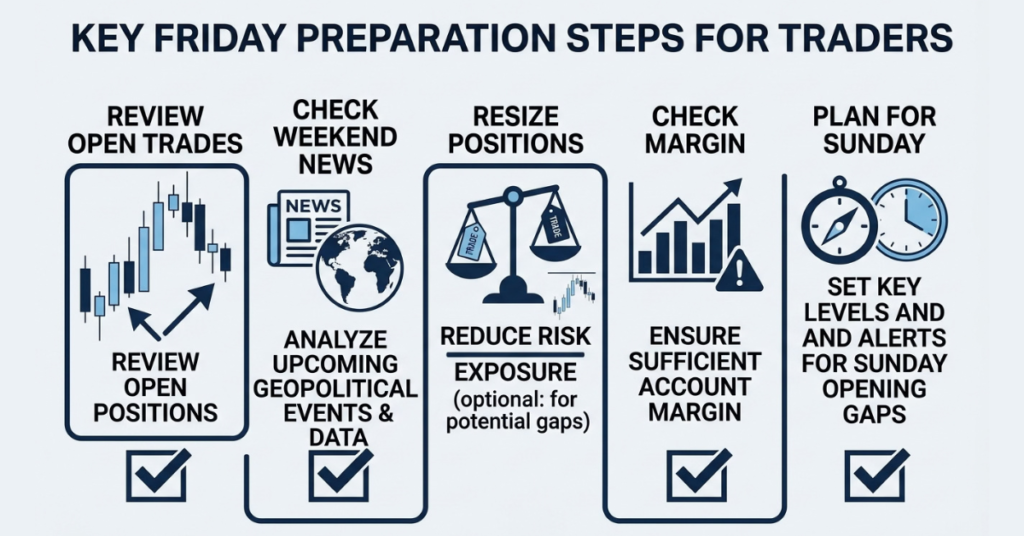
A few minutes on Friday afternoon can save you a lot of stress on Sunday night. Run through these steps before the market closes.
- List every open trade. Note the pair, size, entry and current profit or loss.
- Check the weekend calendar. Look for elections, central bank speeches, OPEC meetings or summits scheduled for Saturday or Sunday.
- Ask one question per trade: “Would I open this trade right now, knowing the market will be closed for two days?” Use the answer to review the trade against your written holding and exit rules.
- Resize for gap risk. Stress-test several adverse reopening prices in account-currency terms. There is no reliable maximum of two or three times the stop distance; severe gaps can be larger.
- Check your margin level. Review free margin and the broker’s stop-out rules. A cash buffer reduces vulnerability but cannot guarantee protection against a severe gap or a margin call.
- Check conditions at reopening. Review spreads, executable prices and your entry rules before placing new trades. Conditions do not normalize on a fixed schedule.
Is There Any Way to Trade on Weekends?
Mainstream retail forex pairs generally cannot be traded during the weekly closure. Some providers offer separate weekend products. Spot cryptocurrency markets generally operate 24/7, but that does not mean every crypto CFD does. Defcofx’s crypto CFD page advertises 24/5 trading, so check the current MT5 symbol sessions before assuming weekend access. Crypto volatility and liquidity also vary. Read more in Can You Trade Forex on Weekends?, and compare forex vs crypto trading before you switch markets.
How Defcofx Takes Some of the Pain Out of Weekends
Defcofx’s advertised conditions affect costs and account handling. They do not eliminate weekend gaps or guarantee execution:
| Defcofx feature | How it helps with weekend trading |
| Zero swap fees | Defcofx advertises swap-free trading. Confirm the current account and symbol conditions; price risk still applies |
| Zero commissions | No trading commission, but closing and reopening still incurs spreads and may incur slippage |
| Spreads from 0.5 pips | Advertised minimum spreads are not guaranteed at reopening; spreads can widen |
| Withdrawals typically around 3 hours, subject to conditions | The withdrawal page lists a $10 USDT fee and possible wallet or unused-deposit fees. Saturday requests are declined if you had a position open as of Friday; the page says to resubmit Monday. Sufficient free margin is required. |
| Negative balance protection | Defcofx states that negative balances are reset to zero. This does not protect your deposited funds or guarantee a stop price. See its negative balance protection policy |
| 24/5 support | The FAQs advertise 24/5 support; do not assume continuous weekend availability |
Check the full forex market hours and holiday schedule to plan around closures.
Open Free Demo AccountWhat do traders say about Defcofx?
Read customer experiences on Trustpilot and REVIEWS.io. Compare recent positive and negative feedback on execution, support and withdrawals with the published terms. Reviews do not guarantee future performance or protection from losses.
Sources checked: account specifications, withdrawal rules, support FAQs and MT5 symbol specifications. Broker conditions can change. Leveraged forex and CFD trading carries a risk of loss.
Plan for Weekend Forex Risks
Weekends are difficult for forex traders because the market pauses while the events that move currencies continue. Elections, policy decisions, geopolitical developments, and unexpected news can all change market expectations before trading resumes, creating gaps and making it impossible to manage an open position during the closure.
The biggest concern is not simply that prices can move, but that they can reopen beyond a planned Stop Loss. A position that appears to have a controlled risk on Friday can therefore face a larger loss on Sunday if the market gaps. Thin liquidity and wider spreads around the reopening can add another layer of difficulty for traders entering new positions.
FAQ
Because the market is closed for about 48 hours while news keeps happening. Traders cannot manage open trades, prices can gap past stop losses when the market reopens, and Sunday opens often have wider spreads.
Yes, it carries extra risk. The main danger is a price gap at the Sunday open, which can cause losses bigger than your planned stop. Smaller position sizes reduce exposure. A wider stop alone can increase the planned loss and does not prevent gap slippage; reduce size if widening it.
A weekend gap is the difference between Friday’s closing price and Sunday’s opening price. It happens when news over the weekend changes how the market values a currency, so trading resumes at a different level.
An accepted standard stop remains attached to the position, but cannot execute without tradable prices. If the reopening price is beyond it, execution can occur at a worse available price. A stop level is not a guaranteed loss limit.
Retail forex generally resumes around 5:00 PM New York time on Sunday; check your broker’s symbol hours and daylight-saving changes. Liquidity may be thin near the opening.
There is no universal rule for every beginner. A short-term plan usually closes trades before the weekly shutdown. Holding should follow tested rules and an assessment of news, margin and gap exposure; smaller positions still carry risk.
Spot crypto markets generally trade 24/7, but individual venues can have outages and broker-offered crypto CFDs can have restricted hours. Defcofx advertises crypto CFD trading as 24/5. Check symbol sessions and execution conditions before assuming weekend access.