


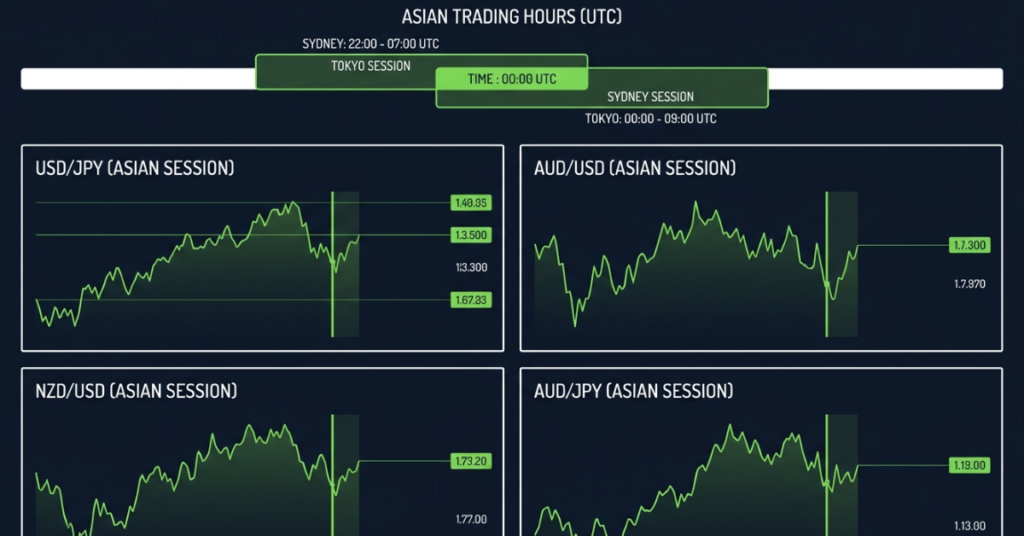
The best forex pairs for the Asian session are USD/JPY, AUD/USD, NZD/USD, AUD/JPY and AUD/NZD. Tokyo and Sydney are the only major financial centers open during these hours, so JPY, AUD and NZD pairs carry the deepest liquidity, while EUR and GBP pairs tend to trade in tight, low volume ranges.
Key Takeaways
- The Asian session covers the Sydney and Tokyo trading hours, roughly from 10pm to 9am GMT.
- JPY, AUD and NZD pairs see the most activity because their home markets are the ones actually open.
- Cross pairs such as AUD/JPY, NZD/JPY and AUD/NZD often move more, relative to their normal range, than USD majors during this window.
- EUR/USD and GBP/USD usually trade in their tightest ranges of the day during Asian hours.
- Range trading and opening range breakout strategies are popular because of the session’s lower overall volatility.
- Defcofx offers spreads from 0.3 pips and leverage up to 1:2000 on JPY, AUD and NZD pairs through MetaTrader 5.
Asian Session Trading Hours Explained
The Asian session is really two overlapping sessions, Sydney and Tokyo. Sydney opens first, and Tokyo follows a couple of hours later, creating a window where both centers are trading at once.
| Trading Center | Opens (GMT) | Closes (GMT) |
| Sydney Session | 10:00 PM | 7:00 AM |
| Tokyo Session | 12:00 AM | 9:00 AM |
| Sydney-Tokyo Overlap | 12:00 AM | 7:00 AM |
The Sydney-Tokyo overlap, from midnight to 7am GMT, is the core of the Asian session and the period when JPY, AUD and NZD pairs see their best liquidity. Converted into other time zones, this core window looks like this:
| Time Zone | Window Start | Window End |
| GMT / UTC | 12:00 AM | 7:00 AM |
| EST (New York) | 7:00 PM (previous day) | 2:00 AM |
| AEST (Sydney) | 10:00 AM | 5:00 PM |
| JST (Tokyo) | 9:00 AM | 4:00 PM |
| IST (India) | 5:30 AM | 12:30 PM |
| PKT (Pakistan) | 5:00 AM | 12:00 PM |
For a deeper look at how this session lines up with US market hours, see what is the opening bell for the Asian session in EST.
Why JPY, AUD and NZD Pairs Lead the Asian Session
Liquidity in any session tends to follow whichever markets are actually open. During London hours, that means GBP and EUR. During the Asian session, it means JPY, AUD and NZD, since Japan, Australia and New Zealand are the major economies trading in real time. USD pairs do not disappear, but without US or European desks active, even heavily traded pairs like EUR/USD and GBP/USD slow down considerably.
To see how this compares across the full trading day, which currencies are most active during specific trading sessions breaks down currency activity session by session.
Open a Live Trading AccountBest Currency Pairs for the Asian Session
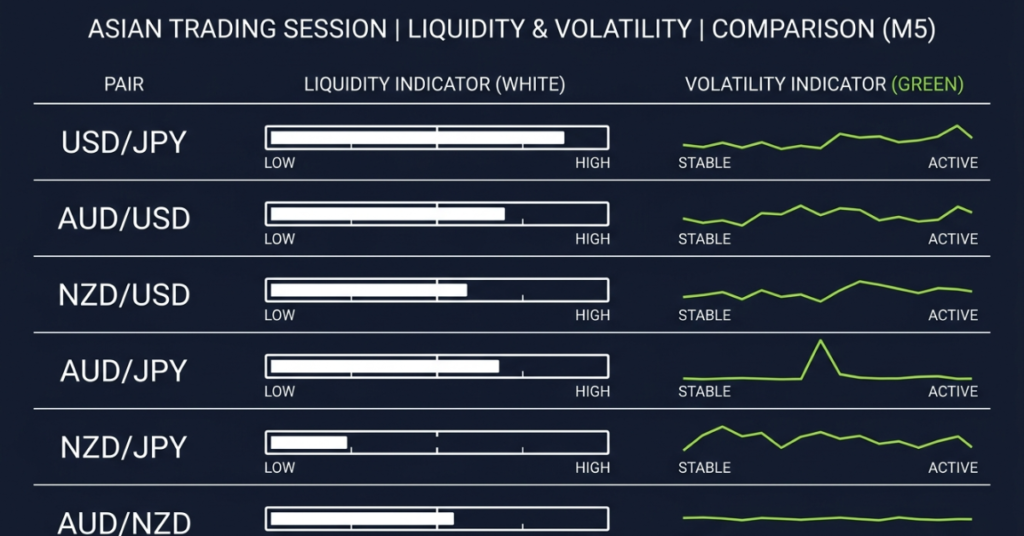
The pairs below are the ones most worth watching once Sydney and Tokyo are both active.
| Pair | Why It Works in the Asian Session |
| USD/JPY | The benchmark JPY pair, with the Tokyo market driving steady two way flow throughout the session. |
| AUD/USD | Reflects Australian economic data and commodity demand, most active while Sydney is open. |
| NZD/USD | Moves alongside AUD/USD but with its own drivers tied to New Zealand data and dairy and agricultural exports. |
| AUD/JPY | A cross pair with both legs fully active during Asian hours, often producing some of the session’s largest moves. |
| NZD/JPY | Similar to AUD/JPY, this cross benefits from having both home markets open at the same time. |
| AUD/NZD | A regional pair driven almost entirely by the relative strength of two neighboring economies, ideal for traders focused purely on Asia-Pacific themes. |
USD/JPY During Asian Hours
USD/JPY is the most natural starting point for the Asian session, since the Tokyo market provides constant two way flow throughout the morning. For a detailed hour by hour breakdown, see best time to trade USD/JPY. Many traders also use this pair as a reference point for broader risk sentiment, since it often moves in line with how investors feel about Asian and global growth.
AUD/JPY and NZD/JPY: The Session Specialists
If there is one idea that separates a strong Asian session watchlist from a generic one, it is this: AUD/JPY and NZD/JPY are pairs where both currencies belong to markets that are open at the same time. That is not true for EUR/USD or GBP/USD during these hours, where neither home market is trading. As a result, AUD/JPY and NZD/JPY can produce moves that are large relative to their typical daily range, even on days when the broader market feels quiet elsewhere.
These pairs are also popular for carry trade style strategies, since AUD and NZD have historically offered higher interest rates than JPY, though this relationship can change over time depending on central bank policy. To check whether NZD/JPY fits within the major pair category for your trading plan, see is NZD/JPY a major currency pair.
AUD/NZD: The Regional Pair
AUD/NZD is sometimes overlooked, but it is one of the purest ways to trade the relative strength of two Asia-Pacific economies. Because both Australia and New Zealand are active during this session, AUD/NZD tends to move on regional data, commodity prices and RBA versus RBNZ policy expectations rather than on US or European headlines. For more on NZD specific timing, see best time to trade NZD and best time to trade NZD/USD.
Why EUR/USD and GBP/USD Are Quiet During the Asian Session
EUR/USD and GBP/USD are the two most traded pairs in the world, but during Asian hours neither the Eurozone nor the UK market is open. Without active institutional flow from either side, these pairs typically settle into a narrow range, often the tightest of the entire trading day. This is not a flaw, it is simply a reflection of where the active markets are at that time.
For a side by side look at how the Asian session compares to London on volatility and pair selection, see is it better to trade Tokyo or London session, and for the full Tokyo specific pair list, Tokyo session forex pairs and best currency pairs Tokyo session both go into more detail.
Open a Demo Trading AccountAsian Session Trading Strategies
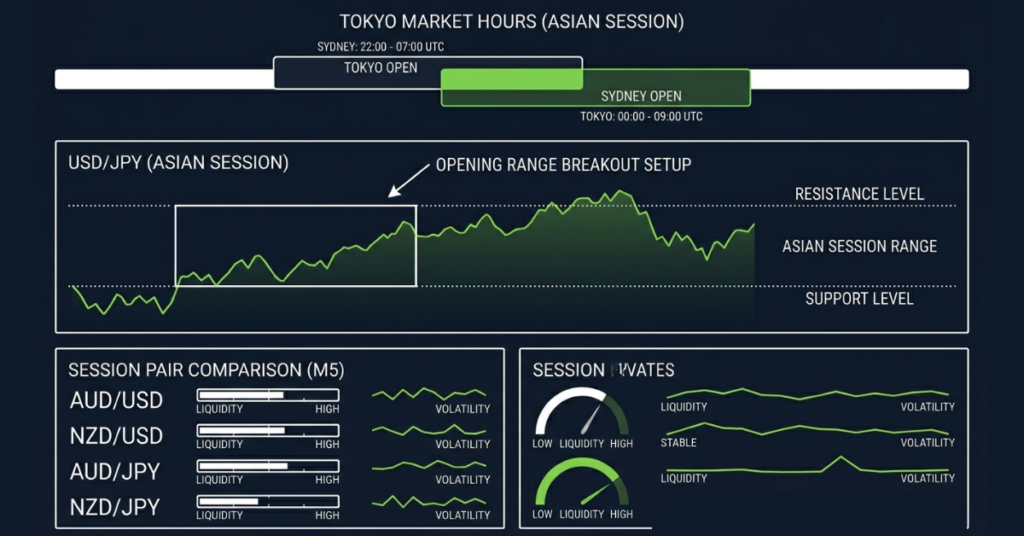
Range trading: Because many pairs consolidate during Asian hours, identifying the high and low of the early session range and trading between those levels is one of the most common approaches.
Opening range breakout: Some traders mark the range formed in the first hour or two of the Sydney-Tokyo overlap and look for a breakout once momentum picks up later in the session.
Carry style positioning: Longer term traders sometimes use AUD/JPY or NZD/JPY to express views on interest rate differentials between Australia, New Zealand and Japan, though this is a longer term approach rather than an intraday one.
If you want to see whether an opening range breakout approach holds up during these hours, Defcofx has covered this directly in does ORB strategy work for Asia session and does ORB strategy work for Tokyo session.
Risks of Trading the Asian Session
Beyond intervention risk, the main challenge of the Asian session is simply its lower volatility compared to London and New York. Strategies that rely on strong directional trends may underperform here, while range based approaches tend to fit the conditions better.
If lower volatility suits your style, the low volatility currency pairs guide covers pairs that tend to stay calm across multiple sessions, not just during Asian hours.
Trading Asian Session Pairs with Defcofx
Whether you are focused on USD/JPY, the AUD/JPY and NZD/JPY crosses, or AUD/NZD as a purely regional play, the conditions you trade under during these quieter hours still matter. Defcofx provides the same tight pricing and execution quality around the clock.
| Feature | Details |
| Spreads | From 0.3 pips on major currency pairs |
| Leverage | Up to 1:2000 |
| Commissions | Zero commission on trades |
| Swap Fees | Zero swap / overnight fees |
| Welcome Bonus | 40% bonus on qualifying first deposits of $1,000 or more |
| Withdrawals | Processed within 4 business hours, including weekends |
| Trading Platform | MetaTrader 5 (MT5) |
| Regulation | Registered in Saint Lucia |
You can also explore best currency pairs Sydney session and the broader best currency pairs to trade during Asian session guide for additional pair ideas if you want to expand beyond the core list covered here.
Asian Session by the Numbers
- The Asian session is generally considered the calmest of the three major sessions, with lower average pip ranges across most pairs.
- The Sydney-Tokyo overlap covers roughly seven hours, making it the longest overlap of any two sessions in the trading day.
- AUD/JPY and NZD/JPY are among the most followed cross pairs for traders who focus specifically on Asia-Pacific market hours.
- Japan, Australia and New Zealand each publish key economic data, including GDP, employment and central bank rate decisions, during their own local trading hours, directly affecting JPY, AUD and NZD pairs in real time.
Final Thoughts on Best Forex Pairs for the Asian Session
The Asian session offers a unique trading environment that differs significantly from the faster-paced London and New York sessions. While overall volatility is lower, traders who focus on the right currencies particularly JPY, AUD, and NZD pairs can still find consistent opportunities driven by regional economic data, central bank decisions, and shifts in market sentiment. Pairs such as USD/JPY, AUD/USD, AUD/JPY, and NZD/JPY tend to provide the best balance of liquidity and movement because the economies behind those currencies are actively trading during these hours.
Success during the Asian session often comes from adapting your strategy to the session’s characteristics rather than expecting the large trends commonly seen during London or New York trading. Range trading, opening range breakouts, and carefully managed carry-trade strategies are often better suited to the calmer conditions. Most importantly, traders should remain aware of unexpected events such as Bank of Japan interventions, which can quickly change market conditions.
FAQ
The Asian session generally starts with the Sydney open at around 10pm GMT, with Tokyo following at midnight GMT. The core overlap between the two runs from midnight to around 7am GMT.
USD/JPY, AUD/USD, NZD/USD, AUD/JPY and AUD/NZD are widely considered the best pairs for the Asian session because JPY, AUD and NZD are the currencies whose home markets are actually open during these hours.
Both currencies in AUD/JPY and NZD/JPY belong to markets that are open during Asian hours, Australia or New Zealand on one side and Japan on the other. This means both legs of the pair can see active trading at the same time, which is not the case for pairs like EUR/USD during this session.
Neither the Eurozone nor the UK market is open during Asian hours, so there is less institutional flow driving these pairs. They typically settle into their tightest ranges of the day until London opens.
Many beginners find the Asian session easier to start with because of its generally lower volatility and more predictable ranges. For a direct comparison with London, see is it better to trade Tokyo or London session.
Range trading and opening range breakout strategies are the most commonly used approaches during the Asian session, since many pairs consolidate during these hours rather than trending strongly.
Yes. Defcofx runs on MetaTrader 5 around the clock, with spreads from 0.3 pips and leverage up to 1:2000 on JPY, AUD and NZD pairs. You can open a live account or practice on a demo account before trading the Asian session live.