


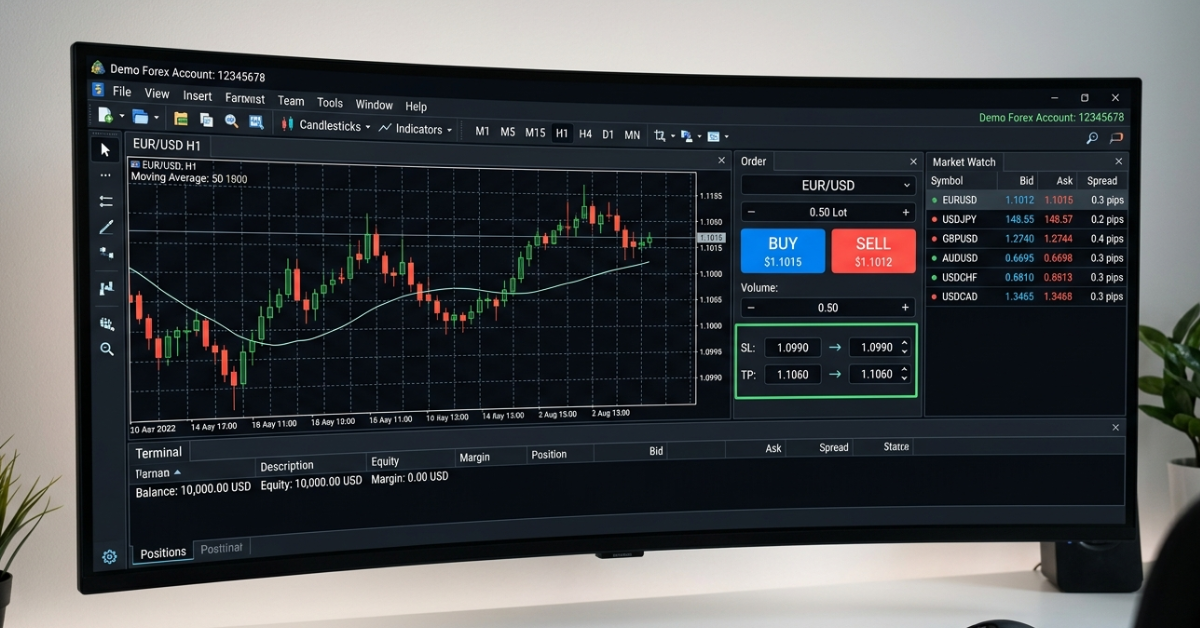
You can execute trades faster by using a stable, low-latency internet connection; choosing the right order type for your strategy; trading during high-liquidity market sessions; optimizing your platform performance; and working with a broker that has fast execution infrastructure. For automated strategies, a VPS (Virtual Private Server) can further improve consistency and reduce latency. Faster execution reduces slippage and helps ensure your trades fill closer to your intended price.
Key Takeaways
- Execution speed directly affects entry and exit accuracy; even small delays compound into meaningful performance differences over hundreds of trades
- Your internet connection, broker infrastructure, and platform performance are the three factors with the biggest combined impact on execution speed
- Market orders execute fastest but sacrifice price control; limit orders offer price precision but may not fill during fast-moving conditions
- Trading during high-liquidity sessions (particularly the London-New York overlap) provides the smoothest, fastest order matching
- Slippage cannot be eliminated entirely, but faster and more consistent execution significantly reduces how often and how severely it occurs
- A VPS improves execution consistency for automated strategies and Expert Advisors, which is less valuable for manual traders but worth considering at higher frequency
- Risk management always matters more than execution speed; fast fills on poorly planned trades still produce losses
Why Trade Execution Speed Matters More Than Most Traders Realize
Most traders spend significant time studying technical analysis, developing strategies, and refining entries. Far fewer spend time thinking about what happens between clicking “buy” and the trade actually filling at the exchange. That gap matters more than it appears.
Imagine identifying a clean breakout setup on EUR/USD during a US employment release. You click buy, but by the time your order travels from your device to your broker’s servers and back, the price has moved 5 pips beyond your entry. Over a single trade, the difference is small. Over 300 trades in a year, that consistent slippage erodes a meaningful percentage of your edge.
This problem compounds for shorter-term strategies where the target profit per trade is small relative to the spread and any slippage. A scalper targeting 8–10 pips per trade is far more sensitive to a 2-pip execution delay than a swing trader holding for 150 pips.
What Actually Happens Between Clicking Buy and Entering a Trade
Many new traders assume the trade executes the moment they press the button. In practice, several distinct steps occur:
- Your order leaves your device and travels over the internet to your broker’s servers
- The broker’s system processes the order and routes it to available liquidity
- The order is matched with a counterparty or liquidity provider at the current market price
- Execution confirmation travels back from the server to your platform
- Your platform displays the filled trade with its actual entry price
This entire process typically takes fractions of a second under normal conditions. During major news events, periods of thin liquidity, or server congestion, it can take noticeably longer, and in that extra time, prices can move.
The goal is not instantaneous execution in the nanosecond sense. It is efficient, consistent, and predictable execution so that what you see when you click is close to what you actually receive.
The Biggest Factors That Affect Trade Execution Speed
Execution quality is determined by multiple variables, some within your control and some dependent on your broker and market conditions.
| Factor | Impact on Execution | Within Your Control? |
| Internet connection | Affects transmission speed of orders to broker servers | Yes, upgrade or stabilise |
| Broker infrastructure | Determines processing speed and liquidity access | Yes, choose carefully |
| Market liquidity | More participants = faster and cleaner order matching | Partial, choose sessions |
| Order type selected | Market orders fill faster; limit orders prioritise price | Yes, choose per strategy |
| Platform performance | Heavy system load slows platform response | Yes, optimise regularly |
| Market volatility | Fast price movement increases execution challenges | No, manage via timing |
| Server proximity (VPS) | Physical distance to broker server adds latency | Yes, VPS option available |
Step 1: Upgrade Your Internet Connection
Your internet connection is the first link in the execution chain. A slow or unstable connection delays the moment your order reaches your broker’s servers, which directly translates to delayed fills and potential slippage during fast-moving market conditions.
You do not need enterprise-grade internet for good execution. What matters more than raw speed is stability and low latency. A connection that consistently delivers 20ms latency is better for trading than one that averages 10ms but spikes to 200ms unpredictably.
What to check and improve:
- Wired over wireless: A wired Ethernet connection is more stable and lower-latency than Wi-Fi, which is susceptible to interference and packet loss
- Avoid congested networks: Shared office networks, crowded public Wi-Fi, and weak mobile signals all increase the chance of execution delays during the critical moments when you click to trade
- Test your latency: Use your broker’s server ping times as a benchmark, not general internet speed tests. A 5 ms ping to your broker’s servers matters more than download speed for trading purposes
- Avoid trading over a VPN: VPNs add routing steps that increase latency. If you use one for security, consider whether that’s necessary during trading sessions
Step 2: Choose the Right Order Type for Your Strategy
Many traders unintentionally reduce their execution speed by choosing an order type that is mismatched to what they are trying to achieve.
| Order Type | Execution Speed | Price Control | Best Used When |
| Market Order | Fastest | None, fills at current market price | Speed is the priority; you want immediate entry |
| Limit Order | Conditional | High, fills only at your specified price | Price precision matters more than immediate fill |
| Stop Order | Conditional | Moderate, triggers at price, fills at market | Breakout entries or stop-loss protection |
| Stop-Limit Order | Conditional | High but may not fill in fast markets | You want breakout entry with price protection |
If execution speed is your primary concern, market orders provide the quickest fills because they instruct the broker to fill your trade immediately at whatever the current best available price is. The trade-off is that during fast markets, that price may differ from what you saw when you clicked.
Understanding what is deviation in forex, the maximum price variance you allow for market order fills, is an important tool for balancing speed and price control. Setting deviation too tight causes frequent requotes; too wide opens you to unwanted slippage. You can also see how stop-limit orders work in our dedicated guide.
Trade with Fast Execution on Defcofx
Access major forex pairs, gold, and indices through MetaTrader 5 with competitive spreads from 0.3 pips and fast order processing. No commissions, no swap fees.
Step 3: Trade During High-Liquidity Sessions
Liquidity and execution speed are directly linked. When there are more buyers and sellers actively participating in the market, your order finds a counterparty faster, spreads are tighter, and the fill is more likely to match your intended price.
In forex, liquidity varies significantly across the 24-hour trading day based on which financial centers are active.
| Session | Liquidity Level | EST Hours | Best For |
| Sydney Session | Low | 5:00 PM – 2:00 AM | AUD/NZD pairs; quieter conditions |
| Asian / Tokyo Session | Moderate | 7:00 PM – 4:00 AM | JPY and AUD pairs; range strategies |
| London Session | High | 3:00 AM – 12:00 PM | EUR, GBP, CHF pairs; trend and breakout |
| New York Session | High | 8:00 AM – 5:00 PM | USD pairs; news trading |
| London-New York Overlap | Very High | 8:00 AM – 12:00 PM | Peak volume; fastest execution across all pairs |
The London-New York overlap is consistently the best window for execution quality across the widest range of currency pairs. For traders focused on specific pairs, check best time to trade forex and forex trading sessions in EST for a full session-by-session breakdown. For pair-specific timing, best currency pairs to trade during the London session and the New York session forex pairs list are useful references.
Step 4: Optimise Your Trading Platform Performance
Even with a fast internet connection and a good broker, execution can be degraded by poor local device performance. Your trading platform is software running on your computer or mobile device, and like any software, its responsiveness depends on available system resources.
Practical steps to improve platform performance:
- Close unused applications: Every background program competes for CPU, RAM, and network bandwidth. Close web browsers, video streaming, and any non-essential software during trading sessions
- Reduce chart indicators: Running 15 indicators on 10 open charts strains your system. Keep only the indicators you actively use in your strategy, and close charts for instruments you are not currently watching
- Keep your platform updated: Updates to MetaTrader 5 and other platforms often include performance improvements and bug fixes. Outdated versions can have stability issues that affect execution reliability
- Restart regularly: Long platform uptime can lead to memory bloat. Restarting your platform and computer periodically before trading sessions clears accumulated system load
- Use a dedicated device: If possible, trade on a device used only for trading. Shared family computers with many background processes, browser tabs, and updates running are not ideal execution environments
MT5 in particular has efficient multi-window charting that is less resource-intensive than some older platforms. See how to use MetaTrader 5 for a full guide on configuring the platform for performance and usability.
Understanding Slippage and How Faster Execution Helps
Slippage is the difference between the price you expected when placing an order and the price at which it actually filled. It is one of the most direct consequences of execution delays and is especially visible during fast-moving or thinly traded market conditions.
4 Common causes of slippage:
- Major economic news releases (Non-Farm Payrolls, CPI, central bank decisions) where price gaps rapidly in fractions of a second
- Trading during low-liquidity periods such as the Asian session on exotic pairs, or during market open/close transitions
- Large position sizes that exceed available depth at the best price, pushing the fill into less favorable price levels
- Slow internet connection or overloaded platform that introduces delay between your click and the order reaching the broker server
| Scenario | Order Placed At | Actual Fill | Slippage |
| Buy order, news spike, | 1.1000 | 1.1006 | +6 pips (negative slippage) |
| Sell order, thin market | 1.1000 | 1.0993 | +7 pips (negative slippage) |
| Buy order, deep market | 1.1000 | 1.0999 | +1 pip (positive slippage) |
Slippage cannot be eliminated entirely; it is a market reality. But faster execution, trading in liquid sessions, and choosing appropriate order types all reduce its frequency and magnitude. See what is a spread in forex, what is the average spread in forex, and what is raw spread in forex to understand how spreads and execution costs interact.
Should You Use a VPS for Faster Execution?
A Virtual Private Server (VPS) is a remote computer hosted in a data center that runs your trading platform continuously, 24 hours a day, 7 days a week, regardless of whether your personal computer is on.
The execution benefit comes from physical proximity. A VPS hosted in the same data center as your broker’s servers can transmit orders with latency measured in single-digit milliseconds, far faster than a home internet connection traveling through multiple network hops.
Who benefits most from a VPS:
- EA and algorithmic traders: Automated strategies need continuous uptime. If your home computer restarts or your internet drops during a trade, an EA on a VPS is unaffected
- High-frequency scalpers: Strategies targeting very small price moves are most sensitive to latency. A VPS close to the broker’s server can meaningfully reduce fill times
- Traders with unreliable home internet: A VPS provides stable connectivity independent of your local ISP, which benefits anyone in regions with inconsistent broadband quality
Who does NOT need a VPS:
- Manual traders who close all positions before logging off, your execution window matches your activity window, so continuous uptime is irrelevant
- Swing traders holding positions for days: execution at entry is less sensitive at this timeframe, and positions can simply be left open on the broker’s server with defined stop-loss and take-profit levels
Defcofx provides a VPS service for traders who want optimized, low-latency execution for automated strategies. See also the knowledge base VPS guide for setup details and what is an Expert Advisor if you are new to automated trading on MT5.
The Role Your Broker Plays in Execution Quality
Even if you optimize every factor on your side, internet, platform, order types, and session timing, your broker ultimately controls the final step in the execution chain. Broker infrastructure has a direct and significant impact on how quickly and accurately your orders are filled.
Key broker infrastructure factors:
- Server speed and location: Brokers with servers located in major financial data centers (London, New York, Chicago) and using modern hardware process orders faster than those on slower or remotely located infrastructure
- Liquidity provider access: A broker connected to multiple tier-1 liquidity providers can find better prices for your orders and fill them faster because more counterparty liquidity is available at any moment
- Platform stability: Server outages, platform crashes, and performance degradation during news events are all signs of infrastructure quality issues that directly hurt your execution
- Spread model: A broker offering genuinely tight spreads from deep liquidity is more likely to provide clean fills than one with artificially widened spreads that mask poor liquidity access. Compare spread-only accounts and see lowest spread forex brokers for context
- Requote policy: Frequent requotes (where your order is rejected and a new price offered) indicate either poor liquidity or a dealing desk model that actively manages against client orders. ECN/STP brokers typically have fewer requotes
When evaluating a broker for execution quality, check how to choose a forex broker and Defcofx trading conditions to understand what you should be looking for and comparing.
Which Trading Styles Benefit Most from Faster Execution
Not every trading style is equally affected by execution speed. Understanding where your style falls helps prioritise how much effort to invest in execution optimisation.
High sensitivity to execution speed:
- Scalpers: Targeting 5–15 pip moves means a 2-pip execution delay represents 13–40% of your target. See scalp trading vs swing trading and are you scalping too much for context on scalping approaches
- News traders: Entering on major economic releases where price can move 30–50 pips in seconds makes execution latency critically important
- EA and algorithmic traders: Automated systems can generate and attempt to fill multiple orders simultaneously, making infrastructure quality central to strategy performance
Moderate sensitivity:
- Day traders: Holding for 20–100 pips per trade. Execution matters but a 1–2 pip slippage is less devastating relative to the target size. See best technical indicators for day trading
- Breakout traders: Entry timing on breakouts benefits from fast execution, but the post-breakout move is typically large enough that minor slippage is manageable
Low sensitivity:
- Swing traders: Holding for 100–500+ pips over multiple days. A 2-pip execution difference at entry is noise relative to the trade target. Focus on best technical indicators for swing trading and forex risk management
- Position traders: Holding for weeks to months. Execution quality at individual trade level is essentially irrelevant to overall performance
4 Key Data Points on Execution Quality and Slippage
- Research from the Bank of International Settlements shows that bid-ask spreads on EUR/USD, one of the most liquid instruments, can widen by 3–10x their normal levels during the 30 seconds surrounding a major economic release, directly increasing slippage risk for any order placed in that window
- Studies on retail forex trader performance show that traders who consistently trade during peak-liquidity sessions (London-New York overlap) report lower average slippage than those who trade during off-peak hours on the same instruments
- For scalpers using automated EAs, round-trip latency (order placed to confirmation received) of under 10ms to the broker server is generally considered good for most strategies; above 50ms begins to create meaningful execution risk on very short-term setups
- The London-New York overlap accounts for approximately 30% of daily forex volume despite covering only 4 hours of the 24-hour trading day, a concentration that directly translates to tighter spreads and faster fills during that window
Execution Speed Optimisation Checklist
Use this checklist before your next trading session to confirm your setup is optimized for the fastest possible fills.
- ✓ Wired internet connection in use, or Wi-Fi tested for stability and low latency
- ✓ Platform is updated to the latest version
- ✓ Unused charts, indicators, and background applications closed
- ✓ Order type matches the strategy (market order if speed is critical, limit order if price precision is critical)
- ✓ Deviation/slippage tolerance set appropriately in platform settings
- ✓ Trading session is a high-liquidity window for the instrument being traded
- ✓ Economic calendar checked for scheduled high-impact releases that could cause sudden volatility
- ✓ VPS running if using EAs or automated strategies
Execute Trades Efficiently with Defcofx
Defcofx is an online forex and CFD broker registered in Saint Lucia, running on MetaTrader 5 (MT5). The platform is built for efficient execution across forex pairs, gold, indices, stocks, and cryptocurrencies, with server infrastructure focused on minimizing delays and providing consistent fill quality.
- Spreads from 0.3 pips with no commissions and no swap fees; see Defcofx spreads knowledge base and trade forex with low spreads
- Fast MT5 execution with support for all order types, including market, limit, stop, and stop-limit. See how to use MetaTrader 5 to configure your platform
- VPS available for traders using automated strategies or EAs. See buy VPS for options
- Up to 1:2000 leverage with negative balance protection, see trade forex with high leverage
- 40% welcome bonus on first deposits of $1,000 or more. See the promotion page
- Withdrawals processed within 4 business hours, including weekends
- Test execution on a free demo account before going live. Multiple account types are available
Experience Faster, More Consistent Execution on Defcofx
Trade on MT5 with spreads from 0.3 pips, fast order processing, and access to a VPS for automated strategies. Open a live account or start risk-free on the demo.
Frequently Asked Questions
Why is my trade execution slow?
Slow execution is most commonly caused by a weak or unstable internet connection, overloaded platform performance, low market liquidity for the instrument or session you are trading, or limitations in your broker’s server infrastructure. During major news events, all brokers experience some execution strain as order volume spikes suddenly. Identifying which factor is causing the delay in your specific case is the first step toward fixing it.
Do market orders execute faster than limit orders?
Yes. Market orders prioritize immediate execution at the best available price, which means they fill as fast as the infrastructure allows. Limit orders wait for the market to reach your specified price before triggering; they introduce no additional speed, and during fast-moving markets they may not fill at all if the price passes through without matching your level.
Can internet speed affect trading performance?
Yes, particularly in two ways. First, a slow connection delays the transmission of your order to the broker’s servers, potentially causing you to fill at a worse price than when you clicked. Second, an unstable connection can cause platform disconnections during live trades, which prevents you from managing or closing positions. A stable, low-latency wired connection is more important than raw download speed for trading.
What is slippage in trading?
Slippage is the difference between the price you intended to enter or exit at and the price you actually received. It can be positive (filled at a better price than expected) or negative (filled at a worse price). Negative slippage is most common during high-volatility events like major news releases or when trading during low-liquidity periods. See what is deviation in forex for more on how to set slippage tolerance in your platform.
Does liquidity affect execution speed?
Yes, directly. In liquid markets with many active buyers and sellers, your order finds a counterparty almost instantly. In thinly traded markets or during quiet sessions, the matching process takes longer, spreads widen, and the chance of slippage increases. The London-New York overlap provides the deepest liquidity for most major forex pairs and consistently produces the fastest fills.
Should I use a VPS for faster trading?
A VPS is most valuable for traders using expert advisors or automated strategies, where continuous uptime and low-latency server proximity are directly tied to strategy performance. For manual traders who are present during their trading sessions and close positions when they log off, a VPS adds minimal execution benefit. Defcofx offers a VPS option for traders who need it.
What is the best time to trade for fast execution?
The London-New York overlap (8:00 AM – 12:00 PM EST) consistently provides the fastest execution and tightest spreads for major currency pairs because market participation is at its highest point of the day. The full London session (3:00 AM – 12:00 PM EST) and New York session (8:00 AM – 5:00 PM EST) are both strong windows. See best time to trade forex for a complete session-by-session guide.
Does risk management still matter if my execution is fast?
Absolutely, fast execution does not replace good risk management. Even perfectly timed, zero-slippage entries in a poorly planned trade will produce losses. Faster execution is a tool that supports your strategy; it is not a substitute for having a sound one. Always define your stop loss, position size, and risk-to-reward ratio before entering any trade. See forex risk management for a complete framework.
Build a Faster, Better Trading Setup with Defcofx
Tight spreads, an MT5 platform, VPS access, and fast order processing—everything you need to trade efficiently across forex, gold, indices, and crypto.