


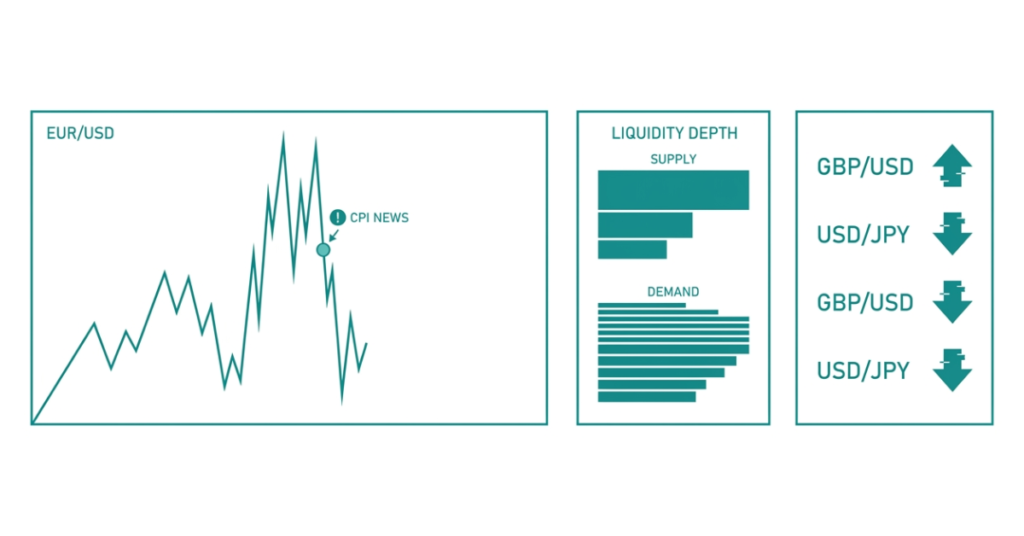
To ensure liquidity during global currency fluctuations, trade major currency pairs during peak market hours, use brokers with deep liquidity pools and tight spreads, avoid overexposing positions during high-volatility news events, and keep cash reserves in stablecoins or base currencies. Proper risk management and order types protect your access to liquidity at all times.
Key Takeaways
- Liquidity in forex means how easily and quickly you can enter or exit a trade at a fair price.
- Major pairs like EUR/USD and GBP/USD have the highest liquidity.
- Trading during London and New York sessions gives you access to the deepest liquidity pools.
- Central bank decisions, geopolitical events, and economic data releases can drain liquidity fast.
- Choosing a broker with direct market access and tight spreads ensures your orders fill at expected prices.
- Hedging, diversification, and pending orders help manage positions when markets turn volatile.
What Is Liquidity in Forex?
Liquidity in forex refers to how easily a currency can be bought or sold without causing a big price change. A liquid market means there are plenty of buyers and sellers, trades execute fast, spreads are tight, and slippage is minimal.
The forex market is the most liquid financial market in the world, with trillions of dollars changing hands every day. But that liquidity is not evenly distributed. It changes based on the time of day, the currency pair, and the market conditions at any given moment.
When currency fluctuations are extreme, like during central bank announcements or geopolitical crises, liquidity can dry up fast. That is when spreads widen, orders slip, and exits become harder. Understanding this dynamic is part of building a solid forex risk management approach.
Global Forex Liquidity: Key Statistics
| Metric | Data |
| Daily forex market turnover (BIS 2022 Triennial Report) | ~$7.5 trillion |
| Share of spot transactions in daily volume | ~28% |
| Most liquid currency pair | EUR/USD (~22% of volume) |
| Highest liquidity trading hours | London-New York overlap (1pm-5pm GMT) |
| Lowest liquidity periods | Asian session off-hours, market holidays |
| Major currency pairs share of total volume | Over 70% |
Source: Bank for International Settlements (BIS) Triennial Central Bank Survey.
Why Currency Fluctuations Threaten Liquidity
Currency fluctuations become extreme when unexpected events hit markets. Central bank surprises, inflation data misses, geopolitical tensions, trade policy changes, and financial crises can all cause sharp, sudden price moves. In these moments:
- Spreads widen as market makers pull back quotes.
- Stop losses and take profits may not fill at the intended price (slippage).
- Pending orders may gap past your entry or exit price.
- Execution speed slows as order books thin out.
How to Ensure Liquidity as a Forex Trader
There are several practical strategies that protect your ability to enter and exit trades in any market condition.
1. Trade Major Currency Pairs
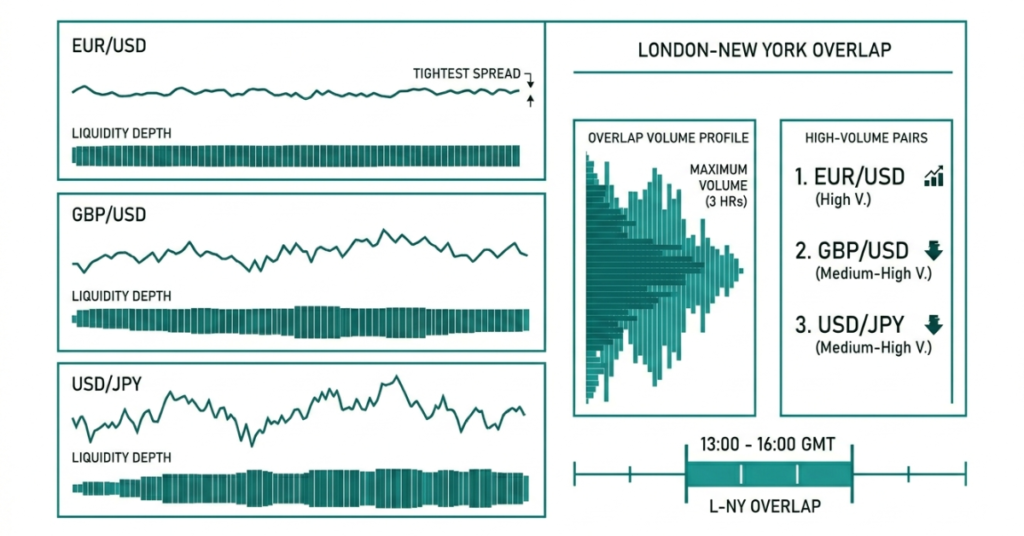
Major pairs like EUR/USD, GBP/USD, USD/JPY, and USD/CHF carry the deepest liquidity. They have the tightest spreads and the most participants at any given time. Review the best currency pairs to trade if you are unsure which pairs offer the best conditions for your style.
2. Trade During Peak Hours
The London-New York session overlap (roughly 8am to 12pm US Eastern Time) is when the most volume flows through the forex market. Liquidity is deepest here, spreads are tightest, and your orders fill quickly. See the best time to trade currency guide for session-by-session breakdowns.
3. Avoid Trading During High-Impact News Events
If you do not have a news-based strategy, avoid entering or exiting positions in the minutes immediately before and after major releases like Non-Farm Payrolls, CPI data, or central bank decisions. Liquidity evaporates at these moments, which creates unpredictable slippage.
4. Use Limit Orders to Protect Entry and Exit Prices
Market orders fill at the best available price, which may not be your intended price when liquidity is low. Limit orders specify the exact price you are willing to accept. Using them reduces the risk of getting a bad fill. Read more on how to see limit orders placed on the exchange to understand how institutional-level order flow works.
5. Use a Broker With Deep Liquidity Access
Your broker’s connection to liquidity providers directly affects the fills you get. A broker with multiple liquidity providers aggregates the best prices from a wide pool, giving you tighter spreads and better execution. This is one of the main things to look for when choosing a forex broker.
6. Diversify Across Currency Pairs
Do not concentrate all your exposure in one currency. If you hold positions across EUR/USD, GBP/JPY, and USD/CAD, a liquidity crunch in one pair does not affect all your positions at once. Diversification is one of the oldest risk management tools in trading.
7. Hedge When Volatility Rises
When you expect volatile conditions, hedging allows you to open an opposing position that limits your exposure without closing the original trade. This is a common technique during geopolitical uncertainty. The forex hedging strategy guide explains how to apply this in practice.
8. Keep a Cash Reserve in Your Trading Account
Always maintain free margin in your trading account. This gives you the ability to open or close positions even if markets move against you. Running a fully margined account with no reserves means one sharp move can trigger a margin call and force your broker to close your positions at the worst possible price.
Open a Live Trading AccountHow Central Banks Affect Currency Liquidity
Central bank decisions are the single biggest driver of currency volatility. When the Federal Reserve, European Central Bank, Bank of England, or Bank of Japan changes interest rates or signals a policy shift, currency pairs can move hundreds of pips in minutes.
For traders, this creates both opportunity and risk. If you are unprepared, a central bank surprise can trigger slippage, stop outs, and margin calls. If you plan for it, you can use pending orders to capture the move after the initial reaction settles.
Liquidity Challenges in Exotic Currency Pairs
Exotic pairs like USD/TRY (US Dollar / Turkish Lira) or USD/ZAR (US Dollar / South African Rand) are far less liquid than majors. During currency fluctuations, their spreads can widen dramatically, and getting a fair fill is harder. If you trade exotics, reduce your position size and always use low volatility currency pairs as a benchmark for comparison.
Leverage and Liquidity: What You Need to Know
High leverage amplifies both gains and losses. When liquidity drops and prices move fast, leveraged positions can close on margin call before you have a chance to react. Defcofx offers leverage up to 1:2000, but responsible traders use only a fraction of available leverage to maintain breathing room in their accounts. Learn more at the forex leverage guide.
Using MT5 Tools to Monitor Liquidity
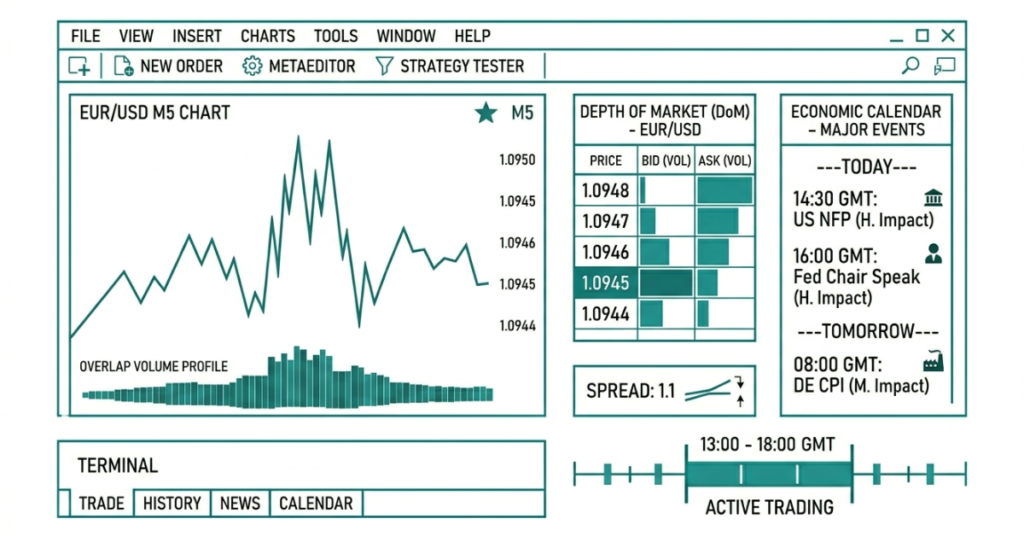
Defcofx provides the MetaTrader 5 platform, which includes several tools to help you monitor market conditions:
- Spread indicator: Shows real-time spread data so you can see when liquidity is dropping.
- Volume indicator: MT5 shows tick volume, which reflects trading activity and is a proxy for liquidity.
- Economic calendar: Built into MT5, it shows upcoming high-impact events so you can adjust positions in advance.
- Depth of Market (DoM): Shows the order book at current price levels, giving insight into where liquidity is concentrated.
How Defcofx Handles Liquidity for Its Traders
Defcofx operates with access to institutional-grade liquidity providers, which means:
- Spreads start from 0.3 pips even during active market conditions.
- Fast execution on the MT5 platform minimizes slippage.
- No hidden requotes or artificial execution delays.
- Clients from all countries can access the same level of execution quality.
- Withdrawals are processed within 4 business hours, including weekends, so your capital is accessible when you need it.
Final Thoughts on How to Ensure Liquidity in Global Currency Fluctuations?
Managing liquidity in a world where currency fluctuations can happen fast is not about avoiding volatility. It is about being prepared for it. The right pair, the right time, the right broker, and the right order types put you in a position to execute trades on your terms, not the market’s.
Defcofx provides the infrastructure for that, with tight spreads, high leverage options, no commissions, and fast withdrawals. Whether you are trading major pairs during peak hours or holding positions through news events, understanding liquidity keeps you ahead of situations that catch unprepared traders off guard.
FAQ
Liquidity in forex refers to how easily you can buy or sell a currency at a fair price without causing significant price movement. High liquidity means tight spreads, fast execution, and minimal slippage.
EUR/USD, USD/JPY, GBP/USD, and USD/CHF are the most liquid pairs. They account for the majority of daily forex trading volume and have the tightest spreads under normal conditions.
Central bank interest rate decisions, forward guidance, and quantitative easing or tightening programs can cause sharp price swings, temporarily reducing liquidity as market makers widen spreads and pull back quotes during the initial reaction.
Yes, but with adjustments. Reduce position sizes, avoid market orders in favor of limit orders, use stop losses, and trade after the initial volatility settles. Avoid entering trades in the minutes immediately surrounding high-impact data releases unless you have a specific news-based strategy.
High leverage increases the impact of price moves on your account balance. When liquidity drops and prices gap, leveraged positions can be stopped out or margin called before you can act. Always use leverage conservatively relative to your account size.
Defcofx aggregates liquidity from multiple providers through MetaTrader 5, offering spreads from 0.3 pips, fast execution, and no commissions. This setup helps maintain fair fills even during periods of elevated market activity.