


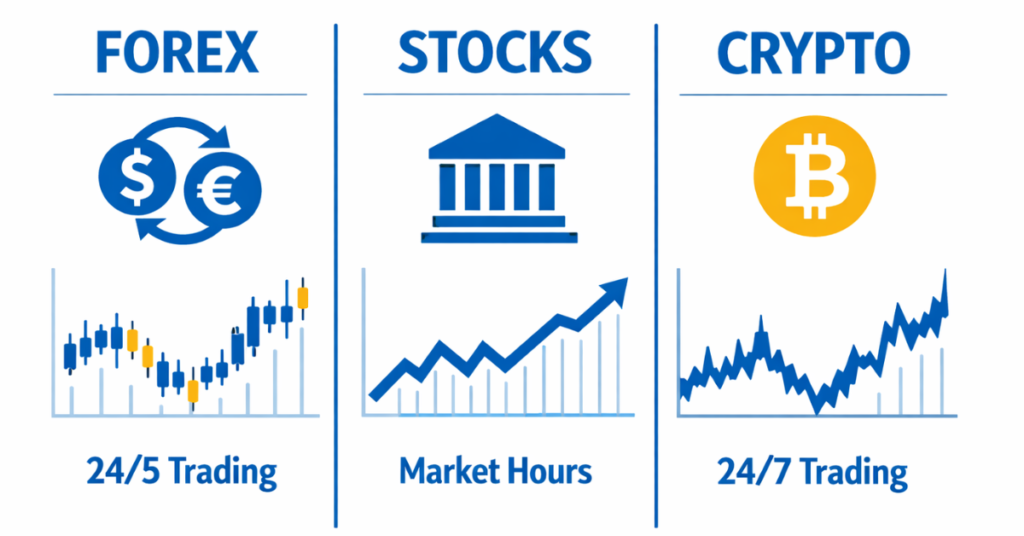
Forex, stocks, and crypto differ mainly in risk, volatility, costs, and accessibility. Forex suits active traders seeking liquidity and leverage, stocks favor long-term investors wanting stability, while crypto attracts high-risk traders chasing rapid price movements. The best choice depends on experience, risk tolerance, and trading goals.
Forex vs Stocks vs Crypto – Complete Detailed Comparison Table
| Category | Forex Trading | Stock Market Trading | Crypto Trading |
|---|---|---|---|
| What It Is & How It Works | Forex (foreign exchange) trading involves buying one currency while selling another (e.g., EUR/USD) to profit from exchange rate fluctuations. Traders can go long (buy) or short (sell) depending on market expectations. | Stock trading involves buying shares of publicly listed companies (e.g., Apple, Tesla) through exchanges like NYSE or NASDAQ. Investors profit from price appreciation and sometimes dividends. | Crypto trading involves buying and selling digital currencies like Bitcoin or Ethereum on exchanges. Traders speculate on price movements or trade derivatives such as futures. |
| What You Actually Own | You do not own physical currency; you speculate on price movements between two currencies. | You own a portion of a company, which may provide dividends and voting rights. | You own digital tokens stored in a wallet or speculate via contracts without holding actual coins. |
| Market Hours & Accessibility | Operates 24 hours a day, 5 days a week (24/5), making it highly flexible for global traders. | Operates during specific exchange hours (usually 6–8 hours daily), with limited after-hours trading. | Operates 24/7 globally with no closing time, offering constant access. |
| Market Size & Liquidity | The largest financial market in the world with extremely high liquidity, allowing fast trade execution and minimal slippage. | Highly liquid for major stocks, but liquidity can vary for smaller companies. | Liquidity depends on the coin and exchange; major coins are liquid, smaller tokens may not be. |
| Volatility Level | Medium volatility; price movements are often driven by economic data and central bank decisions. | Low to medium volatility; generally more stable, especially for established companies. | High volatility; prices can rise or fall sharply within minutes or hours. |
| Leverage Availability | Offers high leverage (up to 1:2000 depending on broker), allowing traders to control larger positions with smaller capital. | Leverage is typically low (around 1:2 to 1:5 margin), making it less aggressive. | Some exchanges offer leverage (commonly 1:10–1:20), but liquidation risk is high due to volatility. |
| Risk Level | Moderate to high risk, especially when using leverage. Proper risk management is essential. | Generally lower risk, particularly for long-term investors holding diversified portfolios. | High risk due to extreme price swings and limited regulatory protection. |
| Main Influencing Factors | Influenced by economic indicators, interest rates, inflation data, geopolitical events, and central bank policies. | Influenced by company earnings, industry performance, economic growth, and investor sentiment. | Influenced by market sentiment, regulatory news, technological developments, and global adoption trends. |
| Trading Costs | Usually low spreads (e.g., from 0.3 pips) and often no commissions, depending on the broker. | Often involves commissions or small transaction fees per trade. | Includes exchange trading fees, spreads, and blockchain network fees. |
| Profit Potential | High profit potential due to liquidity and leverage, but losses can also be amplified. | Moderate and steady profit potential, often realized over longer periods. | Very high short-term profit potential, but equally high loss risk. |
| Best Trading Style | Ideal for scalping, day trading, and short-term strategies due to liquidity and leverage. | Suitable for long-term investing, dividend strategies, and swing trading. | Best for short-term speculation, momentum trading, and high-risk strategies. |
| Example Trade | A trader buys EUR/USD expecting the euro to strengthen after an ECB interest rate hike. | An investor buys Amazon shares expecting long-term e-commerce growth. | A trader buys Bitcoin after positive ETF approval news anticipating rapid price increase. |
| Best For | Active traders seeking flexibility, liquidity, and leverage opportunities. | Investors looking for stability, predictable growth, and lower volatility. | High-risk traders comfortable with rapid price swings and speculative markets. |
| Beginner Suitability | Moderate – beginners must use leverage carefully and apply strict risk management. | High – easier to understand, with more predictable price movements. | Low – extreme volatility makes it challenging for inexperienced traders. |
Simple Real-Life Examples: Forex vs Stocks vs Crypto
These quick examples show what a typical trade or investment looks like in each market—no complicated terms.
🌍 Forex Example
You think the U.S. dollar will get stronger. So you trade a pair like EUR/USD. If the price moves your way, you profit. If it moves against you, you lose.
📈 Stock Example
You believe a company will grow (like Apple). You buy shares and hold them. If the company performs well, the share price can rise—so your investment grows too.
₿ Crypto Example
You buy Bitcoin because you expect the price to rise. Crypto can jump quickly— but it can drop just as fast. It trades 24/7, even on weekends.
How to Start Trading Forex, Stocks, or Crypto Safely (Via CFDs)
Many traders want exposure to Forex, stocks, or crypto. It’s important to understand that brokers like Defcofx provide access mainly through CFDs (Contracts for Difference), meaning you speculate on price movements without owning the underlying asset.
Here’s how to get started safely:
Step 1: Understand What You’re Trading
Forex (Core Offering at Defcofx)
Forex trading involves currency pairs like EUR/USD or GBP/JPY. It’s known for:
- High liquidity
- 24/5 market access
- Tight spreads
- Leverage opportunities
Stocks & Crypto via CFDs
If available under CFDs, this means:
- You do not own actual company shares or cryptocurrency
- You trade price movements (up or down)
- Profits and losses are based on price differences
This structure allows flexibility but also increases risk, especially when using leverage.
Step 2: Choose a Reliable CFD Broker
When selecting a broker, look for:
- A professional platform (e.g., MetaTrader 5)
- Competitive spreads (Defcofx advertises spreads from 0.3 pips)
- Transparent trading conditions
- Fast execution speeds
- Clear deposit and withdrawal processes
Defcofx focuses primarily on Forex trading and CFD-based instruments, offering high leverage options and a platform suited for active traders.
Step 3: Open and Verify Your Account
To begin trading:
- Register on the platform
- Complete identity verification (KYC)
- Choose your account type
- Deposit funds
Always review leverage limits and margin requirements before funding your account.
Step 4: Practice Before Trading Live
Before risking real money:
- Use a demo account (if available)
- Learn how to place buy/sell orders
- Understand margin and leverage
- Study basic technical analysis
Trading CFDs requires understanding how leverage magnifies both gains and losses.
Open a Demo Trading AccountStep 5: Manage Risk Carefully
CFD trading carries significant risk. To trade safely:
- Use stop-loss orders
- Avoid over-leveraging
- Risk only a small percentage of capital per trade
- Never trade money you cannot afford to lose
Leverage can amplify profits, but it can also quickly lead to substantial losses.
Important Clarification
If you want to own real stocks or cryptocurrencies, you would need a broker that offers direct asset ownership.
Defcofx primarily provides Forex and CFD trading, which is designed for traders focused on price speculation rather than long-term asset ownership.
Open a Live Trading AccountFAQs
Stocks are generally safest due to lower volatility and predictable growth.
Forex can be suitable with proper education, demo accounts, and responsible use of leverage.
Crypto is high-risk and should be approached cautiously with small positions.
Forex and crypto offer opportunities for short-term gains. Forex provides high leverage up to 1:2000 and low costs on platforms like Defcofx, while crypto can move rapidly but carries extreme risk. Stocks are more suitable for long-term growth.
Leverage amplifies both profits and losses. Beginners should start with small positions, use stop-loss orders, and only trade with capital they can afford to lose. Platforms like Defcofx provide risk management tools alongside high leverage.
Forex generally has the lowest trading costs, especially when trading with brokers like Defcofx offering tight spreads from 0.3 pips, zero commissions, and no swap fees. Stocks and crypto typically have higher transaction costs.
Forex and crypto are globally accessible. Stocks are limited to exchange-specific markets. Defcofx supports clients from all countries and provides multiple language options, enhancing global trading access.
Withdrawal speed depends on the broker. Platforms like Defcofx complete withdrawals within 4 business hours, including weekends, ensuring fast access to funds.
Discover More Forex Guides With Defcofx
- Can I Trade With $1 on MetaTrader 5?
- What Does It Mean to Short the Market?
- What is an Expert Advisor | Automated Trading Guide
- Pairs Trading – Market-Neutral Stock & Forex Guide
- How to Read Stock Candlesticks?
- How Many Countries Use Dollars?
- What Is Insider Trading?
- How Much Can I Earn From Trading per Month?
- When Should I Sell my Stock?