


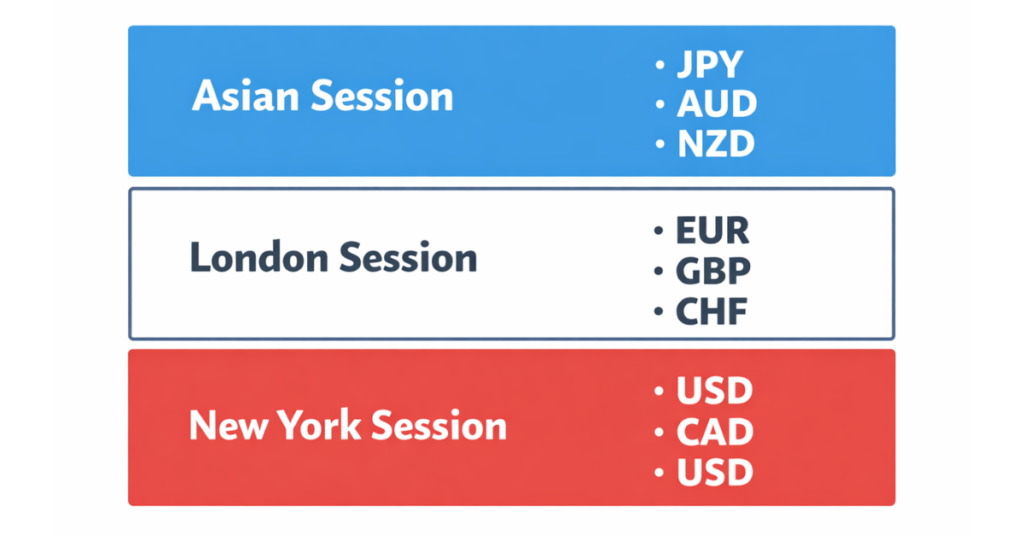
The most active currencies during specific trading sessions depend on regional market hours. The Asian session sees higher activity in JPY, AUD, and NZD pairs. The London session drives strong movement in EUR and GBP pairs, while the New York session increases volatility in USD and CAD pairs, especially during session overlaps.
Forex Trading Session Times (UTC Reference)
- Asian Session: 23:00–08:00 UTC
- London Session: 07:00–16:00 UTC
- New York Session: 12:00–21:00 UTC
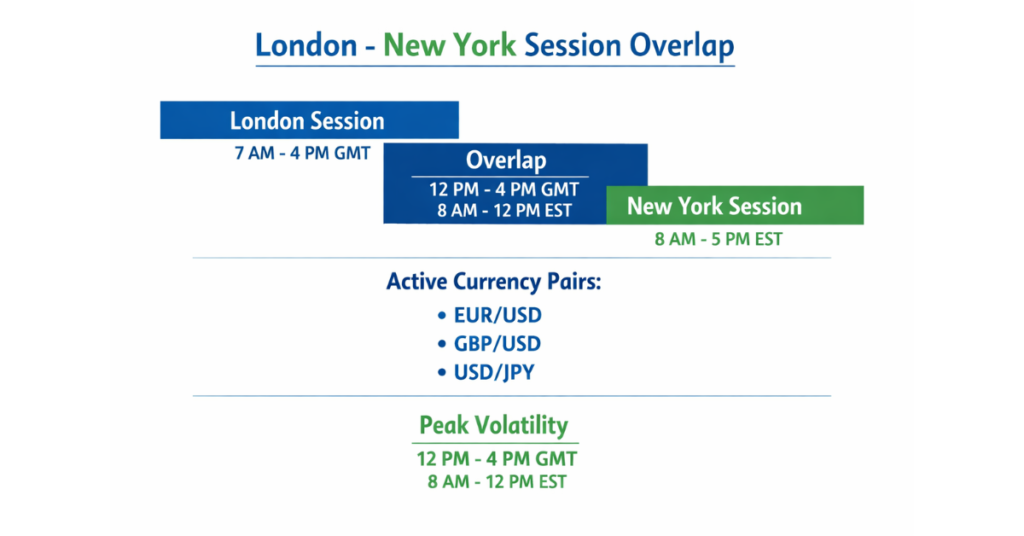
- London–New York Overlap: 12:00–16:00 UTC
Note: Session times may shift slightly during daylight saving time (DST). Always confirm your broker’s server time.
Key Takeaways
- The Asian session is most active for JPY, AUD, and NZD currency pairs.
- The London session generates the highest liquidity for EUR and GBP pairs.
- The New York session increases volatility in USD and CAD pairs, especially during economic news releases.
- The London–New York overlap produces the highest trading volume and volatility.
- Liquidity and volatility vary by session, directly affecting spreads, price movement, and trading strategy.
Asian Session: Most Active Currency Pairs
The Asian session begins with the opening of major financial hubs like Tokyo and later includes participation from Sydney. During this period, trading activity is generally lower compared to London and New York, but specific regional currencies become noticeably more active.
Liquidity also comes from Singapore and Hong Kong, which play an important role in regional institutional trading.
The most active currencies during the Asian session are:
- Japanese Yen (JPY)
- Australian Dollar (AUD)
- New Zealand Dollar (NZD)
As a result, currency pairs such as USD/JPY, AUD/USD, NZD/USD, and AUD/JPY tend to see relatively stronger price movement compared to European pairs during these hours.
The Japanese yen often leads activity because Japan remains one of the world’s largest economies and a major exporter. Institutional flows, regional trade settlements, and economic releases from Japan can significantly influence JPY pairs. Meanwhile, the Australian and New Zealand dollars are sensitive to commodity prices and Asian market sentiment, particularly economic developments in China.
Volatility during the Asian session is typically moderate. Price movements are often more range-bound rather than explosive. This makes the session suitable for traders who prefer structured price channels, support-and-resistance strategies, or short-term scalping in tighter ranges.
Although volatility is lower on average, sudden movements can still occur when unexpected economic data is published. Traders who focus on JPY, AUD, or NZD pairs often find the Asian session offers cleaner technical setups with less erratic price behavior compared to later sessions.
London Session: Highest Liquidity in Europe
The London session is widely recognized as the most liquid and active trading period in the forex market. It begins with the opening of London financial centers and overlaps with both the tail end of the Asian session and the beginning of the New York session. This overlap often leads to significant trading volume and strong price movements.
The most active currencies during the London session include:
- Euro (EUR)
- British Pound (GBP)
- Swiss Franc (CHF)
Key currency pairs include EUR/USD, GBP/USD, EUR/GBP, and GBP/JPY. These pairs see tighter spreads and larger volatility during London hours due to high participation from European banks, hedge funds, and multinational corporations executing transactions.
The London session is especially favored for breakout trading strategies because the high liquidity allows for smooth execution and reduced slippage. Price action is more dynamic compared to the Asian session, with frequent trending opportunities and potential for rapid moves during economic news releases, such as UK or Eurozone interest rate announcements, employment data, or GDP reports.
Increased volatility allows for stronger breakout opportunities.
Suitable for both short-term scalpers and day traders.
Overlaps with New York sessions provide maximum market activity.
New York Session: USD Activity Peak
The New York session begins with the opening of New York financial markets and is heavily influenced by U.S. economic news releases. During this session, the U.S. dollar becomes the dominant currency, driving volatility and trading volume across many major pairs.
The most active currencies during the New York session are:
- U.S. Dollar (USD)
- Canadian Dollar (CAD)
Key currency pairs include EUR/USD, USD/CAD, GBP/USD, and USD/JPY. These pairs often experience rapid price movements, especially around scheduled U.S. economic events such as nonfarm payrolls, Federal Reserve announcements, and retail sales reports.
Volatility during the New York session can be high, particularly in the first few hours after the U.S. market opens and during overlap with the London session. Traders often see strong momentum, making this session ideal for breakout strategies, news trading, and day trading.
The New York session’s influence is amplified when it overlaps with the London session. This overlap produces some of the highest liquidity and volatility of the day, providing excellent opportunities for scalping and high-frequency trading strategies.
London–New York Overlap: Peak Volatility Window
The London–New York overlap occurs when both European and U.S. markets are open simultaneously, typically between 12:00–16:00 UTC (may shift slightly during daylight saving time).. This period produces the highest liquidity and volatility of the trading day, as two of the world’s largest financial centers are active at the same time.
During the overlap, the most active currency pairs include:
- EUR/USD
- GBP/USD
- USD/CHF
These pairs often experience large price swings and strong directional moves, creating opportunities for traders who thrive on momentum and breakout strategies. Tight spreads, combined with high trading volume, make it easier to enter and exit trades efficiently.
Comparison Table: Currency Activity by Session
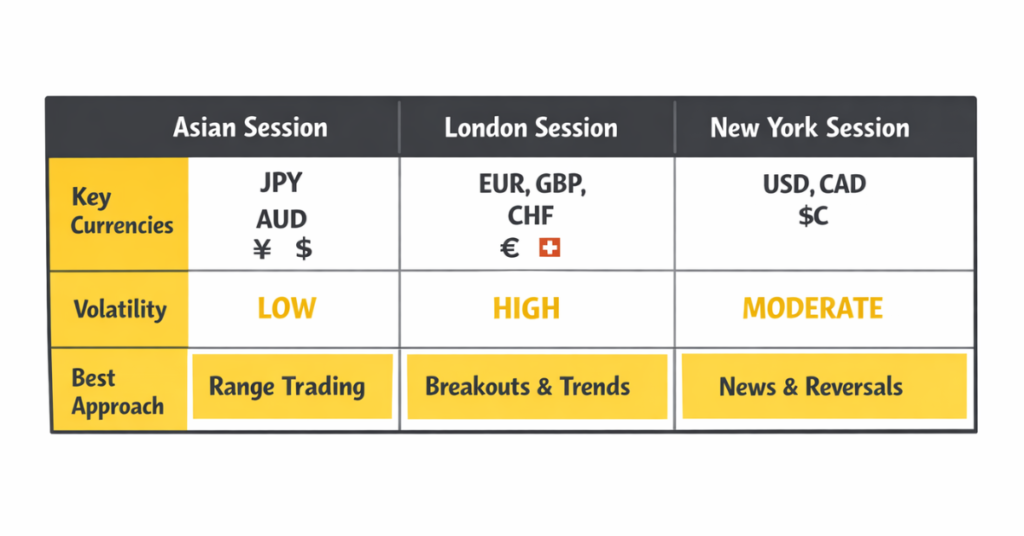
| Trading Session | Most Active Currencies | Popular Pairs | Volatility Level | Best For |
| Asian (Tokyo/Sydney) | JPY, AUD, NZD | USD/JPY, AUD/USD, NZD/USD, AUD/JPY | Moderate | Range trading, scalping |
| London (London) | EUR, GBP, CHF | EUR/USD, GBP/USD, EUR/GBP, GBP/JPY | High | Breakouts, day trading |
| New York (New York) | USD, CAD | EUR/USD, USD/CAD, GBP/USD, USD/JPY | High | News trading, momentum |
| London–New York Overlap | EUR, GBP, USD | EUR/USD, GBP/USD, USD/CHF | Very High | Scalping, breakout strategies |
Which Trading Session Is Best for Beginners?
For beginner traders, understanding session volatility and liquidity is crucial to manage risk effectively. Typically, the Asian session is considered the most suitable for novices because price movements are generally more stable and range-bound. Lower volatility means fewer sharp spikes, making it easier to follow technical setups and avoid emotional decision-making.
Key considerations for beginners:
- Spread Behavior: Tighter spreads are found in more liquid sessions, but the Asian session still offers manageable spreads on major pairs like USD/JPY and AUD/USD.
- Volatility Control: Moderate volatility allows beginners to practice risk management without the stress of sudden large moves.
- Time Commitment: Asian session hours may align better with traders in certain time zones who prefer less intensive trading periods.
While the London and New York sessions offer higher liquidity and profit potential, the sharp volatility and rapid price swings may be overwhelming for inexperienced traders. Beginners should start with lower-risk currency pairs and gradually explore high-liquidity sessions as they gain confidence.
How to Choose the Right Session for Your Trading Style
Selecting the best trading session depends on your strategy, risk tolerance, and preferred trading style. Each session offers unique opportunities based on volatility, liquidity, and the dominant currencies involved.
- Scalpers: Thrive during high-liquidity periods, especially the London–New York overlap, where tight spreads and fast price movements allow quick trades.
- Day Traders: London and New York sessions are ideal for capturing intraday trends in major pairs like EUR/USD and GBP/USD.
- Swing Traders: Can benefit from London session breakouts and New York session momentum, holding positions for several hours to take advantage of trending moves.
- News Traders: The New York session is particularly suitable for trading around U.S. economic releases and central bank announcements.
Traders should also consider session overlaps, which combine high liquidity with strong volatility, providing ideal conditions for both short-term and mid-term strategies.
For those seeking cost-efficient trading, platforms like Defcofx offer advantages during these sessions, including tight spreads from 0.3 pips, leverage up to 1:2000, and fast withdrawals within 4 business hours, which can enhance trading flexibility and execution speed.
Open a Live Trading AccountMajor Economic Drivers by Trading Session
Each trading session is influenced by economic data and central bank decisions from its dominant region. Understanding these drivers helps traders anticipate volatility instead of reacting unexpectedly.
Asian Session: Market movement is mainly driven by Bank of Japan policy updates, Japan inflation data, Australian employment reports, and RBA/RBNZ rate decisions. Chinese economic releases, such as PMI data, also impact AUD and NZD due to strong trade connections.
London Session: The euro and pound are influenced by ECB and Bank of England interest rate decisions, Eurozone and UK inflation reports, employment data, and German economic indicators. These releases often create sustained trends due to high European liquidity.
New York Session: U.S. economic data has global impact. Key drivers include Non-Farm Payrolls (NFP), CPI inflation reports, Federal Reserve decisions, Retail Sales, and GDP figures. Canadian CPI and oil price movements also affect USD/CAD volatility during this session.
Monitoring the economic calendar for session-specific releases allows traders to manage risk, adjust position size, and prepare for potential volatility spikes.
5 Practical Tips for Trading Different Sessions
Trading effectively across sessions requires understanding market behavior, liquidity patterns, and volatility characteristics. Here are actionable tips for maximizing results:
- Monitor Economic Calendars: Always track key economic releases for the session you’re trading, as news can significantly impact price movements, especially in London and New York sessions.
- Focus on Major Pairs: Stick to high-liquidity pairs (EUR/USD, GBP/USD, USD/JPY) to ensure tighter spreads and smoother executions.
- Adjust Position Sizes: Volatility differs by session. Lower your exposure during Asian hours and increase cautiously during London–New York overlap.
- Use Technical Analysis: Identify support and resistance levels and look for breakout opportunities during high-volatility periods.
- Avoid Illiquid Hours: Trading outside peak sessions can result in wider spreads and unpredictable price gaps.
Trading conditions vary significantly across sessions, and successful traders adjust their strategy, position size, and risk management according to session-specific volatility and liquidity.
Final Thoughts on Which Currencies Are Most Active During Specific Trading Sessions?
Understanding which currencies are most active during specific trading sessions is crucial for successful forex trading. The Asian session favors JPY, AUD, and NZD pairs with moderate volatility, making it ideal for beginners. The London session offers high liquidity for EUR and GBP pairs, while the New York session amplifies USD and CAD activity, especially during key economic releases. The London–New York overlap represents the peak of daily volatility, presenting excellent opportunities for scalpers, breakout traders, and day traders.
By aligning your trading strategy with session characteristics, you can manage risk, optimize trade timing, and capitalize on market movements. Platforms like Defcofx enhance this experience by offering tight spreads starting from 0.3 pips, leverage up to 1:2000, fast withdrawals within 4 business hours, and global accessibility, ensuring traders have the tools to execute efficiently.
Open a Live Trading AccountFAQs
The London–New York overlap has the highest volatility due to simultaneous activity from the two largest financial centers. EUR/USD, GBP/USD, and USD/CHF pairs experience the most significant price swings during this period.
During the London session, EUR/USD, GBP/USD, EUR/GBP, and GBP/JPY are the most active, benefiting from high liquidity and European market participation.
Yes, the Asian session is ideal for traders preferring moderate volatility and stable price movements. JPY, AUD, and NZD pairs are most active, making it suitable for range trading and scalping strategies.
EUR/USD is most active during the London session and the London–New York overlap. Liquidity peaks during these periods, creating opportunities for breakout and trend-following strategies.
The Asian session is generally best for beginners due to lower volatility, predictable ranges, and manageable spreads, allowing new traders to learn risk management effectively.
Discover More Forex Guides With Defcofx
- Can I Trade With $1 on MetaTrader 5?
- What Does It Mean to Short the Market?
- What is an Expert Advisor | Automated Trading Guide
- Pairs Trading – Market-Neutral Stock & Forex Guide
- How to Read Stock Candlesticks?
- How Many Countries Use Dollars?
- Can I Trade Gold With $100?
- What Country has the Best Exchange rate for USD?
- What Are the 4 Types of Trade?