


Forex trading hours vary primarily due to time zone differences, local business hours, and regional market practices. While the market is open 24 hours a day during weekdays, not all sessions are equally active.
Knowing these variations is important for newbie traders or even experienced traders to optimize their strategies and reduce risk.
Session Overlaps and Liquidity
The most significant variation occurs during session overlaps, when two markets are open simultaneously:
London–New York Overlap (13:00–17:00 GMT)
- Typically offers the highest liquidity and increased volatility, especially during major economic releases.
- Tight spreads make it ideal for scalping and day trading. Spread conditions may vary depending on the broker and market conditions.
Tokyo–London Overlap (08:00–09:00 GMT)
- Short overlap, moderate activity.
- Useful for Asian/European currency pairs such as EUR/JPY and GBP/JPY.
Sydney–Tokyo Overlap (00:00–07:00 GMT)
- Boosts liquidity during the early Asian session.
- Best for AUD/JPY and NZD/JPY pairs.
Inactive Periods
- During non-overlapping sessions, volatility tends to be lower.
- Currency pairs linked to inactive markets may experience slower price movement and wider spreads.
Currency-Specific Activity Patterns
- USD, EUR, GBP: Highly active during London and New York sessions.
- JPY, AUD, NZD: Peak activity during Tokyo and Sydney sessions.
These differences allows traders to select the best times to trade specific pairs.
For example, trading GBP/USD is optimal during the London–New York overlap, while AUD/JPY trades better during Tokyo–Sydney hours.
Important Key Points
- The Forex market operates 24 hours a day from Monday to Friday, opening with the Sydney session (22:00 GMT Sunday) and closing after the New York session (22:00 GMT Friday).
- Four major sessions: Sydney, Tokyo, London, and New York, each with unique liquidity patterns and active currency pairs.
- Session overlaps (especially London–New York, 13:00–17:00 GMT) provide the highest trading activity and tightest spreads.
- DST transitions shift session hours by one hour; Tokyo is the only major session unaffected by DST.
- Awareness of local trading hours aids risk management and strategy optimization.
- Traders using forex platforms like Defcofx can leverage high flexibility, fast execution, and global access to trade across all sessions effectively.
4 Major Forex Trading Sessions
The Forex market is divided into four major trading sessions, each aligned with the business hours of key global financial centers. These 4 sessions influence market liquidity, volatility, and currency pair activity throughout the trading day.
Sydney Session (Oceania Session)
Opens at 22:00 GMT (Sunday) and closes at 07:00 GMT. EST equivalent: 5:00 PM – 2:00 AM.
Most active currency pairs include AUD/USD, NZD/USD, and AUD/JPY.
This session generally experiences lower overall volatility compared to London and New York but remains important for trading commodity-linked currencies. The Sydney session overlaps significantly with the Tokyo session (00:00–07:00 GMT), blending into early Asian trading hours.
Tokyo Session (Asian Session)
Opens at 00:00 GMT and closes at 09:00 GMT. EST equivalent: 7:00 PM – 4:00 AM.
Most active currency pairs include USD/JPY, EUR/JPY, GBP/JPY, and AUD/JPY.
Liquidity is generally moderate but can increase significantly during major economic releases from Japan, Australia, or China. JPY-related pairs tend to see the strongest activity during this session.
London Session (European Session)
Opens at 08:00 GMT and closes at 17:00 GMT. EST equivalent: 3:00 AM – 12:00 PM.
Most active currency pairs include EUR/USD, GBP/USD, EUR/GBP, and USD/CHF.
This is typically the most liquid and active standalone session, as London is a major global financial hub. Trading volume increases sharply when European economic data is released.
New York Session (US Session)
Opens at 13:00 GMT and closes at 22:00 GMT. EST equivalent: 8:00 AM – 5:00 PM.
Most active currency pairs include EUR/USD, GBP/USD, USD/CAD, and USD/JPY.
Volatility often increases during the overlap with the London session (13:00–17:00 GMT), as both U.S. and European markets are active simultaneously.
📣 The London–New York overlap (13:00–17:00 GMT) is typically the most active period of the Forex trading day, often producing the highest liquidity and increased price movement.
Forex Market Sessions at a Glance
| Session | Open (GMT) | Close (GMT) | EST Time | Active Currency Pairs | Liquidity Level |
|---|---|---|---|---|---|
| Sydney | 22:00 | 07:00 | 5:00 PM – 2:00 AM | AUD/USD, NZD/USD, AUD/JPY | Low–Moderate |
| Tokyo | 00:00 | 09:00 | 7:00 PM – 4:00 AM | USD/JPY, EUR/JPY, AUD/JPY | Moderate |
| London | 08:00 | 17:00 | 3:00 AM – 12:00 PM | EUR/USD, GBP/USD, EUR/GBP | High |
| New York | 13:00 | 22:00 | 8:00 AM – 5:00 PM | EUR/USD, USD/CAD, USD/JPY | High |
Major Economic Drivers by Session
- Asian session volatility is influenced by Bank of Japan announcements, Japanese inflation data, Australian employment reports, and RBA/RBNZ interest rate decisions. Chinese economic releases can also impact AUD and NZD.
- London session activity is driven by ECB decisions, Eurozone inflation data, UK employment figures, and Bank of England policy updates.
- New York session volatility peaks during U.S. economic releases such as Non-Farm Payrolls, CPI reports, Federal Reserve meetings, and Canadian data affecting USD/CAD.
5 Factors Affecting Forex Market Hours
Although the Forex market operates 24 hours a day from Monday to Friday, actual trading conditions can vary depending on external factors. Understanding these influences helps traders manage risk, avoid unexpected volatility, and adjust their strategies accordingly.
1. Weekends
The Forex market closes on Saturday and Sunday because major financial institutions and liquidity providers are not operating.
- Trading typically ends on Friday at 22:00 GMT (after the New York session closes).
- The market reopens on Sunday at 22:00 GMT with the Sydney session.
Orders placed before the weekend may be affected by weekend gaps, where prices open significantly higher or lower due to geopolitical events or economic developments that occurred while markets were closed.
2. Public Holidays
National holidays in major financial centers such as the United States, United Kingdom, Japan, or the Eurozone can significantly impact trading activity. The only two days when the entire Forex market typically closes are Christmas Day and New Year’s Day.
During other major holidays:
- Liquidity may decline.
- Spreads can widen.
- Volatility may decrease — unless unexpected news breaks.
Even if only one major market is closed (e.g., a U.S. bank holiday), global Forex trading continues, but with reduced participation.
3. Daylight Saving Time (DST)
Daylight Saving Time shifts in regions like the U.S., UK, and Europe can temporarily change Forex session overlaps by one hour. Tokyo does not observe DST, so its UTC-based hours remain stable year-round.
Key transitions to be aware of:
- When the U.S. moves to EDT but Europe has not yet adjusted, the London–New York overlap temporarily shifts to 12:00–16:00 GMT instead of the usual 13:00–17:00 GMT.
- EST becomes EDT (Eastern Daylight Time) in March; GMT becomes BST (British Summer Time) and CET becomes CEST in late March.
- Traders relying on fixed session times must update their schedules during these seasonal transitions.
⚠️ Always verify session hours with your broker platform during seasonal clock changes.
4. Local Economic Events and Market Practices
While Forex is decentralized, regional economic activity influences currency behavior. Examples include:
- Early market closures before major holidays
- Central bank policy meetings
- National elections
- Unexpected geopolitical events
These events do not close the Forex market but can significantly affect liquidity and volatility during specific sessions.
5. Platform and Broker Factors
Individual broker platforms may:
- Conduct scheduled maintenance
- Experience temporary downtime
- Operate on different server time zones (GMT, GMT+2, EST, etc.)
Server time differences can affect chart candles and session indicators, even though the underlying global market remains open. Traders should always confirm their broker’s server time, trading hours for specific instruments, and maintenance schedules.
Best Time to Trade Forex
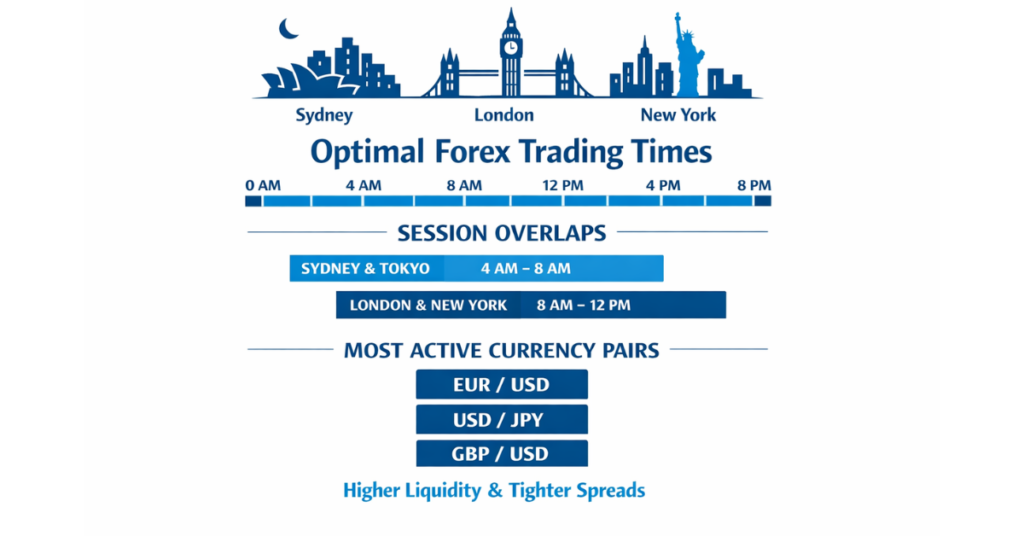
Knowing the best time to trade Forex allows traders to maximize profits, minimize risks, and take advantage of high liquidity periods. While the market is open 24 hours during weekdays, activity levels vary depending on the session and currency pairs traded.
Peak Trading Periods
- London–New York Overlap (13:00–17:00 GMT):
- Highest liquidity and volatility.
- Ideal for major currency pairs like EUR/USD, GBP/USD, and USD/JPY.
- Tokyo–London Overlap (08:00–09:00 GMT):
- Short window with moderate activity.
- Best for JPY, AUD, and EUR trading.
Currency Pair Considerations
- USD, EUR, GBP pairs: Trade best during London and New York sessions.
- JPY, AUD, NZD pairs: Trade best during Tokyo and Sydney sessions.
- Aligning the currency pair with the session increases trade efficiency and reduces spread costs.
3 Tips for Traders
- Inactive sessions may suit longer-term or range-trading strategies but are generally less suitable for scalping.
- Consider your time zone and personal availability to ensure active participation.
- Use platforms like Defcofx that provide high leverage up to 1:2000 and fast execution to capitalize on peak market hours efficiently.
Final Thoughts
Understanding how trading hours vary across different Forex markets is essential for any trader aiming to maximize efficiency and profitability. Each major session, Sydney, Tokyo, London, and New York, has distinct activity levels, liquidity patterns, and currency pair behavior. By aligning trading strategies with these hours, traders can optimize entry and exit points, avoid periods of low liquidity, and reduce exposure to price gaps or slippage.
Peak periods, such as the London–New York overlap, offer the highest liquidity and the tightest spreads, making them ideal for trading major currency pairs. Conversely, inactive sessions require careful planning, as volatility may drop and spreads can widen, impacting trade efficiency. Traders who understand these patterns gain a strategic advantage, making their decisions more precise and informed.
Platforms like Defcofx enhance this advantage by offering high leverage up to 1:2000, no commissions or swap fees, a 40% welcome bonus, and fast support and withdrawals, ensuring that traders can act quickly during optimal market hours. By integrating session awareness into daily trading routines and leveraging the right tools, traders can increase their potential for profit while managing risks effectively.
Open a Live Trading AccountFAQs
The most active session is the London–New York overlap (13:00–17:00 GMT). During this period, liquidity and volatility peak, making it ideal for trading major currency pairs like EUR/USD, GBP/USD, and USD/JPY.
Yes. Currency pairs are more active during sessions aligned with their respective regions. For example, JPY, AUD, and NZD pairs perform best during Tokyo and Sydney sessions, while USD, EUR, and GBP pairs peak during London and New York sessions.
The Forex market operates 24 hours a day from Monday to Friday, but activity and liquidity vary across sessions. Traders should focus on peak hours and session overlaps to take advantage of tighter spreads and higher market movement.
Most public holidays reduce liquidity and widen spreads but do not close the market entirely. The only days when the entire global Forex market typically closes are Christmas Day and New Year’s Day. Traders should monitor holiday calendars for major financial centers to avoid unexpected gaps or slower execution.
Platforms like Defcofx provide high leverage, no commissions, fast withdrawals, and global access, allowing traders to effectively trade across all sessions and capitalize on market opportunities whenever they arise.
Explore More Forex Guides from Defcofx
- Which Forex Chart Is Best for Beginners?
- Can You Learn Forex by Yourself?
- What Was the Highest Yen to USD Rate Ever?
- What Is a Good Exchange Rate for USD to SEK?
- Is Forex a Digital Currency?
- Common Forex Trading Terms and Their Meanings: A Beginner’s Guide
- What Are General Trade and Modern Trade?
- US30 Pip Value Explained with Easy Examples