


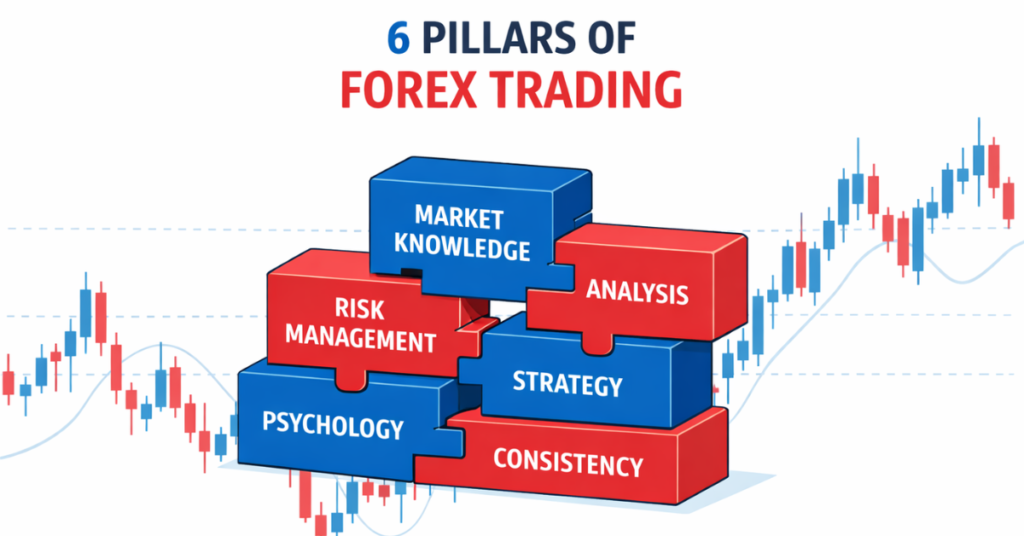
The 6 pillars of forex trading are market knowledge, technical and fundamental analysis, risk management, trading strategy, trading psychology, and consistency with continuous learning. Together, these pillars form the complete foundation of successful trading, helping traders understand the market, manage risk, and make disciplined decisions over time.
Key Takeaways
- The 6 pillars of forex trading form a complete framework combining knowledge, strategy, analysis, and discipline.
- Risk management and psychology are the most critical pillars, as they determine long-term survival in the market.
- Both technical and fundamental analysis help traders make data-driven decisions instead of guessing.
- A solid trading strategy and consistent learning ensure traders can adapt to changing market conditions.
- Success in forex is not based on one skill alone, but on how well all six pillars work together.
What Are the 6 Pillars of Forex Trading?
The 6 pillars of forex trading are the essential building blocks that guide how traders understand, approach, and succeed in the market. Instead of relying on luck or random trades, these pillars provide a structured framework for making informed and consistent decisions.
At its core, forex trading is not just about buying and selling currencies. It is about understanding the market, managing risk, controlling emotions, and following a proven plan. Each pillar covers a different aspect of trading, but they all work together to create a complete system.
A trader might have strong market knowledge but still fail due to poor risk management or emotional decision-making. Equally, having a good strategy without discipline or consistency leads to losses. This is why applying all six pillars matters, not just one or two.
Pillar 1: Market Knowledge (Understanding Forex Basics)
Market knowledge is the foundation of forex trading. Without it, trading becomes guesswork. It means understanding how the forex market works, what causes price movements, and how different currency pairs behave under various conditions.
The forex market involves trading one currency against another, for example EUR/USD. Prices move based on supply and demand, which are shaped by economic data, interest rates, geopolitical developments, and market sentiment. Understanding these forces helps traders make sense of why the market moves rather than reacting blindly.
A strong foundation in market knowledge includes:
- How currency pairs are structured (base vs quote currency)
- What pips, spreads, and leverage mean in real terms
- When the market is most active (trading sessions and overlaps)
- Key factors that cause price fluctuations, from central bank decisions to economic reports
Pillar 2: Technical and Fundamental Analysis
Technical and fundamental analysis are the two core methods traders use to understand and anticipate market movements. Together, they help traders make data-driven decisions rather than emotional or random ones.
Technical Analysis
Technical analysis focuses on price charts and historical market data. Traders study patterns, trends, and indicators to identify potential entry and exit points. The core idea is that price action reflects all available market information, so studying charts helps anticipate future moves.
Key elements include support and resistance levels, trend lines and chart patterns, technical indicators like moving averages and RSI, and candlestick patterns.
Fundamental Analysis
Fundamental analysis looks at the economic and political factors that drive currency values. These include interest rates and central bank decisions, inflation and employment data, GDP growth reports, and geopolitical events. When a country’s economy strengthens, its currency typically gains value as investor confidence rises.
How They Work Together
Most experienced traders combine both approaches. Fundamental analysis gives direction, pointing you toward which currencies are likely to strengthen or weaken. Technical analysis gives timing, helping you find the right entry and exit points within that direction.
Pillar 3: Risk Management (Core Survival Skill)
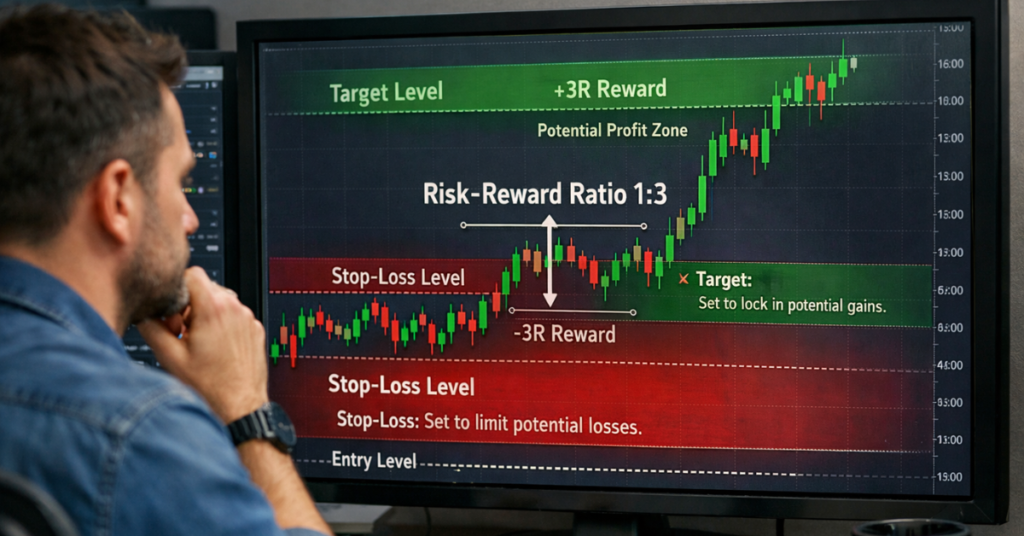
Risk management is arguably the most important pillar of forex trading because it determines how long you stay in the market. Even with a strong strategy and solid analysis, poor risk control can wipe out an account quickly. This pillar is about protecting your capital first and growing it second.
At its core, risk management means controlling how much you are willing to lose on each trade, and making sure no single trade can significantly damage your account.
Key elements of risk management include:
- Stop-loss orders: Automatically close a trade at a preset loss level to cap downside
- Position sizing: Adjusting trade size based on account balance and acceptable risk per trade
- Risk-reward ratio: Ensuring potential profit is greater than potential loss, commonly 1:2 or 1:3
- Capital preservation: Avoiding overexposure to a single trade, session, or market condition
Risk management also protects you emotionally. When traders risk too much on a single trade, they tend to make impulsive decisions like removing stop-losses or overtrading to recover. This creates a damaging cycle that is hard to break. In short: risk management is not about avoiding losses. It is about keeping them small, controlled, and recoverable.
Pillar 4: Trading Strategy and Planning
A trading strategy is a structured plan that defines when to enter a trade, when to exit, and under what conditions to trade or stay out entirely. Without a strategy, trading becomes reactive and emotional, which produces inconsistent results.
What a Trading Strategy Includes
A proper trading strategy typically contains entry rules, exit rules (take profit and stop loss levels), market condition filters (trending, ranging, or volatile), the timeframe being traded, and confirmation methods such as indicators, price action signals, or news filters.
Trading Styles to Consider
- Scalping: Very short-term trades targeting small profits multiple times per session
- Day trading: Trades opened and closed within the same day
- Swing trading: Holding trades for several days or weeks based on medium-term trends
- Position trading: Long-term trades aligned with major macro trends
Each style requires discipline and consistency. Switching randomly between them based on recent results is one of the most common reasons traders struggle.
Why Planning Matters
A clear plan eliminates emotional decisions like entering trades out of boredom or fear of missing out. It also makes your trading measurable. When every trade follows the same rules, you can identify what is working and what needs adjusting. A good strategy does not guarantee profits. It guarantees that every trade is intentional, not impulsive.
Practice Your Strategy on a Free Demo AccountPillar 5: Trading Psychology (Emotions and Discipline)
Trading psychology refers to the mental and emotional state a trader brings to every decision. Even with strong knowledge, solid analysis, and a good strategy, emotions can override logic and produce poor outcomes. This pillar is about controlling behavior, maintaining discipline, and staying consistent under pressure.
Common Psychological Challenges in Forex
- Fear: Closing trades too early or avoiding valid setups after a losing streak
- Greed: Overholding trades or risking too much for higher returns
- FOMO (Fear of Missing Out): Entering trades without proper confirmation just to be in the market
- Overtrading: Taking too many trades after wins or losses, often leading to poor quality setups
- Revenge trading: Increasing position size to recover losses quickly, without a plan
Building Trading Discipline
Discipline means following your trading plan consistently, even when emotions push back. It means accepting losses without reacting, waiting for high-quality setups, avoiding impulsive trades, and sticking to your strategy rules whether the last trade was a winner or a loser.
Traders who struggle with psychology often have the right knowledge but cannot execute it under pressure. This is why practicing in a risk-free environment, such as a demo account, is one of the most effective ways to build discipline before trading live capital.
Pillar 6: Consistency and Continuous Learning
Consistency and continuous learning separate short-term traders from long-term successful ones. This pillar is about building habits, refining skills, and adapting to a market that is always changing. Forex trading is not a one-time skill. It is an ongoing process.
What Consistency Really Means
Consistency does not mean winning every trade. It means following your trading plan on every trade, applying the same risk rules regardless of recent results, avoiding random strategy changes based on short-term outcomes, and maintaining discipline across both winning and losing periods. A consistent trader focuses on process, not just outcomes.
Why Continuous Learning Matters
Markets evolve. Economic conditions shift, volatility patterns change, and new tools and strategies emerge. Traders who stop learning after early success often find their edge fades. Continuous improvement includes reviewing past trades through journaling, learning new market concepts and strategies, staying informed on economic data and news impact, and refining risk and money management skills over time.
How the 6 Pillars Work Together
The 6 pillars are not separate skills. They function as a connected system where each one supports the others. Weakness in any single pillar weakens the whole framework.
A trader with strong technical analysis but no risk management can still blow their account on a few bad trades. A trader with a solid strategy but poor psychology will break their own rules when emotions run high. Every pillar has a specific role:
- Market knowledge gives you the foundation to understand what you are trading
- Technical and fundamental analysis help you identify opportunities with higher probability
- Risk management protects your capital so you stay in the game
- Trading strategy provides the rules and structure for every trade
- Psychology ensures you can execute your plan under pressure
- Consistency and learning improve all the other pillars over time
Think of it this way: Trader A has strong analysis skills but ignores risk and emotions. Trader B applies all six pillars consistently, even with a simpler strategy. Over time, Trader B will almost always perform better because their approach is structured, controlled, and built to last.
How Beginners Can Apply the 6 Pillars Step by Step
Understanding these pillars is important. Applying them in a structured, progressive way is what actually builds real trading skill. Beginners should work through them one at a time rather than trying to master everything at once.
Step 1: Build Market Knowledge First
Start with the basics of how the forex market works. Learn how currency pairs are quoted, what pips and spreads mean, how leverage affects your positions, and when the major sessions are active. Do not rush this step.
Step 2: Learn Basic Analysis
Once you understand the market, start reading simple price charts. Learn support and resistance levels, basic candlestick patterns, and how economic news releases affect currency prices. Keep it simple at first, then build from there.
Step 3: Apply Risk Management From Day One
Even as a beginner, risk management is non-negotiable. Use a stop-loss on every single trade. Size your positions to risk no more than 1–2% of your account per trade. Avoid overleveraging, especially when you are still learning.
Step 4: Build a Simple, Rule-Based Strategy
Create a basic system that defines when to enter, when to exit, and when to stay out. It does not need to be complex. A simple, consistent plan beats a complicated one you cannot follow. Refer to beginner trading tips as you develop your approach.
Step 5: Work on Your Psychology
Practice trading in a demo environment to build emotional discipline without financial pressure. Learn to accept losses calmly, avoid revenge trading, and stick to your plan even when it feels uncomfortable. Discipline is a skill that takes time to develop.
Step 6: Be Consistent and Keep Learning
Keep a trading journal and review your trades regularly. Identify patterns in your mistakes. Improve step by step rather than jumping between strategies. Long-term consistency comes from honest self-review and gradual refinement.
Apply the 6 Pillars with Defcofx
Defcofx is a global forex and CFD broker registered in Saint Lucia, offering access to currencies, commodities, indices, stocks, and cryptocurrencies through the MetaTrader 5 (MT5) platform. For traders working to apply the 6 pillars effectively, having the right broker environment makes a real difference.
- Leverage up to 1:2000, giving traders full flexibility in position sizing according to their own risk strategy
- 40% welcome bonus on first deposits of $1,000 or more, available to all clients globally
- Spreads from 0.3 pips with no commissions or swap fees, keeping trading costs low while you build consistency
- Withdrawals processed within 4 business hours, including weekends, so your capital stays accessible
- Global access with multilingual support, welcoming traders from all countries
- Free demo account on MT5 with live market data, ideal for practicing your strategy and psychology before going live
Whether you are building your first strategy, practicing risk management, or ready to trade live, opening an account with Defcofx takes only a few minutes. Start on a demo, apply the pillars, and move to live trading when you are ready.
Open a Live Trading Account5 Common Mistakes That Undermine the 6 Pillars

Most beginners struggle in forex not because the market is unfair, but because they repeat avoidable mistakes. Recognizing these errors early protects capital and improves long-term consistency.
1. Ignoring Risk Management
Trading without proper risk control is the most common and most damaging mistake. It includes skipping stop-losses, oversizing positions, and overleveraging. Even a strong strategy cannot survive this over time.
2. Overtrading
Overtrading happens when traders enter positions without proper setups, out of boredom, to recover losses quickly, or simply to feel active. More trades do not mean more profits. They usually mean more exposure to low-quality signals.
3. Trading Without a Clear Strategy
Trading based on guesses, tips, or random signals without defined entry and exit rules is not a strategy. It is gambling. Switching strategies after every losing trade is just as damaging, as it prevents you from ever identifying what actually works.
4. Emotional Decision-Making
Fear causes early exits on perfectly valid trades. Greed causes traders to hold past their take-profit levels. Revenge trading after a loss leads to oversized, poorly timed entries. All of these break the discipline that the other five pillars depend on.
5. Stopping Learning Too Early
Some traders stop reviewing their performance after a few early wins. Without trade journaling, honest mistake analysis, and continuous improvement, progress stalls. Markets change, and traders who do not adapt get left behind.
Final Thoughts on the 6 Pillars of Forex Trading
The 6 pillars of forex trading, market knowledge, technical and fundamental analysis, risk management, trading strategy, trading psychology, and consistency with continuous learning, form a complete framework for approaching the market with structure and discipline. Each pillar has a specific role, but long-term success depends on how well they all work together.
Forex is not about finding a single winning formula and running it forever. It is about building a structured approach, protecting capital, managing emotions, and continuing to improve. Traders who commit to all six pillars develop the kind of consistency that purely signal-based or strategy-only traders never achieve.
If you are ready to put these pillars into practice, Defcofx gives you the tools, conditions, and platform to do exactly that, whether you are starting on a demo or trading live markets.
Open a Live Trading AccountFAQ
The 6 pillars of forex trading are market knowledge, technical and fundamental analysis, risk management, trading strategy, trading psychology, and consistency with continuous learning. Together, they form the structured foundation that helps traders understand the market, make informed decisions, and trade with discipline over the long term.
These pillars are important because they provide a structured, logical approach to trading. Instead of guessing or reacting emotionally, traders use knowledge, analysis, and risk control to make consistent decisions. Ignoring even one pillar can weaken the entire trading framework.
Risk management is generally considered the most critical pillar because it protects trading capital. Even a high-performing strategy fails without proper risk control, since uncontrolled losses can quickly exceed accumulated profits and end a trader’s account.
Yes. The six pillars actually provide a clearer learning path for beginners than jumping straight into live trading. Starting with market knowledge and risk management, then adding analysis and strategy, gives new traders a structured progression that reduces costly early mistakes.
Most traders fail because they neglect key pillars, particularly risk management, trading psychology, and consistency. Common failure patterns include overtrading, lacking a defined strategy, trading emotionally, and not reviewing or learning from past mistakes.
Building a solid foundation across all six pillars typically takes several months of consistent practice and study. However, mastery is an ongoing process. Even experienced traders continue refining their skills, adapting to new market conditions, and reviewing their performance.
Yes. A demo account lets you practice applying all six pillars, including strategy, risk management, and psychology, without risking real capital. Defcofx offers a free demo account on MetaTrader 5 with live market data, making it an ideal environment to build skills before trading live.