


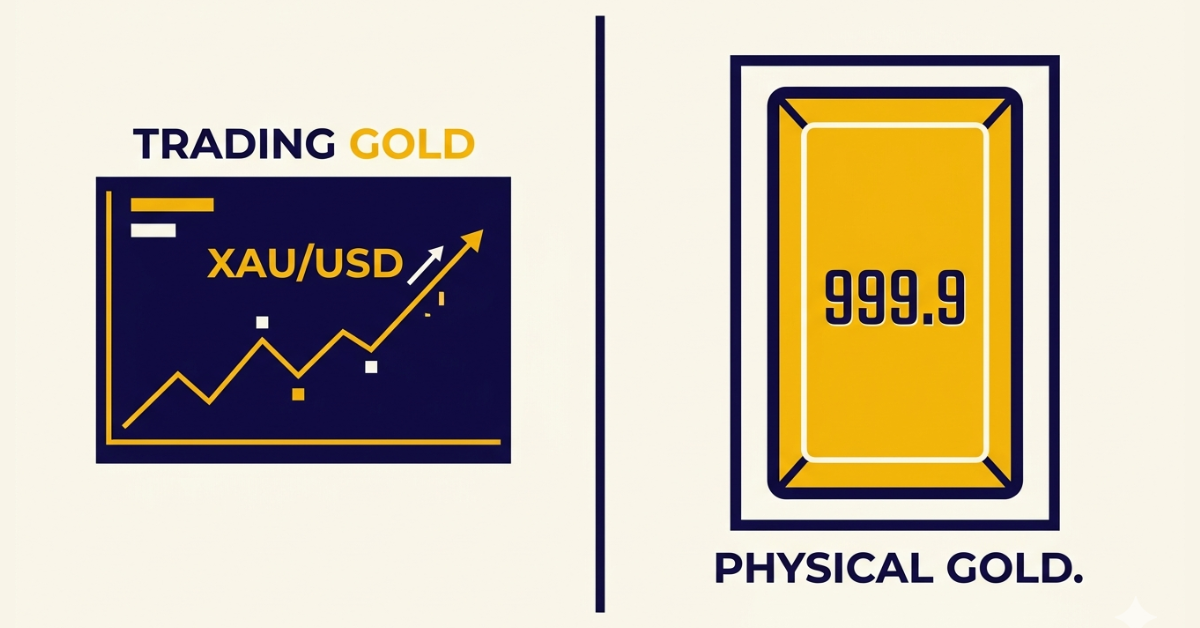
Gold trading in forex involves buying or selling gold against a currency, almost always the US dollar, through the XAU/USD pair. Traders profit from gold price movements by taking long positions when they expect prices to rise and short positions when they expect a decline. Unlike buying physical gold, forex gold trading requires no storage or delivery and lets you use leverage, trade both directions, and react quickly to global events.
Key Takeaways
- Gold is traded in forex markets as XAU/USD, the price of one troy ounce of gold in US dollars
- Gold prices are heavily influenced by US dollar strength, interest rates, and global uncertainty
- Gold is a safe-haven asset, it tends to rise during economic crises, geopolitical tension, and financial instability
- Gold is known for high volatility and strong trending behavior, creating significant trading opportunities
- Both technical analysis and fundamental analysis are important for gold traders
- Risk management is critical, gold can move hundreds of dollars in a single session during major news events
- You can trade gold CFDs through platforms like Defcofx without owning physical gold.
What Does Gold Trading Mean in Forex?
In forex and CFD markets, gold is treated like a currency pair. The symbol XAU/USD represents the price of gold in US dollars. XAU is the ISO code for one troy ounce of gold (approximately 31.1 grams), while USD is the US dollar.
When you buy XAU/USD, you are speculating that gold prices will rise against the dollar. When you sell it, you are expecting gold to fall. The profit or loss is calculated by the number of pips or dollar moves between your entry and exit, multiplied by your position size.
Unlike physical gold investing, trading gold through a forex broker gives you access to leverage, lets you profit from both rising and falling prices, and requires no physical storage or insurance. Positions are opened and closed digitally with no delivery of physical metal.
Why Gold Is So Popular Among Forex Traders
Gold attracts traders for several reasons that set it apart from standard forex pairs.
- High volatility and strong trends: Gold regularly moves $20–$50 per ounce in a single session during normal conditions, and several hundred dollars during major risk events. This creates substantial intraday opportunities that many forex pairs cannot match.
- Safe-haven demand: When financial markets are stressed, during banking crises, geopolitical conflicts, or equity market crashes, investors rush into gold. These safe-haven flows can produce sharp, sustained rallies that are difficult to find in regular currency pairs.
- Inflation hedge: Gold has historically been used to preserve purchasing power during inflationary periods. When inflation expectations rise, gold demand tends to increase, pushing prices higher.
- Global participation: Gold is traded 24 hours a day across Asian, European, and American sessions. This global participation means liquidity is generally strong and price discovery is continuous throughout the trading week.
To understand how gold compares to standard forex pairs as a trading instrument, see is gold better than forex?.
The Main Factors That Move Gold Prices
Understanding what drives gold is essential before placing any trade. Gold does not respond to the same factors that move currency pairs, it has its own set of primary drivers.
- US dollar strength (inverse relationship): Since gold is priced in USD, a stronger dollar makes gold more expensive for buyers holding other currencies, which tends to suppress demand. A weaker dollar has the opposite effect, supporting gold prices. This inverse relationship is one of the most consistent in financial markets.
- Real interest rates: Gold does not pay interest or dividends. When real interest rates (nominal rates minus inflation) rise, the opportunity cost of holding gold increases, and investors often move capital to interest-bearing assets. When real rates fall or turn negative, gold becomes relatively more attractive.
- Inflation expectations: Gold is widely seen as a hedge against inflation. When CPI data comes in above expectations or central banks signal loose monetary policy, inflation expectations rise and gold demand typically follows.
- Geopolitical risk: Wars, sanctions, banking failures, and diplomatic crises drive investors toward gold as a store of value. The more uncertain the global environment, the more demand for gold tends to increase.
- Central bank buying: Central banks worldwide hold gold as part of their reserve assets. Large-scale purchases by central banks (notably in emerging markets) can move prices meaningfully over medium to long-term time horizons.
Gold Trading vs Regular Forex Pair Trading
Gold behaves differently from most currency pairs, and understanding those differences helps traders approach it with the right expectations.
| Feature | Gold Trading (XAU/USD) | Standard Forex Pairs |
| Volatility | High, large daily ranges | Moderate, depends on pair |
| Main Drivers | Rates, inflation, USD, global risk | Economic data, interest rate differentials |
| Safe-Haven Status | Yes, rises during crises | USD and JPY have safe-haven status |
| Trading Hours | Nearly 24/5 | Nearly 24/5 |
| Pip Value | Higher per pip due to price level | Lower per pip on most pairs |
| Trend Behavior | Strong multi-week trends common | Trends vary by pair and conditions |
| News Sensitivity | Very high (Fed, inflation, risk) | High (economic calendar events) |
| Beginner Suitability | Requires caution due to volatility | Major pairs are more beginner-friendly |
Trade Gold (XAU/USD) with Defcofx
Access gold CFDs with real-time pricing, tight spreads, and up to 1:2000 leverage. No commissions, no swap fees, and withdrawals processed within 4 hours.
How Beginners Can Start Trading Gold
Gold is not the easiest market for complete beginners because of its volatility. But with the right foundation, it is very much tradable from day one.
- Learn the basics first: Understand how XAU/USD moves, what drives it, and how to read charts before committing real capital. Read how to trade commodities in forex for a broader framework
- Start with a demo account: Practice on live gold prices with zero risk. A demo account lets you test strategies, understand leverage effects, and build familiarity with how gold reacts to news
- Focus on economic events: Gold is very sensitive to the economic calendar. Fed meeting dates, US CPI releases, and NFP reports are the most important events to monitor. Keep the economic calendar open during trading sessions
- Use appropriate position sizing: Gold moves in larger dollar increments per pip than most forex pairs. Always check XAU/USD pips and lot size before placing your first trade to understand the monetary value of each position
- Set stop-loss orders every time: A sharp gold move without a stop can erase a significant portion of an account in minutes. No exceptions
Popular Strategies for Trading Gold
- Trend following: Gold is known for sustaining strong directional trends, sometimes running for weeks or months. Many traders identify the overall trend using moving averages or trendlines and look for pullback entries to trade in the trend direction. This is one of the most widely used gold strategies.
- Breakout trading: Key technical levels on gold are closely watched. When gold breaks above a major resistance or below a major support with strong momentum and volume, breakout traders enter in the direction of the break. These setups occur frequently around high-impact news events.
- Range trading: During periods of consolidation, gold tends to oscillate between defined support and resistance levels. Range traders buy near support and sell near resistance, using RSI to identify overbought and oversold conditions within the range.
- News-based trading: Some traders focus specifically on entering gold positions immediately before or after major economic releases. This requires fast execution and a strong understanding of how different data outcomes affect gold prices.
Technical Analysis Tools for Gold Trading
Gold responds well to technical analysis because of the large number of participants watching the same key levels globally.
- Support and resistance: Round numbers like $2,000, $2,500, and $3,000 attract enormous attention on gold. These levels act as both support and resistance and are where the highest-quality reversal and breakout setups often form
- Moving averages: The 50-day and 200-day moving averages are widely watched on gold daily charts. Crossovers and bounces from these levels are significant signals for longer-term traders
- RSI: RSI divergence on gold charts, where price makes a new high but RSI does not, has historically preceded notable reversals
- Candlestick patterns: Engulfing patterns, hammer formations, and morning stars at key gold price levels attract significant institutional attention. See candlestick patterns for day trading for pattern details
- ATR (Average True Range): Because gold moves in large dollar amounts, using ATR to size stops and targets proportionally is a best practice. Read more at Average True Range
5 Common Mistakes Gold Traders Make
- Overleveraging: Gold’s high volatility combined with large leverage multiples creates a dangerous combination. A $30 move per ounce on an oversized position can cause severe account drawdown. Start with smaller position sizes until you fully understand the dollar value per pip
- Ignoring the dollar index (DXY): Because gold has a strong inverse relationship with the USD, tracking DXY alongside XAU/USD is standard practice for experienced gold traders
- Ignoring fundamentals: Gold trading without awareness of major economic events is like trading blind. Fed decisions, CPI prints, and geopolitical headlines can render technical setups irrelevant in seconds
- Chasing moves: Gold can gap sharply on news. Entering a position after a $40 move has already happened without a clear continuation signal is chasing, not trading
- No clear exit plan: Always define both your stop loss and your target before entering. Gold’s volatility means prices can reverse rapidly. See forex risk management for a structured approach
Trade Gold with Defcofx
Defcofx provides access to gold (XAU/USD) trading through MetaTrader 5 (MT5) with real-time pricing, professional charting tools, and the execution speed needed to react quickly when gold moves.
- Spreads from 0.3 pips on major instruments. Check Defcofx metal trading for full gold trading details
- Up to 1:2000 leverage, check leverage and margin requirements before trading gold
- No commissions, no swap fees, all-in pricing on gold positions
- 40% welcome bonus on first deposits of $1,000 or more. See the promotions page
- Can I trade gold with $100? Yes, see can I trade gold with 100 for specifics
- Trading hours for gold on Defcofx: precious metals trading hours
- Multiple account types including demo accounts where you can practice gold setups at zero risk
Start Trading Gold (XAU/USD) Today
Open a Defcofx account and access gold CFDs with competitive spreads, fast execution, and no commissions. Beginners can start with a free demo account and practice on live gold prices.
Frequently Asked Questions
What is gold called in forex trading?
Gold is traded in forex markets as XAU/USD. XAU is the ISO symbol for one troy ounce of gold, derived from the Latin word “aurum,” while USD is the US dollar. The pair shows the current price of gold denominated in dollars.
Is gold better than forex pairs for trading?
Gold is not inherently better, but it behaves differently. Gold is more volatile than most forex pairs, creating larger potential moves but also greater risk. Many traders include gold alongside forex pairs to diversify their setups. See is gold better than forex for a detailed comparison.
Why does gold move so much?
Gold reacts to a wide range of factors simultaneously: US dollar strength, real interest rates, inflation expectations, central bank policy, and geopolitical events. When several of these drivers align in the same direction, gold can move very sharply in a short period.
Is gold good for beginners?
Gold can be traded by beginners, but requires extra caution because of its volatility and larger pip values. Start with a demo account, use small position sizes, and always use a stop loss. Review XAU/USD pips and lot size to understand position sizing before trading live.
What is the best time to trade gold?
Gold is most active during the London-New York overlap, roughly 8:00 AM to 12:00 PM EST. This is when the highest volume trades and price movement tends to be most reliable. See best times to trade gold for a full breakdown.
Can I trade gold without buying physical gold?
Yes. Through a forex or CFD broker like Defcofx, you trade gold price movements digitally. No physical metal is involved, you simply open a buy or sell position and close it when you want to take profit or cut losses.
Does gold always rise during economic crises?
Not always, but gold has a strong historical tendency to rise during genuine financial stress. During sharp equity sell-offs, the initial reaction can sometimes include gold selling as investors raise cash. But sustained crises typically see gold rally as safe-haven demand builds.
How much money do I need to start trading gold?
This depends on your broker and the leverage used. On Defcofx, you can trade gold with $100, though proper risk management means never risking more than 1–2% of your account per trade regardless of account size.
What moves gold more, technicals or fundamentals?
Both matter significantly for gold. On shorter intraday timeframes, technical levels and candlestick patterns drive many trades. On medium to longer timeframes, fundamental factors like interest rate policy, inflation data, and geopolitical events dominate. The best gold traders use both.
Trade Gold the Right Way, Start with Defcofx
Access XAU/USD with real-time pricing, tight spreads, and professional charting tools through MT5. A free demo account lets you practice gold trading strategies at zero risk.