


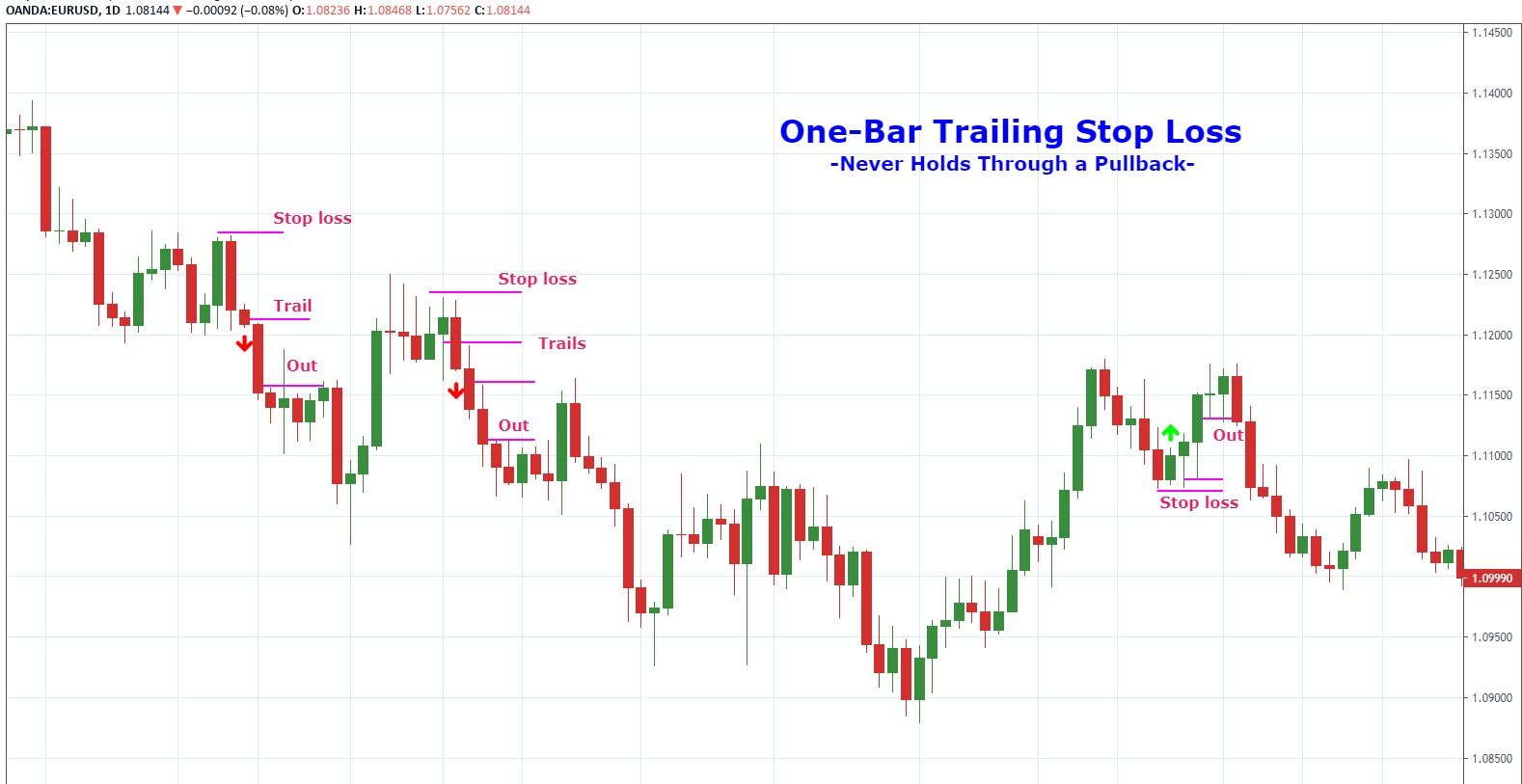
A trailing stop loss is a dynamic stop-loss order that automatically follows the market price as it moves in your favor. Unlike a fixed stop loss that stays in one place, a trailing stop adjusts upward (in a long trade) or downward (in a short trade) as the price moves, locking in profits while keeping the trade open. It is one of the most practical risk management tools available to forex and CFD traders.
Key Takeaways
- A trailing stop loss moves automatically with price, following gains while staying at a set distance
- It helps protect profits without requiring you to manually adjust your stop loss as the trade progresses
- Trailing stops only move in one direction: with your profit. They never move against you once set
- They work best in trending markets where price moves steadily in one direction
- In sideways or choppy markets, trailing stops can trigger prematurely due to normal price fluctuations
- The right trailing stop distance depends on the asset, timeframe, and how much volatility you are dealing with
What Is a Trailing Stop Loss?
A trailing stop loss is a type of stop-limit order that adjusts automatically when the market moves in your favor. It follows the price at a fixed distance, whether measured in pips, points, or a percentage.
Unlike a regular fixed stop loss, which remains at the level you originally set, a trailing stop moves dynamically. Once you set it, it does the work for you, updating your exit point as your profit grows.
For long (buy) trades, the trailing stop moves upward as the price rises. For short (sell) trades, it moves downward as the price falls. In both cases, the stop only moves in the direction of profit and locks in what you have gained.
Simple Trailing Stop Loss Example: EUR/USD
The example below uses EUR/USD with an entry at 1.1000 and a trailing stop distance of 50 pips. This is one of the most common ways to visualize how a trailing stop operates in a live trade.
| Market Price | Trailing Stop | Price Move | Status |
| 1.1000 | 1.0950 | — | Trade just opened |
| 1.1050 | 1.1000 | +50 pips | Stop moved up 50 pips |
| 1.1100 | 1.1050 | +100 pips | Profit locked: 50 pips |
| 1.1150 | 1.1100 | +150 pips | Profit locked: 100 pips |
| 1.1100 | 1.1100 | -50 pips | Stop hit → trade closes |
In this example, the trader enters at 1.1000 with the stop set 50 pips below at 1.0950. As EUR/USD rises to 1.1150, the stop follows it all the way up to 1.1100. When the price drops back to 1.1100, the trade closes automatically, locking in 100 pips of profit.
Without a trailing stop, the trader would have had to decide manually when to exit. The trailing stop handled the exit decision automatically, removing emotion from the equation.
Why Traders Use Trailing Stop Losses
Deciding when to close a profitable trade is one of the hardest parts of trading. Many traders close too early because they fear giving back gains, or they hold too long and watch profits disappear during a reversal. Trailing stops address both problems.
- Removes emotional decision-making: Once a trailing stop is set, the exit happens automatically. You do not need to stare at the chart or second-guess yourself.
- Keeps you in trends longer: Without a trailing stop, traders often exit early during minor pullbacks, missing the larger trend move. A properly distanced trailing stop gives the market room to breathe.
- Dynamic profit protection: As the trade gains, the stop rises with it, so the minimum exit price keeps improving. You can never gain 200 pips and then lose all of it if a trailing stop is active.
Trailing stops are especially effective when combined with a solid forex risk management approach and a clear trading checklist before each session.
Fixed Stop Loss vs Trailing Stop Loss: Key Differences
| Feature | Fixed Stop Loss | Trailing Stop Loss |
| Movement | Stays fixed once set | Moves with price in your favor |
| Profit Protection | Limited — only prevents bigger losses | Dynamic — locks in gains as trade runs |
| Flexibility | Lower | Higher |
| Best Use Case | Ranging or uncertain markets | Trending markets with clear momentum |
| Emotional Control | Moderate | Strong — exit is fully automated |
| Setup Effort | Set once and leave | Set distance carefully based on volatility |
| Risk of Early Exit | Low unless price reverses sharply | Higher if set too tight or in choppy markets |
When to Use a Trailing Stop
Trailing stops work best in specific market conditions. Using them in the wrong environment leads to more frustration than benefit.
Good conditions for trailing stops:
- Strong trending markets with clear momentum and minimal noise
- After a major economic news release that has set a clear directional move
- When you want to hold a position overnight or over multiple sessions without active monitoring
- On higher timeframes like the 4-hour or daily chart where trends have more room to develop
Avoid trailing stops in these conditions:
- Sideways or ranging markets where price bounces between support and resistance
- Immediately before major news events where price could spike in both directions
- On very short timeframes with high noise levels that trigger stops without real reversals
How to Choose the Right Trailing Stop Distance
The distance you set for a trailing stop determines how much room the trade has to move before it exits. This is one of the most important settings to get right.
Method 1 – Fixed pip distance: Set a specific number of pips based on what you know about the asset. For example, a major liquid pair like EUR/USD might use a 30–50 pip trailing stop on the 1-hour chart, while a volatile pair like GBP/JPY might need 80–120 pips.
Method 2 – ATR-based distance: The Average True Range (ATR) measures an asset’s typical daily price movement. Setting a trailing stop at 1x or 1.5x ATR gives the trade room based on actual market behavior rather than a fixed number. Read more about Average True Range.
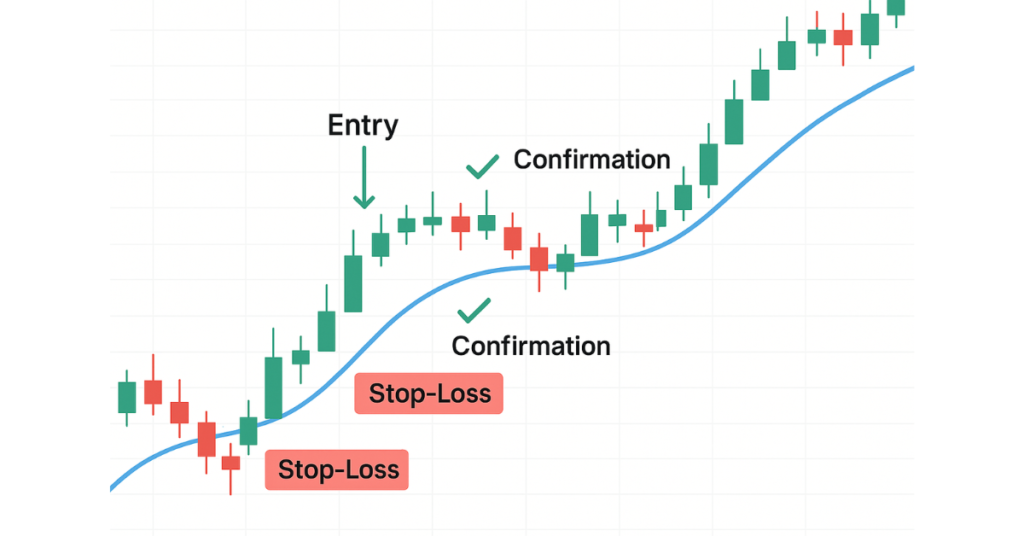
Method 3 – Structural distance: Set the stop below a recent swing low (for longs) or above a swing high (for shorts). This ties the exit to actual market structure rather than an arbitrary number.
Trailing Stop Loss vs Trailing Stop Limit
A trailing stop loss closes your trade at the market price when the stop level is reached. A trailing stop limit sets both a trigger price and a limit price, meaning the order will only fill within a defined price range.
The main practical difference: a trailing stop loss guarantees the trade will close when triggered (though possibly at a worse price in fast markets). A trailing stop limit does not guarantee a fill if the price moves through the limit level too quickly. For most Forex traders, a standard trailing stop loss is the more reliable choice.
5 Common Mistakes Traders Make with Trailing Stops
- Setting the distance too tight: Normal market noise triggers the stop before a real reversal happens. The trade closes early and then the price continues in the original direction
- Activating the stop too early in the trade: If you activate a trailing stop before the trade has enough room to develop, small initial fluctuations will close it before the real trend begins
- Using the same distance across all markets: Gold, EUR/USD, and GBP/JPY all have very different volatility profiles. One-size-fits-all settings rarely work across multiple assets
- Treating trailing stops as a complete strategy: Trailing stops are a risk management tool. They do not replace proper entry analysis, technical indicators, and market reading
- Ignoring trailing drawdown features: Some platforms like MT5 offer trailing drawdown tools that work differently from standard trailing stops.
Use Trailing Stops on Defcofx with MetaTrader 5
Defcofx runs on MetaTrader 5 (MT5), which has built-in trailing stop functionality. You can set a trailing stop directly from the trade management window in pips or points, and the platform adjusts it automatically as the trade moves in your favor.
MT5 also supports Expert Advisors (EAs) for traders who want to automate trailing stop logic with custom rules, advanced ATR-based distances, or multi-step trailing levels.
- Set trailing stops directly in MT5 with no additional software required. Learn how to use MetaTrader 5
- Spreads from 0.3 pips on major pairs, tight spreads mean your trailing stop distance is not eaten up by transaction costs
- Up to 1:2000 leverage with built-in negative balance protection
- 40% welcome bonus on first deposits of $1,000 or more. View details at promotion page
- Multiple account types available including demo accounts where you can practice trailing stop strategies with zero risk
Practice Trailing Stops Risk-Free with Defcofx
Open a demo account and test your trailing stop strategies on live market prices without risking real capital. When you are ready, switch to a live account with spreads from 0.3 pips and fast execution.
Frequently Asked Questions
What is a trailing stop loss in simple terms?
A trailing stop loss is a stop-loss order that automatically follows the market price as it moves in your favor, maintaining a set distance. When the price reverses by that distance, the trade closes automatically.
How does a trailing stop work step by step?
You set a distance (e.g., 50 pips). The stop starts at that distance from your entry. As the price moves in your favor, the stop follows at the same distance. If the price reverses by 50 pips from its best level, the trade closes and your profit up to that point is locked in.
Is a trailing stop loss good for beginners?
Yes, it can be very useful for beginners because it removes the need to manually decide when to exit a winning trade. However, beginners should practice on a demo account first to learn how to set the right distance for different markets.
What is the best trailing stop distance?
There is no single best distance. It depends on the asset, timeframe, and current volatility. Using the Average True Range (ATR) as a guide is a popular method, typically setting the stop at 1–1.5x the ATR of the asset you are trading.
Can trailing stops guarantee profits?
No. Trailing stops protect gains and reduce the chance of giving back large profits, but they cannot guarantee a specific outcome. Slippage during fast markets can mean the trade closes at a slightly different level than expected.
Are trailing stops better than fixed stop losses?
Neither is universally better. Trailing stops are more effective in trending markets because they let profits run while protecting gains. Fixed stops may be more appropriate in ranging markets or when you have a defined target. Using both types in different situations is a sign of an adaptable trader.
Do professional traders use trailing stops?
Yes, many professional and institutional traders use trailing stops as part of their position management. They are especially common in trend-following strategies where staying in a move as long as possible is part of the approach.
Can trailing stops be used on gold and crypto?
Yes. Trailing stops work on any tradable instrument, including forex pairs, gold (XAU/USD), stocks, and cryptocurrencies. The key is adjusting the trailing distance for the higher volatility that assets like gold and crypto typically display.
What is the difference between a trailing stop and a trailing stop limit?
A trailing stop closes at the market price when triggered, guaranteeing an exit. A trailing stop limit only fills within a specified price range. Trailing stop limits can fail to fill if the price moves too fast, while trailing stop losses will always close the trade, sometimes with slight slippage.
Take Control of Your Trades with Better Risk Tools
Trailing stops, advanced order types, and real-time execution are all available through Defcofx and MT5. Start with a free demo account and build your confidence before going live.