


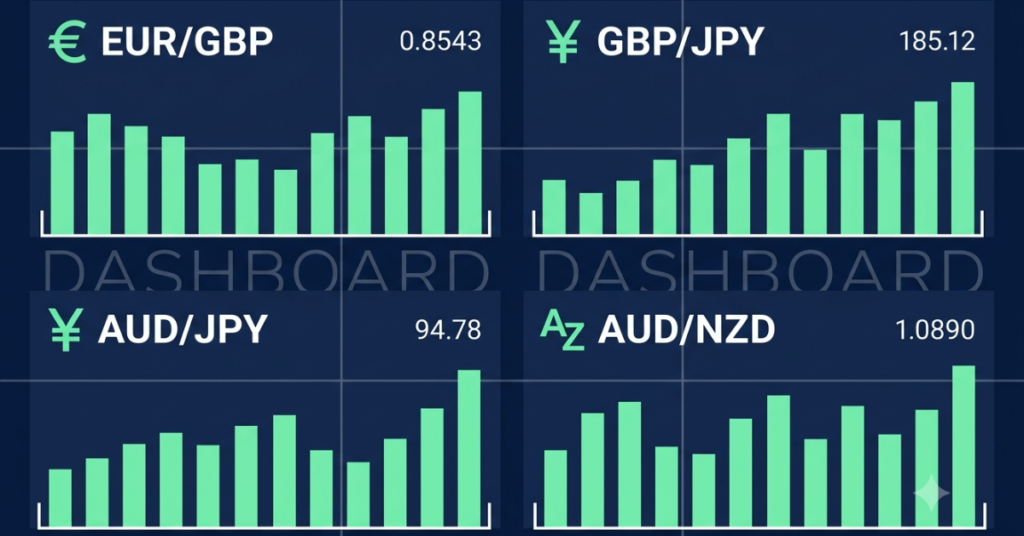
The best forex cross pairs to trade are EUR/GBP, GBP/JPY, AUD/NZD, AUD/JPY, and EUR/CHF. Cross pairs trade two currencies without the US dollar on either side, which lets traders focus on regional interest rate gaps, risk sentiment, and commodity-currency relationships that do not always show up in USD pairs.
Key Takeaways
- A cross pair is any pair that does not include the US dollar, such as EUR/GBP or GBP/JPY. See the full list of major forex pairs for how crosses fit alongside majors and minors.
- EUR/GBP is the most traded cross pair and tracks the policy gap between the ECB and the Bank of England. Best time to trade EUR/GBP
- Yen crosses such as GBP/JPY and AUD/JPY are sensitive to global risk sentiment because the yen is widely used as a funding currency. Trade GBP/JPY or trade AUD/JPY
- AUD/NZD is a classic relative-value pair between two commodity-linked economies with closely correlated, but not identical, drivers. Trade AUD/NZD
- Cross pairs are usually priced from two underlying USD legs, so their spreads tend to be wider than the majors. How is the spread calculated
- Defcofx offers a wide range of cross pairs with spreads from 0.3 pips, leverage up to 1:2000, zero commissions, and zero swap fees on MetaTrader 5.
What Is a Forex Cross Pair?
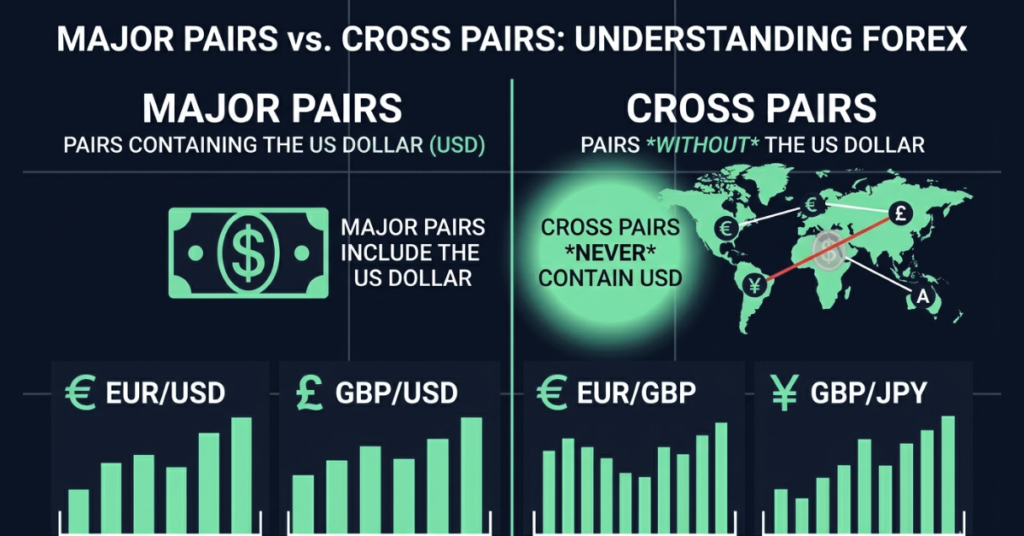
A cross pair, sometimes called a cross currency pair, is any exchange rate that does not have the US dollar on either side. EUR/USD and USD/JPY are majors because they pair a currency directly against the dollar. EUR/JPY and EUR/GBP are crosses because they pair two non-dollar currencies against each other. For a full picture of how currencies are grouped, the forex currency pairs overview and the 28 major forex pairs list both explain where majors, minors, and crosses sit relative to one another.
Some pairs sit in a grey area depending on how a broker classifies them. NZD/USD, for example, is sometimes treated as a major and sometimes as a minor, as covered in is NZD/USD a major or minor pair, while is NZD/JPY a major currency pair looks at the same question for a true cross pair.
Why Trade Cross Pairs Instead of Majors?
Express a View Without USD Exposure
If you expect the euro to weaken against the pound regardless of what the US dollar does, EUR/GBP isolates that view. Trading EUR/USD or GBP/USD instead would mix your euro or pound thesis with whatever is happening to the dollar at the same time, which can blur the result.
Trade Regional Themes and Correlations
Some currencies move together because their economies share drivers. AUD and NZD are both linked to commodity exports and Asia-Pacific demand, so AUD/NZD often reflects the relative strength of the two economies rather than a broad risk-on or risk-off move. The currency pairs correlation table is a useful starting point for spotting which pairs tend to move together and which tend to diverge.
Access Pairs With Lower Day-to-Day Noise
Certain crosses see calmer price action than the busiest majors, which can suit traders who prefer fewer, cleaner moves. The low volatility currency pairs guide covers which pairs tend to sit at the quieter end of the spectrum, and the how to enter forex trades across 28 pairs article looks at building a watchlist that spans majors, minors and crosses together.
Open a Live Trading AccountThe Best Forex Cross Pairs to Trade
EUR/GBP: The Policy Divergence Pair
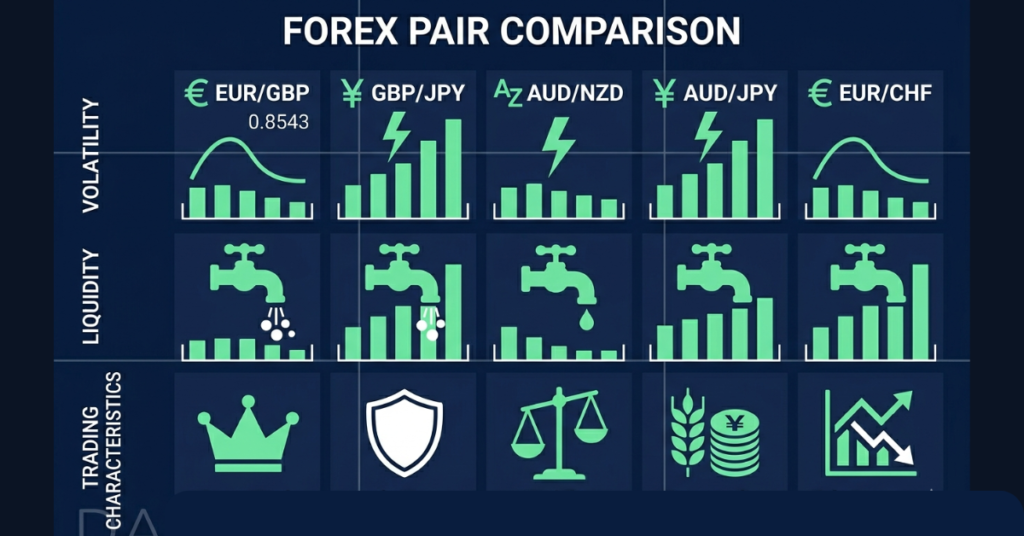
EUR/GBP is the most actively traded cross pair and reflects the relative path of the European Central Bank and the Bank of England. When one central bank is expected to cut or hold rates while the other holds firm, EUR/GBP tends to drift in the direction of that policy gap. Best time to trade EUR/GBP covers the session timing that tends to produce the clearest moves.
GBP/JPY: The High-Beta Risk Pair
GBP/JPY combines a relatively high-yielding currency with the yen, which is often used to fund positions in other assets. When risk appetite improves, GBP/JPY tends to climb faster than calmer pairs, and when sentiment turns, it can fall just as quickly. This makes it popular with traders looking for bigger ranges, but it also means position sizing deserves extra attention. Trade GBP/JPY and best time to trade GBP/JPY cover trading conditions and timing.
AUD/NZD: The Commodity Currency Spread
Australia and New Zealand are both commodity exporters with closely linked economies, so AUD/NZD often trades in a comparatively narrow band relative to other crosses. Traders use it to express a view on relative monetary policy or commodity demand between the two countries without taking on broad USD risk. Trade AUD/NZD has the current trading conditions for this pair.
AUD/JPY: The Risk Barometer Cross
AUD/JPY pairs a commodity currency with the yen, and it is widely watched as a rough proxy for global risk appetite. Rising AUD/JPY often coincides with a broadly positive market mood, while declines tend to line up with risk-off periods. Trade AUD/JPY shows the conditions available on this pair.
EUR/CHF: The Stability Cross
EUR/CHF pairs the euro with the Swiss franc, a currency often sought during periods of regional uncertainty. The pair can see sharper moves around Swiss National Bank policy decisions or shifts in eurozone sentiment, while staying comparatively contained the rest of the time. Trade EUR/CHF has the current spread and contract details.
Cross Pair Snapshot
| Pair | Currencies Involved | Typical Character | Trade This Pair |
| EUR/GBP | Euro vs British Pound | Tracks ECB-BOE policy gap | See trading page |
| GBP/JPY | British Pound vs Japanese Yen | High-beta, wide ranges | See trading page |
| AUD/NZD | Australian Dollar vs New Zealand Dollar | Relative commodity-currency value | See trading page |
| AUD/JPY | Australian Dollar vs Japanese Yen | Risk sentiment barometer | See trading page |
| EUR/CHF | Euro vs Swiss Franc | Calmer, SNB-sensitive | See trading page |
More Cross Pairs Available on Defcofx
Beyond the five highlighted above, Defcofx supports a wide range of cross pairs covering Australian, Canadian, British, European, New Zealand and Swiss currency combinations. These give traders more ways to diversify away from the US dollar and to build positions around specific regional themes.
- AUD/CAD: two commodity currencies, often correlated with oil and metals demand
- AUD/CHF: a higher-yield commodity currency against the traditional safe-haven franc
- CAD/CHF: Canadian dollar against the Swiss franc, sensitive to oil prices and risk sentiment
- CAD/JPY: Canadian dollar against the yen, blending commodity and risk-sentiment drivers
- CHF/JPY: two currencies often associated with safe-haven flows, traded against each other
- EUR/NZD: euro against the New Zealand dollar, combining European and Pacific themes
- GBP/AUD: British pound against the Australian dollar, sensitive to BOE-RBA policy gaps
- GBP/CAD: British pound against the Canadian dollar, often tracking oil and BOE-BOC divergence
- GBP/NZD: British pound against the New Zealand dollar, a wider-ranging pound cross
- NZD/CHF: New Zealand dollar against the franc, pairing a higher-yield currency with a safe haven
- NZD/JPY: New Zealand dollar against the yen, another risk-sentiment cross
What Drives Cross Pair Prices?
Interest Rate Differentials
When two central banks are moving in different directions, the currency from the bank raising rates or holding firm tends to gain ground against the currency from the bank cutting or signalling cuts. EUR/GBP, GBP/AUD and GBP/CAD are all examples where the relative path of two central banks shows up directly in the exchange rate.
Risk Sentiment and the Yen
The Japanese yen has historically been used as a low-cost funding currency, so when investors feel confident, money tends to flow out of yen and into higher-yielding currencies, pushing pairs like GBP/JPY, AUD/JPY, CAD/JPY and NZD/JPY higher. When sentiment sours, the reverse can happen quickly. Tracking whether a new forex trend is taking over can help put sudden moves in yen crosses into a broader context.
Commodity Prices
AUD, NZD and CAD are all linked to commodity exports, oil, dairy and metals respectively, in broad terms. Crosses involving these currencies, such as AUD/CAD, AUD/NZD and CAD/CHF, can be influenced by shifts in commodity prices even when broader USD sentiment is unchanged.
Spreads and Liquidity on Cross Pairs
Cross pairs are generally less liquid than the seven major pairs, which means their spreads tend to be a little wider. This is a natural result of how crosses are priced from two underlying USD legs rather than traded directly in the same volume as EUR/USD or USD/JPY. Understanding how spreads are calculated helps explain why a pair like EUR/CHF might carry a different spread than EUR/USD even on the same broker.
Choosing a broker with consistently low spreads matters more for cross pairs than for majors, since the wider starting spread leaves less room for extra markup before a trade becomes expensive to hold or exit quickly.
Cross Pair Trading Strategies
Correlation and Relative Value
AUD/NZD is the textbook example of a relative value trade, where the goal is to capture the gap between two related currencies rather than predict a broad market direction. The currency pairs correlation table is worth checking regularly, since correlations between pairs can shift as economic conditions change.
Trend and Momentum
Yen crosses like GBP/JPY and AUD/JPY can develop sustained trends during periods of consistent risk sentiment. Tools such as trendlines and the Leman trend indicator are commonly applied to these pairs to help identify when a trend is intact versus when it may be losing momentum.
Swing Trading Crosses
Because crosses can carry wider spreads, many traders hold them for longer to let the move work in their favour relative to the entry cost. The best technical indicators for swing trading and best moving averages for swing trading guides apply well to EUR/GBP, AUD/NZD and similar pairs held over several days.
Risk Management for Cross Pairs
Cross pairs carry exposure to two currencies and, by extension, two economies, two central banks and two sets of news events. This is part of what makes them useful for diversification, but it also means a single position can be affected by more moving parts than a USD pair. Reviewing lot size vs leverage before sizing a cross pair trade helps keep exposure proportionate to account size, especially on higher-beta pairs like GBP/JPY.
Leverage up to 1:2000 is available across Defcofx cross pairs, which can be useful for managing margin efficiently, but it does not reduce the underlying price risk. The 100x leverage in forex and trading forex without leverage articles both look at how leverage choices interact with position sizing on pairs with wider average ranges.
Trading Cross Pairs on Defcofx
Defcofx supports a broad range of cross currency pairs alongside the majors, all on MetaTrader 5. The conditions below apply across the cross pairs covered in this guide.
| Feature | Details |
| Spreads | From 0.3 pips on major currency pairs |
| Leverage | Up to 1:2000 |
| Commissions | Zero commission on trades |
| Swap Fees | Zero swap / overnight fees |
| Welcome Bonus | 40% bonus on qualifying first deposits of $1,000 or more |
| Withdrawals | Processed within 4 business hours, including weekends |
| Trading Platform | MetaTrader 5 (MT5) |
| Regulation | Registered in Saint Lucia |
Cross Pair Statistics Worth Knowing
Cross and minor pairs make up a meaningful and growing slice of global forex activity.
| Statistic | Figure |
| Global daily forex turnover (2025) | Around $9.6 trillion |
| Share of turnover from the seven major pairs (2025) | Around 66.3%, down from 85% in 2022 |
| Approximate share from cross, minor and emerging pairs | Around 33.7% |
| USD/CHF share of global turnover (2025) | Around 4.9%, up from 3.9% in 2022 |
Source: Bank for International Settlements, 2025 Triennial Central Bank Survey.
Final Thoughts on Best Forex Cross Pairs to Trade
Cross pairs offer a different perspective on the forex market by allowing traders to focus on the relationship between two currencies without the influence of the US dollar. Whether you’re trading the policy divergence of EUR/GBP, the risk-sensitive movements of GBP/JPY and AUD/JPY, the regional economic dynamics of AUD/NZD, or the stability-focused nature of EUR/CHF, cross pairs can provide opportunities that major pairs may not always offer.
The key to trading cross pairs successfully is understanding the unique drivers behind each currency. Interest rate differentials, central bank policies, commodity prices, and global risk sentiment often have a more direct impact on cross pairs than they do on USD-based majors. While these pairs can offer diversification and unique trading opportunities, they also tend to have wider spreads and sometimes greater volatility, making proper risk management essential.
For traders looking to expand beyond traditional major pairs, cross pairs can become a valuable addition to a well-rounded trading plan. By focusing on the sessions when both underlying currencies are most active, staying aware of economic events from both countries, and applying disciplined position sizing, traders can take advantage of some of the most interesting opportunities the forex market has to offer.
FAQ
Any currency pair that does not include the US dollar. EUR/GBP, GBP/JPY and AUD/NZD are all cross pairs, while EUR/USD and USD/JPY are majors. See the 28 major forex pairs list for the full breakdown.
Not inherently, but they often carry wider spreads and can have larger average ranges, particularly yen crosses like GBP/JPY and AUD/JPY. The risk depends on position sizing relative to those wider ranges, not on the pair category itself.
It is the most actively traded cross pair and closely tracks the policy gap between the European Central Bank and the Bank of England, which gives it a clear, well-understood set of drivers. Best time to trade EUR/GBP covers timing in more depth.
Both the Australian and New Zealand dollars are linked to commodity exports, so shifts in commodity demand can move both currencies, sometimes in the same direction and sometimes by different amounts, which is exactly the gap AUD/NZD reflects.
Yes, cross pairs trade throughout the forex week, but liquidity for each cross is generally best when both of its underlying currencies’ home markets are open. For yen crosses this often means the Tokyo and London sessions. See forex trading sessions in EST for the full session schedule.
Yes, though it helps to start with a demo account to get a feel for how a cross pair’s spread and range compare to a major pair you already know. Open a demo account to practise before committing real funds.